Healing from trauma with hypnosis
7 Signs You Are Healing From Trauma (Even When It Still Hurts)
TL;DR: Healing from trauma rarely means you never feel upset again. The clearest sign is that you settle faster after something sets you off. Other signs include a shorter story, fewer detours around reminders, and letting people back in. Fanis Makrigiannis at Mind Spirit Body Hypnosis in Oshawa, Ontario, explains each sign and a simple way to track it at home.
Quick Answer
Healing from trauma is the slow return of your body and mind to feeling safe in daily life. Research shows most people who live through a hard event recover over time, and a key sign is that your stress settles faster after a reminder. Fanis Makrigiannis, a Certified Hypnotherapist (ABH, NGH) and NLP Master Practitioner at Mind Spirit Body Hypnosis in Oshawa, Ontario, offers virtual sessions across Ontario for people who want support with that process.
Questions This Article Answers
How do I know if I am healing from trauma?
Why do I still get triggered if I am getting better?
Does a bad day mean I am back at the start?
How can I track my progress at home?
When is it time to reach out for support?
In this article:
Introduction
You drive past the spot where it happened. Your hands grip the wheel. Your chest gets loud. Then, two songs later, you notice you are humming.
Most people would call that a bad moment. I would call it progress. Not long ago, that same drive might have cost you the whole afternoon.
In my practice, people often tell me they feel stuck because they still react. They expect healing to mean the reaction never comes. That is rarely how it works. Healing usually shows up in how fast you come back to yourself.
Why Is Healing So Hard to See?
Pain is loud. Progress is quiet. When something hurts, you notice right away. When something hurts a little less, you often miss it.
Many lists online say healing means feeling calm, peaceful, or free of triggers. That sets a bar almost no one can reach. So people overlook real change because it does not look like a finish line.
Picture a lake in cottage country on a still morning. A stone drops in. Rings spread across the water. You cannot stop the stone from landing, and you do not need to. The lake knows how to go still again. It does not try. It simply settles when nothing keeps stirring it.
Trauma can leave the water stirred for a long time. Healing is the lake remembering how to settle. The stones still fall. The rings just fade sooner.
How Common Is Recovery After Trauma?
Here is something most people never hear. Living through something awful is common. Staying stuck is not.
A national survey run by Health Canada's public health agency found that 64.4% of adults in Canada had lived through at least one potentially traumatic event. That means an event like a serious crash, an assault, or a life-threatening illness. In the same 2023 survey, 8.5% of adults screened positive for post-traumatic stress symptoms (Public Health Agency of Canada, 2023).
A large review of 54 studies, shared by Columbia University, found the same pattern. About two in three people stayed steady after a hard event. About one in five struggled at first and then recovered over time (Galatzer-Levy, Huang and Bonanno, 2018).
So recovery is the normal path. When healing stalls, it usually means something keeps the water stirred. That part can be worked with. Below are the signs you are healing from trauma that I watch for most closely with clients across Durham Region and Ontario.
What is trauma?
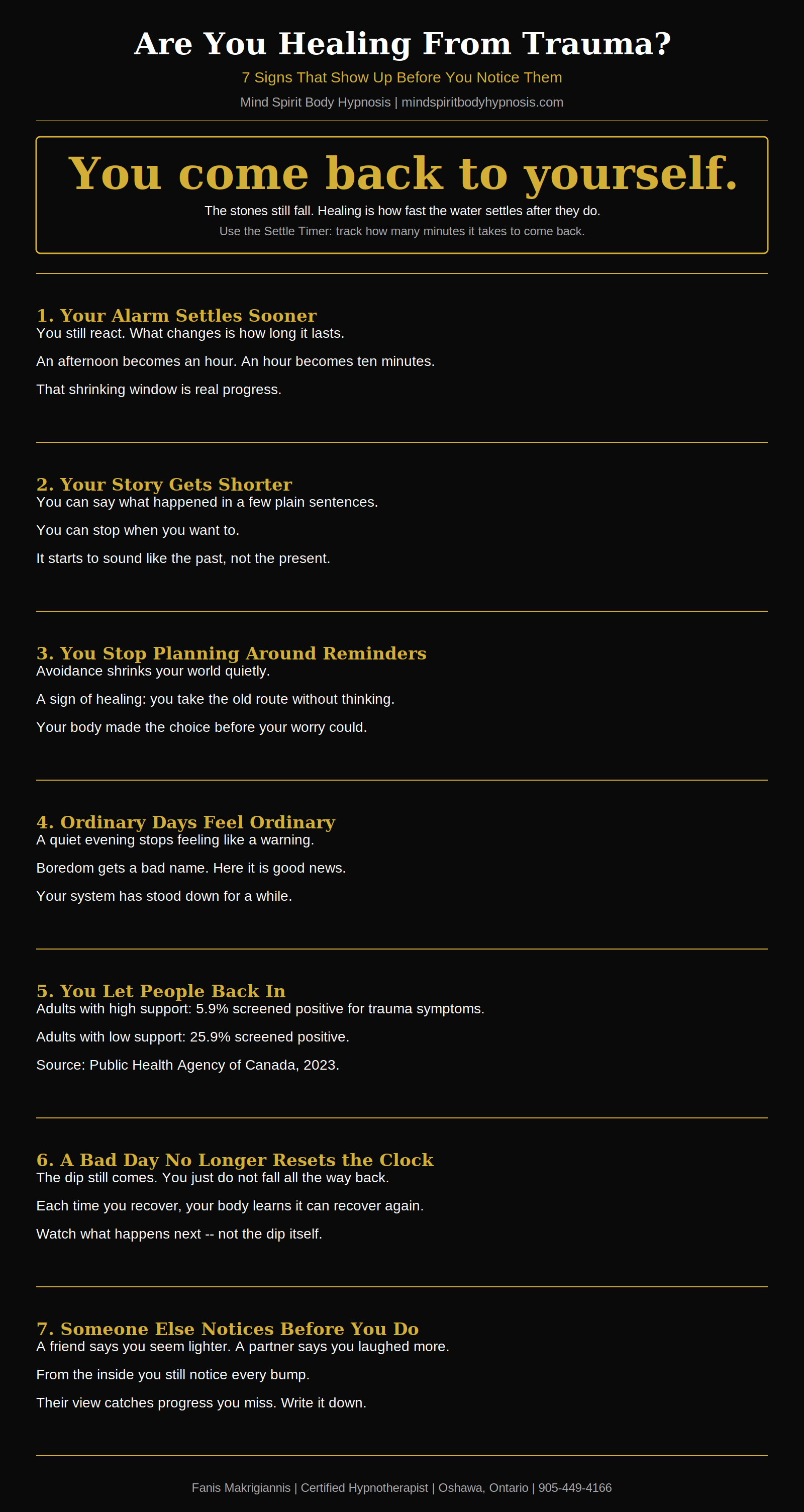
1. Your Alarm Still Goes Off, but It Settles Sooner
The first sign is about time, not feelings. A loud bang, a raised voice, or a certain smell may still set off your body's alarm. Your heart may still race. What changes is how long it lasts.
Early on, one reminder might cost you a whole day. Later, it costs an hour. Then ten minutes. That shrinking window is real progress, even if the first jolt feels the same.
People often tell me they feel like a failure because they still jump. I ask a different question. How long did it take to come back? That answer usually tells us much more.
2. Your Story Gets Shorter
When something is still raw, the story pulls you in. You tell it with every detail, and you feel it all again as you speak. Some people avoid telling it at all because it is too much.
As you heal, the story often gets shorter. You can say what happened in a few plain sentences. You can stop when you want to. It starts to sound like something that happened in the past, instead of something still happening now.
You do not need to forget anything. The memory stays. It simply stops taking over the room.
3. You Stop Planning Your Day Around Reminders
Avoidance is quiet. It looks like taking the long way home to skip one intersection. Leaving the room when a certain show comes on. Letting calls from a familiar number go to voicemail.
These detours make sense. They protect you. Over time, though, they shrink your world.
A sign of healing is noticing that a detour is gone. Maybe you drove the old route without thinking. Maybe you only realized it afterward. That afterward moment is worth noting. It means your body made the choice before your worry could.
4. Ordinary Days Start to Feel Ordinary
This one surprises people. After trauma, calm can feel suspicious. A quiet evening makes you uneasy, as if something bad must be coming. Some people stay busy all the time so they never have to sit still.
As healing takes hold, a plain Tuesday can just be a plain Tuesday. You might even feel a little bored. Boredom gets a bad name, but here it is good news. It means your body no longer feels it has to stand guard every minute.
If you catch yourself yawning on the couch and feeling fine, take note. Your system has stood down for a while.
If you would like help working out where you are right now, you can book a free 30-minute virtual strategy session. It is a relaxed conversation with no pressure.
5. You Let People Back In
Trauma often pulls people inward. You cancel plans. You keep the hard parts to yourself. You decide no one would understand.
A sign of healing is reaching out a little sooner. Saying yes to coffee. Telling one person the truth about how your week went.
This matters more than most people think. In the 2023 Canadian survey, adults with low social support were far more likely to screen positive for post-traumatic stress symptoms (25.9%) than adults with high support (5.9%). Connection does not fix everything. It does give your nervous system, the part of you that runs your stress reactions, proof that you are not alone.
6. A Bad Day No Longer Resets the Clock
Healing has dips. An anniversary, a news story, or a rough week at work can bring old feelings back. Many people read a bad day as proof that nothing has changed.
Watch what happens next. Do you bounce back in a day instead of a month? Do you know what helps you settle? Can you tell yourself this is a hard day, and not your whole life again?
That shift is a sign of healing. The dip still comes. You just do not fall all the way back to the start. Each time you recover, your body learns that it can recover again.
7. Someone Else Notices Before You Do
Most lists leave this sign out, yet it is one of the most common. A friend says you seem lighter. Your partner says you laughed more this month. A coworker says you seem less on edge.
People close to you see the change from the outside. From the inside, you are still busy noticing every bump. So their view can catch progress you miss.
If someone says something like this, do not brush it off. Ask what they noticed. Write it down. On a hard day, that note can remind you the change is real.
How Can You Track Your Healing at Home?
Here is a simple exercise you can start today. I call it the Settle Timer.
Next time something sets you off, glance at the clock and note the time.
Let the feeling move through. You do not need to fix it.
When your breathing slows and your shoulders drop, check the clock again.
Write the number of minutes in your phone notes.
Do this for two weeks, then look back at the list.
You are not trying to stop the reaction. You are measuring how fast the lake goes still. Many people find the numbers drift down, even when the feelings still seem big. If they do not, that is useful to know too. Something may be keeping the water stirred, and that is worth exploring with support.
If a reaction ever feels too big to sit with, do whatever helps you feel safe first. Your safety comes before the timer.
What Does Healing Look Like Compared With the Myths?
"I should never get triggered again." Reactions still happen, but they pass sooner. The jolt is not the problem. The length of the recovery is the number to watch.
"If I am healed, I will stop thinking about it." The memory stays, but it takes up less room. You can think about what happened without it taking over the day.
"A bad day means I am back at the start." Dips happen, and you climb out faster each time. The floor of the dip gets higher. That is real progress, even if it does not feel like it in the moment.
"Calm means something bad is coming." Quiet, and even boredom, start to feel safe. A plain Tuesday can just be a plain Tuesday.
"I have to handle this alone." Letting people in is part of the healing. Connection gives your nervous system proof that you are not alone.
Where Does Hypnotherapy Fit In?
As a certified hypnotherapist (ABH, NGH) and NLP Master Practitioner, I work with adults across Ontario who feel stuck on one or more of these signs. Hypnotherapy uses a calm, focused state to help the mind practise feeling safe. In sessions at Mind Spirit Body Hypnosis, we often focus on shortening that settle time, so reminders lose some of their pull. You can read more about how this work is set up on the trauma support page at Mind Spirit Body Hypnosis.
The research is promising but still early. A 2026 review in the medical journal L'Encéphale looked at 12 studies of hypnosis for adults with post-traumatic stress. Most reported full or partial improvement. Unwanted memories that pop up on their own improved most often (Thellier-Francois et al., 2026). The authors also noted that the studies were small and very different from one another.
An evidence summary from Neuroscience Research Australia found large effects for hypnotherapy on these symptoms. It also rated the quality of that evidence as moderate to low (NeuRA, 2021). So think of hypnotherapy as one way to support a process your mind and body already know how to do.
If your reactions still confuse you, this guide to trauma responses in adults explains why they happen. And if your body still feels on guard even when your mind feels fine, read about why trauma can stay in the body.
When Should You Reach Out for Support?
Time and support help most people. Some signs suggest it would help to reach out now:
Your settle time is not getting shorter after several weeks.
You avoid more places or people than you used to.
Sleep, work, or relationships keep slipping.
You rely on alcohol or other substances to get through the day.
If you ever feel unsafe or have thoughts of ending your life, call or text 988 in Canada, any time. For ongoing care, your family doctor or a registered mental health professional is a good first step. Hypnotherapy can work alongside that care.
Looking for the signs you are healing from trauma is a kind act in itself. It trains your attention to see what is going right. Start the Settle Timer this week. The stones will still fall. Watch how the water settles.
WHAT MY CLIENTS SAY
“I don’t even know where to begin! Fanis saved my life! I have battled over 5 decades of trauma. After 5 sessions and a final negative moment in my life I felt the shift. I can’t thank you enough Fanis. I have tried therapy and felt it was not really helping too much. Hypnosis was the answer. I am SO happy. I feel better than ever. I will be recommending Fanis to so many people I know struggling with different issues. A++” —Helen R.
Frequently Asked Questions
Why do I still get triggered if I am healing? Triggers often stay for a while because your body learned to watch for certain cues. Healing tends to change how long a reaction lasts before it changes whether the reaction shows up. If you settle faster than you used to, that counts as progress.
Does a bad day mean I am back at square one? No. Dips are a normal part of recovery, especially around anniversaries or stressful weeks. What matters is how quickly you climb back out, and that usually gets faster over time.
Can trauma heal on its own? Often, yes. A review of 54 studies found that about two in three people stayed steady after a hard event, and about one in five struggled at first and then recovered. If you still feel stuck after several months, extra support can help get things moving.
How long does it take to heal from trauma? There is no set timeline. It depends on what happened, what support you have, and what else is going on in your life. Many people notice small changes, like shorter reactions, well before they would call themselves healed.
What is the difference between coping and healing? Coping is what gets you through a hard moment, like leaving a room or distracting yourself. Healing is when you need those escape routes less often. Both matter, and good coping skills often make healing possible.
How can I track my progress at home? Time how long it takes to settle after something upsets you, and write the minutes down for two weeks. Also note any detours you no longer take and anything friends say they have noticed. Looking back at your notes can show progress you missed day to day.
Is it a good sign if I feel calm or even bored? Usually, yes. After trauma, calm can feel unsafe, so people keep busy or stay on alert. Feeling comfortable with a quiet, ordinary day often means your body no longer feels it has to stand guard.
When should I reach out for support? Reach out if your reactions are not easing after several weeks, if you avoid more of your life than before, or if sleep, work, or relationships keep slipping. If you ever feel unsafe, call or text 988 in Canada at any time. A family doctor or registered mental health professional is a good place to start.
Can hypnotherapy help if I am already making progress? Hypnotherapy may help you build on progress you have already made, for example by practising calm responses to reminders. Many people reach out when they feel they have stopped moving forward. Fanis Makrigiannis offers virtual sessions across Ontario, and the work fits well alongside other support.
RECOMMENDED READING
Ready to Take the Next Step?
If you are ready to shorten the time it takes to come back to yourself, I would love to help.
I offer a free 30-minute virtual strategy session for new clients across Ontario. There is no pressure, just a conversation about what you are going through and how hypnotherapy or NLP might support you.
Book your free session: calendly.com/mindspiritbodyhypnosis
Call or text: 905-449-4166
Email: info@mindspiritbodyhypnosis.com
Visit: mindspiritbodyhypnosis.com
Serving clients virtually across Ontario, including Durham Region, Toronto, Canada, and beyond.
Disclaimer: This article is for informational purposes only and does not constitute medical or psychological advice. Hypnotherapy and NLP are complementary approaches and are not a substitute for diagnosis or treatment by a qualified healthcare provider. If you are in crisis, call or text 988 or go to your nearest emergency department. Results vary by individual.
Written by Fanis Makrigiannis | Certified Hypnotherapist & NLP Master Practitioner | Mind Spirit Body Hypnosis.