What hypnosis cannot do
What Hypnosis Cannot Do: 5 Honest Limits (and What It Can)
TL;DR: What hypnosis cannot do is just as important to understand as what it can. It cannot control your mind or force you to act against your values. It cannot cure serious medical conditions on its own. It cannot reliably retrieve accurate memories, and it can actually increase the risk of false ones. It cannot make you unconscious or unaware. And it cannot work without your genuine willingness. Within those limits, the research consistently shows it can help with anxiety, pain, habits, sleep, and stress, often in ways that surprise people.
Quick Answer
What hypnosis cannot do includes controlling a person's mind, curing serious diseases, erasing or reliably retrieving memories, causing unconsciousness, or producing results without the person's willingness. A 2023 paper in BJPsych Advances by Stein, Lynn, and Terhune confirmed that these limits are not just ethical guidelines but reflect what the research actually shows. Fanis Makrigiannis, a Certified Hypnotherapist and NLP Master Practitioner at Mind Spirit Body Hypnosis in Oshawa, Ontario, applies hypnotherapy within these honest limits to help clients across Ontario reduce anxiety, change habits, and manage stress.
Questions This Article Answers
What hypnosis cannot do, despite what people believe?
Can hypnosis control your mind or force you to act against your will?
Can hypnosis cure medical conditions like cancer or diabetes?
Can hypnosis erase bad memories or reliably recover lost ones?
Do you lose consciousness during hypnosis?
Can anyone be hypnotized against their will?
What can hypnosis actually do, within its real limits?
In this article:
Introduction
Most people who contact me have done some research on hypnotherapy before reaching out. The questions they come in with are often good ones: Will I be under your control? Can it fix my problem for good? What if I say something I did not mean to? Can I get stuck?
These questions reveal what the word "hypnosis" still triggers in most people's minds. The entertainment version, where a swinging watch turns someone into a puppet, has been far more visible than the clinical version, where a trained practitioner helps someone access the subconscious and build new patterns. The gap between those two images is exactly where the honest conversation needs to happen.
So here is a straightforward answer. What hypnosis cannot do matters as much as what it can. Understanding both is how you figure out whether it is right for you.
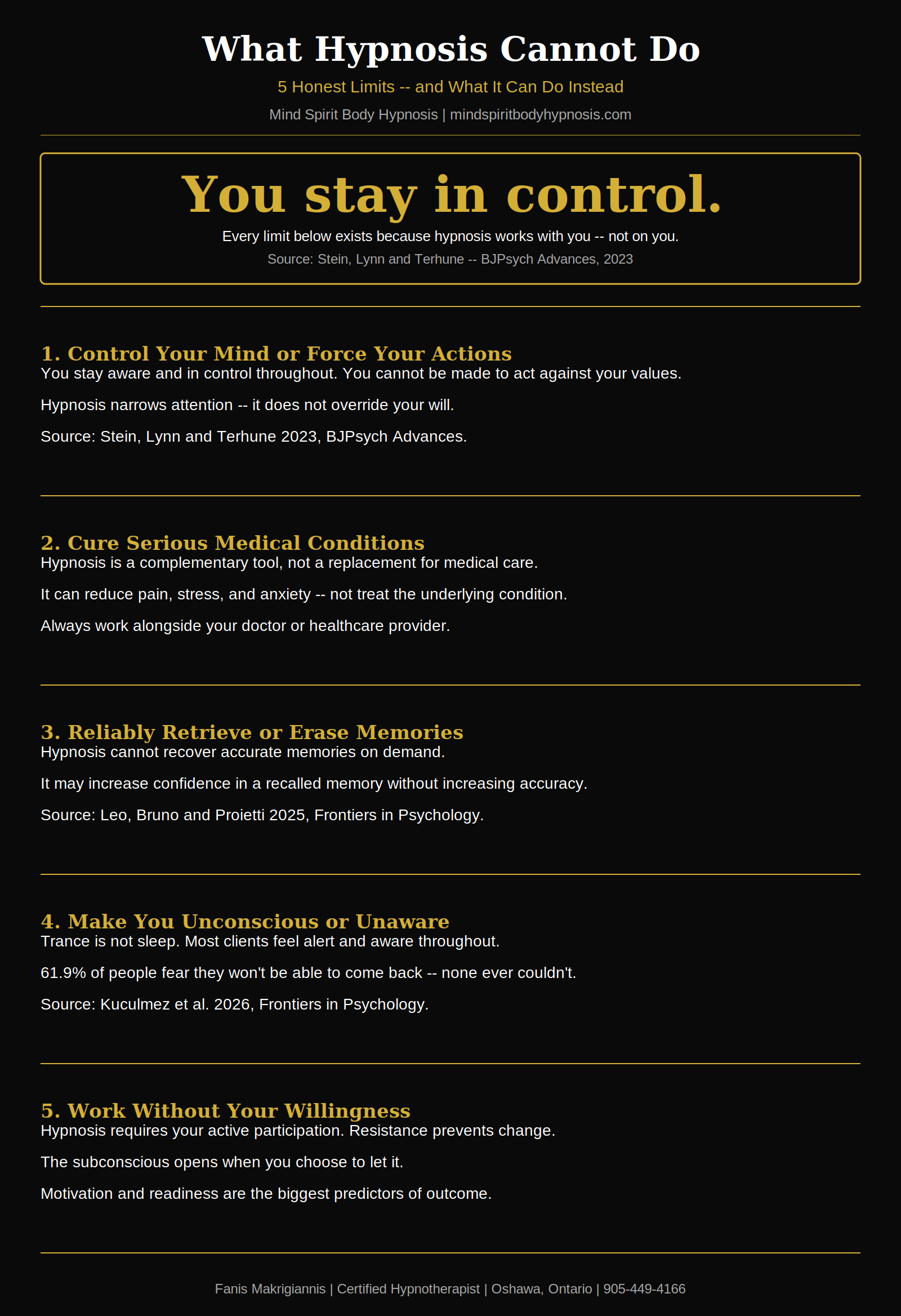
1. Control Your Mind or Force Your Actions
This is the fear that shows up most often, and the research is detailed. Hypnosis cannot control your mind or make you act against your values and ethics.
You remain conscious and aware throughout a session. You can hear everything that is said. You can speak, move, or stop the session at any point. Research published in BJPsych Advances in 2023 by Stein, Lynn, and Terhune states directly that there is no systematic evidence that people lose voluntary control during hypnosis, and describes the idea of blind obedience under hypnosis as patently false.
What hypnosis does is reduce the volume of the inner critic that usually interrupts new thinking. It does not replace your judgment. It quiets the noise so you can access the part of your mind that actually runs your habits, automatic reactions, and emotional responses.
People often tell me they were fully aware of every word spoken in their first session. They expected to feel passive. Instead, they felt focused. That focus is what hypnosis actually produces. Your critical mind does not disappear. It relaxes.
If a suggestion conflicts with your values, your subconscious simply does not accept it. This has been documented consistently in hypnosis research across decades. You are always the one in charge.
2. Cure Serious Medical Conditions
Hypnotherapy cannot cure cancer, diabetes, heart disease, or any other serious physical illness. Suggesting it can is not just wrong. It is dangerous because it can delay people from getting the medical care they need.
What hypnosis can do is help manage some of the symptoms and psychological burden that come alongside serious conditions. A 2024 meta-analysis by Rosendahl, Alldredge, and Haddenhorst in Frontiers in Psychology, covering 261 studies, found that hypnotherapy produced significant results in outcomes, with the strongest effects in pain management, procedural anxiety, and sleep. These are supportive outcomes, not curative ones.
In my practice, I work alongside whatever medical care a client is receiving, not instead of it. Someone preparing for a medical procedure might use hypnotherapy to reduce anticipatory anxiety and improve their experience of that procedure. Someone managing chronic pain might use it to lower medication needs, in consultation with their physician. The role is complementary. It supports the person, not replaces the care.
This is also why I am careful with language. I do not promise that anxiety and stress will disappear after one session, or that a deeply rooted habit will dissolve overnight. What I can honestly say is that the research supports hypnotherapy as a meaningful addition to a well-rounded approach to wellbeing, for specific outcomes, in a defined supportive role.
3. Reliably Retrieve or Erase Memories
This is perhaps the most nuanced limit, and the one competitors handle least carefully.
Hypnosis cannot reliably retrieve accurate memories. A 2025 narrative review by Leo, Bruno, and Proietti in Frontiers in Psychology reviewed the literature and concluded that results on hypnotic memory enhancement are contradictory, and that unintentional suggestion during hypnosis can actually increase false memory formation. People recall things with more confidence under hypnosis, but confidence and accuracy are not the same thing. Courts have recognized this. Hypnotically retrieved testimony is generally inadmissible because it cannot be verified and may reflect suggestion rather than fact.
Hypnosis also cannot erase memories. What it can do is change the emotional weight a memory carries. Trauma-focused approaches may help reduce the distress triggered by a difficult memory, not by deleting it but by processing it differently. This is careful, specialist work that belongs within a structured therapeutic framework, not a single session of generic hypnotherapy.
The Stein, Lynn, and Terhune 2023 paper in BJPsych Advances notes that spontaneous amnesia is incredibly rare in clinical hypnosis, and that the dramatic memory effects seen in entertainment portrayals simply do not reflect standard clinical experience. Most clients remember their sessions clearly.
4. Make You Unconscious or Unaware
Hypnosis is not unconsciousness. You do not go under in the way sleep or anesthesia takes you under. You are aware throughout. You can hear environmental sounds. You know where you are.
A 2026 cross-sectional study in Frontiers in Psychology by Kuculmez et al. (doi: 10.3389/fpsyg.2026.1766305) found that 61.9% of people feared they would be unable to emerge from hypnosis, and 86.2% reported some fear of the process generally. These fears are built on the unconsciousness myth. When people understand that trance is a state of focused awareness rather than sleep, the fear typically dissolves.
The experience is closer to the state you are in when you are so absorbed in a book or a film that you lose track of time. You are not asleep. You are extremely focused in one direction. That focus is what makes you receptive to suggestions, not any loss of awareness.
You can also end the session yourself at any point. Trance ends naturally. If a session were interrupted, you would return to ordinary awareness within minutes or drift into normal sleep and wake up on your own.
5. Work Without Your Willingness
Hypnosis requires your participation. It cannot be done to you without your knowledge or consent, and it does not produce reliable results in someone who is actively resisting it.
This is a feature, not a flaw. A therapeutic relationship built on consent and trust is more effective than any technique applied against a person's resistance. The pre-talk that opens every session is partly about building the safety that makes genuine engagement possible.
People sometimes ask me whether a very skeptical person can still benefit. The answer is yes, as long as they are willing to give it a genuine try. Skepticism about how hypnosis works does not prevent it from working. Active resistance, meaning deliberate effort to fight every suggestion, does. But most people who book a session are not in that category. Curiosity and openness are enough.
The science behind hypnosis.
What Hypnosis Can Do Within These Limits
Understanding what hypnosis cannot do makes the genuine capabilities clearer and more credible.
What the research supports: Anxiety and stress reduction, procedural pain management, sleep improvement, habit change (smoking, overeating, repetitive patterns), and confidence and performance. The Rosendahl et al. 2024 meta-analysis found significant results in outcomes across 261 studies.
What that looks like in practice: A client working with me on anxiety does not stop thinking. The automatic alarm response that fires before a specific situation gradually becomes quieter, less urgent, easier to manage. A client working on a long-held habit notices the trigger differently. Not gone. Different. A client who sleeps poorly finds the state of rest easier to access because the subconscious has rehears.
2ed it. These are real, documented changes, within the honest limits of what hypnosis is.
If you are curious whether hypnotherapy could genuinely support something you are working on, the free 30-minute strategy session I offer to new clients across Ontario is designed to answer exactly that question, honestly, without pressure. Clients working on trauma and stress are always given a clear picture of what is realistic before any session begins.
WHAT MY CLIENTS SAY
“I used to dread any kind of social situation. Birthday parties, work events, even small family dinners would send my anxiety through the roof days in advance. I would cancel plans constantly and then feel ashamed about it afterward. It had been going on for years, and I had started to believe it was just who I was. A colleague mentioned hypnotherapy, and I figured I had nothing to lose. What surprised me most was how fast it worked. By the third session with Fanis, something had genuinely shifted. I attended a work function the following week, and for the first time in years, I was not counting the minutes until I could leave. I actually stayed the whole evening and enjoyed myself. Fanis identified the root of the fear quickly and worked on it directly rather than just teaching me to cope with it. Three sessions. Years of avoiding life, gone. I cannot recommend him enough.” — Cici D.
Frequently Asked Questions
What hypnosis cannot do is control me, right? I stay in charge? Correct. Research confirms there is no systematic evidence that people lose voluntary control during hypnosis. You remain aware; you can speak or move at any time, and your values stay intact. If a suggestion conflicts with your ethics, your subconscious does not accept it. You are always in charge of what you do.
Can hypnosis cure anxiety or depression? No, not cure in the clinical sense. Hypnotherapy may significantly reduce the intensity and frequency of anxiety and improve mood, and the research supports this, but it is a complementary approach. It works best alongside, not instead of, appropriate professional care. I always recommend clients maintain their existing medical or psychological treatment while we work together.
Can hypnosis make me remember things I have forgotten? Not reliably. Research shows that hypnosis can increase people's confidence in recalled memories but does not reliably improve accuracy. It can also inadvertently increase false memory formation. I do not use hypnosis to retrieve specific past events as though they were factual records. Therapeutic work with memories focuses on reducing distress, not reconstructing history.
Can a hypnotherapist make me do things I would not normally do? No. This is one of the most persistent myths in hypnosis, and one the research has consistently refuted. People under hypnosis retain their normal moral judgment and can resist or reject suggestions that feel wrong. The "mind control" scenario belongs to stage entertainment, not clinical practice.
What happens if a hypnotherapy session does not work for me? Hypnotherapy is not a guaranteed outcome for every person or every goal. Individual hypnotizability varies, and some goals respond better to other approaches. I discuss realistic expectations in the free strategy session I offer before any work begins, so clients have a clear picture before committing.
Is hypnosis dangerous? No, when practised by a trained, certified hypnotherapist. A 2026 study in Frontiers in Psychology found that 33.3% of participants viewed hypnosis as dangerous, despite meta-analytic evidence that it is safe when properly applied. Choosing a certified practitioner and being open about any mental health history before beginning is the appropriate due diligence.
Can hypnosis work on someone who does not believe in it? Mild scepticism does not prevent results. What matters is a genuine willingness to try. Active, deliberate resistance is a barrier. Curiosity and openness are enough to engage with the process productively.
How many sessions does it typically take? It depends entirely on the goal. Some clients notice a meaningful shift after one session. Most goals respond over three to six sessions. Complex or long-standing patterns typically need more sustained work. I map this out during the free strategy session so there are no surprises.
Is virtual hypnotherapy as effective as in-person? Yes. Virtual sessions produce comparable results to in-person ones, and many Ontario clients find the familiarity of their own home actually supports deeper relaxation.
What is the first step if I want to try it? Book the free 30-minute virtual strategy session. We talk about your goal, what you have tried, and whether hypnotherapy is a realistic fit. There is no commitment and no pressure.
RECOMMENDED READING
Ready to Take the Next Step?
If you want an honest conversation about whether hypnotherapy could help with something you are working on, I would be glad to have it.
I offer a free 30-minute virtual strategy session for new clients across Ontario. There is no pressure, just a direct conversation about what is realistic for your situation.
Book your free session: calendly.com/mindspiritbodyhypnosis
Call or text: 905-449-4166
Email: info@mindspiritbodyhypnosis.com
Visit: mindspiritbodyhypnosis.com
Serving clients virtually across Ontario, including Durham Region, Toronto, Canada, and beyond.
Disclaimer: This article is for informational purposes only and does not constitute medical or psychological advice. Hypnotherapy, NLP, and EMDR are complementary approaches and are not a substitute for diagnosis or treatment by a qualified healthcare provider. Please consult a licensed professional if you have concerns about your mental or physical health.
Written by Fanis Makrigiannis | Certified Hypnotherapist & NLP Master Practitioner | Mind Spirit Body Hypnosis.