Why does trauma live in the body?
Why Does Trauma Live in the Body? Hypnotherapy for Nervous System Healing in Ontario
TL;DR: Trauma does not end when the event ends. Research by leading trauma specialists, including Bessel van der Kolk and Peter Levine, has established that difficult experiences are encoded in the body's procedural memory, keeping the nervous system in a low-grade state of alert that no amount of talking or understanding alone can fully resolve. Hypnotherapy offers a direct route to this stored material, and Fanis Makrigiannis at Mind Spirit Body Hypnosis in Oshawa, Ontario, offers virtual sessions across Ontario for clients who understand what happened but whose body has not yet caught up.
Quick Answer
Hypnotherapy for trauma and nervous system healing is a subconscious-focused approach that helps the body update its stored threat response after adverse experiences, so that the nervous system can return to a genuine baseline of safety rather than remaining in the chronic low-grade alert state that prolonged stress and difficult experiences can produce. Research cited by the National Center for Complementary and Integrative Health identifies hypnotherapy as a "high programmatic priority" mind-body intervention for mental and somatic health conditions. Fanis Makrigiannis, a Certified Hypnotherapist and NLP Master Practitioner at Mind Spirit Body Hypnosis in Oshawa, Ontario, offers virtual trauma-informed hypnotherapy sessions for clients across Ontario who are ready to help the body feel safe again.
Questions This Article Answers
Why does the body stay on alert long after a difficult experience is over?
Why does understanding what happened not always make the physical symptoms go away?
What does "trauma stored in the body" actually mean?
How does hypnotherapy help the nervous system feel safe?
What can I expect from trauma-informed hypnotherapy sessions?
In this article:
Most people who arrive for trauma-informed hypnotherapy work do not arrive without insight. They have often already done considerable work. They understand what happened. They can describe it, analyze it, and talk about how it has affected them. And yet, at unpredictable moments, the body does something that the understanding does not prevent. A tightening. A rush of heat. A sudden inability to think clearly. A wave of emotion that seems disproportionate to what is happening right now.
In my practice, I hear this described in many ways. "I know I am safe, but my body doesn't." That sentence captures the gap this work addresses.
Why Does the Body Stay on Alert After a Difficult Experience?
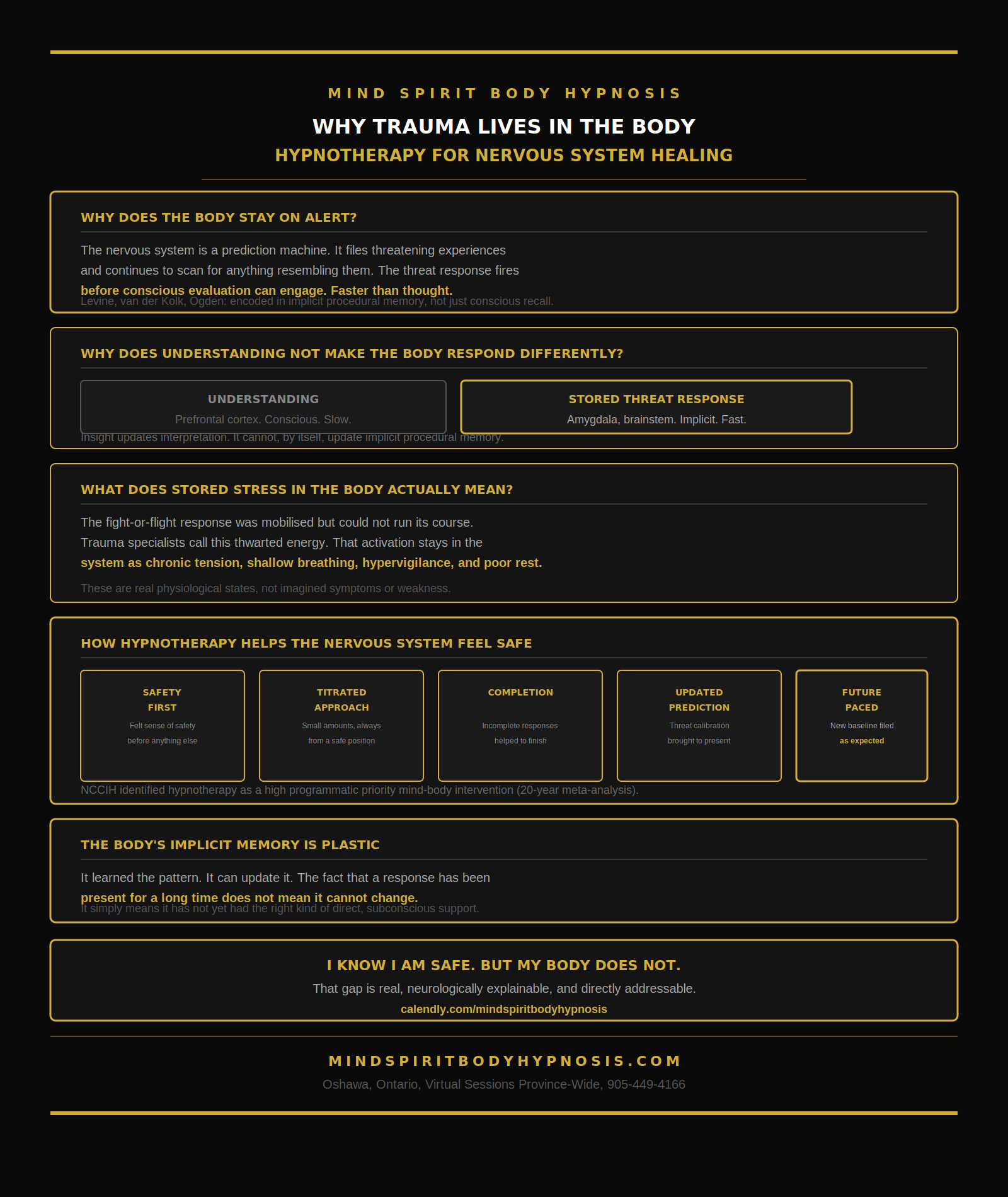
The nervous system is a prediction machine. Its primary job is not to respond to what is happening now but to predict what might happen next, based on everything that has happened before. When a threatening or overwhelming experience occurs, the nervous system files it as a reference point for future prediction.
After the experience is over, the subconscious continues to scan for anything that resembles it. A particular tone of voice, a smell, a time of year, a sensation in the body. These matches are not processed consciously. They fire the threat response automatically, before the thinking mind can evaluate whether the current situation is actually dangerous.
Research by Peter Levine, Bessel van der Kolk, and Pat Ogden has established that difficult experiences are encoded not only in explicit memory but in the body's implicit, procedural memory. This is the kind of memory that does not require conscious recall to influence present experience. It lives in the body's automatic systems: the startle response, the muscle tension patterns, the breathing, the gut, the nervous system's baseline activation level.
This is why the body can carry the effects of old experiences long after the person has consciously processed them. The thinking mind has moved on. The procedural memory has not.
For more on how the anxiety system and nervous system hyperactivation are addressed through hypnotherapy, the hypnotherapy for anxiety and stress in Ontario page covers the foundational nervous system mechanisms.
Why Does Understanding What Happened Not Always Make the Physical Symptoms Go Away?
Because understanding is a function of the prefrontal cortex, and the stored threat response lives in older, faster parts of the brain and body that operate independently of it.
When a difficult experience triggers the body's threat response, the activation travels through the amygdala and brainstem before it ever reaches the prefrontal cortex, where rational thought and language live. By the time the thinking mind is involved, the body has already responded. Understanding can inform the thinking mind's interpretation of the response. It cannot, by itself, stop the response from happening.
This is one of the most frustrating aspects of carrying the effects of difficult experiences. The person can describe exactly what is happening, explain why it is happening, and still be unable to prevent the body from responding the way it always has. This is not a failure of insight or intelligence. It is the nature of implicit, procedural memory: it is faster than thought, and it does not update from information the way explicit memory does.
This gap between understanding and felt experience is precisely the gap that hypnotherapy is designed to bridge. In the trance state, the prefrontal cortex's critical filtering function quiets, and the work can reach the older, faster systems where the stored threat response actually lives.
What Does "Trauma Stored in the Body" Actually Mean?
The phrase sounds metaphorical, but it describes something specific and physiological.
When a threat response is activated and is unable to complete its natural cycle, the energy that was mobilized for fight or flight does not simply dissipate. Trauma specialists describe this as thwarted energy: the fight-or-flight response was triggered but was prevented from running its course, leaving that activation trapped in the system. The body prepared to act and was not able to. That incomplete action creates a kind of holding pattern in the nervous system.
This is visible in the body. Chronic muscle tension, particularly in the shoulders, jaw, neck, and diaphragm, that does not resolve with ordinary relaxation. Breathing that is habitually shallow. A startle response that is easily triggered. A gut that stays tense in anticipation. Sleep that does not fully restore because the body is maintaining a level of vigilance even in rest.
These are not imagined symptoms, and they are not weakness. They are the body's literal attempt to remain ready for the threat it learned to expect. The stored response is functional, in the sense that it was appropriate to the original experience. The problem is that it is being applied in the present, to a situation that no longer contains the original threat.
Helping the nervous system update this stored response requires working at the level where it lives: the subconscious, the body's implicit systems, the procedural memory that explicit understanding cannot reach alone.
How Does Hypnotherapy Help the Nervous System Feel Safe?
As a Certified Hypnotherapist working with clients across Ontario, I address the body's stored stress responses through a carefully paced approach that prioritizes safety above all else. The work is never about forcing the system to release or process more than it is ready to. It is about gradually expanding what the nervous system is willing to experience as safe.
The approach at Mind Spirit Body Hypnosis for trauma-informed work includes the following components:
Safety and resourcing first. Before any exploration of difficult material, the first sessions are dedicated to establishing a genuine felt sense of safety in the trance state. This means building internal resources: a felt experience of calm, of the body being supported, of there being enough space. The nervous system that has been hypervigilant for a long time needs to learn that it is safe to rest before anything else can be addressed.
Titrated approach to stored material. In trance, stored material is approached gradually and in small amounts, always from a position of felt safety rather than from inside the activated response. The goal is to touch the stored material lightly, allow a small amount of processing, and return to the resource state. This is the opposite of flooding or re-experiencing. It is incremental and always within the window of what feels manageable.
Completion of incomplete responses. Some stored physical tension represents an incomplete action from the original experience. In trance, through gentle imagery and suggestion, the nervous system is helped to complete what it was unable to complete at the time. This is not reliving the event. It is helping the body finish something it started.
Updated threat prediction. The subconscious prediction system is gradually updated with the understanding that the current environment is not the same as the environment where the threat occurred. The body's threat detection calibration is brought into proportion with current reality, so that everyday triggers stop firing the full threat response.
Future pacing. The person is walked through future situations that previously triggered the stored response, experiencing them from the updated baseline. This files the new response as expected, rather than the old response.
The National Center for Complementary and Integrative Health has identified hypnotherapy as a high programmatic priority for mind-body intervention, reflecting a growing body of evidence that approaches which address both the cognitive and physiological dimensions of stored stress produce more complete and lasting results.
For more on how the identity and confidence patterns that often change alongside trauma recovery are addressed, the hypnotherapy for confidence and self-sabotage in Ontario page covers these dimensions.

What Do Sessions Look Like at Mind Spirit Body Hypnosis?
Trauma-informed hypnotherapy sessions at Mind Spirit Body Hypnosis are structured to be gradual, paced, and always within what feels manageable for the person in the room.
A typical programme:
Session 1: Intake and nervous system mapping. A thorough conversation about current symptoms, what triggers the body's alarm response, what feels safe, and what the person wants to be different. No pressure to describe difficult events in detail. The focus is on the current experience of the body and nervous system, not the narrative of the past.
Sessions 2 and 3: Safety, resourcing, and baseline. Establishing the felt experience of safety in trance. Building internal resources. Allowing the nervous system to experience genuine calm, possibly for the first time in a long time. This is foundational and is not skipped even when a client wants to move quickly.
Sessions 4 and 5: Gradual titrated work. Approaching stored material incrementally, always from safety. Helping the nervous system complete incomplete responses. Updating the threat prediction calibration. These sessions move at the body's pace, not a predetermined schedule.
Sessions 6 and beyond (where needed): Consolidation and future pacing. Deepening the updated baseline. Addressing the specific situations and triggers that are most active in the person's daily life. Filing the new response as the expected default.
In my practice, trauma-informed nervous system work typically runs between four and six sessions for the core work, with some presentations requiring more. All sessions are virtual, available across Ontario, and open to clients aged 10 and older. No referral is required. More about my approach and qualifications is on the about page.
Frequently Asked Questions
Why does the body stay on alert after a difficult experience is over? Because the nervous system is a prediction machine that files threatening experiences as reference points for future scanning. After a difficult experience, the subconscious continues to check for anything resembling it, and fires the threat response automatically when it finds a match. This happens faster than conscious thought and does not require the thinking mind's involvement.
Why doesn't understanding what happened make the body symptoms go away? Because understanding is a function of the prefrontal cortex, and the stored threat response lives in older, faster brain systems that operate independently of it. Explicit understanding can inform interpretation but cannot, by itself, update implicit procedural memory. The gap between knowing and feeling is real and neurologically explainable.
What does it mean that trauma is stored in the body? It means that difficult experiences leave physiological traces: patterns of muscle tension, breathing, gut response, startle sensitivity, and nervous system activation that persist because the body's threat response was not able to complete its natural cycle. These are real, measurable physiological states, not imagined symptoms.
Is hypnotherapy safe for people who have experienced difficult or overwhelming events? Yes, when conducted by a trained practitioner using a trauma-informed approach. The work at Mind Spirit Body Hypnosis always prioritizes safety and pacing. Nothing is forced or rushed. The first sessions are dedicated to establishing a genuine felt sense of safety before any stored material is approached. Clients remain in control throughout.
Will I have to describe what happened in detail? No. The work does not require a detailed narrative of past events. The focus is on the current experience of the nervous system and body, what is happening now, and what the person wants to be different. Past events are approached indirectly and only to the degree that feels safe and useful.
How is this different from talk therapy for trauma? Talk therapy works primarily at the conscious, narrative level. Hypnotherapy reaches the implicit, procedural memory where the body's stored response actually lives. The two approaches are complementary, and many clients find hypnotherapy most useful alongside, not instead of, other forms of support.
How many sessions will I need? In my practice, trauma-informed nervous system work typically runs four to six sessions for the core work. The pace is always determined by the individual, not a fixed schedule. An honest estimate for your specific situation is always given in the free strategy session.
Can younger people be helped with this kind of work? Yes. I work with clients aged 10 and older. Many patterns that show up as tension, anxiety, or emotional reactivity in younger people have their roots in nervous system responses formed early in life, and hypnotherapy is well-suited to address these at any age.
Can I access sessions from anywhere in Ontario? Yes. All sessions at Mind Spirit Body Hypnosis are delivered virtually across Ontario, including Durham Region, Toronto, Ottawa, and beyond. No referral is required, and no in-person visit is needed.
What if I have been carrying this for a very long time? Long-standing nervous system patterns can feel deeply entrenched, but they are not permanent. The body's implicit memory is plastic: it learned the pattern, and it can update it. The fact that a response has been present for a long time does not mean it cannot change. It usually means it has simply not yet had the right kind of direct, subconscious support.
Ready to Take the Next Step?
If your body is still carrying something that your mind has already tried to move past, you do not have to keep working around it. I'd love to help.
I offer a free 30-minute virtual strategy session for new clients across Ontario. There is no pressure—just a conversation about what the body has been holding and whether this approach might help.
Book your free session: calendly.com/mindspiritbodyhypnosis
Call or text: 905-449-4166
Email: mindspiritbodyhypnosis@gmail.com
Visit: mindspiritbodyhypnosis.com
Serving clients virtually across Ontario, including Durham Region, Toronto, Ontario, and beyond.
Disclaimer: This article is for informational purposes only and does not constitute medical or psychological advice. Hypnotherapy, NLP, and EMDR are complementary approaches and are not a substitute for diagnosis or treatment by a qualified healthcare provider. If you are experiencing significant distress related to past experiences, please also consult your doctor or a registered mental health professional. Results vary by individual.
Written by Fanis Makrigiannis | Certified Hypnotherapist and NLP Master Practitioner | Mind Spirit Body Hypnosis.