Does getting hypnotized really work?
Does Getting Hypnotized Really Work? 7 Things That Happen Inside Your Mind
TL;DR: Getting hypnotized is a real, measurable process. During a session, your brain shifts into a slower wave state, your critical inner voice quiets down, and your subconscious becomes far more open to new ideas. A 2022 review of 40 brain imaging studies confirmed that theta wave activity increases during hypnosis and that real changes happen in how the brain processes attention, pain, and emotion. It is not sleep, and it is not tricks. It is focused attention with a purpose.
Quick Answer
Getting hypnotized really works through a structured process that moves your brain from ordinary waking awareness into a focused, relaxed state where your subconscious is more open to change. Theta brain waves increase, self-critical thinking quiets, and positive suggestions bypass the part of your mind that usually resists new ideas. Fanis Makrigiannis, a Certified Hypnotherapist and NLP Master Practitioner at Mind Spirit Body Hypnosis in Oshawa, Ontario, guides clients through this process virtually across Ontario to help with anxiety, stress, habits, and sleep.
Questions This Article Answers
Does getting hypnotized really work, or is it just placebo?
What actually happens to your brain when you are hypnotized?
What are the steps of a hypnotherapy session?
What is the subconscious mind, and how does hypnosis reach it?
What is the critical faculty, and why does it matter?
How does a hypnotherapist plant suggestions that actually stick?
Will you remember what happened after your session?
In this article:
Introduction
Most people arrive at hypnotherapy with a simple question: is this actually going to do anything? That is a fair thing to wonder. The word "hypnosis" carries a lot of cultural baggage, from stage shows to movie clichés. But what happens inside a real clinical session is quite different.
In my practice, clients often say the same thing after their first session: "I was aware the whole time, but something shifted." That shift is real. It is not imagination, and it is not a party trick. It is the result of a structured process that takes the brain through distinct stages, each one building on the last. This article walks through those stages, so you know exactly what to expect.
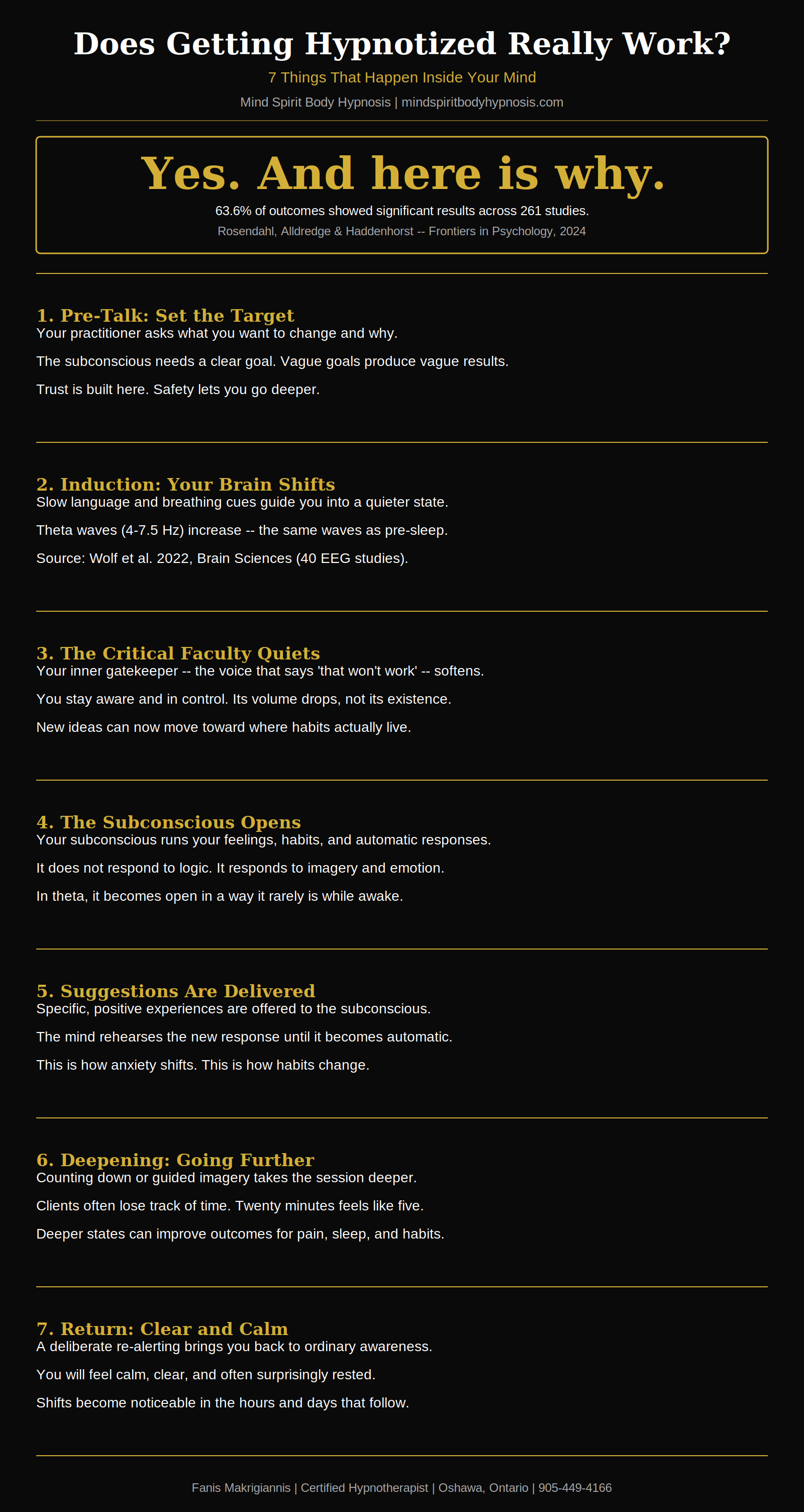
1. The Pre-Talk: Setting the Frame
Before any hypnosis begins, a good hypnotherapist takes time to talk with you. This is not filler. It is one of the most important parts of the session.
The pre-talk does three things. First, it clears up misconceptions. Most people carry mental images of a swinging pocket watch and someone clucking like a chicken. That is stage hypnosis for entertainment. Clinical hypnosis is private, purposeful, and completely different. Second, it establishes what you want to change and why. The subconscious needs a clear target. A vague goal produces vague results. Third, it begins to build trust between you and your practitioner, which directly affects how deeply you can relax. A client who feels safe goes deeper. A client who feels guarded stays shallow. The pre-talk is where that safety is built.
2. Induction: Shifting Your Brain State
Induction is the process of guiding you from ordinary waking awareness into a focused, relaxed state. It typically involves slow, calm language, deliberate breathing cues, and gentle suggestions to let your body and mind settle.
This is where something measurable happens in your brain. A 2022 systematic review by Wolf et al., published in Brain Sciences (doi: 10.3390/brainsci12010108), analyzed 40 EEG and neuroimaging studies and found that theta wave activity increases during hypnotic induction. Theta waves operate at 4 to 7.5 cycles per second. They are the same waves your brain produces during light sleep, deep daydreaming, and the moments just before you fall asleep at night. This is not sleep. You remain aware. But your brain is running in a quieter mode that makes the next steps possible.
Induction usually takes between five and fifteen minutes, depending on the person and the method.
3. Bypassing the Critical Faculty: The Inner Gatekeeper
This is the step most people have never heard of, and it is arguably the most important one.
The critical faculty is the part of your conscious mind that evaluates everything. It is the internal voice that says "that is not true" or "that will never work for me" when you try to think differently. It is a useful function in everyday life. But it is also the reason so many people stay stuck. You can know, logically, that you should feel less anxious in social situations. But knowing it does not change the automatic feeling. That is because the automatic feeling lives in the subconscious, which the critical faculty guards.
During hypnosis, as theta activity increases and your analytical mind relaxes, the critical faculty quiets. It does not turn off. You remain aware and in control. But its volume drops enough that new ideas can move past it, toward the part of your mind where habits and automatic responses actually live.
4. Reaching the Subconscious: Where Change Actually Happens
Your subconscious mind runs most of your life. It controls your breathing, your posture, your emotional reactions, and the habits you repeat without thinking. It also holds the beliefs you formed about yourself and the world, many of which were shaped long before you were old enough to question them.
The subconscious does not respond well to force or logic. You cannot lecture it into changing. But it does respond to imagery, emotion, and repetition experienced in a relaxed, receptive state. That is what hypnosis creates. Once the critical faculty has quieted and the brain is running in the theta range, your subconscious becomes far more open to receiving and acting on new information.
The Wolf et al. review also noted that hypnosis reduces activity in brain regions associated with self-referential and self-critical thinking. When that quiets, the subconscious is no longer working against itself.
5. Delivering Suggestions: Reprogramming the Automatic Mind
Suggestions are the therapeutic core of a hypnotherapy session. They are carefully worded statements, images, or scenarios that your subconscious can absorb and act on. A good suggestion is positive, specific, and emotionally resonant. It does not tell your mind what to stop doing. It shows your mind what to do instead.
For example, a suggestion for someone working on sleep might not say "stop worrying at night." Instead, it might guide your mind through the experience of lying down and feeling your body get heavy, your thoughts slow, and your breath deepen. The subconscious rehearses the new response. Over time, and especially with reinforcement, that rehearsed response becomes the automatic one.
This is why hypnotherapy is used for anxiety and stress relief, breaking habits, and building new patterns of thinking. The suggestions are not magic words. They are carefully constructed experiences that the subconscious treats as real.
6. Deepening: Going Further In
After initial suggestions are delivered, many practitioners use deepening techniques to take the session further. This might involve counting down, guiding you down an imaginary staircase, or using progressive relaxation to bring more of the body and mind into the restful state.
Deeper states are not required for results. Research consistently shows that even light to medium trance depth produces measurable changes. But deepening can make the session more effective for certain goals, particularly pain, sleep, and deeply rooted habits. As the Wolf et al. review described, theta activity tends to shift and intensify as trance depth increases, with activity moving from the front of the brain toward posterior regions. The brain is not doing less. It is doing something different.
During this stage, clients often lose track of time. Twenty minutes can feel like five. This is a sign that the session is working, not that something has gone wrong.
7. Return and Integration: Coming Back
Every session ends with a clear, deliberate return to ordinary waking awareness. This is sometimes called the re-alerting or emergence phase. Your practitioner will guide you back gradually, often using ascending counts or gentle cues that signal to your brain it is time to return.
You will not wake up confused or disoriented. Most clients feel calm, clear, and surprisingly rested. Some feel a mild mental tiredness similar to what you feel after a good meditation. This passes quickly.
What you may notice in the hours and days after a session is more significant. Clients working with me on anxiety and confidence in Ontario often describe a quieter inner voice, less reactivity in situations that used to trigger them, or a new ease around something they previously dreaded. These shifts can feel subtle at first. They tend to build with each session.
Is hypnosis real?
What the Research Shows
Does getting hypnotized really work? The evidence says yes.
The Wolf et al. 2022 review confirmed that brain activity changes during hypnosis are measurable, not imagined. EEG studies show real shifts in theta oscillations, and imaging studies show reduced activity in regions associated with self-criticism and pain processing.
A 2024 meta-analysis by Rosendahl, Alldredge, and Haddenhorst, published in Frontiers in Psychology, analyzed 261 hypnotherapy studies and found that outcomes showed significant results. The strongest outcomes were in pain management, procedural anxiety, and sleep.
What hypnotherapy is well-supported for: Pain management, anxiety and stress, sleep difficulties, habits and cravings, and performance and confidence.
What it works alongside: Standard medical care, psychotherapy, medication (as a complement, not a replacement), coaching, and lifestyle change.
Research also shows that approximately 10 to 15% of adults are highly hypnotizable and respond to suggestions very easily. Most adults fall in a moderate range and still benefit from sessions. Willingness and a relaxed mindset matter more than any innate ability.
WHAT MY CLIENTS SAY
“I really couldn’t recommend Fanis more highly. He helped me push through barriers I didn’t even realize were there. He’s incredibly down to earth, patient, and makes you feel completely at ease while working with you. The experience has made such a meaningful difference for me. You truly couldn’t be in better hands. Highly recommend!” — Daniela G
Frequently Asked Questions
Does getting hypnotized really work, or is it just the placebo effect? The research says it is real. Brain imaging studies confirm measurable changes in EEG activity and neural connectivity during hypnosis. These are not changes produced simply by believing something will happen. A 2022 review in Brain Sciences analyzed 40 studies and found consistent increases in theta oscillations during hypnotic induction, along with real shifts in how the brain handles attention and pain.
Will I be unconscious or asleep during hypnosis? No. You will be aware, alert, and able to speak throughout the session. Hypnosis feels more like deep focus or the state just before falling asleep, where you are still aware of your surroundings but feel deeply relaxed. You will not lose consciousness.
Will I remember what was said during the session? Most people remember the session clearly, or at least the parts that felt meaningful. Some experience a mild fuzziness around specific suggestions, similar to how you might not recall every word of a conversation while very relaxed. Your subconscious retains what it received, whether or not you consciously recall every detail.
Can anyone be hypnotized? Most adults can experience at least a light to moderate state of hypnosis. Research suggests around 10 to 15% of people are highly hypnotizable and respond very easily. The majority fall in a moderate range, which is still effective for therapeutic purposes. Willingness is the biggest factor. Resistance or anxiety about the process can create a barrier, which is exactly why the pre-talk exists.
How many sessions does it take to see results? This depends on the goal. Some clients notice a shift after a single session. Most work toward a specific change over three to six sessions. Deeply rooted habits or long-standing anxiety patterns typically benefit from more sustained work. I discuss realistic expectations during the pre-talk so clients know what to plan for.
Is hypnotherapy safe? Yes, when practised by a trained and certified hypnotherapist. There are no known serious risks associated with clinical hypnotherapy. You remain in control throughout. A well-conducted session will not cause distress or implant unwanted ideas. It is a complementary support and is not a substitute for medical or psychological care.
What does hypnosis feel like physically? Most people describe a sense of heaviness in the body, warmth, and deep calm. Some notice their breathing slows naturally. Some feel a pleasant tingling or lightness. The experience varies by person, but the common thread is a sense of rest that feels different from ordinary relaxation.
Can hypnosis make me say or do something I do not want to? No. Your values and judgment remain intact during hypnosis. You will not reveal secrets, act against your ethics, or follow suggestions that conflict with who you are. If a suggestion feels wrong, your mind simply will not accept it. This is one of the most consistent findings in hypnosis research.
Does virtual hypnotherapy work as well as in-person sessions? Yes. Virtual sessions produce results comparable to in-person sessions. Many clients in Ontario and across the province find that doing the session from their own home actually helps them relax more deeply, which can improve outcomes.
How do I know if hypnotherapy is right for me? The best first step is a conversation. I offer a free 30-minute virtual strategy session where we talk about what you are working on and whether hypnotherapy is a good fit. No commitment, no pressure.
RECOMMENDED READING
Ready to Take the Next Step?
If you are curious about what happens during hypnosis and want to experience the process yourself, I would love to help.
I offer a free 30-minute virtual strategy session for new clients across Ontario. There is no pressure, just a conversation about what you are going through and how hypnotherapy or NLP might support you.
Book your free session: calendly.com/mindspiritbodyhypnosis
Call or text: 905-449-4166
Email: info@mindspiritbodyhypnosis.com
Visit: mindspiritbodyhypnosis.com
Serving clients virtually across Ontario, including Durham Region, Toronto, Canada, and beyond.
Disclaimer: This article is for informational purposes only and does not constitute medical or psychological advice. Hypnotherapy, NLP, and EMDR are complementary approaches and are not a substitute for diagnosis or treatment by a qualified healthcare provider. Please consult a licensed professional if you have concerns about your mental or physical health.
Written by Fanis Makrigiannis | Certified Hypnotherapist & NLP Master Practitioner | Mind Spirit Body Hypnosis.