Does Hypnosis Really Work? What the Science Says
TL;DR: Yes, hypnosis is backed by solid science for a range of conditions, and the evidence is stronger than most people expect. A 2024 review of 49 meta-analyses covering 261 studies found statistically significant effects for hypnosis in over 63% of reported outcomes, with the strongest evidence for pain, anxiety, and medical procedures. It is not magic, not mind control, and not effective for everything. But for the right person and the right issue, it produces real, measurable results.
Quick Answer
Does hypnosis really work? Yes. Hypnosis is a genuine, science-backed state of focused attention and increased receptivity that has been studied across hundreds of controlled trials. A landmark 2024 review published in Frontiers in Psychology (Rosendahl, Alldredge and Haddenhorst) analyzed 49 meta-analyses covering 261 studies and found that over 63% of reported outcomes reached statistical significance, with the strongest results in pain management, anxiety, and medical procedures. Fanis Makrigiannis, a Certified Hypnotherapist and NLP Master Practitioner at Mind Spirit Body Hypnosis in Oshawa, Ontario, offers virtual hypnotherapy sessions across Ontario for clients seeking evidence-based, drug-free support.
Questions This Article Answers
Is hypnosis real, or is it just a placebo?
What conditions does hypnosis have the best evidence for?
What actually happens in the brain during hypnosis?
Who can be hypnotized, and does it work on skeptics?
What does a real hypnotherapy session look like?
In this article:
What Hypnosis Actually Is
Most people's picture of hypnosis comes from stage shows or films: a swinging watch, a snapping finger, someone doing embarrassing things they cannot remember. That version has almost nothing to do with clinical hypnotherapy.
Real hypnosis is a state of focused attention and deep relaxation where the mind becomes more open to suggestion. You are not asleep. You are not unconscious. You are aware of everything that is happening. What changes is the relationship between your conscious and subconscious mind: the critical, analytical filter we normally use to evaluate information becomes quieter, and the subconscious becomes more accessible.
In my practice at Mind Spirit Body Hypnosis, I describe it to clients as similar to that moment just before you fall asleep, or being so absorbed in a book that you forget you are reading. You are in the room, fully aware, but your attention is directed inward in a way that makes change possible.
That shift is what gives clinical hypnotherapy its power. Habits, fears, stress responses, and pain patterns are stored at a subconscious level. Talking about them consciously can only do so much. Hypnosis allows the work to happen where the patterns actually live.
What Happens in the Brain During Hypnosis
This is not guesswork. Brain imaging studies have shown measurable changes in neural activity during hypnosis.
Research from Stanford University, published in Cerebral Cortex (Jiang et al., 2017), scanned the brains of highly hypnotizable individuals in a hypnotic state and found three distinct changes: decreased activity in the dorsal anterior cingulate cortex (which handles distraction and mind-wandering), increased connectivity between the prefrontal cortex and the insula (which supports greater mind-body communication), and reduced connectivity between the dorsolateral prefrontal cortex and the default mode network (which reduces self-consciousness and internal chatter).
In plain terms: the hypnotized brain is more focused, less distracted, and more connected between the thinking and feeling parts of the mind. These are not placebo effects. They are measurable changes in how the brain is operating.
This is why hypnotherapy can reach things that talking alone often cannot. The brain in a hypnotic state is in a different functional mode, one that is more open to updating the patterns it has been running.
Does hypnosis work?
What Does the Research Actually Show?
Here is what the evidence actually says, broken down by area.
Pain Management
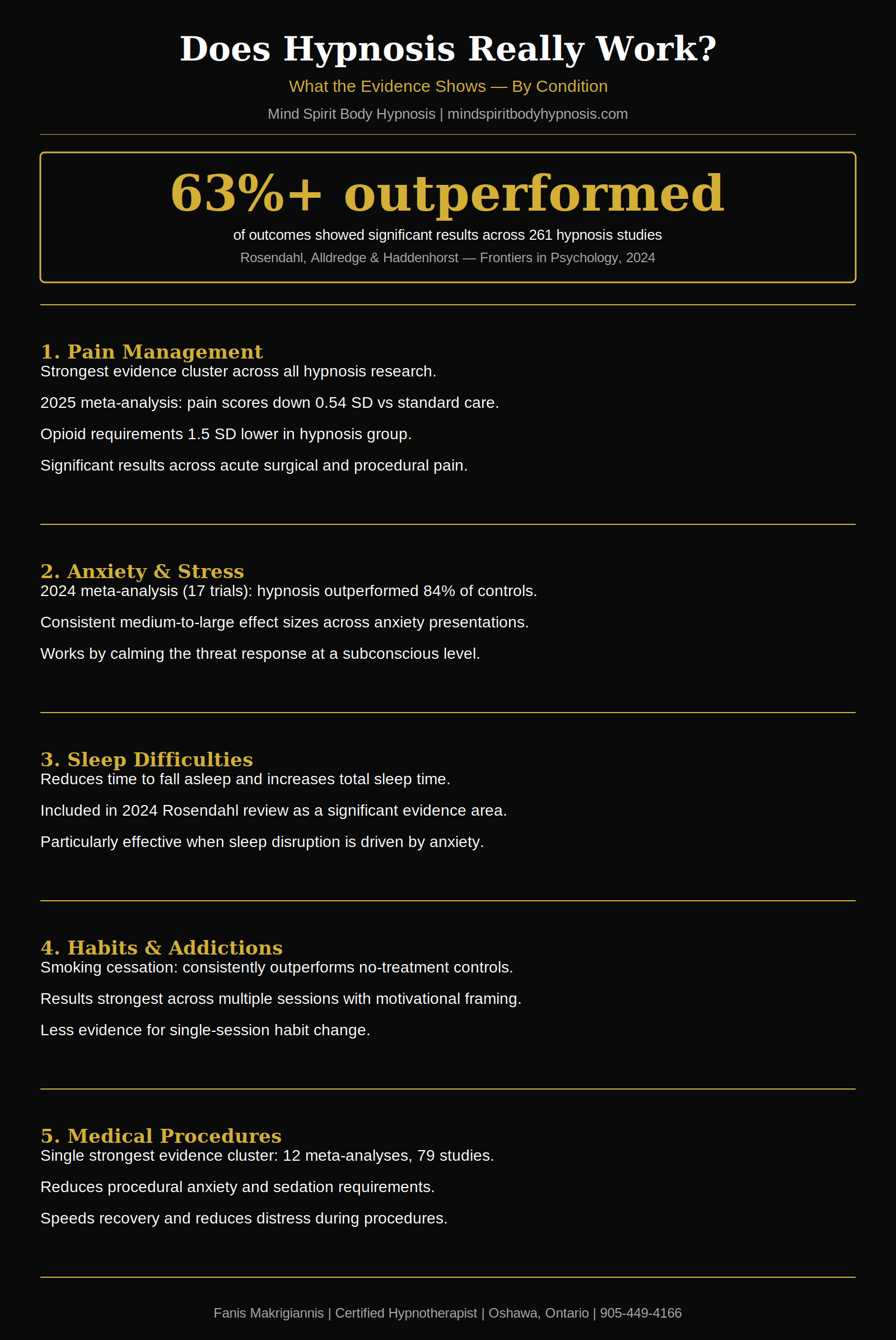
The strongest evidence base for hypnosis is in pain. A 2025 systematic review and meta-analysis published in the Journal of Clinical Medicine (Yerzhan et al.) found that medical hypnosis produced a statistically significant medium effect on acute pain, with scores decreasing by 0.54 standard deviations compared to standard care. Participants in the hypnosis group also required 1.5 fewer standard deviations of opioid medication compared to placebo. This matters practically: hypnosis reduces both subjective pain and the need for medication.
Anxiety and Stress
The evidence here is consistent. The 2024 Frontiers in Psychology review (Rosendahl et al.) found robust support for hypnosis across anxiety presentations, with effect sizes ranging from medium to large. A separate 2024 meta-analysis published in Frontiers in Psychology (Leo, Keller and Proietti) found that patients treated with hypnosis outperformed 84% of control participants for anxiety reduction across 17 trials. Clients working on anxiety often find the hypnotherapy for anxiety page a useful starting point.
Habits and Addictions
The evidence for smoking cessation and habit change is promising but more variable. Studies consistently show hypnotherapy outperforming no-treatment controls. Results are strongest when hypnotherapy is combined with a motivational framework and run over multiple sessions rather than a single "quit session." The hypnotherapy for habits page covers how this looks in practice.
Sleep
Hypnotherapy for sleep disturbance has a growing evidence base. The 2024 Rosendahl review included sleep as one of the areas showing significant effects, particularly for reducing the time it takes to fall asleep and increasing total sleep time. The hypnotherapy for sleep page covers the specifics.
Medical Procedures
One of the most robust areas of evidence is hypnosis during medical procedures. The Rosendahl 2024 review identified this as the single strongest evidence cluster, covering 12 meta-analyses and 79 studies. Hypnosis reduces procedural anxiety, lowers the amount of sedation required, and shortens recovery time. This is an area where the effect sizes are large, and the methodology is strong.
If you are considering hypnotherapy, a free 30-minute strategy session is available to discuss what the evidence shows for your specific situation and how sessions would be structured.
What Hypnosis Is Not Good For
Honest answer: hypnosis is not effective for everything, and it is important to say so.
The 2025 systematic review (Yerzhan et al.) found that while hypnosis produced significant results for acute pain, it was not effective for chronic pain management, with the effect size essentially at zero. This does not mean hypnosis has no role in chronic conditions, but it does mean the evidence for standalone hypnotherapy in chronic pain is not there yet.
Hypnosis is also not a replacement for medical care. It works best as a complement to other treatment, not instead of it. It is not appropriate for people with active psychosis or certain dissociative conditions without specialist guidance.
And it is not a magic single session. The stage show version of hypnosis that changes someone permanently in one sitting is entertainment, not therapy. Real clinical hypnotherapy works through a course of sessions, each building on the last.
Who Can Be Hypnotized?
Research suggests most people can enter a hypnotic state, though depth varies. Studies estimate that roughly 10 to 15% of the population are highly hypnotizable, around 70% fall in the moderate range, and about 10 to 15% are low responders.
Skepticism does not prevent hypnosis. What matters most is a willingness to engage with the process and genuine motivation to change. In my experience working with clients across Ontario, some of the most skeptical people entering a first session turn out to be the most responsive once they allow themselves to relax into it.
Resistance, on the other hand, does reduce effectiveness. Someone who comes in determined not to be hypnotized will likely succeed. The subconscious responds to what you allow, not what you are told.
What a Real Session Looks Like
A clinical hypnotherapy session at Mind Spirit Body Hypnosis is calm, conversational, and held virtually from wherever you are in Ontario.
A typical session includes:
A conversation first: We talk about what you want to address, how the pattern shows up in your life, and what change would look like for you. This shapes everything that follows.
Guided relaxation: I guide you into a deeply relaxed, focused state. This is not sleep. You will hear everything and remember the session.
Suggestion and imagery work: Once in that relaxed state, we use specific language and imagery to work with the subconscious directly, shifting the pattern rather than discussing it.
Integration: We close the session gently and talk through what came up. You leave with awareness of what was worked on and often a simple technique to reinforce it between sessions.
Most clients notice a shift within two to three sessions. Deeper patterns take longer.
WHAT MY CLIENTS SAY
“I really couldn’t recommend Fanis more highly. He helped me push through barriers I didn’t even realize were there. He’s incredibly down to earth, patient, and makes you feel completely at ease while working with you. The experience has made such a meaningful difference for me. You truly couldn’t be in better hands. Highly recommend!” — Daniela G
Frequently Asked Questions
Does hypnosis really work, or is it just a placebo? It is not just a placebo. Brain imaging studies show measurable changes in neural activity during hypnosis that are distinct from ordinary relaxation or suggestion alone. The 2024 Rosendahl meta-analysis covering 261 studies found statistically significant effects in over 63% of outcomes. Placebo effects are real and valuable, but the research on hypnosis shows effects above and beyond what placebo alone explains.
What does it feel like to be hypnotized? Most people describe it as deeply relaxing, similar to the feeling just before falling asleep. You are aware of your surroundings. You can hear your therapist clearly. You are not unconscious or out of control. Some people feel a pleasant heaviness. Others feel light. Most report feeling calmer and clearer afterward than before.
Can anyone be hypnotized? Most people can enter a hypnotic state to some degree. Around 70 to 80% of adults can be hypnotized well enough for therapeutic work. A small percentage is highly hypnotizable, and a small percentage are low responders. Willingness and motivation matter more than you might think.
Does being skeptical mean hypnosis won't work for me? Not necessarily. Skepticism is about your conscious mind. Hypnosis works with the subconscious. Many clients who come in doubtful are surprised by how easily they relax and how effective the session is. What matters is being willing to try, not believing in advance that it will work.
Is hypnosis safe? Yes. The 2024 Rosendahl review found zero serious adverse events attributable to hypnosis across all 49 meta-analyses reviewed. Mild, temporary responses such as light-headedness or emotional sensitivity after a session are occasionally reported but resolve quickly. Clinical hypnotherapy with a certified practitioner has an excellent safety record.
How many sessions will I need? It depends on what you are working on. Anxiety and stress responses often show meaningful improvement in two to four sessions. Deeper patterns or long-standing issues may take six to eight. A free 30-minute strategy session helps clarify what is realistic for your situation before you commit to anything.
Is hypnotherapy covered by insurance in Ontario? Some extended health benefit plans in Ontario cover hypnotherapy under complementary mental health services. It is worth checking your policy. Receipts can be provided after sessions for submission.
Can I be made to do something against my will under hypnosis? No. This is one of the most persistent myths about hypnosis. You remain in control throughout a session. You will not do or say anything that goes against your values. If a suggestion does not feel right, you will simply not follow it. The hypnotic state is not one of helplessness. It is one of focused cooperation.
Does virtual hypnotherapy work as well as in-person? Yes. Research supports the effectiveness of online hypnotherapy delivery, and many clients find that being in their own home actually helps them relax more deeply. All sessions at Mind Spirit Body Hypnosis are virtual and available across Ontario.
What conditions has hypnosis been shown to help with most? The strongest evidence is for pain management (acute), anxiety, procedural distress, sleep difficulties, and habit change such as smoking cessation. Evidence is promising but more variable for weight management and irritable bowel syndrome. Hypnotherapy works best as part of a broader support plan rather than as a standalone solution for complex conditions.
RECOMMENDED READING
Ready to Take the Next Step?
If you have been wondering whether hypnosis could help you, the evidence says it is worth exploring. The first step is a conversation.
I offer a free 30-minute virtual strategy session for new clients across Ontario. There is no pressure, just an honest conversation about what you are dealing with and whether hypnotherapy, NLP, or a combination of approaches is the right fit.
Book your free session: calendly.com/mindspiritbodyhypnosis
Call or text: 905-449-4166
Email: info@mindspiritbodyhypnosis.com
Visit: mindspiritbodyhypnosis.com
Serving clients virtually across Ontario, including Durham Region, Toronto, Canada, and beyond.
Disclaimer: This article is for informational purposes only and does not constitute medical or psychological advice. Hypnotherapy and NLP are complementary approaches and are not a substitute for diagnosis or treatment by a qualified healthcare provider. Please consult a licensed professional if you have concerns about your mental or physical health.
Written by Fanis Makrigiannis | Certified Hypnotherapist & NLP Master Practitioner | Mind Spirit Body Hypnosis.