Can hypnosis make me do something I don’t want to do?
Can Hypnosis Make You Do Something You Don't Want To Do?
TL;DR: No. Hypnosis cannot override your values, your instincts, or your right to refuse. You stay aware throughout a session and can stop at any time. A 2023 paper in BJPsych Advances confirms that hypnotized people retain full control over their actions and can resist any suggestion they choose to.
Quick Answer
Hypnotherapy is a subconscious-focused approach that works with your existing goals and values, not against them. Research published in BJPsych Advances by Stein, Lynn and Terhune (2023) found that people remain in control of their actions during hypnosis and can resist or refuse any suggestion that conflicts with their values. Fanis Makrigiannis, a Certified Hypnotherapist and NLP Master Practitioner at Mind Spirit Body Hypnosis in Oshawa, Ontario, offers virtual hypnotherapy sessions across Ontario to help clients with anxiety, stress, habits, and confidence using approaches that put the client in the driver's seat at every step.
Questions This Article Answers
Can hypnosis make you do something against your will?
Does hypnosis take away your free will?
Can a hypnotherapist make you reveal personal secrets?
Will you remember what happens during a hypnotherapy session?
Is hypnosis a form of mind control?
What actually happens in a hypnotherapy session?
Can you be hypnotized without knowing it?
Is hypnotherapy safe for people who worry about losing control?
In This Article
The Truth About Hypnosis and Control
The number one fear people bring to a first hypnotherapy session is losing control. They worry they will say something embarrassing, do something they would not normally do, or get stuck in a trance. These fears are completely understandable. They are also based on a myth.
In my practice, I hear some version of this from almost every new client: can hypnosis make you do something you don't want to do? The honest answer is no. Hypnosis works with your mind, not against it. It follows where your own goals and values lead. The moment a suggestion conflicts with who you are, your mind simply won't follow it.
Where Does This Fear Come From?
The fear of losing control under hypnosis comes almost entirely from movies, stage shows, and TV. In those settings, a person clucks like a chicken or pretends to be a robot. It looks like mind control. It is not.
Stage hypnosis is entertainment. Every person who walks up onto that stage has been pre-screened for high suggestibility and has agreed to play along for the crowd. They are not being controlled. They are performing, with a willing and playful mindset that they chose to bring.
Therapeutic hypnosis is completely different. There is no audience, no pressure to perform, and no suggestions that push against your values. The goal is to help you reach your own goals, using your own mind more effectively.
What Research Actually Shows
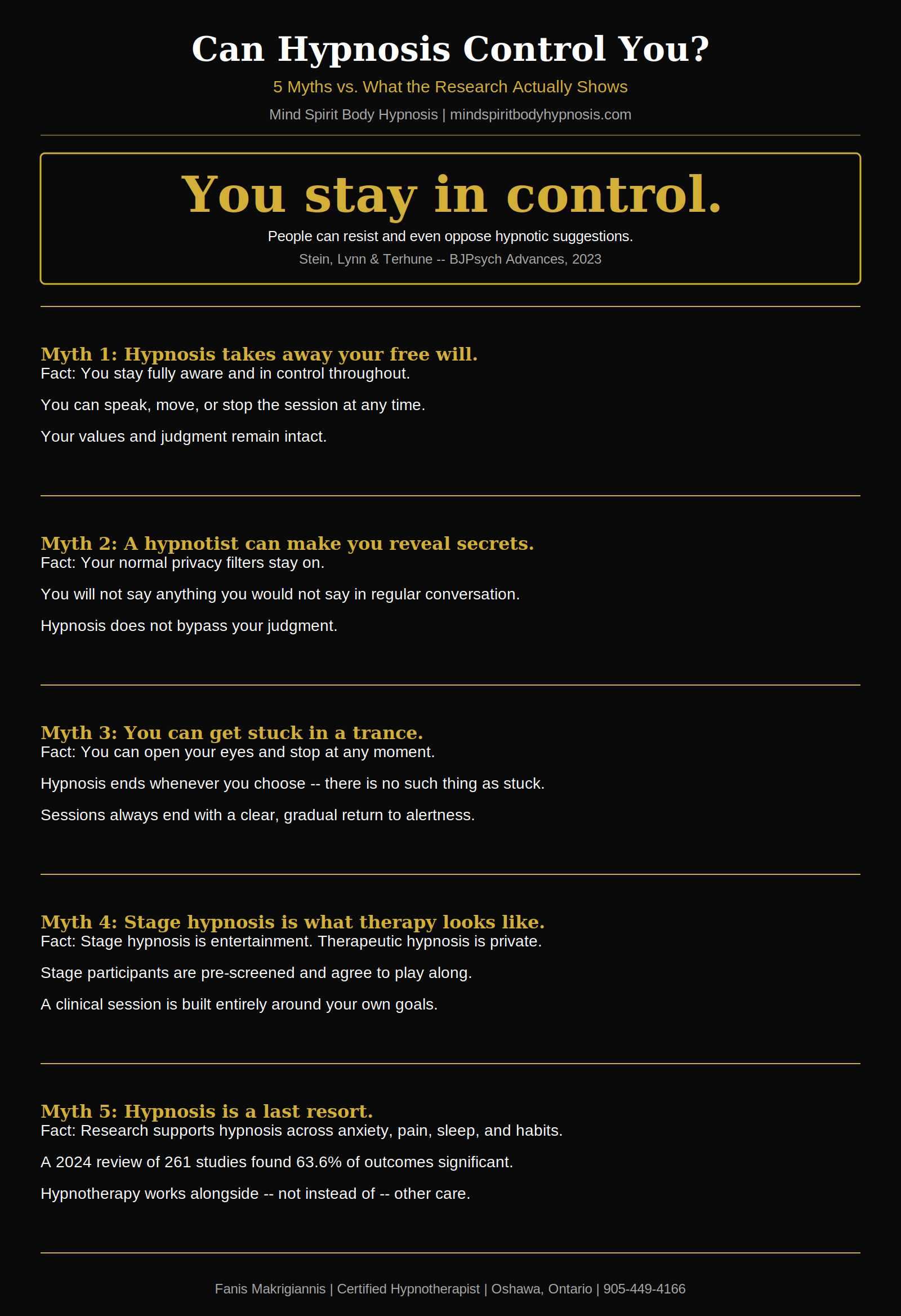
The science here is clear. A 2023 review by Stein, Lynn and Terhune, published in BJPsych Advances, examined the most persistent myths about hypnosis and compared them with the research evidence. On the question of control, the authors were direct: people do not lose control of their actions during hypnosis, and "people can resist and even oppose hypnotic suggestions." (Stein, Lynn & Terhune, 2023, BJPsych Advances, doi: 10.1192/bja.2023.30)
This reflects decades of research into how hypnosis actually works. Hypnotized people remain aware of their surroundings. They can hear everything that is said. They can respond, move, and stop the session at any time.
As a certified hypnotherapist working with clients in Ontario (Global), I have never had a client do something they did not want to do. Every session moves at the client's pace, with the client's goals driving the work.
The science behind hypnosis.
What Hypnosis Can and Cannot Do
What Hypnosis Can Do
Hypnosis can help you access a calmer, more focused state of mind. In that state, the mind tends to be more open to suggestions that line up with what you already want. If you want to feel less anxious, hypnotherapy can help you practise calm at a subconscious level. If you want to change a habit, hypnotherapy can work with the part of your mind that runs that habit on autopilot.
Research backs this up. A large 2024 review in Frontiers in Psychology (Rosendahl, Alldredge and Haddenhorst) found that across 261 hypnosis studies, outcomes showed significant results for conditions including anxiety, pain, and sleep difficulties. (Rosendahl, Alldredge & Haddenhorst, 2024, Frontiers in Psychology, doi: 10.3389/fpsyg.2023.1330238)
For clients across Durham Region and Ontario who are dealing with anxiety and stress, fears and phobias, or general patterns they want to shift, hypnotherapy offers a focused way to work with the mind rather than fight against it.
What Hypnosis Cannot Do?
Hypnosis cannot make you act against your core values. It cannot make you reveal information you do not want to share. It cannot make you harm yourself or anyone else.
A person who is deeply opposed to something will simply not follow a suggestion toward it. The mind has a natural filter. When something does not fit, it does not land.
If you are nervous about control, that concern is the first thing a good therapist will address before anything else begins. As someone trained through the American Board of Hypnotherapy and the National Guild of Hypnotists, I spend the early part of every first session explaining exactly what will happen, answering every question, and making sure the client feels completely safe before we start.
Hypnosis and control: what the evidence shows vs. what the myths claim
Research shows: You stay aware and in control throughout. The myths claim you fall into an unconscious sleep with no memory of what happens.
Research shows: You can resist or stop any suggestion. The myths claim you have no ability to refuse the hypnotist.
Research shows: Hypnosis works with your existing values and goals. The myths claim a skilled hypnotist can override your values entirely.
Research shows: Memory is generally intact after a session. The myths claim you wake up with no recollection.
What Happens in a Real Session?
How a Session Actually Begins
A hypnotherapy session starts with a conversation. I ask what you are hoping to work on, what has and has not worked before, and what questions or concerns you have. There are no surprises.
When the hypnosis portion begins, I guide you into a relaxed, focused state using verbal suggestions. This feels a bit like the edge of sleep: your body relaxes, your attention narrows, and your mind becomes quieter. Most people describe it as deeply pleasant.
You are not asleep. You are not unconscious. You will remember the session. If I say something that does not feel right, you can speak, move, or simply open your eyes and stop.
After the Session
The session ends with a gradual return to full alertness. Most people feel calm and refreshed. Many describe it as the best rest they have had in weeks.
One thing I often offer new clients is a free 30-minute virtual strategy session before any formal work begins. This lets us talk through your goals and any concerns, with no commitment required.
Is Hypnotherapy Right for You If You're Worried About Control?
Ironically, people who are most worried about control often make excellent hypnotherapy clients. That worry shows you are self-aware and that you take your inner life seriously. Those qualities tend to make for focused, effective work.
The concern about losing control usually fades completely once a person has experienced one session. The reality is so different from the movie version that most clients laugh about their original fears afterward.
If the concern is still there after reading this, bring it into the session. A good hypnotherapist will welcome the question, answer it honestly, and let you move at whatever pace feels right.
Frequently Asked Questions
Can hypnosis make you do something you don't want to do? No. This is the most common myth about hypnosis, and it has been consistently disproved by research. A 2023 review in BJPsych Advances confirmed that people can resist and oppose any suggestion they choose to. You remain aware and in control throughout a session. A certified hypnotherapist works with your goals, not against them.
Does hypnosis take away your free will? No. Hypnosis is a focused and relaxed state of attention. You keep your values, your judgment, and your ability to respond. If a suggestion does not fit with who you are, your mind simply does not follow it. Free will stays intact.
Can a hypnotherapist make you reveal personal secrets? No. You will not say anything in hypnosis that you would not say in ordinary conversation. Your normal judgment and sense of privacy stay on. If a question feels intrusive, you can choose not to answer it, just as you would at any other time.
Will you remember what happens during a hypnotherapy session? Yes, in most cases. Most people remember the session clearly. You are not asleep or unconscious. You are in a relaxed, focused state similar to daydreaming, and your memory of it is generally intact.
Is hypnosis the same as sleep? No. Hypnosis feels restful, but your brain is active and alert. Neuroimaging research shows that the brain during hypnosis looks different from the brain during sleep. You are aware, responsive, and present throughout.
Can you get stuck in hypnosis? No. This fear comes from movies and has no basis in how hypnosis actually works. A session ends when the therapist guides you out of the relaxed state, or when you simply choose to open your eyes. There is no such thing as being stuck.
Is hypnotherapy safe for anxious or trauma-sensitive clients? Yes, when done by a trained professional. A skilled hypnotherapist adjusts pace and depth to your comfort level. The session moves at your speed. If anything feels too intense, you can speak up or stop at any time.
What does it actually feel like to be hypnotized? Most people describe it as deeply relaxing. Your body feels heavy and comfortable. Your thoughts slow down. It often feels like the moments just before sleep, except you remain aware and can respond. Most clients find it pleasant from the very first session.
Can anyone be hypnotized? Most people can enter a useful state of hypnotic focus with a skilled guide and a willing mindset. Hypnotisability varies across individuals and across suggestion types. People who are open to the process and willing to engage tend to get the most from it.
How is a professional hypnotherapy session different from stage hypnosis? Stage hypnosis is entertainment. Participants are pre-screened for high suggestibility and agree to play along for the crowd. A therapeutic session is private, goal-directed, and built around your intentions. A certified hypnotherapist has professional training, ethical obligations, and a duty of care toward you as a client.
WHAT MY CLIENTS SAY
“I don’t even know where to begin! Fanis saved my life! I have battled over 5 decades of trauma. After 5 sessions and a final negative moment in my life I felt the shift. I can’t thank you enough Fanis. I have tried therapy and felt it was not really helping too much. Hypnosis was the answer. I am SO happy. I feel better than ever. I will be recommending Fanis to so many people I know struggling with different issues. A++” — Helen R.
RECOMMENDED READING
Ready to Take the Next Step?
If you are curious about hypnotherapy but still have questions, I would love to talk.
I offer a free 30-minute virtual strategy session for new clients across Ontario. No pressure, no commitment. It is just a conversation about what you are dealing with and how hypnotherapy or NLP might support you.
Book your free session: calendly.com/mindspiritbodyhypnosis
Call or text: 905-449-4166
Email: info@mindspiritbodyhypnosis.com
Visit: mindspiritbodyhypnosis.com
Serving clients virtually across Ontario, including Durham Region, Toronto, Canada, and beyond.
Disclaimer: This article is for informational purposes only and does not constitute medical or psychological advice. Hypnotherapy, NLP, and EMDR are complementary approaches and are not a substitute for diagnosis or treatment by a qualified healthcare provider. Please consult a licensed professional if you have concerns about your mental or physical health.
Written by Fanis Makrigiannis | Certified Hypnotherapist & NLP Master Practitioner | Mind Spirit Body Hypnosis.