Can hypnotherapy really heal trauma?
Trauma Responses in Adults: Your Questions Answered
TL;DR: A trauma response is not an overreaction. It is the nervous system doing exactly what it was trained to do: protect you from something it learned to see as threatening. Understanding why it happens, and why it happens in the body before the mind can catch up, is the first step toward changing it. At Mind Spirit Body Hypnosis in Oshawa, Ontario, Fanis Makrigiannis helps adults across Ontario work with trauma responses at the subconscious level where they are stored.
Quick Answer
A trauma response is an automatic reaction from the nervous system to a perceived threat a threat that may not be present right now but that the subconscious has learned to prepare for based on experience. These responses happen in the body first and fast, before conscious thought has a chance to intervene. They include fight, flight, freeze, and fawn, four distinct survival responses that each produce recognizable patterns in adult life. Hypnotherapy helps change these responses by working directly with the subconscious, where the threat learning is stored. At Mind Spirit Body Hypnosis in Oshawa, Ontario, Fanis Makrigiannis offers virtual sessions province-wide for clients of all ages.
Questions This Article Answers
What is a trauma response?
Why do I feel fine and then suddenly not fine?
Why does my body react before my mind does?
Why does trauma make me shut down instead of speak up?
Can hypnotherapy help with trauma responses?
In This Article:
People often come in confused about their own reactions. They were fine. Then something happened nothing dramatic, maybe a tone of voice or a certain look and suddenly they were not fine. Heart pounding. Chest tight. A wave of something they could not name.
Or they were in a conversation where they needed to speak up, and instead they went completely blank. Could not find words. Could not move. Just waited for it to be over.
Or they found themselves in conflict mode over something that, in hindsight, did not warrant that level of intensity. The reaction came faster than they could think. It was already happening before they understood what had triggered it.
These are not overreactions. They are trauma responses. And they make complete sense once you understand what the nervous system is doing and why.
What Is a Trauma Response?
A trauma response is the nervous system's automatic reaction to something it perceives as threatening.
The key word is perceives. The threat does not have to be real and present. It just has to resemble something that was threatening in the past.
The nervous system is a very fast, very efficient pattern-matching machine. It stores the sensory details of threatening experiences sounds, tones of voice, physical sensations, smells, images and uses them to scan for danger. When something in the present matches the stored pattern closely enough, the alarm fires. The survival response activates. All of this happens in a fraction of a second, before the thinking part of the brain has time to assess whether the current situation actually warrants the response.
This is why trauma responses can feel bewildering. From the outside, they can look disproportionate. From the inside, they arrive so fast there is no warning, only aftermath.
Four primary survival responses develop from trauma:
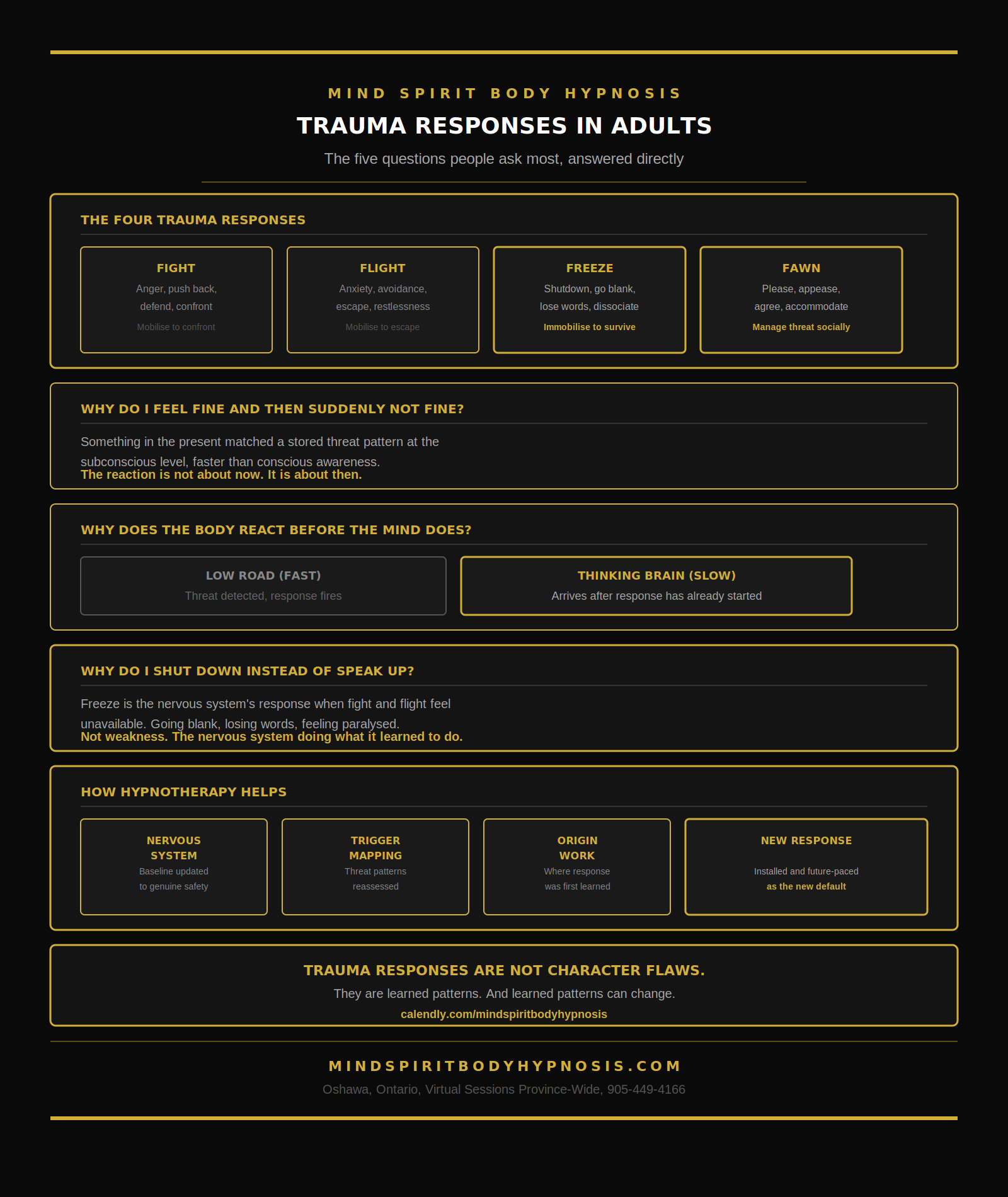
Fight. Anger, irritability, the urge to push back, argue, or defend. The nervous system is mobilizing to confront the perceived threat.
Flight. Anxiety, restlessness, the urge to leave, avoid, or escape. The nervous system is mobilizing to get away from the perceived threat.
Freeze. Shutdown, going blank, dissociation, the inability to speak or move. The nervous system has shifted into immobilization, the response when fight and flight are not available.
Fawn. People-pleasing, appeasement, automatic agreement, putting others' needs first to reduce the threat of conflict. The nervous system is managing the perceived threat by becoming as unthreatening as possible.
Most people have a dominant response pattern. Most have experienced all four at different times and in different contexts.
⭐ Pro Tip: Your dominant trauma response is not a personality type it is a trained nervous system preference. The one that worked best in the environment where the trauma occurred is the one the subconscious has continued to rely on. Fight responses develop in environments where aggression was the best available protection. Freeze responses develop in environments where there was no escape and no safe way to fight. Fawn responses develop in environments where managing another person's emotional state was the most reliable route to safety. Understanding this changes the story from I am this kind of person to my nervous system learned this.
Why Do I Feel Fine and Then Suddenly Not Fine?
Because the trigger is usually not what it appears to be.
When a trauma response fires from a situation that seems small or neutral, it is almost always because something in that situation matched a stored threat pattern and that match happened at the subconscious level, faster than conscious awareness.
The match might be sensory: a tone of voice that resembles the tone used when things were about to go badly. A particular quality of silence. A facial expression. A smell. A physical sensation in the body.
The match might be relational: a dynamic that resembles the dynamic from a past threatening relationship. Someone withdrawing slightly. Someone asking a particular kind of question. The beginning of a pattern the nervous system has been trained to recognize as a precursor to something painful.
In each case, the subconscious has registered the match and activated the survival response before the conscious mind has had time to evaluate the current situation accurately. The person then finds themselves in a full physiological stress response: racing heart, tight chest, flooding emotions, without a clear conscious explanation for why.
This produces a particular kind of distress: the distress of not understanding your own reactions. Of feeling out of control. Of knowing intellectually that the current situation does not warrant this level of response and being unable to do anything about it because the response is already running.
Research on trauma consistently shows that the amygdala, the brain region responsible for threat detection, processes sensory information and initiates the stress response significantly faster than the prefrontal cortex, which handles rational evaluation and context (LeDoux, 2015, Anxious). This is not a malfunction. It is the design. Speed matters in genuine danger. The problem is when the system has learned to fire in the absence of genuine danger.
⭐ Pro Tip: When a strong reaction arrives without a clear explanation, try pausing and asking: what did this situation feel like? Not think like -- feel like. Often there is a quality to the feeling that is familiar in an older way. A feeling that belongs to an earlier time and an earlier version of the situation. That older feeling is the clue to what the subconscious matched. It is also the beginning of the thread that leads back to where the response was originally learned.
Why Does My Body React Before My Mind Does?
Because the survival system is built for speed, not accuracy.
The pathway from sensory input to threat response bypasses the cortex, the thinking brain and runs directly through the amygdala. This is sometimes called the low road of threat processing. It is fast, automatic, and operates on pattern matching rather than rational analysis.
By the time the cortex receives the information and begins to evaluate whether the perceived threat is accurate, the body is already in survival mode. Heart rate has increased. Stress hormones are already circulating. Muscles are already primed for action.
This is why it is so difficult to think clearly in the middle of a trauma response. The prefrontal cortex, the part responsible for clear thinking, context, language, and rational evaluation, is significantly suppressed during high stress. This is adaptive in genuine danger. You do not need to evaluate options carefully when something is genuinely threatening your survival. You need to act.
The consequence in everyday life is that the thinking mind arrives late to the scene, already in the middle of a physiological response it did not initiate and often cannot easily explain. The rational mind then tries to make sense of what the body has already done, often generating a story that does not fully account for the true trigger.
This also explains why cognitive approaches alone, trying to think differently about the trigger, produce limited results with established trauma responses. The response has already happened before thinking begins. Changing the response requires working at the level where the threat assessment is being made: the subconscious.
For more on how anxiety and trauma share the same nervous system foundation and are addressed together at Mind Spirit Body Hypnosis, the hypnotherapy for anxiety and stress pillar page covers the mechanisms in detail.
Why Does Trauma Make Me Shut Down Instead of Speak Up?
This is the freeze response, and it is one of the most misunderstood trauma responses because it looks passive but is entirely involuntary.
Freeze is not a choice. It is the nervous system's response to a situation where fight and flight both feel unavailable or unsafe. It is the biological equivalent of playing dead, a last-resort survival response that evolved for situations of inescapable threat.
In human experience, freeze shows up as going blank, losing the ability to speak, feeling paralyzed or disconnected, being unable to respond even when you know you want to. In the moment it happens, it can feel like stupidity, weakness, or cowardice. It is none of those things. It is the nervous system doing what it learned to do in a situation that resembled an experience of inescapable threat.
The environments that most commonly produce freeze responses are ones where the child had no safe way to fight or escape. Where conflict was too dangerous to engage with. Where the adult in the room was too powerful, too volatile, or too unpredictable to confront or leave. The nervous system learned that the safest available response was to go very still and wait.
In adult life, freeze fires in situations that resemble those dynamics, often in conflict, in confrontation, in situations of perceived power imbalance. The person finds themselves unable to speak up, unable to respond, waiting for the moment to pass. Then, afterwards, the frustration of having not said what they needed to say.
For more on how the origins of freeze and other trauma responses are addressed through hypnotherapy, the EMDR and trauma therapy pillar page covers the clinical approach in full.

Can Hypnotherapy Help With Trauma Responses?
Yes, and it is particularly well suited to this work because trauma responses are stored and triggered at the subconscious level, which is exactly where hypnotherapy operates.
The approach at Mind Spirit Body Hypnosis addresses trauma responses in four specific ways:
Nervous system regulation. The trance state produces genuine parasympathetic activation, the physiological opposite of the threat response. For clients whose nervous system has been chronically activated, experiencing genuine safety in the body is itself significant work. Repeated across sessions, it begins to update the nervous system's baseline.
Trigger mapping and threat reassessment. The specific triggers that activate the trauma response the sensory details, relational dynamics, and situational patterns the subconscious has learned to treat as threatening are identified and addressed. The subconscious is updated to understand that the current environment is not the same as the one where the threat was real.
Origin work. The specific experiences that established the survival response pattern are accessed in trance with adult resources and perspective. The child who learned that freeze was the safest available option is met by the adult self, who can offer what was not available then: safety, acknowledgment, and the understanding that more options are now available.
Response installation. New and more functional responses to the previously triggering situations are installed in trance and future-paced, experienced in advance as the expected default. The old automatic response loses its automatic quality as a new response becomes available.
In my practice, trauma response work typically takes up to four sessions. The specific number depends on the depth of the original experience and the number of distinct trigger patterns involved. An honest estimate is always given in the free strategy session. More about the approach is available on the about page.
What My Clients Say
"I began seeing Fanis after a long battle with trauma and grief. I suffered from severe anxiety, panic attacks, insomnia and self harm. After 3 months of weekly hypnotherapy sessions done online, I no longer suffer from panic attacks, insomnia, or self harm and have learned how to better regulate my emotions and find peace. Fanis helped me process many childhood traumas and confront my overwhelming grief. I am eternally grateful to Fanis and his wonderful work."
Sara V. | Trauma and Grief | Five Stars
"Working with Fanis has changed my life. After years of therapy for anxiety and confidence issues, I wanted to try something different. This experience has transformed me from the inside out and continues to have an effect even after our sessions. I am now able to be myself, face my fears, surround myself with those who care about me and live a fulfilling and happy life. So grateful."
Kristen W. | Anxiety and Confidence | Five Stars
FAQ
What is a trauma response? An automatic reaction from the nervous system to a perceived threat, one that may not be present now but that resembles something threatening from the past. It happens in the body before the thinking mind can intervene. The four primary trauma responses are fight, flight, freeze, and fawn.
Why do I feel fine and then suddenly not fine? Because the trigger matched a stored threat pattern at the subconscious level, faster than conscious awareness. Something in the current situation a tone, a look, a dynamic resembled something threatening from the past, and the nervous system activated the survival response before the thinking mind could evaluate the current situation accurately.
Why does my body react before my mind does? Because the survival system bypasses the thinking brain for speed. The amygdala processes threat cues and initiates the stress response faster than the prefrontal cortex can evaluate context. By the time the thinking mind arrives, the body is already in a stress response it did not consciously initiate.
What is the freeze response? The nervous system's response to situations where fight and flight both feel unavailable or unsafe. It produces going blank, losing the ability to speak, and feeling paralyzed. It is not weakness or cowardice. It is the nervous system doing what it learned to do in situations of inescapable threat.
What is the fawn response? Automatic people-pleasing, appeasement, and accommodation as a survival strategy. The nervous system manages the perceived threat by becoming as unthreatening as possible, agreeing, accommodating, and prioritizing the other person's emotional state to reduce the risk of conflict or harm.
Can trauma responses be changed? Yes. They are learned patterns, not permanent features. They developed in a specific context and can be updated through direct subconscious work. Hypnotherapy addresses the threat assessment and the stored response pattern directly at the level where they operate.
How many sessions will I need? In my practice, trauma response work typically takes up to four sessions. The number depends on the depth of the original experience and the range of trigger patterns involved. An honest estimate is always given in the free strategy session.
Can I do sessions virtually from anywhere in Ontario? Yes. All sessions are delivered virtually, province-wide, with no referral required.
How do I get started? Book a free 30-minute virtual strategy session at calendly.com/mindspiritbodyhypnosis. No referral needed.
Ready to Take the Next Step?
If your reactions have been confusing you, arriving too fast, feeling too big, leaving you frustrated with yourself, this is not a character problem. It is a nervous system pattern. And nervous system patterns can be changed.
I offer a free 30-minute virtual strategy session for new clients across Ontario. No pressure. No judgment. Just a conversation about what has been happening and whether this work is right for you.
Book your free session: calendly.com/mindspiritbodyhypnosis
Call or text: 905-449-4166
Email: info@mindspiritbodyhypnosis.com
Visit: mindspiritbodyhypnosis.com
Serving clients virtually across Ontario, including Durham Region, Toronto, Ontario, and beyond.
Disclaimer: This article is for informational purposes only and does not constitute medical or psychological advice. Hypnotherapy and NLP are complementary approaches and are not a substitute for diagnosis or treatment by a qualified healthcare provider. If you are in crisis, please contact the 988 Suicide Crisis Helpline or go to your nearest emergency room. Results vary by individual.