I have ADHD, Will hypnotherapy work?
I Have ADHD, Will Hypnotherapy Work?
TL;DR: If you have ADHD and are wondering whether hypnotherapy could help, the short answer is: for some things, yes. Research suggests hypnotherapy may improve attention task performance and emotional wellbeing in adults with ADHD. What it cannot do is replace medication or treat ADHD directly as a clinical condition. Where it tends to help most is with the things that travel alongside ADHD: anxiety, low confidence, restless sleep, and the emotional toll of years of feeling behind. This article explains what the evidence actually says and what to expect if you try it.
Quick Answer
I have ADHD: will hypnotherapy work is a question with a nuanced answer. Hypnotherapy does not treat ADHD as a neurological condition and is not a substitute for medication or specialist assessment. Research suggests it may help adults with ADHD improve sustained attention, reduce anxiety and depression, and feel better psychologically over time. Fanis Makrigiannis, a Certified Hypnotherapist (ABH, NGH) and NLP Master Practitioner at Mind Spirit Body Hypnosis in Oshawa, Ontario, works with adults across Ontario who want a complementary approach for the stress, habits, and confidence challenges that often accompany ADHD.
Questions This Article Answers
Can hypnotherapy help someone with ADHD?
What does the research actually say about hypnosis and ADHD?
Will I be able to be hypnotized if I have ADHD?
What specifically can hypnotherapy help with for ADHD adults?
How is hypnotherapy different from medication or CBT for ADHD?
Is hypnotherapy safe to use alongside ADHD medication?
In this article:
Introduction
A lot of people who reach out to me about ADHD have already tried something. Medication that worked but made sleep harder. Planners that lasted two weeks. Podcasts about productivity systems that sounded great at the time. The pattern they describe is not a lack of effort. It is effort that does not seem to stick.
What I hear underneath most of these conversations is a question about identity. Not just "can I focus better?" but "why does this feel so much harder for me than for everyone else?"
That is a question worth taking seriously. And it is one where hypnotherapy has something useful to offer, not as a fix for ADHD, but as a way to work with what ADHD leaves behind.
Can People With ADHD Even Be Hypnotized?
This is the first thing most people ask, because they assume the restless, hard-to-hold quality of ADHD would make hypnosis impossible.
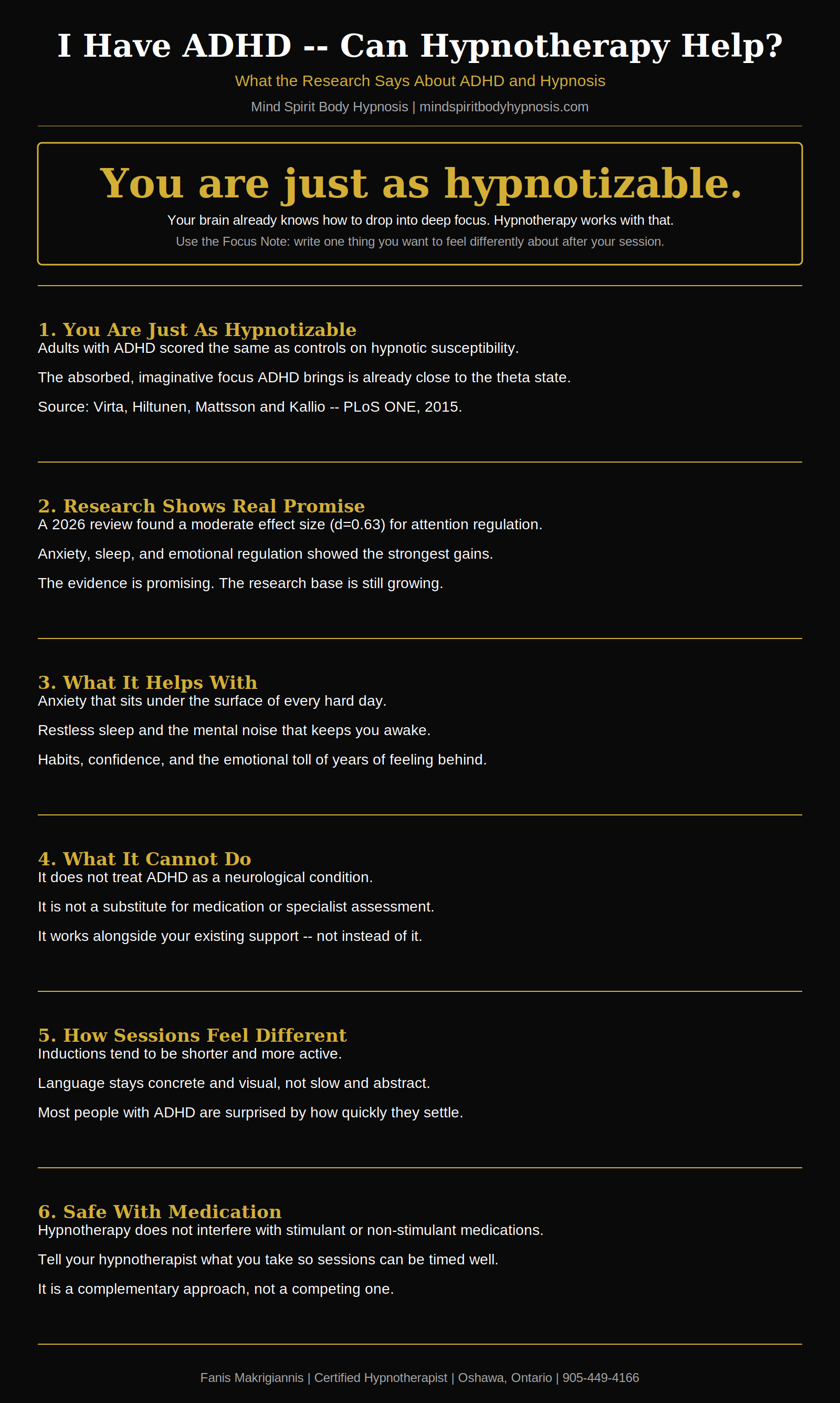
Research suggests the opposite. A 2015 study in PLoS ONE by Virta, Hiltunen, Mattsson, and Kallio tested 27 adults with ADHD and 31 healthy controls on hypnotic susceptibility. The two groups did not differ significantly. Adults with ADHD were just as hypnotizable as those without.
One reason may be that the absorbed, imaginative states people with ADHD slip into naturally the deep focus some call hyperfocus are already close to the theta brain state that hypnosis encourages. Your brain is not less capable of that state. It just does not tend to arrive on demand.
In practice, sessions with ADHD clients do run a little differently. Inductions tend to be shorter and more active. The language stays concrete and visual rather than slow and abstract. Most people are surprised by how quickly they settle.
What Does the Research Show?
The honest summary is this: the evidence is promising but still thin. There are no large randomized controlled trials, and the research base is smaller than for established ADHD treatments like medication and CBT. What exists is worth knowing about.
The same 2015 PLoS ONE study found that hypnotic suggestions for speed and accuracy significantly reduced reaction times on a sustained attention task in both the ADHD group and healthy controls. This is a laboratory finding, not a clinical outcome, but it suggests that hypnotic suggestions can reach and temporarily influence the attention system in adults with ADHD.
A six-month follow-up study by Virta and colleagues, published in Contemporary Hypnosis (2010), compared hypnotherapy with CBT in adults with ADHD. At follow-up, the hypnotherapy group showed better outcomes on psychological well-being, anxiety, and depression, and the advantage on ADHD symptom scales approached significance. The sample was small, and both treatments helped, but hypnotherapy held its gains longer.
This is enough to take seriously. It is not enough to overstate.
What is ADHD?
What Hypnotherapy Can Help With If You Have ADHD
The clearest benefits are not for ADHD itself. They are for what typically builds up around it.
Anxiety and overwhelm. Many adults with ADHD carry chronic low-level anxiety from years of missed deadlines, lost things, and misread social cues. Hypnotherapy may significantly reduce anxiety. A Rosendahl et al. 2024 meta-analysis in Frontiers in Psychology, covering 261 studies, found significant results in outcomes, with anxiety among the strongest areas of response.
Sleep. Settling the mind at night is genuinely harder with ADHD. The same Rosendahl meta-analysis found strong effects for hypnotherapy on sleep. When sleep improves, attention and emotional regulation tend to follow.
Habits and self-sabotage. The gap between knowing what to do and actually doing it is one of the most frustrating features of ADHD. Hypnotherapy works at the subconscious level, where habits actually live, not at the level of conscious planning. Clients I work with on habits and automatic patterns often describe the shift not as trying harder but as the resistance quietly dropping away.
Confidence and self-worth. The internal story many ADHD adults carry is one built from a long list of things that did not go as planned. Hypnotherapy can help update that story at a level deeper than affirmations or self-talk. This is slow work, but it tends to be durable. You can read more about this on the confidence and self-sabotage page.
Stress. Managing anxiety and stress in daily life is where a lot of ADHD clients feel the most immediate benefit. The nervous system gets a genuine rest during a session that many people say they have not felt since childhood.
If you are curious whether this would fit your situation, I offer a free 30-minute virtual strategy session to new clients across Ontario. It is a plain conversation, not a sales call.
What Hypnotherapy Cannot Do?
This matters as much as what it can do.
It cannot treat ADHD as a neurological condition. ADHD is a difference in how the brain regulates attention, impulse control, and executive function. Hypnotherapy does not change brain structure or chemistry. Medication and evidence-based psychological treatments like CBT remain the first-line options for that.
It cannot replace a diagnosis or assessment. If you suspect you have ADHD but have not been assessed, that is where to start. A proper assessment by a qualified clinician tells you what you are actually dealing with and what combination of support makes sense.
It is not a substitute for structure. ADHD brains respond to external structure: timers, routines, accountability. Hypnotherapy can reduce the emotional resistance to those tools, but it does not replace them.
It may not work for everyone. Individual response to hypnotherapy varies. Some people notice a shift quickly. Others need more sessions. Some goals respond better to other approaches. I discuss this openly in the strategy session before any work begins.
How a Session Feels Different When You Have ADHD
Think of the last time you were so caught up in something, a game, a project, a show, that you looked up and two hours had gone. You were not trying to focus. You were just in it.
That absorbed state is not far from where hypnotherapy takes you. The difference is that it is deliberate and directed toward something useful. Instead of your attention being pulled somewhere random, it is given a quiet, specific place to rest.
In sessions with ADHD clients, I tend to keep the language moving. I use imagery that is concrete and sensory. I might anchor a suggestion to something physical, a breath, a colour, a sound, because abstract ideas can slip away quickly. People often tell me they expected to feel restless and instead felt the kind of quiet they usually only get after a very long run.
You remain fully aware throughout. You can speak, move, or end the session at any point. The idea that you need to be perfectly still to be hypnotized is one of the most common myths I hear from ADHD clients.
Is It Safe to Use Alongside Medication?
Yes, in general. Hypnotherapy is a non-pharmacological approach. There is no chemical interaction with ADHD medication. Many clients use it alongside their existing treatment, whether that is stimulant medication, non-stimulant medication, or another psychological therapy.
One nuance worth knowing: an Israeli study by Lazarovits et al. found that methylphenidate (a common stimulant medication) actually increased hypnotic susceptibility in adults with ADHD. The researchers proposed that the medication's calming effect on attention allowed for deeper engagement with hypnotic induction. If you take medication, you may find sessions easier, not harder.
As with any complementary approach, tell your prescribing doctor you are adding it. Not because there is a risk, but because good care means your whole team knows what you are doing.
What does healing look like for ADHD adults in practice?
"I know what I need to do but I can't start." Hypnotherapy can work on the emotional resistance to starting, not by fixing executive function but by reducing the anxiety or dread that precedes the task.
"I crash emotionally when things go wrong." Emotional dysregulation is one of the less talked about features of ADHD. Hypnotherapy can help train the nervous system to recover faster after a setback.
"I can't wind down at night." The racing mind that keeps ADHD adults awake responds well to the theta states hypnotherapy encourages. Many clients report noticeably better sleep within a few sessions.
"I have tried everything and feel like a failure." This is the one I hear most. The story that has built up over years of trying and not quite making it is often the biggest barrier. Hypnotherapy addresses that story directly, at the level where it lives.
WHAT MY CLIENTS SAY
“Working with Fanis has been such an incredible and, at times, surreal experience. After hitting what felt like rock bottom and losing myself to chronic pain, stress, and anxiety, I had become so accustomed to certain memories and experiences intruding on my daily life and influencing my emotions. They could creep into my mind unexpectedly and completely change how I felt in the moment, often sending me into a spiral before I even realized what was happening. What has been truly remarkable about working with Fanis is experiencing those same memories becoming completely neutralized. Things that once carried so much emotional weight no longer have the same power over me. I can think about them without being pulled back into the emotions associated with them. It’s difficult to put into words just how surreal it is to realize that something that once affected my day, my thoughts, and my emotions can now simply be a memory. Within just a couple of weeks of working together for one hour a week, I began noticing a profound shift. I felt more grounded, more in control of my emotions, and, most importantly, more like myself again. Fanis has given me an entirely different relationship with my past, and the freedom that has come from that has been incredibly meaningful. I’m genuinely grateful for the work we’ve done together and would wholeheartedly recommend Fanis to anyone who feels overwhelmed by the weight of their past, struggles with memories that continue to affect their everyday life, or simply feels like they’re carrying emotional weight that needs to be lifted.” — Karly B.
Frequently Asked Questions
Can hypnotherapy actually help someone with ADHD? Research suggests it may help with attention, task performance, anxiety, sleep, and emotional wellbeing in adults with ADHD. It is not a treatment for ADHD as a neurological condition, but it can meaningfully support the challenges that travel alongside it. A 2015 PLoS ONE study found that hypnotic suggestions significantly improved sustained attention performance in adults with ADHD.
Will I be able to be hypnotized if I have ADHD? Yes, in most cases. Research shows that adults with ADHD have similar hypnotic susceptibility to those without ADHD. The absorptive, imaginative qualities of many ADHD minds can actually support the process. Sessions are adapted to be more active and concrete for ADHD clients.
Is hypnotherapy a replacement for ADHD medication? No. Medication and specialist assessment remain the primary clinical options for ADHD. Hypnotherapy works best as a complement to existing treatment, not a substitute for it. Always maintain your existing medical care while exploring hypnotherapy.
How many sessions does it take to notice a difference? It depends on the goal. Anxiety and sleep often show movement within two to four sessions. Deeper habit and confidence work typically takes longer. I map this out honestly in the free strategy session, so you know what to expect.
What specifically can hypnotherapy help with if I have ADHD? The strongest areas are anxiety and overwhelm, sleep, emotional dysregulation, habits and self-sabotage, and confidence. These are the things that build up around ADHD over time and often feel as disabling as the attention symptoms themselves.
Does it matter whether I take medication or not? Not for whether hypnotherapy can help you. Some research suggests stimulant medication may actually increase hypnotic susceptibility. If you take medication, mention it in the strategy session and note whether you plan to take it on session days.
Can children with ADHD benefit from hypnotherapy? My practice works with adults. For children, consult a pediatrician or registered child psychologist specializing in ADHD before exploring any complementary approach.
Is virtual hypnotherapy as effective as in-person for ADHD? Yes. Virtual sessions produce comparable results. Many ADHD clients find their own environment more comfortable, which supports relaxation and engagement. Sessions run online for clients across Ontario.
How is hypnotherapy different from mindfulness for ADHD? Mindfulness asks you to observe your thoughts without acting on them. Hypnotherapy uses a focused, receptive state to offer the subconscious specific suggestions that may shift automatic patterns. They work differently, and some people find hypnotherapy easier than mindfulness because it is more structured and directive.
What is the first step? Book the free 30-minute virtual strategy session. We talk through your situation, what you have already tried, and whether hypnotherapy makes sense as part of your approach. No commitment, no pressure.
RECOMMENDED READING
Ready to Take the Next Step?
If you have ADHD and are wondering whether hypnotherapy could help with the anxiety, habits, sleep, or confidence challenges that come with it, I would be glad to have that conversation.
I offer a free 30-minute virtual strategy session for new clients across Ontario. No pressure, just a direct conversation about what is realistic for your situation.
Book your free session: calendly.com/mindspiritbodyhypnosis
Call or text: 905-449-4166
Email: info@mindspiritbodyhypnosis.com
Visit: mindspiritbodyhypnosis.com
Serving clients virtually across Ontario, including Durham Region, Toronto, Canada, and beyond.
Disclaimer: This article is for informational purposes only and does not constitute medical or psychological advice. Hypnotherapy and NLP are complementary approaches and are not a substitute for diagnosis or treatment by a qualified healthcare provider. If you suspect you have ADHD, please seek assessment from a qualified clinician. Please consult a licensed professional if you have concerns about your mental or physical health.
Written by Fanis Makrigiannis | Certified Hypnotherapist & NLP Master Practitioner | Mind Spirit Body Hypnosis.