Letting go of the past with Hypnotherapy
Can I Become So Attached to My Own Story That It Prevents Me from Healing?
TL;DR: The past is not always what holds people back. Often it is the story built around the past that does. When that story becomes part of how you see yourself, it filters out evidence of change and keeps old patterns running even when you want something different. Letting go of the past with hypnotherapy works at the level where the story lives, not just at the level of conscious thought. Fanis Makrigiannis at Mind Spirit Body Hypnosis offers virtual sessions across Ontario for people who are ready to work at that level.
Quick Answer
Letting go of the past with hypnotherapy is not about forgetting what happened. It is about releasing the conclusions the past produced about who you are. Research on narrative identity, the internal story each person holds about themselves, shows that people whose stories are rigid and fixed tend to have lower well-being and less capacity for change than those whose stories remain open to new meaning (McAdams & McLean, 2013). Fanis Makrigiannis, a Certified Hypnotherapist and NLP Master Practitioner at Mind Spirit Body Hypnosis in Oshawa, Ontario, works with clients across Ontario who have found that understanding the past was not enough to move beyond it.
Questions This Article Answers
Can you become too attached to your own story?
Why does the past keep affecting me even when I understand it?
What is the difference between processing the past and letting it go?
How does hypnotherapy help with letting go of the past?
Why do I keep repeating old patterns even when I want to change?
Is letting go of the past hypnotherapy effective?
In this article:
A client asked me a question recently that I have not stopped thinking about.
She had done years of work. Therapy, journaling, reading, honest reflection. She understood where her patterns came from. She could trace each one back to a specific experience, a specific person, a specific moment. And yet the patterns kept running. The anxiety before conversations. The pull to make herself small. The sense that something was always about to go wrong.
"Can you become so attached to your own story," she asked, "that it actually prevents you from changing?"
The answer is yes. And it is more common than most people realize.
The Difference Between the Past and the Story About the Past
Something happened. That part is fixed. You cannot go back and change the event, the conversation, the year, the relationship.
But something else happened after the event. You made sense of it. You concluded. You decided what it meant about you, about other people, about what to expect from the world. That part is not fixed. That part is a story.
The story is not the same as the past. The past is a fact. The story is an interpretation. And interpretations can change.
Most approaches to processing the past work with the event itself. They ask you to remember it clearly, make sense of it, feel the feelings, and eventually place it in context. That is valuable work. But there is another level below it, where the conclusions from the event have been absorbed into how you see yourself. Not "something painful happened" but "I am someone who that kind of thing happens." Not "I was hurt once" but "I am someone who gets hurt."
That is where the story becomes the problem.
How Your Story Becomes Your Identity
Research in psychology describes what is called narrative identity: the internal story a person holds about who they are, where they came from, and where they are going. This story is built gradually, from the significant experiences of a life and the meaning drawn from them. It connects the remembered past to the imagined future and gives a sense of continuity across time (McAdams & McLean, 2013).
Narrative identity is not a bad thing. A coherent story about yourself helps you navigate the world, make decisions, and understand your own behaviour. The problem arises when the story becomes rigid. It stops being a way of making sense of experience and starts being a filter that screens out anything that contradicts it.
Think of it this way. Your story is like the banks of a river. The water flows where the banks allow. When the banks are flexible, the river finds new paths. When they are fixed and deep, the water flows in the same channel regardless of what changes upstream. Hypnotherapy does not drain the river. It works with the banks so that new channels become possible.
A rigid story says: I am anxious. I am not good enough. I am someone who gets left. I am someone who cannot trust. These statements feel like facts. They do not feel like conclusions drawn from past experience. They feel like permanent features of who you are.
And because they feel like facts, they function like facts. They shape what you pay attention to. They filter incoming information so that confirming evidence arrives loudly and disconfirming evidence slides past. When the story says you are not good enough, praise feels hollow or suspicious. Criticism feels true. Every neutral event gets interpreted through the lens of the story. The story is always looking for proof of itself.
In sessions with clients in Ontario, this is one of the patterns I see most clearly. The person knows the story is not entirely accurate. They can argue against it logically. But knowing it is not accurate does not make it feel less true. That gap between knowing and feeling is where the work needs to happen.
Signs of emotional trauma.
Why Understanding the Past Is Not Always Enough
Understanding is important. It matters to know where a pattern came from. It reduces shame, builds compassion for yourself, and helps you see the pattern clearly.
But understanding does not automatically update the subconscious conclusion that was drawn from the experience. That conclusion was formed before understanding was possible, often in childhood, before the mind had the tools to examine it. It was formed through felt experience, not through reasoning. And it does not respond easily to reasoning after the fact.
This is why people often describe doing years of therapeutic work and still finding the old feeling arriving. Not because the work was wrong or wasted. Because understanding the story is a different thing from releasing the part of you that is still living inside it.
My training through the American Board of Hypnotherapy covers the difference between conscious insight and subconscious updating. Insight is cognitive. It happens at the level of thought. Subconscious updating happens at the level of felt experience, in the state where the original conclusion was formed. Reaching that level requires a different kind of approach.
If trauma is part of what has shaped your story, hypnotherapy for trauma covers in more detail how a subconscious-focused approach works differently from talk-based processing alone.
What Letting Go Actually Means
Letting go of the past does not mean pretending it did not happen. It does not mean forgiving what was harmful before you are ready, or deciding the past did not matter, or arriving at a place of permanent peace.
What it means, in practical terms, is that the past stops functioning as active evidence about who you are right now.
There is a difference between "that happened to me" and "that is what I am." The first is a fact. The second is a story. Letting go means the fact stays true while the story loses its grip on how you see yourself in the present.
For many people, the story was protective at the time it was formed. If you concluded early that you were not safe trusting people, that conclusion kept you safe in an environment where that was true. The problem is that the subconscious does not automatically update when the environment changes. The story that protected you at seven can limit you at thirty-five without either version of you choosing it consciously.
Letting go is not erasing the protection. It is recognizing that you no longer need the same walls because you are no longer in the same house.
A free 30-minute strategy session is available if you want to talk through what your own story looks like and whether this approach is the right fit.
How Hypnotherapy Helps
Hypnotherapy works in a focused, receptive state where the subconscious is more accessible than in ordinary waking life. In that state, it becomes possible to work with the conclusions stored below awareness, not by arguing with them, but by introducing a different felt experience.
Rather than examining the story from the outside, hypnotherapy works from inside the level where the story was formed. The nervous system rehearses a different response. The body gets a different experience of what is safe, what is possible, what is true about who you are. Over sessions, that new experience begins to compete with the old story and, gradually, to replace it.
This is different from positive thinking. It is not about replacing "I am not enough" with "I am enough" at the level of words. It is about creating the felt experience of being enough at a level the subconscious can actually update from.
If confidence or self-sabotage is part of what shows up in your story, hypnotherapy for confidence and self-sabotage covers how this works for those specific patterns. And if anxiety is the main way your old story expresses itself in daily life, hypnotherapy for anxiety and stress explains how the subconscious-level approach addresses what sits underneath the anxious response.
What the Research Says
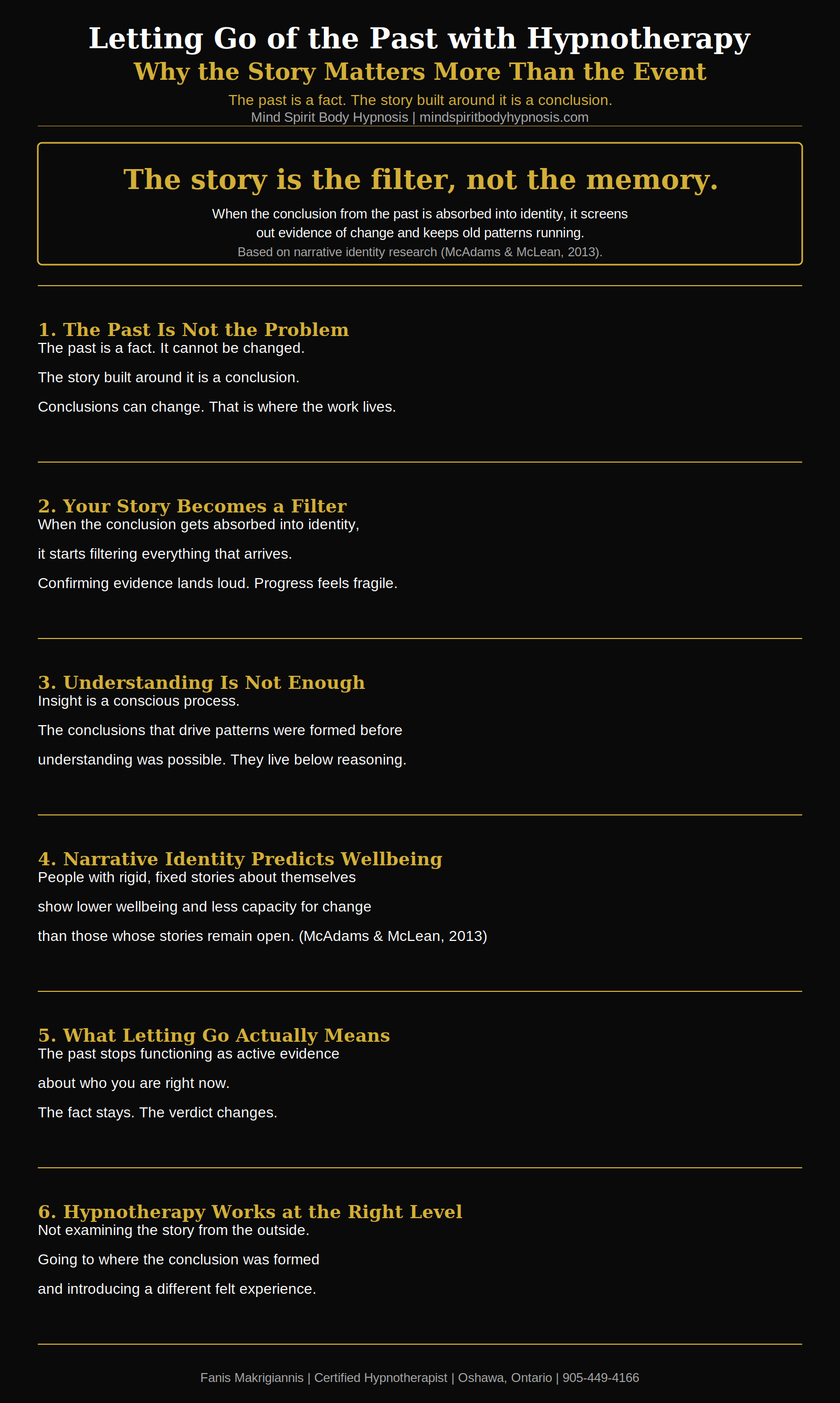
Research on narrative identity shows that the story a person holds about themselves is meaningfully connected to their mental health and wellbeing over time. People whose stories show openness to growth and the ability to find meaning in difficult experiences tend to report better wellbeing and more capacity for change than those with rigid, fixed stories (McAdams & McLean, 2013).
A nine-year longitudinal study found that features of narrative identity predicted trajectories of depression and wellbeing across nearly a decade. The way people narrated their lives was not just a reflection of how they felt. It was a predictor of where they were headed (Lind, Ture, McAdams, & Cowan, 2024).
The honest framing: the research on narrative identity does not directly test hypnotherapy. What it shows is that the story a person holds about themselves has real effects on mental health and change over time, and that those effects persist across years. The mechanism hypnotherapy works with, the subconscious conclusions that shape self-perception, maps closely onto what narrative identity research describes as the internal story that filters experience and resists updating.
The reason letting go of the past with hypnotherapy is worth exploring is not because it promises to erase the past. It is because it works at the level where the story lives, not just at the level where you think about the story.
A Simple Exercise to Try Right Now
This takes about two minutes.
Think of a sentence you use to describe yourself that starts with one of these phrases: "I have always been..." or "I have never been able to..." or "I am just someone who..."
Say the sentence in your head. Notice how certain it feels.
Now ask yourself: Is this a fact, or a conclusion?
Facts are things that happened. Conclusions are what you decided those things meant. "I was not good at school" is a past fact. "I am not someone who learns easily" is a conclusion drawn from that fact, and it has been running ever since.
The sentence that feels most certain is usually the one that has been part of the story the longest. That is useful information. It points directly to the level where the work can happen.
WHAT MY CLIENTS SAY
“A family friend of mine had been seeing Fanis for a few months and would not stop talking about him. I was skeptical but I trusted her completely, so I booked a consultation mostly just to say I tried it. I had been carrying trauma from my childhood for as long as I can remember. I had done some work around it in the past but nothing had really moved it in any meaningful way. What happened with Fanis was different from anything I had experienced before. He was calm, incredibly focused, and seemed to understand exactly what was happening underneath the surface without me having to explain everything ten times over. Within three sessions I noticed something had genuinely changed. Not a temporary lift. An actual shift in how I felt about things that had defined me for decades. I was not expecting results that fast. I am still a little amazed. If someone in your life is telling you to book with Fanis, listen to them. They are not exaggerating. Highly recommended, thank you Fanis!” — Nikhil D.
Frequently Asked Questions
Can you become too attached to your own story? Yes. When a story about yourself becomes fixed, it starts filtering out evidence that contradicts it. Praise feels hollow. Progress feels temporary. Every confirmation of the old story arrives loudly while disconfirming evidence slides past. The person is not choosing to stay stuck. The story is doing it for them, below the level of conscious awareness.
Why does the past keep affecting me even when I understand it? Because understanding is a cognitive process, and the conclusions from the past were formed before understanding was possible. They were formed through felt experience, often in childhood, and they live at a level below reasoning. Understanding the story is different from releasing the part of you that is still living inside it. That is why insight can help and still leave the old feeling in place.
What is the difference between processing the past and letting it go? Processing the past means making sense of what happened, feeling the feelings, and placing the experience in context. This is valuable. Letting go means reaching the point where the conclusions drawn from that experience no longer function as active evidence about who you are today. Processing works with the event. Letting go works with the meaning the event produced.
How does hypnotherapy help with letting go of the past? Hypnotherapy works in a deeply relaxed, receptive state where the subconscious is more accessible. In that state, the conclusions stored below awareness can be worked with directly, not by arguing with them, but by introducing a different felt experience. The nervous system rehearses a new response. Over sessions, that new experience begins to replace the old story at the level where it lives.
Why do I keep repeating old patterns even when I want to change? Because the patterns are being driven by a subconscious conclusion, not by a choice. You cannot choose your way out of a pattern that runs faster than conscious thought. The conclusion that drives the pattern was formed through experience, and it is updated through experience, not through understanding alone. That is the gap hypnotherapy is designed to reach.
Is letting go of the past something I have to do all at once? No. Letting go is not a single event. It is a process that happens in layers. Some things release quickly. Others take more sessions and more time. The most useful frame is not "when will I be done?" but "what is the next layer I am ready to work with?" Each shift is real even when the full process is not complete.
Does letting go mean I have to forgive what happened? Not necessarily. Forgiveness is its own process, and it is not a precondition for letting go. What letting go does require is that you are willing to stop using the past as active evidence about who you are right now. That is a different thing from forgiving the person or situation involved.
How many sessions does it take? It depends entirely on how long the story has been running, how many layers it has, and what specifically needs to change. Some people notice significant shifts in three to five sessions. Others need more. There is no honest fixed number. A strategy session is a good way to get a realistic sense of what your situation involves.
Is hypnotherapy for letting go of the past safe? Yes. Hypnotherapy is a well-established complementary approach. The focused, receptive state it uses is not unconsciousness. You remain aware throughout and can stop at any point. It is not a substitute for medical or psychiatric care, but it is a safe approach for working with the subconscious patterns that keep the past active in the present.
How do I know if my attachment to my story is what is holding me back? A few signs: you have done insight-based work and still find the same feeling returning. You know logically that a belief is not accurate, but it still feels true. Progress feels fragile or temporary, as if you could slip back at any moment. You can explain your patterns clearly but cannot seem to move past them. These are signs the work may need to happen at a deeper level than conscious understanding.
RECOMMENDED READING
Ready to Take the Next Step?
If you recognize the pattern described here and you are ready to work at the level the story actually lives, I would like to help.
I offer a free 30-minute virtual strategy session for new clients across Ontario. No pressure. Just an honest conversation about what is running and whether hypnotherapy or NLP is the right fit for where you are.
Book your free session: calendly.com/mindspiritbodyhypnosis
Call or text: 905-449-4166
Email: info@mindspiritbodyhypnosis.com
Visit: mindspiritbodyhypnosis.com
Serving clients virtually across Ontario, including Durham Region, Toronto, Canada, and beyond.
Disclaimer: This article is for informational purposes only and does not constitute medical or psychological advice. Hypnotherapy and NLP are complementary approaches and are not a substitute for diagnosis or treatment by a qualified healthcare provider. Please consult a licensed professional if you have concerns about your mental or physical health.
Written by Fanis Makrigiannis | Certified Hypnotherapist & NLP Master Practitioner | Mind Spirit Body Hypnosis.