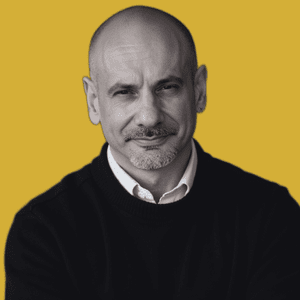
Top hypnosis services near me in Canada
What to Look for When Searching for Top Hypnosis Services Near Me in Canada
TL;DR: Hypnotherapy in Canada is unregulated, which means anyone can use the title. Knowing what separates a qualified, credentialed practitioner from someone who took a weekend course protects you and gets you better results. Mind Spirit Body Hypnosis, run by Fanis Makrigiannis out of Oshawa, Ontario, offers virtual sessions across Canada for clients who want to work with a practitioner trained to a verifiable standard, with a clear method and a track record of client results.
Quick Answer
Top hypnosis services near me in Canada means finding a practitioner with verified credentials, a transparent method, and experience working with your specific concern, not just hypnosis in general. Because hypnotherapy is unregulated across Canada, the title alone means nothing. Fanis Makrigiannis at Mind Spirit Body Hypnosis holds certification through the American Board of Hypnotherapy and the National Guild of Hypnotists, is an ABNLP-certified NLP Master Practitioner, and has worked with clients across Ontario and Canada on anxiety, stress, confidence, habits, sleep, and trauma. Virtual sessions mean location is no longer a barrier to quality care.
Questions This Article Answers
What should I look for when searching for hypnosis services near me in Canada?
Is hypnotherapy regulated in Canada?
How do I know if a hypnotherapist is qualified?
What does Mind Spirit Body Hypnosis offer, and how does it work?
Does virtual hypnotherapy actually work?
How is Fanis Makrigiannis different from other hypnotherapists in Canada?
What conditions does hypnotherapy help with?
In this article:
The search starts simply enough. You type "top hypnosis services near me in Canada," and a list appears. Directories. Profiles. Websites. Some look polished. Some look like they were built in an afternoon. Most tell you very little about what the person actually knows or how they work.
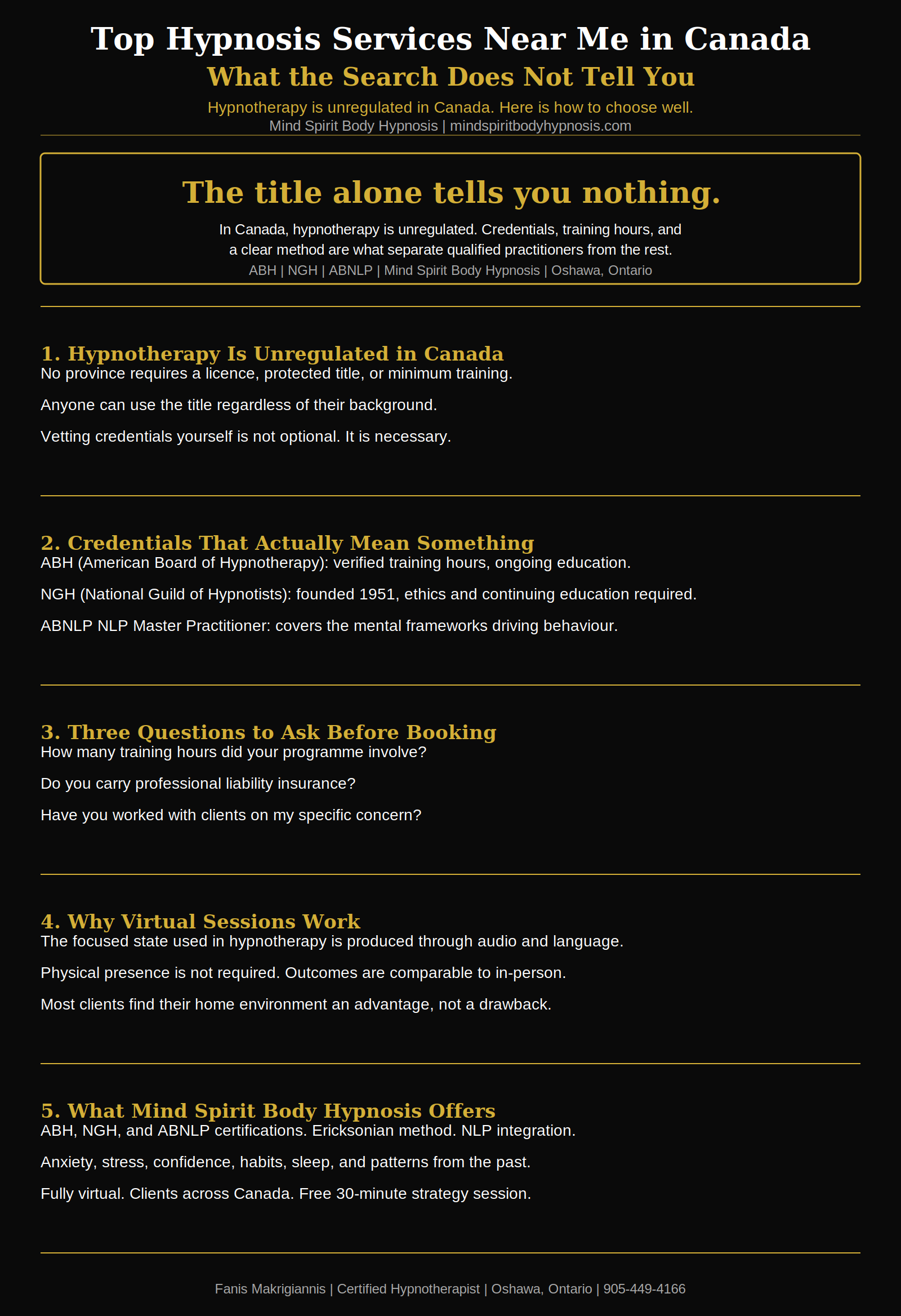
Here is what the search does not tell you: hypnotherapy is unregulated across Canada. In most provinces, including Ontario, anyone can call themselves a hypnotherapist, offer sessions, and charge for them, without any required training, certification, or oversight. That is not a criticism of the field. It is a fact that changes how you need to approach finding someone.
The quality gap between practitioners is wide. On one end are people who completed a weekend course or an online certification with no clinical hours. On the other end are practitioners with hundreds of training hours, multiple certifications from internationally recognized bodies, and years of documented client work. Both can use the same title. The credential does not self-explain. You have to know what to look for.
Why Regulation Matters When Choosing a Hypnotherapist
Hypnotherapy in Canada sits outside the regulated health professions covered by Ontario's Regulated Health Professions Act and its equivalents in other provinces. This means there is no licensing body, no protected title, and no mandatory standard of training. A practitioner is not required to carry insurance, complete continuing education, or have any clinical supervision.
This does not mean hypnotherapy is unsafe or ineffective. Research supports its use for a range of concerns, from anxiety and stress management to sleep and habit change. What it does mean is that the consumer carries more responsibility for vetting who they work with.
The good news is that legitimate credentialing bodies do exist and their standards are clear and verifiable. The American Board of Hypnotherapy (ABH) and the National Guild of Hypnotists (NGH) are two of the most widely recognized internationally. Both require documented training hours, supervised practice, and ongoing education to maintain certification. These credentials do not equal a provincial health licence, but they are real, verifiable standards that distinguish trained practitioners from those who are not.
How hypnosis works
What Credentials Actually Mean
When evaluating top hypnosis services near me in Canada, credentials are the starting point, not the finish line. Here is what each means in practice:
ABH (American Board of Hypnotherapy): Requires completion of a recognized hypnotherapy training programme and ongoing professional development. One of the most widely held credentials among trained practitioners in North America.
NGH (National Guild of Hypnotists): One of the oldest and largest hypnotherapy organizations in the world, founded in 1951. Membership requires training, an ethics agreement, and continuing education.
ABNLP NLP Master Practitioner: Certification through the American Board of Neuro-Linguistic Programming. NLP complements hypnotherapy by working with the language patterns and mental frameworks that drive behaviour.
EMDR Practitioner: Eye Movement Desensitization and Reprocessing, a research-backed approach for processing past experiences. Often integrated with hypnotherapy for clients dealing with earlier experiences that continue to affect the present.
Fanis Makrigiannis at Mind Spirit Body Hypnosis holds all four. His training is not a single certification but a layered set of approaches that work together depending on what the client brings into the session.
My training through the American Board of Hypnotherapy gave me a foundation in clinical hypnosis that goes beyond induction scripts. It covers the subconscious mechanisms behind habit formation, emotional response, and self-perception, which is where most of the work actually happens.
What to Ask Before Booking
Before booking with any hypnotherapy practice in Canada, these questions give you a clear picture of who you are working with:
What certifications do you hold and from which bodies?
How many training hours did your programme involve?
Do you carry professional liability insurance?
Have you worked with clients on my specific concern?
What does a typical session involve, and how many would you expect?
What is your method when hypnotherapy alone is not producing results?
A practitioner who answers these clearly and without defensiveness is a good sign. One who deflects or speaks only in vague outcome promises is not.
A free 30-minute strategy session is a good place to ask these questions. It costs nothing and gives you a real sense of how the person thinks and works before you commit to anything.
How Mind Spirit Body Hypnosis Works
Mind Spirit Body Hypnosis is a virtual practice based in Oshawa, Ontario, serving clients across Canada. Every session is conducted online, which means clients in Toronto, Ottawa, Vancouver, or any city in between can access the same quality of work as someone in Durham Region.
Sessions integrate three approaches depending on what the client needs:
Hypnotherapy works in a relaxed, focused state where the subconscious is more accessible. In that state, the patterns and conclusions driving unwanted behaviour, anxiety, or self-perception can be worked with directly, not just examined from the outside. The subconscious rehearses a new response. Over sessions, that new response becomes the default.
NLP (Neuro-Linguistic Programming) works with the mental frameworks and language patterns that shape how you interpret experience. If the story you tell yourself about a situation is driving the response, NLP addresses the structure of that story, not just the content.
An Ericksonian approach runs through everything. Rather than using direct command-style scripts, the work uses metaphor, indirect suggestion, and the client's own language and imagery. This is gentler, more personalized, and more durable than a one-size approach.
Think of it this way. Most approaches try to change the water in the river. This approach works with the banks, the underlying structure that determines where the water flows. When the banks shift, the river finds a new path on its own. That is what lasting change actually looks and feels like.
For anxiety and stress specifically, hypnotherapy for anxiety and stress explains how the subconscious-level approach addresses what sits underneath the anxious response rather than managing its surface symptoms.
What Clients Come For
The most common concerns clients bring to Mind Spirit Body Hypnosis include:
Anxiety and stress that has not responded to insight-based work alone
Low confidence and self-sabotage patterns that keep repeating
Habits and addictions they have tried to change through willpower
Sleep difficulties driven by an overactive mind
Weight and eating patterns tied to emotional states
Fears and phobias that feel disproportionate but are hard to override
Patterns from the past that continue to show up in the present
Most clients arrive having already tried something. Therapy, journaling, self-help, meditation. They understand their patterns. What they are looking for is a way to reach the level where the pattern actually lives, below the reasoning that has already been applied to it.
Research on hypnotherapy supports its use across several of these areas. A meta-analysis published in the International Journal of Clinical and Experimental Hypnosis found that hypnotherapy produced significant improvements in anxiety across multiple studies, with effects maintained at follow-up (Schnur et al., 2008). For confidence and self-sabotage patterns, hypnotherapy for confidence covers how subconscious belief work addresses the layer below conscious intention. For habits and compulsive patterns, hypnotherapy for habits and addictions explains the mechanism in detail.
Why Virtual Hypnotherapy Works
One of the most common questions new clients ask is whether hypnotherapy works the same way online as it does in person. The short answer is yes, and for most people it works better.
Hypnotherapy does not require physical presence. The focused, receptive state it uses is produced through audio, language, and the client's own internal process. None of that requires being in the same room. What it does require is a quiet space, a comfortable position, and a reliable connection. Most clients have all three at home.
The added advantage of a virtual session is that the client is already in their own environment. There is no travel, no waiting room, and no adjustment period when they get home. The session begins and ends in the same space where the client’s patterns show up in daily life. That continuity matters.
Research on telehealth delivery of psychological interventions consistently shows outcomes comparable to in-person delivery for most conditions, including anxiety and stress (Andersson et al., 2019). Virtual hypnotherapy follows the same principle: the method travels intact.
WHAT MY CLIENTS SAY
“A family friend of mine had been seeing Fanis for a few months and would not stop talking about him. I was skeptical but I trusted her completely, so I booked a consultation mostly just to say I tried it. I had been carrying trauma from my childhood for as long as I can remember. I had done some work around it in the past but nothing had really moved it in any meaningful way. What happened with Fanis was different from anything I had experienced before. He was calm, incredibly focused, and seemed to understand exactly what was happening underneath the surface without me having to explain everything ten times over. Within three sessions I noticed something had genuinely changed. Not a temporary lift. An actual shift in how I felt about things that had defined me for decades. I was not expecting results that fast. I am still a little amazed. If someone in your life is telling you to book with Fanis, listen to them. They are not exaggerating. Highly recommended, thank you Fanis!” — Nikhil D.
Frequently Asked Questions
Is hypnotherapy regulated in Canada? No. Hypnotherapy is not a regulated health profession in any Canadian province. Anyone can use the title and offer sessions without required training or oversight. This makes vetting credentials yourself essential. Look for practitioners certified by internationally recognized bodies such as the ABH or NGH, with documented training hours and professional liability insurance.
How do I know if a hypnotherapist is qualified? Ask directly: what certifications do you hold, from which bodies, and how many training hours did your programme involve? Legitimate certifying bodies like the American Board of Hypnotherapy and the National Guild of Hypnotists have verifiable standards. A practitioner who answers these questions clearly and without deflection is a good sign.
Does virtual hypnotherapy work as well as in-person? Yes. The focused, receptive state used in hypnotherapy is produced through audio and language, not physical proximity. Research on telehealth delivery of psychological approaches consistently shows outcomes comparable to in-person sessions. Most clients find the home environment an advantage, not a drawback.
What is the difference between hypnotherapy and stage hypnosis? Stage hypnosis is entertainment. It uses social compliance and carefully selected participants to produce dramatic public behaviour. Clinical hypnotherapy is a private, focused process aimed at specific outcomes for the individual client. The two share a name and very little else. Clinical hypnotherapy does not make you do things against your will and does not work by making you unconscious. You remain aware throughout.
How many sessions does it typically take? It depends on the concern, how long the pattern has been running, and how many layers it has. Some clients notice significant change in three to five sessions. Others need more. There is no honest fixed number. A strategy session is the right place to get a realistic sense of what your situation involves.
What conditions does hypnotherapy help with? The most well-supported areas include anxiety, stress, phobias, sleep difficulties, habit change, and confidence. Research also supports its use as a complement to other approaches for pain management and nausea. Hypnotherapy is not a treatment for psychiatric conditions and is not a replacement for medical care, but it is a well-established complementary approach for the subconscious patterns that drive many everyday struggles.
What is NLP and how does it work alongside hypnotherapy? NLP stands for Neuro-Linguistic Programming. It works with the mental frameworks and internal language patterns that shape how you interpret and respond to experience. Where hypnotherapy works in the relaxed, receptive state, NLP often works in the ordinary waking state to shift the structure of how you think about a situation. Together they cover more ground than either does alone.
What makes Mind Spirit Body Hypnosis different from other providers? Three things. First, the credentials are layered and verifiable: ABH, NGH, ABNLP NLP Master Practitioner, and EMDR Practitioner. Second, the approach is integrative, drawing on hypnotherapy, NLP, and an Ericksonian framework depending on what the client actually needs, rather than applying one method to every situation. Third, sessions are fully virtual, which means clients across Canada can access the same quality of work without the constraint of geography.
Is hypnotherapy safe? Yes. Clinical hypnotherapy is a safe, well-established complementary approach. The focused state it uses is not unconsciousness. You remain aware and in control throughout. You cannot be made to do or say anything against your values. Hypnotherapy is not a substitute for medical or psychiatric care, but as a complementary approach, it is considered safe for most adults.
How do I get started? A free 30-minute virtual strategy session is the first step. It is a genuine conversation about what you are dealing with and whether hypnotherapy, NLP, or a combination is the right fit. No pressure, no script. Book at calendly.com/mindspiritbodyhypnosis or reach out directly.
RECOMMENDED READING
Ready to Take the Next Step?
If you have been searching for top hypnosis services in Canada and want to work with a practitioner whose credentials are real, whose method is clear, and whose sessions fit into your life wherever you are in the country, I would like to help.
I offer a free 30-minute virtual strategy session for new clients across Canada. No pressure. Just an honest conversation about what you are dealing with and whether this is the right fit.
Book your free session: calendly.com/mindspiritbodyhypnosis
Call or text: 905-449-4166
Email: info@mindspiritbodyhypnosis.com
Visit: mindspiritbodyhypnosis.com
Serving clients virtually across Canada, including Ontario, Durham Region, Toronto, Ottawa, Vancouver, Calgary, and beyond.
Disclaimer: This article is for informational purposes only and does not constitute medical or psychological advice. Hypnotherapy and NLP are complementary approaches and are not a substitute for diagnosis or treatment by a qualified healthcare provider. Please consult a licensed professional if you have concerns about your mental or physical health.
Written by Fanis Makrigiannis | Certified Hypnotherapist & NLP Master Practitioner | Mind Spirit Body Hypnosis.