I feel like a failure
Why Do I Feel Like a Failure? What's Really Going On Beneath the Surface
TL;DR: Feeling like a failure is rarely about a single event. It usually comes from a belief formed long before adulthood that says you are not enough. That belief runs quietly in the background, shaping how you see every mistake, every setback, and every comparison. Hypnotherapy works at the level of that belief, not just the surface thoughts. Fanis Makrigiannis at Mind Spirit Body Hypnosis offers virtual sessions across Ontario for people who are tired of knowing better but still feeling like they fall short.
Quick Answer
Feeling like a failure is a subconscious identity belief, not an accurate summary of your life. It forms through repeated early experiences such as criticism, conditional praise, or high expectations, and it gets reinforced every time something goes wrong. Research on low self-esteem shows that these beliefs sit in a part of the mind that logic and positive thinking rarely reach. Fanis Makrigiannis, a Certified Hypnotherapist and NLP Master Practitioner at Mind Spirit Body Hypnosis in Oshawa, Ontario, works with clients across Ontario to address this belief at its root rather than patch it over at the surface.
Questions This Article Answers
Why do I feel like a failure even when things are going well?
Is feeling like a failure a thought or something deeper?
Can hypnotherapy help when I feel like a failure?
What causes the belief that I am not enough?
How is hypnotherapy for failure feelings different from therapy or self-help?
Will positive thinking fix the way I feel about myself?
In this article:
People often come to me after years of trying to think their way out of it. They have read the books. They have made the lists. They can tell you, logically, that they are not actually a failure. And yet the feeling is still there when they wake up in the morning, still there when a project doesn't land the way they hoped, still there when they scroll past someone else's highlight reel.
That gap between what you know and what you feel is not a willpower problem. It is a sign that the belief lives somewhere logic does not easily reach.
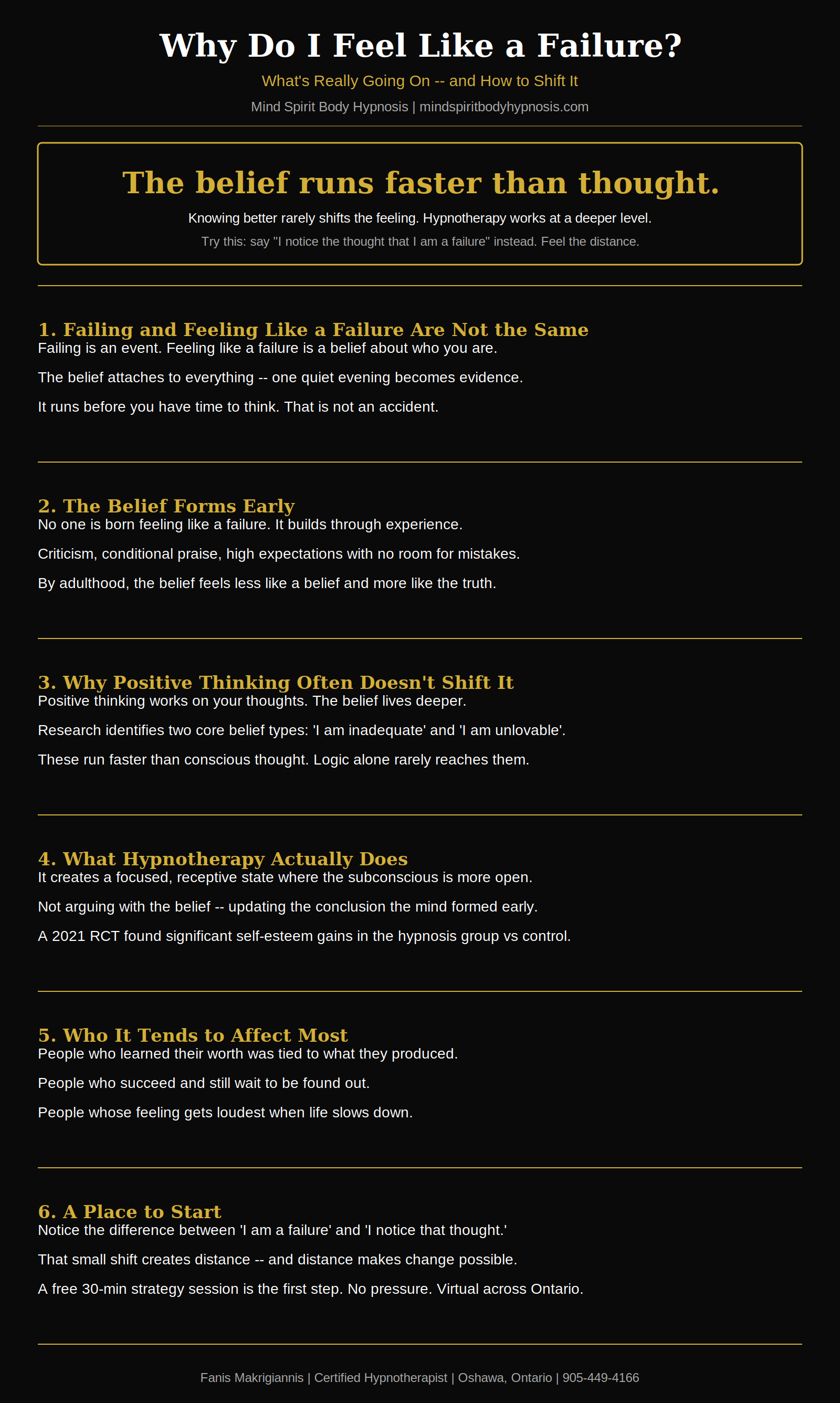
The Difference Between Failing and Feeling Like a Failure
Failing at something is an event. A project falls short. A relationship ends. A goal gets missed. Those things happen to everyone.
Feeling like a failure is different. It is a conclusion about who you are, not what happened. And it tends to attach itself to everything. One critical email becomes evidence. One quiet night at home becomes proof. The mind is not collecting data anymore. It is confirming a story it already believes.
A 2023 paper in Behavioural and Cognitive Psychotherapy described two core belief domains that sit at the root of low self-esteem. One is personal adequacy, the quiet but persistent sense that you are incompetent or insufficient. The other is social connection, the feeling that you are fundamentally unlovable or that others will inevitably reject you. Most people who feel like a failure carry one or both. And crucially, the paper noted that these beliefs are not conclusions drawn from careful observation. They are patterns formed earlier in life that the mind has been confirming ever since (Waite & Creswell, 2023).
In my practice, clients often describe it as a feeling that arrives before they have had time to think. That is not a coincidence. Beliefs that form early and get reinforced often do operate faster than conscious thought.
Where the Belief Comes From
No one is born feeling like a failure. The belief forms through experience, and often through experiences that had nothing to do with performance.
Criticism delivered without warmth. Praise that only came when expectations were met. A parent whose love felt conditional on achievement. A school environment where comparison was constant. These are not catastrophic events on their own. But repeated often enough, they leave behind a rule: that your value depends on what you produce, and that the bar is always just a little higher than where you are.
People also absorb these beliefs through observation. A parent who constantly described themselves as a failure, who never seemed to trust their own decisions, passes that template on without meaning to.
What makes these beliefs hard to shift is their timing. They form before the critical mind is fully online, before you had the tools to question them. By the time you are an adult, they feel less like a belief and more like the truth.
The everyday version of this looks like a client who gets promoted and spends the next three months waiting to be found out. Or someone who receives a genuine compliment and immediately wonders what the other person actually wants. The achievement goes in one ear. The belief filters it before it can land.
Why Advice and Willpower Rarely Fix It
The most common advice for feeling like a failure is to reframe your thinking. Write down three things you did well today. Challenge your inner critic. Look for evidence that contradicts the belief.
These approaches are genuinely useful for managing the surface experience. They can reduce the sharpness of the thought and interrupt the spiral in the moment. But they work at the level of the thought, not the belief beneath it. And a belief is not a thought. It is a conclusion the subconscious mind has already accepted as true.
Imagine trying to convince someone afraid of dogs by listing statistics about bite rates. The information is accurate. But the fear is not living in the part of the mind that processes statistics. It lives somewhere older and faster. The same is true for the belief that you are not enough.
This is one of the reasons I see people who are highly educated, articulate, and capable, and who still cannot shake the feeling. They are applying the right tools to the wrong layer. There is nothing wrong with their thinking. The problem is that thinking is not where the belief lives.
If you have found yourself in that gap, looking at the evidence for why you are actually doing fine and still feeling like you are falling short, you may find it useful to look at hypnotherapy for confidence and self-sabotage as a different kind of entry point.
The psychology of failure.
What Hypnotherapy Actually Does
Hypnotherapy works by creating a state of focused, relaxed attention where the critical mind steps back and the subconscious becomes more open to change. In that state, the belief that says "I am a failure" can be examined and revised, not argued with, but gently updated.
Think of the belief as a record that has been playing the same track for decades. The music has become so familiar that it sounds like background noise. Hypnotherapy does not try to argue with the record. It works with the part of the mind that set it playing in the first place.
In a session, I am not feeding you positive affirmations to repeat. We are working to understand the original experience that formed the belief, reduce its emotional charge, and introduce a more accurate way for your subconscious to interpret who you are and what you are capable of.
A 2021 randomized controlled trial published in Quality of Life Research found that a group intervention combining self-hypnosis and self-care produced a significant improvement in self-esteem scores compared to a wait-list control group. In the hypnosis group, self-esteem rose meaningfully within the study period, while the control group showed no significant change. The authors noted that improvements in mindfulness accounted for about a third of the self-esteem gains, suggesting that the quality of attention, which hypnotherapy directly trains, plays a key role in how we see ourselves (Bouchez et al., 2021).
If the feeling of failure comes attached to anxiety, which it often does, a session may also draw on approaches from hypnotherapy for anxiety and stress. The two are frequently tied together. The belief that you are not enough tends to produce a constant low-level vigilance that looks a lot like generalized anxiety.
Who This Tends to Affect Most
The feeling of failure is not evenly distributed. It tends to run deepest in people who were taught, explicitly or otherwise, that their worth was conditional.
People who grew up in high-expectation environments where good was never quite enough. People who were praised for outcomes but not for effort or character. People who learned early that love or approval could be withdrawn if performance slipped.
It also shows up in people who have never had a single dramatic failure but who carry a constant, nagging sense that they are behind, that they should be further along, that everyone else has somehow figured something out that they have missed.
Clients often tell me that the feeling gets louder when things slow down. When the busyness stops and the room goes quiet, the thought arrives. That is not coincidence. Busyness is one of the most effective short-term strategies for not having to hear the belief. The moment life slows, it speaks.
If this connects with patterns of avoidance, procrastination, or self-defeating behaviour, it may also be worth reading about hypnotherapy for habits and self-sabotage. The two often feed each other in ways that are easier to see from the outside than from within.
What a Session Looks Like
Before any hypnosis work begins, we spend time in conversation. I want to understand where the feeling shows up most, what it sounds like, and what early experiences may have helped form it.
The hypnotic induction itself is simple. You are seated or lying comfortably. I guide your attention inward with a slow, deliberate sequence of language and suggestion. You stay aware throughout. There is no loss of control, no stage-show theatrics, and no moment where I am telling you what to think.
The change happens in the quality of receptivity. In that state, the subconscious is more willing to try a different interpretation on for size. Over sessions, those new interpretations begin to feel more natural than the old ones.
Most clients describe leaving a session feeling calmer than they expected. The belief does not vanish after one session. But the charge attached to it often begins to soften.
A free 30-minute strategy session is available if you want to talk through whether this approach is the right fit before committing to anything. There is no pressure, and no script. Just an honest conversation.
A Simple Exercise to Try Right Now
This is not a cure. But it is a way to begin practising the difference between observing a thought and being owned by it.
The next time the feeling arrives, try this: instead of saying "I am a failure," say "I am noticing the thought that I am a failure."
That one shift in language creates a small but real distance. You are no longer inside the belief. You are watching it. And from that position, it is possible, very gradually, to begin asking whether it is actually true.
WHAT MY CLIENTS SAY
“I really couldn’t recommend Fanis more highly. He helped me push through barriers I didn’t even realize were there. He’s incredibly down to earth, patient, and makes you feel completely at ease while working with you. The experience has made such a meaningful difference for me. You truly couldn’t be in better hands. Highly recommend!”— Daniela G.
FREQUENTLY ASKED QUESTIONS
Can hypnotherapy actually change how I feel about myself? Research suggests it can, particularly for beliefs rooted in early experience. Hypnotherapy works at a subconscious level, which is where most core beliefs about self-worth operate. A 2021 clinical trial found significant self-esteem improvement in participants who completed a hypnosis-based intervention, compared to a control group that saw no meaningful change.
Is feeling like a failure the same as depression? Not necessarily, but they are often related. Persistent feelings of inadequacy and worthlessness can be symptoms of depression. If you are experiencing low mood, loss of motivation, or thoughts of hopelessness alongside the feeling of failure, it is worth speaking with your doctor or a mental health professional. Hypnotherapy can complement professional mental health care, but it is not a substitute for clinical assessment.
Why do I feel like a failure even when I am succeeding? This is one of the most common patterns, and it usually means the belief is about identity rather than outcomes. Success does not automatically update a subconscious belief that says you are not enough. The belief is not checking your performance. It runs independently of what is actually happening in your life.
How is hypnotherapy different from just talking to a therapist? Therapy, particularly cognitive approaches, tends to work with thoughts at the conscious level. Hypnotherapy works in a different register by targeting the subconscious layer where core beliefs operate. Many people find that combining the two produces results neither achieves alone. In Ontario, hypnotherapy is considered a complementary approach, not a clinical treatment.
How many sessions will it take? There is no fixed number, because the answer depends on how long the belief has been in place and how many experiences have reinforced it. Most people notice a meaningful shift within three to five sessions. Some notice something after the first. Changes that come from subconscious work tend to hold, because they do not require ongoing effort to maintain.
I have tried positive thinking, and it doesn't work. Why would hypnotherapy be different? Positive thinking operates at the conscious level. It can interrupt a thought, but it rarely changes the belief beneath it. Hypnotherapy works with the subconscious directly, which is where the belief was formed and where it continues to run. The difference is the depth of access, not the quality of the intervention.
Do I have to talk about everything that happened in my childhood? No. You share whatever feels relevant and comfortable. We work together at a pace you set. Some people find it helpful to trace the origin of the belief. Others prefer to focus on the present feeling and how to shift it. Both approaches can be effective.
Is hypnotherapy safe? Yes. Hypnotherapy is a well-researched complementary approach with a strong safety profile. You remain aware and in control throughout. You cannot be made to say or do anything against your values. Sessions are conducted virtually across Ontario, with no travel required.
What if I don't think I can be hypnotized? Most people can. The state of focused relaxation that hypnotherapy uses is a natural one that most people move in and out of throughout the day. The idea that only certain people can be hypnotized usually comes from stage hypnosis, which uses a very different context and selection process. In a clinical session, I set the pace to suit you.
How do I know if this is the right approach for me? The free 30-minute strategy session is the best way to find out. We talk about what you are experiencing, what you have tried, and whether hypnotherapy is a good fit. There is no obligation, and it is virtual, so you can join from anywhere in Ontario.
RECOMMENDED READING
Ready to Take the Next Step?
If failure has become part of how you see yourself, and the usual advice hasn't shifted it, I would like to help.
I offer a free 30-minute virtual strategy session for new clients across Ontario. There's no pressure. Just a conversation about what you are going through and how hypnotherapy, NLP, or a related approach might support you.
Book your free session: calendly.com/mindspiritbodyhypnosis
Call or text: 905-449-4166
Email: info@mindspiritbodyhypnosis.com
Visit: mindspiritbodyhypnosis.com
Serving clients virtually across Ontario, including Durham Region, Toronto, Canada, and beyond.
Disclaimer: This article is for informational purposes only and does not constitute medical or psychological advice. Hypnotherapy, NLP, and related approaches are complementary and are not a substitute for diagnosis or treatment by a qualified healthcare provider. Please consult a licensed professional if you have concerns about your mental or physical health.
Written by Fanis Makrigiannis | Certified Hypnotherapist & NLP Master Practitioner | Mind Spirit Body Hypnosis.