What is the difference between Hypnotherapy and CBT?
Hypnotherapy vs CBT: What's the Difference and Which One Might Help You?
TL;DR: CBT and hypnotherapy both have research support, but they work at different levels. CBT targets the thoughts you are aware of. Hypnotherapy works with the patterns that sit beneath conscious thought. For many people, one approach reaches what the other misses. Fanis Makrigiannis at Mind Spirit Body Hypnosis offers virtual hypnotherapy sessions across Ontario for people who want to understand their options before deciding.
Quick Answer
Hypnotherapy vs CBT is not a question of which is better; it is a question of where the problem lives. CBT (cognitive behavioural therapy) works by identifying and changing unhelpful thought patterns at a conscious level. Hypnotherapy works in a focused, receptive state where subconscious patterns can be updated directly. A 2021 randomized controlled trial published in the Journal of Affective Disorders found hypnotherapy non-inferior to CBT for mild to moderate depression, suggesting the two approaches produce comparable outcomes through different routes. Fanis Makrigiannis, a Certified Hypnotherapist and NLP Master Practitioner at Mind Spirit Body Hypnosis in Oshawa, Ontario, works with clients across Ontario who have often already tried one approach and are looking for what comes next.
Questions This Article Answers
What is the difference between hypnotherapy and CBT?
Is hypnotherapy as effective as CBT?
Which approach is better for anxiety, depression, or trauma?
Can hypnotherapy and CBT be used together?
What happens in each type of session?
How do I know which one is right for me?
In this article:
A lot of people come to me after a few years of CBT. They are not coming because CBT failed them. Most say it helped. They learned to catch the thoughts, question them, replace them. And for a while, that was enough.
But then they describe a moment, usually something small, a comment from a colleague, a quiet Sunday evening, a look from someone they love, where the old feeling just arrives. Before the thought. Faster than any technique they learned. And they find themselves wondering whether there is a level the work hasn't reached yet.
That is usually the right question.
What CBT Does and How It Works
CBT is one of the most researched psychological approaches available. It is based on the idea that how you think affects how you feel and how you act. If you can identify the thoughts that are driving distress and examine them clearly, you can begin to change the patterns.
In practice, a CBT session involves talking. You and the therapist work through specific situations, identify automatic thoughts, test whether those thoughts are accurate, and practise replacing unhelpful patterns with more balanced ones. You are given tools to use between sessions. Over time, the new patterns become more habitual.
CBT is effective. The evidence base is substantial. It works particularly well when the problem is clear, the thoughts are accessible, and the person is able to step back from their own mind far enough to examine it.
Where CBT can be limited is in situations where the pattern runs faster than thought. When someone knows, logically, that a situation is not dangerous but their body still responds as if it is. When a belief about themselves feels less like a thought and more like the truth. That is not a failure of CBT. It is a sign that the pattern may live at a level below what conscious examination can easily reach.
What Hypnotherapy Does and How It Works
Hypnotherapy produces a focused, deeply relaxed state in which the mind becomes more open to change. In that state, the subconscious, the part that runs habits, emotions, and automatic responses, is more accessible.
Rather than examining thoughts from the outside, hypnotherapy works from the inside. It does not argue with a belief. It creates conditions where the belief can be updated at the level it was formed.
Think of it this way. If a belief about yourself is like a record that has been playing the same track for twenty years, CBT helps you notice the track is playing and choose to listen to something else. Hypnotherapy goes to the player itself and begins to change what is on the record.
In a session, I guide a client into a relaxed, focused state using language, pacing, and imagery. In that state, we work with the pattern directly, not by talking about it analytically, but by introducing a different felt experience. The nervous system rehearses a new response. Over sessions, that response becomes the default.
My training through the American Board of Hypnotherapy and the National Guild of Hypnotists covers both the clinical application of hypnosis and the NLP frameworks that complement it. In sessions with clients in Ontario, I most often see the deepest shifts happen when people stop trying to reason with the pattern and begin working at the level the pattern actually lives.
If anxiety is part of what you are dealing with, hypnotherapy for anxiety and stress covers how this works in more detail for that specific presentation.
Making sense of CBT
How the Two Approaches Compare
The clearest way to understand hypnotherapy vs CBT is to look at where each approach operates:
CBT works at the level of conscious thought, identifying, examining, and replacing patterns you can articulate and observe from the outside.
Hypnotherapy works at the level of subconscious patterns, updating responses, beliefs, and emotional associations that run below the threshold of ordinary awareness.
CBT tends to involve structured homework between sessions and a focus on building conscious skills the person can use independently.
Hypnotherapy tends to involve less homework and more direct change in session, with the work consolidating between appointments.
CBT is usually a longer process, typically 12 to 20 sessions for a full course of treatment.
Hypnotherapy often produces noticeable change in fewer sessions, though the number depends entirely on the individual and what is being addressed.
Both require engagement and willingness from the client. Neither is passive.
Neither approach is universally superior. They operate differently and suit different situations, which is why comparing them as if one must win is not especially useful.
What the Research Says
The research on hypnotherapy vs CBT has grown considerably over the past two decades.
A 2021 randomized controlled trial by Fuhr and colleagues, published in the Journal of Affective Disorders, compared hypnotherapy directly with CBT for mild to moderate depression. The trial found hypnotherapy non-inferior to CBT, meaning the two approaches produced statistically comparable outcomes. This is notable because it is one of the first high-quality direct comparison trials, and it challenges the assumption that CBT should be the automatic first recommendation (Fuhr et al., 2021).
A 2024 systematic review on medRxiv that examined six randomized trials of hypnotherapy for major depressive disorder found that two of those trials compared hypnotherapy directly with CBT, with both finding no significant difference in outcomes between the two approaches. The authors noted methodological limitations across studies and called for larger, more standardized trials. What they did not find was evidence that CBT outperformed hypnotherapy.
Earlier work by Kirsch, Montgomery and Sapirstein examined what happens when hypnosis is added to CBT rather than used instead of it. Across the studies they analyzed, patients receiving hypnosis-augmented CBT showed meaningfully better outcomes than those receiving CBT alone, though that finding has been revisited and debated in the literature since (Kirsch et al., 1995, via NIH Bookshelf).
The honest summary: CBT has more research behind it because it has been studied for longer. Hypnotherapy has a smaller but growing body of evidence, and the direct comparison studies that exist do not show CBT to be more effective. They show the two approaches producing comparable results through different mechanisms.
A free 30-minute strategy session is available if you want to talk through which approach makes sense for your situation. No commitment. Just a real conversation.
Which Conditions Each Tends to Suit
Some situations tend to respond well to one approach over the other, though there is real overlap.
CBT tends to work well for:
Situations where the person has clear, identifiable thought patterns they can work with consciously
Phobias with an obvious cognitive component (e.g., fear of flying, health anxiety with repetitive thought cycles)
OCD where structured exposure and response prevention is central to the treatment
People who prefer an active, skills-based approach with measurable progress between sessions
Hypnotherapy tends to work well for:
Patterns that feel automatic or physical, anxiety that arrives before any thought, habits that persist despite genuine intention to change
Identity-level beliefs ("I am not enough", "I am not safe") that have not shifted through conscious examination alone
Sleep difficulties, where the mind needs to relearn how to hand over control
Trauma where the body holds the response in a way that talk-based work does not fully reach
People who have done talk therapy and found that understanding the pattern did not change it
If trauma is part of what you are working through, hypnotherapy for trauma explains how a subconscious-focused approach can reach what talk therapy sometimes cannot.
Can They Work Together?
Yes, and there is research supporting this. The Kirsch et al. work mentioned above looked specifically at what happens when hypnosis is added to a CBT framework, and found that the combination outperformed CBT alone in the studies examined.
In practice, the approaches are not mutually exclusive. Many people work with a CBT therapist and a hypnotherapist at the same time, using each for what it does best. The conscious skill-building of CBT and the subconscious pattern-updating of hypnotherapy can address different layers of the same problem.
Some practitioners work with both modalities in an integrated way. In my own sessions, I draw on both NLP frameworks and hypnotherapy, which allows work at both the conscious and subconscious level within the same appointment. If confidence or self-sabotage is part of what you are working through, hypnotherapy for confidence and self-sabotage covers this in more detail.
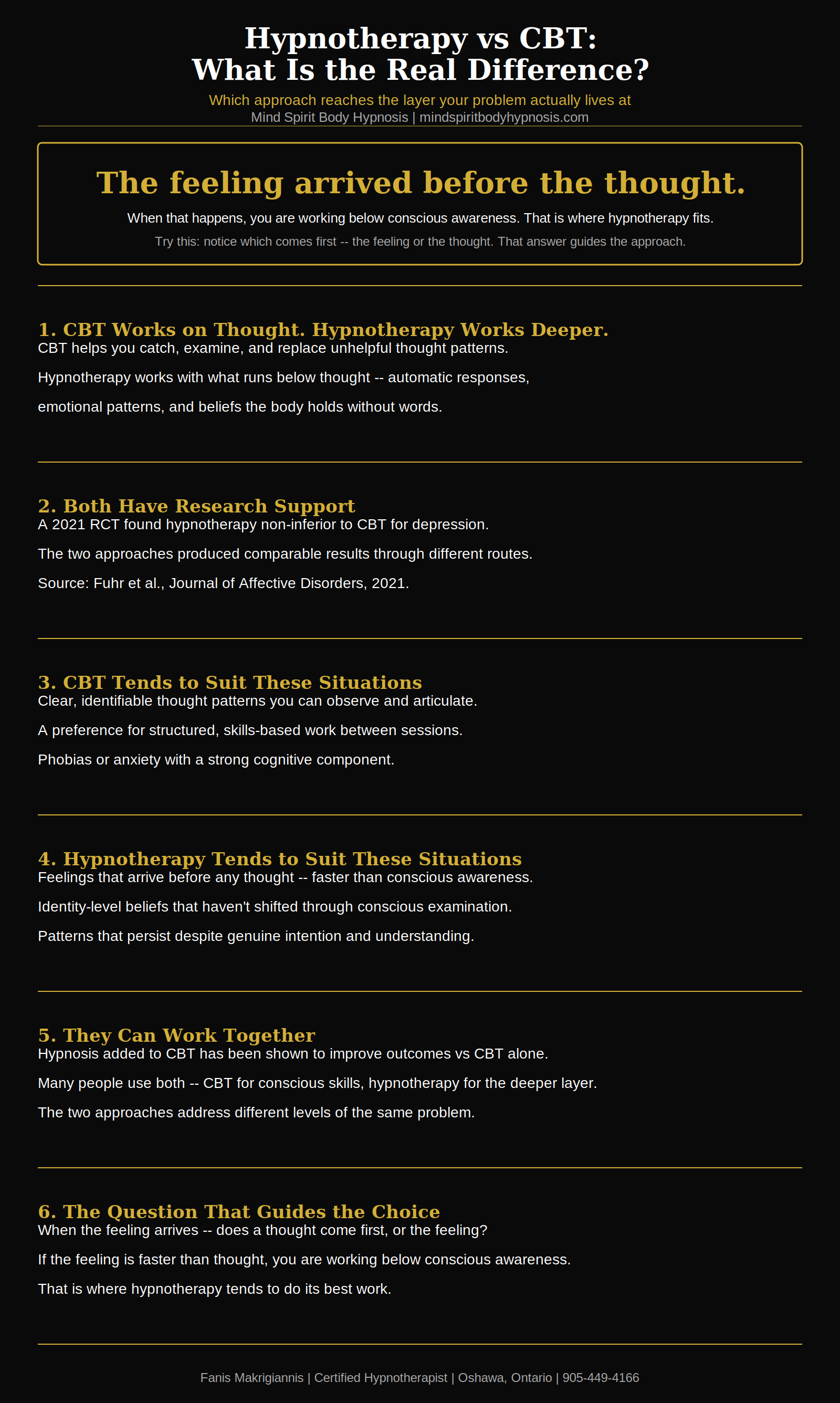
A Simple Exercise to Try Right Now
This takes about two minutes and helps you notice whether a pattern you are carrying is a thought or something that runs deeper.
Think of a situation that produces a feeling you want to change: anxiety before a meeting, a familiar sense of not being good enough, the urge to avoid something you know you should face.
Now ask yourself: when the feeling arrives, does a thought come first? Or does the feeling arrive before any words appear?
If a thought comes first and you can observe it from a distance, CBT-style work is likely to be useful. If the feeling arrives before thought, if the body responds before the mind has registered anything, you are working with something that lives below the conscious level. That is where hypnotherapy tends to do its best work.
Neither answer is better. Both offer useful starting points.
WHAT MY CLIENTS SAY
“My cousin told me about Fanis. Short version: she was right. I came in carrying years of complex trauma. The kind that does not have one clean origin story, just layers of things that built up over time and quietly shaped how I moved through the world. I had done therapy on and off and it helped me understand things, but understanding something and actually being free of it are two very different experiences. Fanis works at a level I had never accessed before. He is precise, unhurried, and completely present in a way that makes the whole process feel safe from the very first session. The pace of results genuinely surprised me. By session four I could feel something that had been there my entire adult life simply was not there anymore. I cannot explain the mechanism but I can describe the outcome. I feel lighter. I respond differently. Things that used to hijack me just do not anymore. Highly recommended. Do not wait as long as I did.” — Idi A.
Frequently Asked Questions
Is hypnotherapy better than CBT? Neither is universally better. They work at different levels. CBT targets conscious thought patterns. Hypnotherapy works with subconscious responses. A 2021 randomized controlled trial found hypnotherapy non-inferior to CBT for depression, meaning the two produced comparable results. The right choice depends on the person and what they are dealing with.
Can I do hypnotherapy if I have already done CBT? Yes, and many people find hypnotherapy most useful after CBT. If you have done the cognitive work and still find the pattern running, hypnotherapy addresses the level CBT may not have reached. The two approaches can also be used at the same time with different practitioners.
How many sessions of hypnotherapy do I need compared to CBT? CBT courses are typically 12 to 20 sessions. Hypnotherapy tends to work in fewer sessions, though the number depends entirely on what is being addressed. Some people notice significant change in three to five sessions. Others need more. There is no honest fixed answer.
Will I be unconscious during a hypnotherapy session? No. You remain aware throughout. Hypnotherapy produces a focused, deeply relaxed state, not unconsciousness. Most people describe it as feeling like very deliberate rest with their attention still present. You can speak, respond, and stop at any point.
Is hypnotherapy evidence-based? Yes. The evidence base is smaller than CBT's, which has been studied for longer, but it is growing. Direct comparison trials have found hypnotherapy non-inferior to CBT for depression. Research on hypnotherapy for anxiety, stress, and sleep disorders is also well-established.
Does hypnotherapy work if I am sceptical? Scepticism does not prevent hypnotherapy from working. What matters is willingness to engage with the process. Many people who come to sessions are sceptical and still experience significant change. The approach does not require belief, it requires a degree of openness and relaxation.
What if I cannot be hypnotized? Most people can reach a useful hypnotic state. Hypnotizability exists on a spectrum, but the focused, relaxed state used in clinical hypnotherapy is accessible to the majority of people. It does not require deep trance. A first session will tell you more about how you personally respond.
Is hypnotherapy available virtually? Yes. I offer virtual hypnotherapy sessions across Ontario via secure video. Virtual sessions are as effective as in-person for most presentations. Many clients find the home environment actually supports deeper relaxation.
How do I choose between hypnotherapy and CBT? Consider where the pattern lives. If you can observe and articulate your thoughts, CBT is a strong starting point. If the feeling arrives before thought, or if CBT has helped partially but something still runs underneath, hypnotherapy is worth exploring. A free strategy session is a good way to talk through what fits your situation.
Is hypnotherapy covered by insurance in Ontario? Coverage varies by plan. Some extended health plans in Ontario include hypnotherapy from a certified practitioner. Check your specific policy. Sessions at Mind Spirit Body Hypnosis are virtual, so there is no travel cost to factor in.
RECOMMENDED READING
Ready to Take the Next Step?
If you are trying to figure out whether hypnotherapy or CBT is the right fit, or if you have already done CBT and want to explore what comes next, I would like to help.
I offer a free 30-minute virtual strategy session for new clients across Ontario. No pressure. Just an honest conversation about where you are and what might actually help.
Book your free session: calendly.com/mindspiritbodyhypnosis
Call or text: 905-449-4166
Email: info@mindspiritbodyhypnosis.com
Visit: mindspiritbodyhypnosis.com
Serving clients virtually across Ontario, including Durham Region, Toronto, Canada, and beyond.
Disclaimer: This article is for informational purposes only and does not constitute medical or psychological advice. Hypnotherapy and NLP are complementary approaches and are not a substitute for diagnosis or treatment by a qualified healthcare provider. Please consult a licensed professional if you have concerns about your mental or physical health.
Written by Fanis Makrigiannis | Certified Hypnotherapist & NLP Master Practitioner | Mind Spirit Body Hypnosis.