Why do I compare myself to others?
Why Do I Compare Myself to Others, and Why Is It So Hard to Stop?
TL;DR: Comparing yourself to others is not a flaw in your character. It is a built-in human drive that psychologists have studied since 1954. The problem is not the comparison itself. It is the belief underneath it that makes the comparison feel like a verdict. Until that belief changes, the comparison keeps hurting regardless of what you achieve. Fanis Makrigiannis at Mind Spirit Body Hypnosis offers virtual sessions across Ontario for people who want to work on this at the level it actually lives.
Quick Answer
Why do I compare myself to others? The short answer is that your brain is built to do it. Psychologist Leon Festinger identified this in 1954, calling it social comparison theory: people evaluate their own abilities and worth by measuring themselves against others, especially when there is no objective standard to use instead. But the reason it feels painful for some people and not others is not the comparison itself. It is the belief already in place about what the comparison means. Fanis Makrigiannis, a Certified Hypnotherapist and NLP Master Practitioner at Mind Spirit Body Hypnosis in Oshawa, Ontario, works with clients across Ontario who find that the comparing never fully stops, even when life is going well.
Questions This Article Answers
Why do I compare myself to others even when I don't want to?
Is social comparison normal or a sign something is wrong?
Why does comparing myself to others make me feel so bad?
Why can't I just stop comparing myself to others?
What is the difference between upward and downward comparison?
Can hypnotherapy help with constant comparison and low self-worth?
In this article:
I hear a version of the same thing fairly often. Someone has done well by most measures. Good work, good relationships, a life that looks fine from the outside. And yet they sit across from me and describe checking someone's LinkedIn at 11pm, or feeling a particular kind of hollow after scrolling through photos of a colleague's holiday.
They are not asking why they did it. They know they did it. What they cannot figure out is why it still hurts.
That question is the right one.
Where the Drive to Compare Comes From
Comparing yourself to others is not a weakness. It is a feature of human cognition that has been documented for decades.
In 1954, psychologist Leon Festinger proposed what he called social comparison theory. His argument was that humans have a basic drive to evaluate their own opinions and abilities. When there is no objective way to measure something, people look to other people instead. How am I doing? Who else is doing this? Where do I sit relative to them? These are questions the mind asks automatically, without permission (Festinger, 1954).
The drive runs toward people who are similar to us. You are more likely to measure yourself against a peer at work than against a billionaire, and more likely to notice a friend's relationship than a stranger's. Closeness makes the comparison feel relevant. And relevant comparisons land harder.
This is not a modern problem created by social media. It is older than the internet by a very long time. Social media did not invent the comparison. It just made it faster, more frequent, and curated to show you only the version of someone else's life that feels most like a gap in your own.
Why Comparison Hurts Some People More Than Others
Here is the part most articles skip.
The comparison itself is not what hurts. What hurts is what the comparison activates.
If you see a colleague get promoted and feel a flash of envy, that is one thing. If you see the same colleague get promoted and feel a wave of shame about your own worth, your career, your choices, your basic adequacy as a person, that is something different. The event is the same. The response is different because the beliefs underneath are different.
Clients I work with in Ontario often describe comparison as something that arrives before they have time to stop it. The scroll, the check, the assessment. But what follows is not just "they have more than me." It is, "and that proves something about me." The comparison becomes evidence for a belief that was already there.
The belief is usually something like: I am not enough. Or: I am falling behind. Or: Other people have figured it out, and I have not. These are not thoughts that arrived with the comparison. They are conclusions formed long before, usually in childhood, that sit below ordinary awareness and wait for a confirming event.
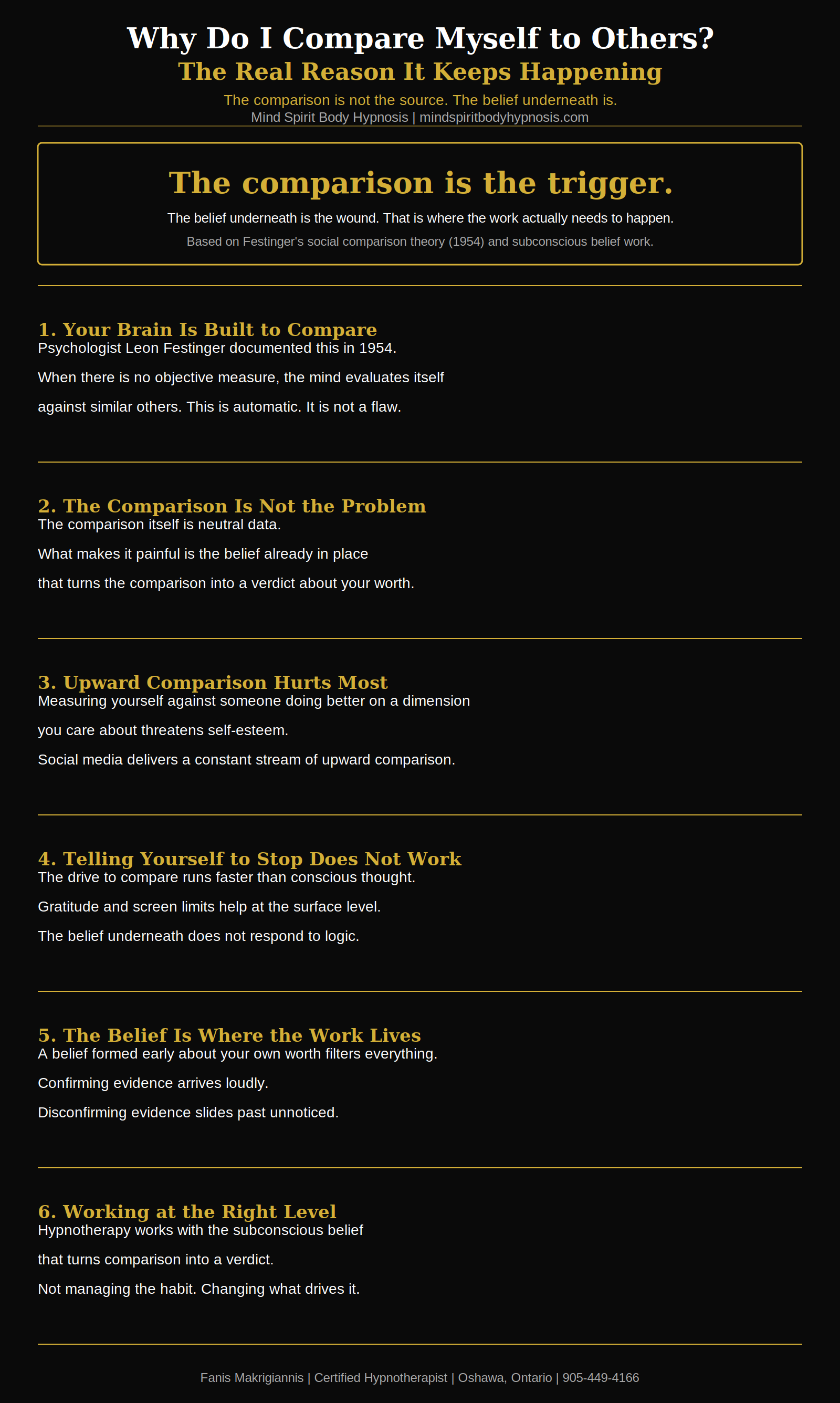
The comparison is the trigger. The belief is the wound.
Stop comparing yourself to others.
Upward and Downward Comparison
Psychologists describe two directions of social comparison.
Upward comparison is when you measure yourself against someone you perceive as doing better. A friend's relationship, a colleague's salary, a stranger's body. Upward comparison often produces motivation when the gap feels closeable, and pain when it does not.
Downward comparison is when you measure yourself against someone you perceive as doing worse. This can produce a temporary boost to self-esteem, though it tends to fade quickly and can produce guilt in people who are aware of what they are doing.
Research suggests that upward comparison is the default in modern life. Social platforms are structured around success, milestones, and highlights. That means the comparison engine gets fed a steady stream of upward material, without the context, the setbacks, or the ordinary days that make anyone's life actually look like a life.
What matters is not just the direction. It is whether the comparison is against a dimension you care about. A 2022 chapter drawing on Festinger's original framework notes that comparisons on irrelevant dimensions can produce admiration, while comparisons on dimensions we care deeply about are the ones that threaten self-esteem (Sanchez, 2022, Thomas Edison State University).
In other words, if you compare yourself to someone else's marathon time and you do not care about running, it means little. If you compare your career to a peer's and career is central to how you see yourself, the comparison does not just land. It cuts.
The Belief Underneath the Comparison
Think of it this way. Your sense of your own worth is like a container. When the container feels full, you can hear about someone else's success and feel genuinely pleased for them. When the container feels uncertain or partially empty, every comparison is a question: how much do I have left?
The container does not get filled by achievement. A new job, a new relationship, a number on a scale. These add something temporarily, but if the underlying belief is that you are not quite enough, each gain needs defending. Each comparison threatens to undo it.
That is why telling yourself to stop comparing does not work. The comparing is not the source of the problem. It is a symptom of how the belief underneath answers the question: am I okay?
My training through the American Board of Hypnotherapy covers the ways subconscious beliefs form and how they operate. A belief formed at seven years old that you were somehow less than a sibling, or less capable than a classmate, does not disappear when you become an adult and start achieving things. It moves below awareness and filters incoming information. Confirming evidence arrives loudly. Disconfirming evidence slides past.
Hypnotherapy works at this level. Not by teaching you to catch the comparison and replace it with a positive thought, but by working with the belief that makes the comparison feel like a verdict in the first place. If you are dealing with low confidence or self-sabotage alongside the comparison, hypnotherapy for confidence and self-sabotage covers this in more detail.
A free 30-minute strategy session is available if you want to talk through what you are experiencing and whether this approach suits your situation.
Why Telling Yourself to Stop Does Not Work
Most advice about social comparison is practical. Limit your screen time. Practise gratitude. Remember you are seeing someone else's highlight reel. Focus on your own journey.
These ideas are not wrong. But they operate at the level of thought. They ask the conscious mind to manage something that runs faster than thought.
If the drive to compare were purely a habit of thinking, cognitive approaches would resolve it fully. For many people, they help somewhat and then plateau. The scroll still happens. The check still comes. The feeling still arrives.
That is because the real engine is not a thought. It is a felt sense about where you stand that lives below words. It does not respond to logic, because it was not formed through logic. It was formed through experience, usually early experience, and it has been running below awareness ever since.
This is the gap between knowing the comparison is unfair and feeling okay. Knowing is a conscious process. Feeling okay requires something to have changed at a deeper level.
If anxiety is part of what you experience when you compare yourself to others, hypnotherapy for anxiety and stress explains how a subconscious-focused approach works for that kind of response. And for people who trace the comparison pattern back to painful early experiences, hypnotherapy for trauma covers how those early experiences continue to shape present responses.
What the Research Says
Leon Festinger's original 1954 paper established that humans compare themselves to similar others when no objective standard is available. The more similar the person, the more relevant the comparison. The more relevant the comparison, the stronger the emotional response (Festinger, 1954).
Subsequent research has found that upward comparisons on dimensions we care about threaten self-esteem, while the same comparisons on dimensions we do not care about can produce admiration rather than pain (Tesser, 1988, cited in Sanchez, 2022). This is why you can watch a professional athlete perform at a level you will never reach and feel inspired, while watching a peer do slightly better than you at something you care about feels crushing. The absolute gap matters less than whether the comparison touches a dimension tied to your identity.
Research on the N-Effect found that average SAT scores at test centres dropped as the number of test-takers at the venue increased. When there are more people to compare with, people perform slightly worse. The presence of comparison itself appears to affect performance (Garcia and Tor, 2009, cited in Sanchez, 2022).
The honest framing: comparison is not something you can eliminate. It is a feature of how human cognition works. What you can change is the belief that makes the comparison feel like a permanent verdict on your worth rather than a piece of information about a moment in time.
A Simple Exercise to Try Right Now
This takes less than two minutes.
Think of a recent comparison that stung. Someone's news, something you saw, a moment where you measured yourself against another person and came up feeling less.
Now ask yourself: if I were completely certain of my own worth, would that comparison have landed the same way?
Most people answer no. The comparison would have registered. It might have even produced some envy or motivation. But it would not have felt like evidence.
That gap between "it would still register" and "it would not feel like evidence" is exactly where the work lives. The comparison is not the problem. The belief that turns a comparison into a verdict is where things actually need to change.
Notice the answer to that question. That is useful information about what is running underneath.
WHAT MY CLIENTS SAY
“A family friend of mine had been seeing Fanis for a few months and would not stop talking about him. I was skeptical but I trusted her completely, so I booked a consultation mostly just to say I tried it. I had been carrying trauma from my childhood for as long as I can remember. I had done some work around it in the past but nothing had really moved it in any meaningful way. What happened with Fanis was different from anything I had experienced before. He was calm, incredibly focused, and seemed to understand exactly what was happening underneath the surface without me having to explain everything ten times over. Within three sessions I noticed something had genuinely changed. Not a temporary lift. An actual shift in how I felt about things that had defined me for decades. I was not expecting results that fast. I am still a little amazed. If someone in your life is telling you to book with Fanis, listen to them. They are not exaggerating. Highly recommended, thank you Fanis!” — Nikhil D.
Frequently Asked Questions
Why do I compare myself to others even when I tell myself not to? Because the drive to compare is not a habit of thought. It is a built-in drive that psychologist Leon Festinger documented in 1954. The mind evaluates itself against similar others automatically, especially when there is no objective measure to use instead. Telling yourself to stop works at the level of thought. The drive runs below that level.
Is comparing yourself to others a sign of low self-esteem? Not exactly. Everyone compares. What differs is what the comparison activates. People with secure self-worth can notice a comparison and let it pass. People with an underlying belief that they are not enough experience the same comparison as confirmation. The frequency is similar. The pain is very different.
Why do I only compare myself to people who are doing better? This is called upward comparison, and research suggests it is the default pattern for most people, especially in environments structured around highlights and milestones. Social platforms amplify this because they show success and progress, not the ordinary days, setbacks, or behind-the-scenes reality. The result is a steady stream of upward comparison material with none of the context that would make it more accurate.
Why does comparison make me feel so bad? Because the comparison is activating a pre-existing belief about your own worth. The comparison itself is neutral data. What makes it painful is the belief underneath that turns it into a verdict. If the belief is "I am not enough," every unfavourable comparison feels like proof.
Can hypnotherapy help me stop comparing myself to others? Hypnotherapy works with the subconscious beliefs that make comparison feel painful. It does not focus on managing the urge to compare. It works at the level where the belief that turns a comparison into a verdict was formed. For many people, that is where the actual change happens, not at the level of catching the thought and replacing it.
Is social comparison more common now than it used to be? The drive itself is not new. Festinger documented it in 1954, and researchers believe it is a basic feature of human cognition that evolved long before the internet. What has changed is the frequency and the curation. Social media delivers a high volume of upward comparison material, all selected to show the best version. The mechanism is old. The context it operates in is new and more intense.
What is the difference between upward and downward comparison? Upward comparison is measuring yourself against someone doing better. Downward comparison is measuring yourself against someone doing worse. Upward comparisons on things you care about tend to threaten self-esteem. Downward comparisons can produce a temporary boost, though this fades and can produce guilt. Most people in modern life experience a higher ratio of upward comparisons because of how social platforms are structured.
Why do I compare myself to specific people and not others? Festinger's research found that people compare most readily to others who are similar to them. A close peer, someone at the same career stage, a sibling. The more similar the person, the more relevant the comparison feels. Relevant comparisons are the ones that produce the strongest emotional responses.
Does comparing yourself to others ever help? Yes. Upward comparison can motivate improvement when the gap feels reachable, and the belief underneath is secure. Downward comparison can restore perspective. The issue is not comparison itself. It is when comparison becomes a chronic source of evidence for an already-negative belief about your own worth.
How do I know if my comparison pattern is something to work on? If the comparison is occasional and motivates you, it is functioning as it should. If the comparison is frequent, arrives before you can choose it, and consistently leaves you feeling less than or behind, the pattern is being driven by something below the surface. That is when working at the subconscious level is likely to produce more lasting change than practical tips alone.
RECOMMENDED READING
Ready to Take the Next Step?
If you recognize this pattern and want to work on it at the level it actually lives, I would like to help.
I offer a free 30-minute virtual strategy session for new clients across Ontario. No pressure. Just an honest conversation about what you are experiencing and whether hypnotherapy or NLP might be a fit.
Book your free session: calendly.com/mindspiritbodyhypnosis
Call or text: 905-449-4166
Email: info@mindspiritbodyhypnosis.com
Visit: mindspiritbodyhypnosis.com
Serving clients virtually across Ontario, including Durham Region, Toronto, Canada, and beyond.
Disclaimer: This article is for informational purposes only and does not constitute medical or psychological advice. Hypnotherapy and NLP are complementary approaches and are not a substitute for diagnosis or treatment by a qualified healthcare provider. Please consult a licensed professional if you have concerns about your mental or physical health.
Written by Fanis Makrigiannis | Certified Hypnotherapist & NLP Master Practitioner | Mind Spirit Body Hypnosis.