Can Hypnotherapy help with burnout?
Can Hypnosis Help With Burnout? What to Know Before You Try It
TL;DR: Burnout is more than exhaustion. It is a state where the body and mind have been running on high alert for so long that they struggle to downshift even when the pressure eases. Rest helps, but it often doesn't reach the layer where burnout lives. Hypnosis for burnout works by helping the nervous system relearn what safe and calm feel like, which is something no amount of vacation time alone can teach. Fanis Makrigiannis at Mind Spirit Body Hypnosis offers virtual sessions across Ontario for people who are tired of being tired and not getting better.
Quick Answer
Hypnosis for burnout is a guided approach that helps the mind and body move out of a prolonged stress state and begin to recover at a deeper level than rest alone provides. Research on hypnosis for stress suggests it can reduce perceived stress and support recovery, with six of nine randomized controlled trials in one systematic review reporting significant stress reduction with hypnosis compared to control conditions. Fanis Makrigiannis, a Certified Hypnotherapist and NLP Master Practitioner at Mind Spirit Body Hypnosis in Oshawa, Ontario, works with clients across Ontario who are recovering from burnout and finding that willpower and time off are not enough.
Questions This Article Answers
Why doesn't rest always fix burnout?
What is hypnosis for burnout and how does it work?
Is there research supporting hypnosis for stress and burnout?
How is hypnotherapy different from other burnout recovery approaches?
Who tends to benefit most from hypnosis for burnout?
What does a session actually feel like?
In this article:
People often come to me after months of doing everything right. They took the vacation. They cut back their hours. They started going to bed earlier. And they still wake up feeling like they haven't slept. Still feel the dread before opening their inbox. Still find themselves snapping at people they care about for no reason they can explain.
That gap between doing the right things and still not feeling better is one of the most disorienting parts of burnout. And it usually means the recovery work hasn't reached the right layer yet.
Why Rest Often Isn't Enough
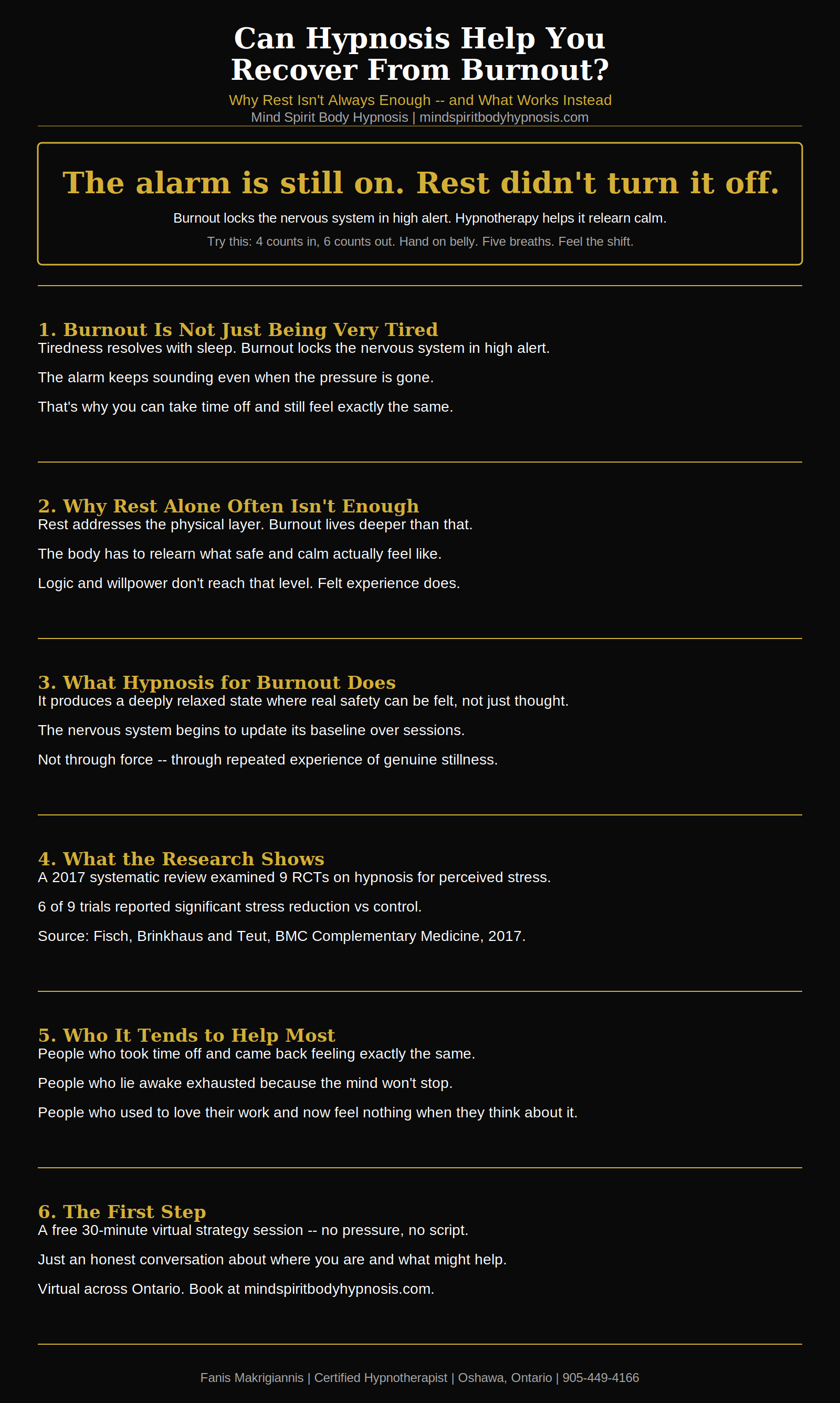
Burnout is not the same as being very tired. Tiredness resolves with sleep. Burnout is a state the nervous system gets locked into after months or years of sustained pressure, and a locked nervous system does not simply unlock because the pressure is removed.
Think of it like a car alarm that keeps sounding after the threat is gone. The system learned to stay alert. It became very good at that job. Now even in quiet moments, it does not fully stand down. The holiday feels anxious. The weekend feels like waiting for Monday. Sleep arrives but doesn't feel restorative.
This is not weakness or ingratitude. It is a nervous system that has been trained, over time, to stay on guard. Retraining it takes more than an absence of stress. It takes something that speaks the same language the alarm system speaks, which is not logic or willpower. It is the body's own sense of safety.
What Burnout Actually Does to the Body and Mind
Burnout has three recognized dimensions. The first is exhaustion, the feeling of being completely drained. The second is what researchers call depersonalization, a kind of emotional distance or numbness that sets in as a protection against feeling too much. The third is a reduced sense of personal accomplishment, the quiet conviction that what you do no longer matters or that you are no longer capable of doing it well.
These are not separate problems. They are stages of the same process. The body and mind go numb because they cannot sustain full engagement with a situation that shows no sign of letting up. The numbness that felt protective starts to feel like emptiness.
What makes burnout particularly stubborn is that the physiological changes it produces are slow to reverse. Research into burnout physiology has found inconsistent cortisol patterns, disrupted sleep architecture, and altered stress reactivity in people with clinical burnout. The body does not simply reset when the workload eases. It needs to relearn what a baseline of calm actually feels like.
If the exhaustion has started to affect sleep, which it often does, it is also worth reading about hypnotherapy for sleep and insomnia. The two issues overlap frequently, and addressing them together tends to produce faster results than working on either one in isolation.
7 Signs of burnout.
How Hypnosis for Burnout Works
Hypnosis works by producing a focused, relaxed state where the mind becomes more open to change. In that state, the nervous system can begin to experience calm as a real, felt condition rather than an intellectual idea.
This matters because burnout creates a gap between what a person knows and what their body believes. They know they are safe. They know the worst stretch is over. But the body hasn't received the message. It is still running the old programme.
A hypnotic session does not argue with the body's alarm system. It works alongside it, using language, imagery, and focused attention to introduce a felt experience of safety and ease. Over time, the nervous system updates its baseline. Not through force, but through repetition of a different felt experience.
In practice, this might mean guiding a client to access a memory of genuine rest, expanding that felt experience, and anchoring it as something retrievable outside the session. Or it might mean exploring the beliefs and identity patterns that kept someone pushing well past their limits for years, and beginning to update those patterns at a subconscious level.
People often tell me that the surprising part is how quickly the body responds in a session, even when the mind is still skeptical. That is because hypnosis communicates in a language the body understands: sensation, imagery, and rhythm.
If burnout has also brought with it a loss of confidence or a sense of not recognizing yourself, hypnotherapy for confidence and self-sabotage addresses the identity layer of recovery, which is a real part of what burnout takes from people and what genuine recovery needs to restore.
What the Research Says
The research base for hypnosis specifically in burnout is still developing. But the evidence for hypnosis in stress reduction, which is the physiological and psychological foundation of burnout, is more established.
A 2017 systematic review published in BMC Complementary and Alternative Medicine examined nine randomized controlled trials of hypnosis for perceived stress. Six of the nine reported significant stress reduction in the hypnosis group compared to controls. The authors noted that hypnotizability did not predict outcomes in most studies, meaning the approach was broadly accessible, not limited to highly suggestible individuals. They also called for larger, more standardized trials to build on these early findings (Fisch, Brinkhaus and Teut, 2017).
The International Society of Hypnosis has reviewed the evidence on hypnosis as a burnout intervention specifically, concluding that the current picture is promising but preliminary. Early experimental work found that deep-trance hypnosis produced significant reductions in burnout, depression, and anxiety compared to control conditions, with changes that differed significantly from those seen in lighter relaxation approaches. Researchers have called for further standardized trials to confirm these findings and identify which elements of hypnotic work are most effective for burnout recovery.
What the research does support clearly is this: approaches that work at the level of the body's stress response, rather than only at the level of conscious thought, tend to produce more durable results in stress-related conditions. Burnout, by that measure, is a strong candidate for this kind of approach.
A free 30-minute strategy session is available if you want to talk through where you are and whether hypnotherapy makes sense for your situation. There is no pressure and no script. Just an honest conversation.
Who Tends to Benefit Most
Hypnosis for burnout tends to be most useful for people who have already done the obvious things and are still not recovering at the pace they expected.
People who took time off and came back feeling exactly the same. People who know, rationally, that the pressure has eased but whose body hasn't caught up with that fact. People who lie awake even when they are exhausted because the mind won't stop processing. People who used to love their work and now feel nothing when they think about it.
It also tends to help people who have been running on performance and achievement for so long that they genuinely do not know what rest feels like anymore. Not just what it looks like on a calendar, but what it actually feels like in the body. For those people, a session is sometimes the first time in months or years that they have experienced genuine stillness.
The everyday version of this is a client who describes sitting in the garden on a Sunday morning, coffee in hand, and not being able to enjoy a single minute of it because their mind is already at Tuesday. That is not a productivity problem. It is a nervous system that has forgotten how to be off duty.
What a Session Looks Like
A session begins with a conversation. I want to understand how the burnout has shown up for you specifically, how long it has been building, and what recovery has already looked like.
The hypnosis itself is simple and comfortable. You are seated or lying down, and I guide your attention inward with a slow sequence of language and suggestion. You stay aware the whole time. The experience tends to feel like a very deep, deliberate rest, but with your attention still present and engaged rather than drifting into sleep.
Most people leave feeling calmer than they expected. Some notice a quality of ease that they haven't felt in a long time. That is not a trick. It is the body's natural response to focused, guided relaxation at a depth that ordinary rest does not reach.
Recovery from burnout is not a single session. But most people notice meaningful change within three to five sessions, and the changes tend to build on each other in a way that passive rest does not.
Here is how common burnout recovery approaches compare:
Time off and rest address physical fatigue and immediate overload, but often miss the nervous system reset and subconscious patterns that keep burnout in place.
Talk therapy and CBT work with thought patterns and coping strategies, but may not reach the bodily stress response or produce a felt sense of safety.
Medication can support mood stabilization and sleep, but does not address underlying beliefs or identity-level recovery.
Hypnotherapy works on the nervous system reset, subconscious beliefs, and felt calm. It is a complementary approach and not a substitute for medical or psychiatric care.
A Simple Exercise to Try Right Now
This works best in a quiet place where you won't be interrupted for three minutes.
Sit down and close your eyes. Put one hand on your chest and one on your belly. Breathe in slowly for four counts, then out for six counts. Do that five times.
As you breathe, let your attention rest on the physical sensation of your belly rising and falling. Not on your inbox. Not on the list. Just the breath.
When your mind wanders, which it will, simply notice it and come back to the breath without judgment. That return, not the wandering, is the practice.
This activates the parasympathetic nervous system, the part responsible for rest and recovery. It will not resolve burnout on its own, but it gives the nervous system a moment of real signal: it is safe to slow down.
WHAT MY CLIENTS SAY
“My cousin told me about Fanis. Short version: she was right. I came in carrying years of complex trauma. The kind that does not have one clean origin story, just layers of things that built up over time and quietly shaped how I moved through the world. I had done therapy on and off and it helped me understand things, but understanding something and actually being free of it are two very different experiences. Fanis works at a level I had never accessed before. He is precise, unhurried, and completely present in a way that makes the whole process feel safe from the very first session. The pace of results genuinely surprised me. By session four I could feel something that had been there my entire adult life simply was not there anymore. I cannot explain the mechanism but I can describe the outcome. I feel lighter. I respond differently. Things that used to hijack me just do not anymore. Highly recommended. Do not wait as long as I did.” — Idi A.
Frequently Asked Questions
Is hypnosis actually effective for burnout? The research base specifically on burnout is still growing, but the evidence for hypnosis in stress reduction is more established. A 2017 systematic review found six of nine randomized trials reported significant stress reduction with hypnosis compared to controls. Early burnout-specific work found meaningful reductions in burnout scores with deeper hypnotic work. The picture is promising, and more rigorous trials are underway.
How is hypnotherapy different from meditation or mindfulness for burnout? Both work with the body's stress response, but in different ways. Mindfulness asks you to observe what arises and return to the present moment. Hypnotherapy goes further by working with subconscious patterns, beliefs, and past experiences that may be driving the burnout response in the first place. Many people find that hypnotherapy produces results more quickly, particularly when burnout has a strong identity or belief component alongside the physical exhaustion.
Can hypnotherapy help if I'm still in a stressful job? Yes. The goal is not to remove stress, which is often not possible, but to change how your nervous system responds to it. People who work with me often report that the same situations feel more manageable after a few sessions, not because the situations changed but because their internal response did.
How many sessions will I need for burnout recovery? There is no fixed number. Burnout that has been building for two years will take longer to address than a shorter acute episode. Most people notice a meaningful shift within three to five sessions. Some feel a difference after the first. The changes tend to hold because they come from updated patterns, not from an ongoing effort to manage symptoms.
Is hypnotherapy safe during burnout when I'm already exhausted? Yes. Hypnotherapy is gentle and does not demand effort from the client. Many people find a session deeply restorative. It is a complementary approach, and if your burnout has produced significant depression, anxiety, or physical health concerns, it is worth also speaking with your doctor. Hypnotherapy works alongside other forms of care, not instead of them.
Do I have to talk about everything that led to the burnout? No. You share what feels relevant and comfortable. Some people find it useful to explore the history of what built the burnout. Others prefer to focus on restoring a felt sense of calm and energy in the present. Both approaches can be effective, and we work at a pace that suits you.
What if I fall asleep during a session? It is common to drift very deeply, particularly when you are exhausted. Light sleep during a session does not nullify the work. Some of the most effective hypnotic work happens in that threshold state between waking and sleep. If you fall into deeper sleep, we simply note it and adjust the approach in subsequent sessions.
Can hypnotherapy help with the emotional numbness that comes with burnout? Yes. The numbness that accompanies burnout is a protective response, not a permanent state. Hypnotherapy gently creates conditions where safety and ease can be felt again, which is often what the numbness was protecting against. As the nervous system begins to regulate, the capacity for genuine engagement tends to return.
Is this covered by insurance in Ontario? Hypnotherapy is a complementary approach in Ontario. Coverage varies by plan. Many extended health benefit plans include coverage for registered psychotherapists, and some cover certified hypnotherapists. Check your specific plan details. Sessions at Mind Spirit Body Hypnosis are offered virtually across Ontario, removing the need for travel.
How do I get started? The free 30-minute virtual strategy session is the easiest first step. We talk about what you are experiencing, how long it has been going on, and whether hypnotherapy is a good fit. There is no obligation and no pressure. You can book at calendly.com/mindspiritbodyhypnosis or reach out by email or phone.
RECOMMENDED READING
Ready to Take the Next Step?
If you are recovering from burnout and rest alone isn't moving the needle, I would like to help.
I offer a free 30-minute virtual strategy session for new clients across Ontario. There's no pressure. Just a real conversation about what you are going through and how hypnotherapy, NLP, or a related approach might support your recovery.
Book your free session: calendly.com/mindspiritbodyhypnosis
Call or text: 905-449-4166
Email: info@mindspiritbodyhypnosis.com
Visit: mindspiritbodyhypnosis.com
Serving clients virtually across Ontario, including Durham Region, Toronto, Canada, and beyond.
Disclaimer: This article is for informational purposes only and does not constitute medical or psychological advice. Hypnotherapy, NLP, and related approaches are complementary and are not a substitute for diagnosis or treatment by a qualified healthcare provider. Burnout with significant mental or physical health symptoms should be assessed by a licensed professional. Please consult your doctor if you have concerns about your health.
Written by Fanis Makrigiannis | Certified Hypnotherapist & NLP Master Practitioner | Mind Spirit Body Hypnosis.