Hypnosis for Dating After Trauma: Why It Feels So Hard
TL;DR: Dating after trauma is not a matter of readiness or willpower. It is a matter of what the nervous system learned the last time it got close to someone. Hypnosis for dating after trauma works by reaching the subconscious patterns that govern how the brain reads intimacy, vulnerability, and risk in relationships, and updating them at the source, so the past stops running the present.
Quick Answer
Hypnosis for dating after trauma is a subconscious-focused approach that works by identifying and updating the attachment and threat patterns the nervous system formed in response to past relational harm. Research shows hypnotherapy produces significant anxiety and PTSD symptom reduction across multiple controlled trials (Valentine et al., 2019). Fanis Makrigiannis, a Certified Hypnotherapist and NLP Master Practitioner at Mind Spirit Body Hypnosis in Oshawa, Ontario, works virtually with clients across Ontario who want to show up to dating without the weight of what happened before.
Questions This Article Answers
Why does dating feel so much harder after a painful relationship?
Why do I sabotage things when they start to go well?
Why do I either feel too much or shut down completely when someone gets close?
What is the nervous system actually doing when I try to date after trauma?
How does hypnotherapy help with dating after trauma?
What can I do right now to start working with this?
In this article
You want to date again. Part of you is ready. And another part keeps getting in the way.
You meet someone who seems good. Safe. And then something happens: you pull back, pick a fight, go cold, or find a reason it won't work. Or the opposite: you feel so intensely, so fast, that it scares you and probably them too.
None of this is a character flaw. It is a nervous system doing exactly what it learned to do.
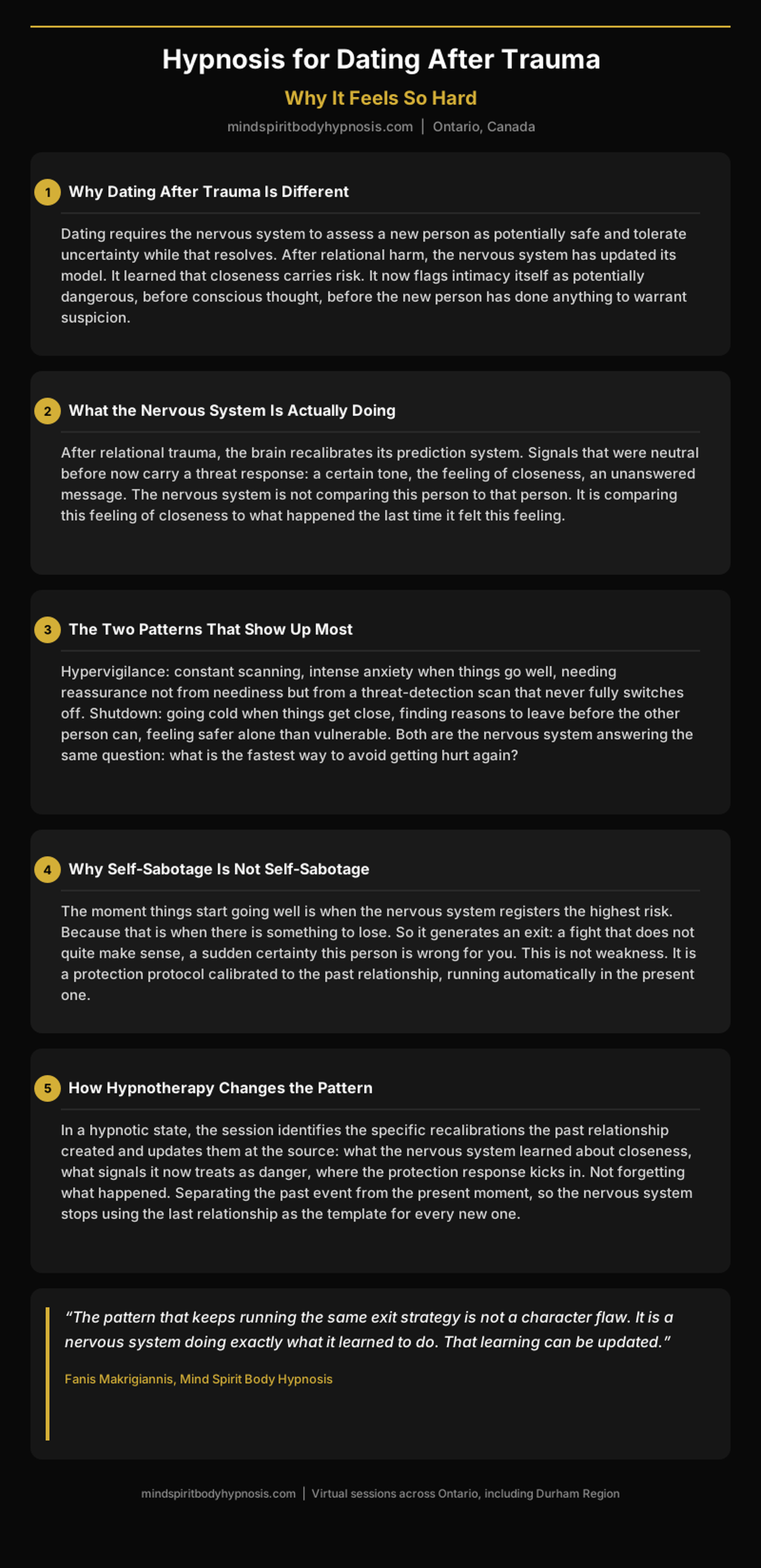
Why Dating After Trauma Is Different
Most advice about dating after trauma focuses on the conscious side: take it slow, set boundaries, communicate your needs. That advice is not wrong. But it misses what is actually driving the difficulty.
Dating requires the nervous system to do something very specific: assess a new person as potentially safe, tolerate the uncertainty of not knowing yet, and remain open while that uncertainty resolves. For someone without relational trauma, that process runs in the background without much friction.
For someone who has been hurt in a relationship, whether through a partner who was unfaithful, emotionally abusive, neglectful, or simply unavailable. The nervous system has updated its model. It learned that closeness carries risk. That someone who seems safe may not be. That vulnerability is a liability.
Most content on this topic focuses on the emotional experience: the fear, the grief, the longing. What it misses is the structural layer underneath. The nervous system is not running feelings. It is running a recalibrated threat model, one that now flags intimacy itself as potentially dangerous. And that model runs before conscious thought, before the person across from you has done anything to deserve the suspicion.
Working with clients in Ontario on confidence and relationship patterns, I see this consistently. The person across from me is not struggling to trust their new partner. They are struggling to trust the nervous system that told them someone was safe the last time.
What the Nervous System Is Actually Doing
When a relationship causes harm, the brain does not simply record a bad memory. It updates its prediction system.
The nervous system is built to anticipate. It is constantly scanning the environment, comparing current signals to past patterns, and generating a threat or safety response before conscious reasoning catches up. After relational trauma, it recalibrates what signals mean danger: a certain tone of voice, the feeling of getting close to someone, the absence of a text message, being asked a personal question. Things that were neutral before now carry a threat signal.
A 2024 study published in Frontiers in Psychology found that insecure adult attachment, often the result of relational trauma, affects how people experience absorption, internal dialogue, and emotional regulation during hypnosis, suggesting the relational patterning is embedded at the level of subconscious processing, not just conscious belief. (Di Filippo and Perri, Frontiers in Psychology, 2024).
This is why the trauma response shows up in dating even when the new relationship is nothing like the old one. The nervous system is not comparing this person to that person. It is comparing this feeling of closeness to what happened the last time it felt this feeling of closeness.
The Two Patterns That Show Up Most
In practice, the nervous system response to relational trauma tends to show up in dating in one of two directions.
The first is hypervigilance. The person scans constantly for signs that something is wrong. They read into small things: a delayed response, a change in tone, a moment of distraction. They feel intense anxiety when things are going well, because things going well is exactly when the floor dropped out before. They need constant reassurance, not because they are needy, but because the nervous system is running a threat-detection scan that never fully switches off.
The second is shutdown. The person disconnects when things get close. They feel emotionally flat when they should feel something. They find reasons to end things before the other person can. They feel safer alone than vulnerable, even though alone is not what they want. The anxiety is not obvious from the outside, but underneath the detachment is a nervous system that has decided the safest response to incoming connection is to not feel it.
Both are protective. Both feel like the problem. Neither is the problem. They are the nervous system's answer to a question it learned to ask: what is the fastest way to avoid getting hurt again?
7 signs of unhealed relationship trauma
Why Self-Sabotage Is Not Self-Sabotage
One of the most important reframes for clients who come to me around dating after trauma is this: what looks like self-sabotage is not sabotage. It is protection.
The moment things start going well is the moment the nervous system registers the highest risk. Because that is when there is something to lose. The closer you let someone in, the more they can hurt you. The brain has the evidence. It knows what happened when you let someone in before.
So it generates an exit. A fight that doesn't quite make sense. A sudden certainty that this person is wrong for you. A wave of feeling smothered when nothing has changed. A pull toward someone unavailable, someone who cannot get close enough to cause the specific kind of harm the nervous system is guarding against.
This is not weakness. It is a nervous system running a protection protocol. The problem is that the protocol is calibrated to the past relationship, not this one. And it runs automatically, before the conscious mind has a chance to evaluate whether the threat is real.
The confidence and self-perception work that matters most here is not about believing you deserve love. Most people already believe that. It is about whether the subconscious nervous system believes you are safe to receive it.
How Hypnotherapy Works With This
Hypnotherapy works for dating after trauma because the patterns driving the difficulty are subconscious. They are not held in conscious understanding or belief. They are held in the nervous system's prediction model, running below the level where insight and willpower reach.
In a relaxed, focused hypnotic state, the subconscious becomes open and accessible. The session identifies the specific recalibrations the past relationship created: what the nervous system learned about closeness, what signals it now treats as danger, and where the protection response kicks in. It then works to update that model at the source.
This is not about forgetting what happened or bypassing the experience. It is about separating the past event from the present moment, so the nervous system stops using the last relationship as the template for every new one.
Research supports this approach. A 2019 meta-analysis found hypnotherapy produced significant anxiety reductions across multiple trial designs, with effects maintained at follow-up (Valentine et al., International Journal of Clinical and Experimental Hypnosis, 2019). The anxiety that runs underneath dating after trauma responds to the same subconscious mechanism.
What clients describe after this work is not that dating becomes easy. It is that it becomes possible. The hypervigilance quiets enough to stay present. The shutdown lifts enough to let someone in. The pattern that kept running the same exit strategy begins to pause long enough to ask whether this situation actually calls for it.
A Simple Exercise to Try
The next time you feel the pull to withdraw from something that is going well, pause before acting on it.
Ask one question: "Is this person doing something, or is this feeling from somewhere else?"
Not to dismiss the feeling. Not to override it. Just to create a small pause between the nervous system's signal and the action it is trying to generate.
The brain after relational trauma responds to the feeling of closeness as though closeness itself is the threat. This question is a small interrupt: it asks the nervous system to locate the actual source of the signal before acting on it.
You will not always be able to hold it. But practising the distinction between this relationship and that relationship begins to build the separation the nervous system needs to update its model.
If you want to work on the deeper recalibration, reach out at info@mindspiritbodyhypnosis.com or book at calendly.com/mindspiritbodyhypnosis.
Self-Assessment: Is This Pattern Running in You?
Five questions. No sign-up. Instant result with a personalized next step based on your score.
Is a Past Relationship Running Your Current Dating Life?
5 questions. Takes about 60 seconds. No sign-up needed.
What my clients say
“A close family friend referred me to Fanis after I mentioned I had been struggling with insomnia, anxiety, and panic attacks for a couple of years. I had tried a few things before but nothing stuck. I was not entirely sure hypnotherapy was for me but I trusted the recommendation enough to book the free session. Fanis took the time to understand exactly what I was dealing with before we ever started. The sessions themselves were calm and completely virtual, which I appreciated. The panic attacks have stopped. My sleep is better than it has been in years.” — Jihad H. via Google
Frequently Asked Questions
What is hypnosis for dating after trauma? Hypnosis for dating after trauma is a subconscious-focused approach that works by identifying how past relational harm recalibrated the nervous system's threat and safety responses, and updating those patterns at the source. It is not about erasing what happened or being told to move on. It is about separating the past relationship's patterns from the present moment, so your nervous system can respond to the person in front of you, not the one who caused the harm.
Why does dating feel so hard after a painful relationship? Because the nervous system updated its model. After relational harm, the brain recalibrates what closeness means: it is now associated with risk. Things that felt neutral before: someone getting close, a moment of vulnerability, a period of uncertainty. These now carry a threat signal. The difficulty in dating is not about the new person. It is about the nervous system running its updated model on every new situation.
Why do things fall apart when they start going well? Because that is when the nervous system registers the highest risk. The closer you let someone in, the more there is to lose. The brain has learned this from experience. So when things start going well, the protection response activates: a fight, a reason to leave, a sudden certainty it won't work. This is not self-sabotage. It is a protection protocol calibrated to the past relationship, running automatically in the present one.
Why do I either feel too much or shut down completely? Both are nervous system responses to perceived threat in a relational context. Feeling too much, too fast, is hypervigilance: the system scanning constantly, trying to stay ahead of potential harm. Shutting down is a different version of the same protection: the nervous system deciding that the safest response to incoming connection is to not feel it. Both feel like the problem. Both are the nervous system's answer to the same underlying question.
Is this about not being ready to date? Readiness is a conscious concept. The nervous system does not operate on readiness. It operates on patterns. Someone can be fully ready, consciously, and still have the subconscious protection pattern running. That is why time alone does not always resolve it. The pattern was formed by experience, and it updates through experience at the subconscious level, not through deciding to be ready.
Does hypnotherapy work for dating anxiety specifically? Yes. Dating anxiety after trauma is an anxiety response with a specific source: the nervous system's learned association between closeness and harm. Hypnotherapy addresses the source of the pattern, not just the symptoms. A 2019 meta-analysis found hypnotherapy produced significant anxiety reductions across multiple trial designs, with effects maintained at follow-up (Valentine et al., 2019).
How is this different from regular therapy for relationship anxiety? Talk therapy works with conscious understanding, insight, and behaviour change. Hypnotherapy works at the subconscious level where the patterns are held. Both have value. The difference is that the patterns driving dating difficulty after trauma are not stored in conscious understanding. They are stored in the nervous system's threat model, running below the level where insight reaches. Hypnotherapy gets to that layer directly.
What does a session look like? Sessions begin with a conversation about the relationship history, what patterns have shown up in dating since, and how the nervous system response is currently presenting: hypervigilance, shutdown, or a mix of both. Hypnotic induction then creates a relaxed, focused state. The session work is tailored to the specific recalibrations this person's nervous system has made. Sessions at Mind Spirit Body Hypnosis are virtual and available across Ontario, including Durham Region.
recommended reading
Ready to Take the Next Step?
If dating keeps following the same pattern and you are not sure why, the answer probably isn't more time. The pattern is running at the subconscious level, below where effort and insight reach.
I offer a free 30-minute virtual strategy session for new clients. No pressure. Just a conversation about what is running and whether this kind of work fits.
Book your free session: calendly.com/mindspiritbodyhypnosis
Call or text: 905-449-4166
Email: info@mindspiritbodyhypnosis.com
Visit: mindspiritbodyhypnosis.com
Serving clients virtually across Ontario, including Durham Region, Toronto, Canada, and beyond.
Disclaimer: This article is for informational purposes only and does not constitute medical or psychological advice. Hypnotherapy and NLP are complementary approaches and are not a substitute for diagnosis or treatment by a qualified healthcare provider. If you are experiencing significant distress, please consult a licensed professional.
Written by Fanis Makrigiannis | Certified Hypnotherapist and NLP Master Practitioner | Mind Spirit Body Hypnosis.