Hypnosis for Betrayal Trauma: Why You Can't Just Move On
TL;DR: Betrayal trauma is not just emotional pain from being hurt by someone you trusted. It is a disruption to the brain's safety map, the subconscious system that decides who is safe, what relationships mean, and whether you can trust your own judgment. Hypnosis for betrayal trauma works by reaching that map at the subconscious level and updating what the brain learned about safety, trust, and self-trust after the betrayal.
Quick Answer
Hypnosis for betrayal trauma is a subconscious-focused approach that works by identifying how the betrayal rewired the brain's threat and safety responses, and updating those patterns at the source rather than managing symptoms at the surface. Research shows hypnotherapy produces significant PTSD symptom reduction across multiple trial types (Rotaru and Rusu, 2016). Fanis Makrigiannis, a Certified Hypnotherapist and NLP Master Practitioner at Mind Spirit Body Hypnosis in Oshawa, Ontario, works virtually with clients across Ontario who are still living in the aftermath of a betrayal long after they thought they should be over it.
Questions This Article Answers
Why does betrayal trauma feel different from other painful experiences?
Why can't I just move on even when I want to?
Why do I no longer trust my own judgement after being betrayed?
What is the brain actually doing after a betrayal?
How does hypnotherapy help with betrayal trauma?
What can I do right now to start working with this?
In this article
You found out. Maybe it was a partner who had been lying for months. A close friend who betrayed your confidence. A parent who was not who you believed them to be. A colleague who took credit for your work or went behind your back.
The facts landed. And something shifted in a way that has not shifted back.
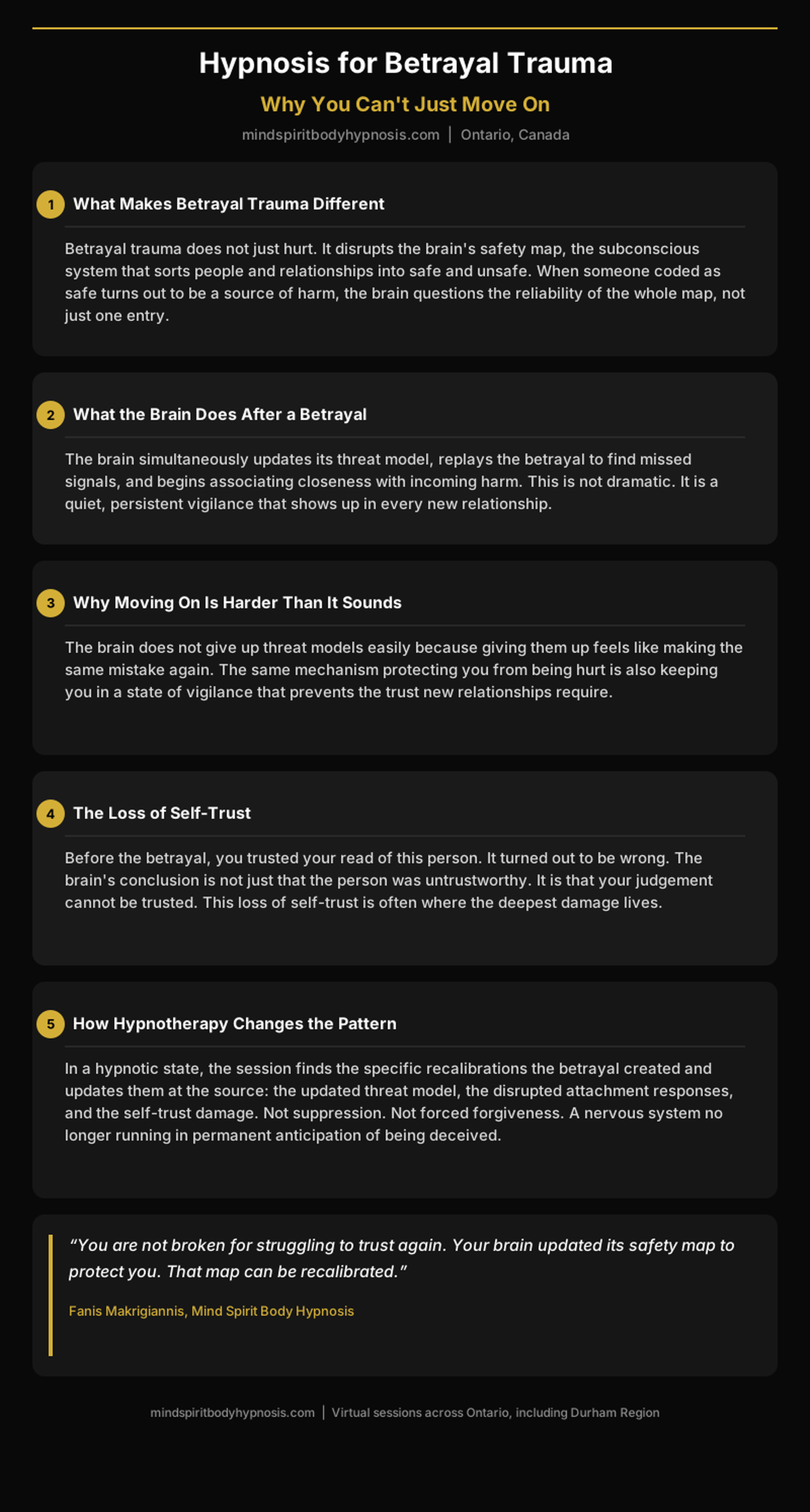
What Makes Betrayal Trauma Different
Not all painful experiences are betrayal trauma. What makes betrayal distinct is that the harm came from someone the nervous system had already classified as safe.
Most content on betrayal focuses on the emotional pain: the grief, the anger, the loss of the relationship. What that misses is the structural damage underneath. Betrayal trauma does not just hurt. It disrupts the brain's safety map, the subconscious system built over years that sorts people, relationships, and environments into safe and unsafe. When someone coded as safe turns out to be a source of harm, the brain does not simply update one entry. It questions the reliability of the whole map.
This is what makes betrayal trauma categorically different from loss or disappointment. It is not just that someone hurt you. It is that the system you were using to navigate trust turned out to be wrong. And that leaves a question the brain cannot easily resolve: if I was wrong about this person, what else am I wrong about?
Working with clients in Ontario on trauma and trust, I see this pattern consistently. The betrayal is months or years in the past. The person knows, rationally, that they should be moving forward. But the nervous system is still running on high alert, still scanning every new relationship for signs of hidden harm, still second-guessing what felt safe the last time.
What the Brain Does After a Betrayal
After a significant betrayal, the brain does several things simultaneously, most of them subconscious.
It updates its threat model. The assumption that people who present as trustworthy are trustworthy has been disproved. The brain responds by raising the baseline threat level in relationships, scanning for signs of deception, and treating closeness itself as a potential source of danger.
It replays the betrayal, looking for missed signals. This is not a choice. The brain is trying to build a better threat-detection model by identifying what it missed. The result is intrusive recall: returning to the events, conversations, and moments before the discovery and searching for what should have been obvious.
It disrupts attachment patterns. For betrayals involving close relationships, the nervous system may begin to associate the feeling of connection with the feeling of incoming harm. Closeness starts to feel unsafe, even with people who have given no reason for concern.
The trauma response running underneath all of this is not dramatic. It is quiet. It shows up as a low-level vigilance that never fully switches off, a difficulty being fully present in new relationships, and a persistent sense that the ground could shift again at any moment.
What is betrayal trauma?
Why Moving On Is Harder Than It Sounds
People are told to move on. Time heals. You need to forgive. These are not wrong, but they address the conscious experience of the betrayal, not the subconscious recalibration the brain is running underneath.
The brain does not move on from a betrayal the way it moves on from a disappointment. A disappointment updates a preference. A betrayal updates a threat model. The nervous system does not give up threat models easily, because giving them up feels like making the same mistake again.
This is the bind. The brain is trying to protect you from being hurt again. The same mechanism that is protecting you is also keeping you in a state of vigilance and self-doubt that prevents the kind of trust that new relationships require. It is not irrational. It is a nervous system doing exactly what it was designed to do, in a context where the design is now working against you.
The anxiety pattern that develops after betrayal often gets treated as a separate problem: sleep disruption, hypervigilance, difficulty relaxing. These are symptoms of the same underlying recalibration. Treating them without addressing the source leaves the root pattern running.
The Loss of Self-Trust
One of the most under-addressed aspects of betrayal trauma is what it does to self-trust.
Before the betrayal, you trusted your own read of this person and this relationship. You felt safe, and you acted from that feeling. Then it turned out you were wrong. The natural conclusion the brain draws is not just "that person was not trustworthy." It is "my judgment cannot be trusted."
This is where the deeper damage lives. It is not just about the other person. It is about whether you can trust your own perceptions. Whether your gut feelings are reliable. Whether the sense of safety you feel in a new relationship is real or another error waiting to surface.
This loss of self-trust is what drives a great deal of the difficulty in moving forward. It is not fear of being hurt again. It is not knowing whether you would recognize the warning signs if they were there. And the confidence and self-perception damage this creates extends well beyond relationships, into decision-making, into how you read other people, into how much weight you give your own experience.
How Hypnotherapy Works With Betrayal Trauma
Hypnotherapy works for betrayal trauma because the patterns created by the betrayal are subconscious. The updated threat model, the disrupted attachment responses, and the loss of self-trust are not held in conscious understanding. They are held in the nervous system, running below the level where insight and willpower operate.
In a relaxed, focused hypnotic state, the subconscious becomes open and accessible. The session identifies the specific ways the betrayal recalibrated the brain's safety map: what got updated, what the brain is now scanning for, and where the self-trust broke. It then works to restore accurate calibration at the source, not by suppressing the memory or forcing forgiveness, but by updating the threat model to reflect the present rather than the past moment of betrayal.
This is what hypnosis for betrayal trauma makes possible: not amnesia, not bypassing the experience, but a nervous system that is no longer running in permanent anticipation of being deceived again.
A 2016 meta-analysis found hypnotherapy produced significant PTSD symptom reduction across multiple controlled trials, with effects maintained at follow-up (Rotaru and Rusu, International Journal of Clinical and Experimental Hypnosis, 2016). Betrayal trauma, particularly when it involves repeated exposure or close attachment figures, produces symptom patterns closely aligned with those addressed in that research.
A Simple Exercise to Try
The next time you catch yourself scanning a current relationship for signs of deception, pause and ask one question: "What is this person actually doing right now?"
Not what they might be hiding. Not what the last person did. What is this specific person, in this specific moment, actually doing?
The brain after a betrayal runs the old threat model on new people. This question is a small interrupt: it asks the brain to respond to what is real and present rather than what was real and past. You will not always be able to hold it. But practicing the distinction between this person and that person begins to create a separation the nervous system needs to update.
If you want to work on the deeper recalibration, reach out at info@mindspiritbodyhypnosis.com or book at calendly.com/mindspiritbodyhypnosis.
Self-Assessment: Is This Betrayal Trauma?
Five questions. No sign-up. Instant result with a personalized next step based on your score.
Is This Betrayal Trauma?
5 questions. Takes about 60 seconds. No sign-up needed.
What my clients say
“Found Fanis through a Google search when I was at my wit’s end with insomnia. The nail biting was a bonus issue I figured I would mention. Did not expect much for either, honestly. Three sessions (three hours only) in and I am sleeping. Like actually sleeping. The nail biting is basically gone too. Fast results, great experience, highly recommended.” — Kennedy O. via Google
Frequently Asked Questions
What is betrayal trauma? Betrayal trauma is the psychological and neurological impact of being harmed by someone you trusted and depended on. Unlike general painful experiences, betrayal disrupts the brain's safety map, the subconscious system used to navigate trust in relationships. The damage is not only emotional. It affects how the nervous system reads safety, how the brain processes new relationships, and how much trust you place in your own judgement.
Why does betrayal trauma feel different from other painful experiences? Because the harm came from someone already classified as safe. The brain does not just process the pain of the betrayal. It has to process the failure of its own threat-detection system. That second layer is what makes betrayal trauma distinct. It is not only "that person hurt me." It is "my read of safety was wrong, and I do not know what else I have misread."
Why can't I just move on even when I want to? Because moving on requires trusting again, and the brain is running an updated threat model that treats closeness as a potential source of harm. The nervous system is not being irrational. It is trying to protect you from repeating the experience. The problem is that the same mechanism keeping you safe is also keeping you in vigilance and self-doubt that prevents the connection you want. This is a subconscious pattern, not a conscious choice.
Why do I keep replaying it even though I know it does not help? Because the brain is trying to build a better threat-detection model by finding what it missed. The replay is not punishment. It is a subconscious scan for signals that should have been obvious. This process runs automatically and does not stop when conscious reasoning asks it to, because it is not operating at the conscious level.
Is it normal to no longer trust my own judgement after a betrayal? Yes, and it is one of the most significant and least discussed effects of betrayal trauma. You trusted your read of this person. It turned out to be wrong. The brain's conclusion is not just "that person was untrustworthy." It is "my perceptions may not be reliable." This loss of self-trust is often what makes moving forward feel so difficult.
Does hypnotherapy require me to forgive the person who betrayed me? No. Hypnotherapy for betrayal trauma does not work through forgiveness. It works by updating what the nervous system learned from the betrayal: the threat model, the attachment disruption, and the self-trust damage. Whether or not you forgive the other person is a separate question entirely. The goal is a nervous system that is no longer running in permanent anticipation of being deceived again, regardless of your relationship with the person who caused the harm.
How is this different from general anxiety treatment? Betrayal trauma produces anxiety symptoms, but the source is specific: a disrupted safety map caused by harm from a trusted person. General anxiety treatment addresses the symptoms. Hypnotherapy for betrayal trauma addresses the specific recalibration that caused them: the updated threat model, the disrupted attachment patterns, and the loss of self-trust. Getting to the source rather than the symptoms is what produces lasting change.
What does a session look like? Sessions begin with a conversation about the betrayal, what changed afterwards, how the patterns are showing up currently, and what has been tried before. Hypnotic induction then creates a relaxed, focused state. The session work is tailored to the specific recalibrations the brain made in response to this betrayal. Sessions at Mind Spirit Body Hypnosis are virtual and available across Ontario, including Durham Region.
Recommended reading
Ready to Take the Next Step?
If you are still living in the aftermath of a betrayal and the vigilance, self-doubt, and difficulty trusting have not resolved on their own, that is not a failure to try hard enough. The patterns are running at the subconscious level, below where effort and insight reach.
I offer a free 30-minute virtual strategy session for new clients. No pressure. Just a conversation about what is running and whether this kind of work fits.
Book your free session: calendly.com/mindspiritbodyhypnosis
Call or text: 905-449-4166
Email: info@mindspiritbodyhypnosis.com
Visit: mindspiritbodyhypnosis.com
Serving clients virtually across Ontario, including Durham Region, Toronto, Canada, and beyond.
Disclaimer: This article is for informational purposes only and does not constitute medical or psychological advice. Hypnotherapy and NLP are complementary approaches and are not a substitute for diagnosis or treatment by a qualified healthcare provider. If you are experiencing significant distress, please consult a licensed professional.
Written by Fanis Makrigiannis | Certified Hypnotherapist and NLP Master Practitioner | Mind Spirit Body Hypnosis.