Hypnosis for Emotional Hunger: Why You Eat When You Are Not Actually Hungry
TL;DR: Emotional hunger is not about food. It is a learned response to discomfort: the brain found that eating relieves stress, boredom, loneliness, or anxiety, and it has been running that solution automatically ever since. Hypnosis for emotional hunger works by finding the trigger that starts the cycle and updating the response at the subconscious level, so eating returns to being about fuel rather than feeling management.
Quick Answer
Hypnosis for emotional hunger is a subconscious-focused approach that works by identifying the emotional triggers behind eating and replacing the learned food response with one that actually meets the underlying need. Research shows hypnosis produces significant reductions in anxiety and compulsive behavioural patterns across multiple trial types (Valentine et al., 2019). Fanis Makrigiannis, a Certified Hypnotherapist and NLP Master Practitioner at Mind Spirit Body Hypnosis in Oshawa, Ontario, works virtually with clients across Ontario who are not eating because they are hungry.
Questions This Article Answers
What is the difference between emotional hunger and physical hunger?
Why do I eat when I am stressed, bored, or upset even when I am not hungry?
Why do diets not stop emotional eating?
What is the brain actually doing when emotional hunger strikes?
How does hypnotherapy help with emotional eating?
What can I try right now?
In this article
You were not actually hungry. You knew that before you started eating. And you ate anyway.
Afterwards comes the guilt. And the question you have asked yourself many times: Why do I keep doing this when I know better?
The answer is not a lack of discipline. It is a pattern the brain learned. And learned patterns can be unlearned.
The Difference Between Emotional and Physical Hunger
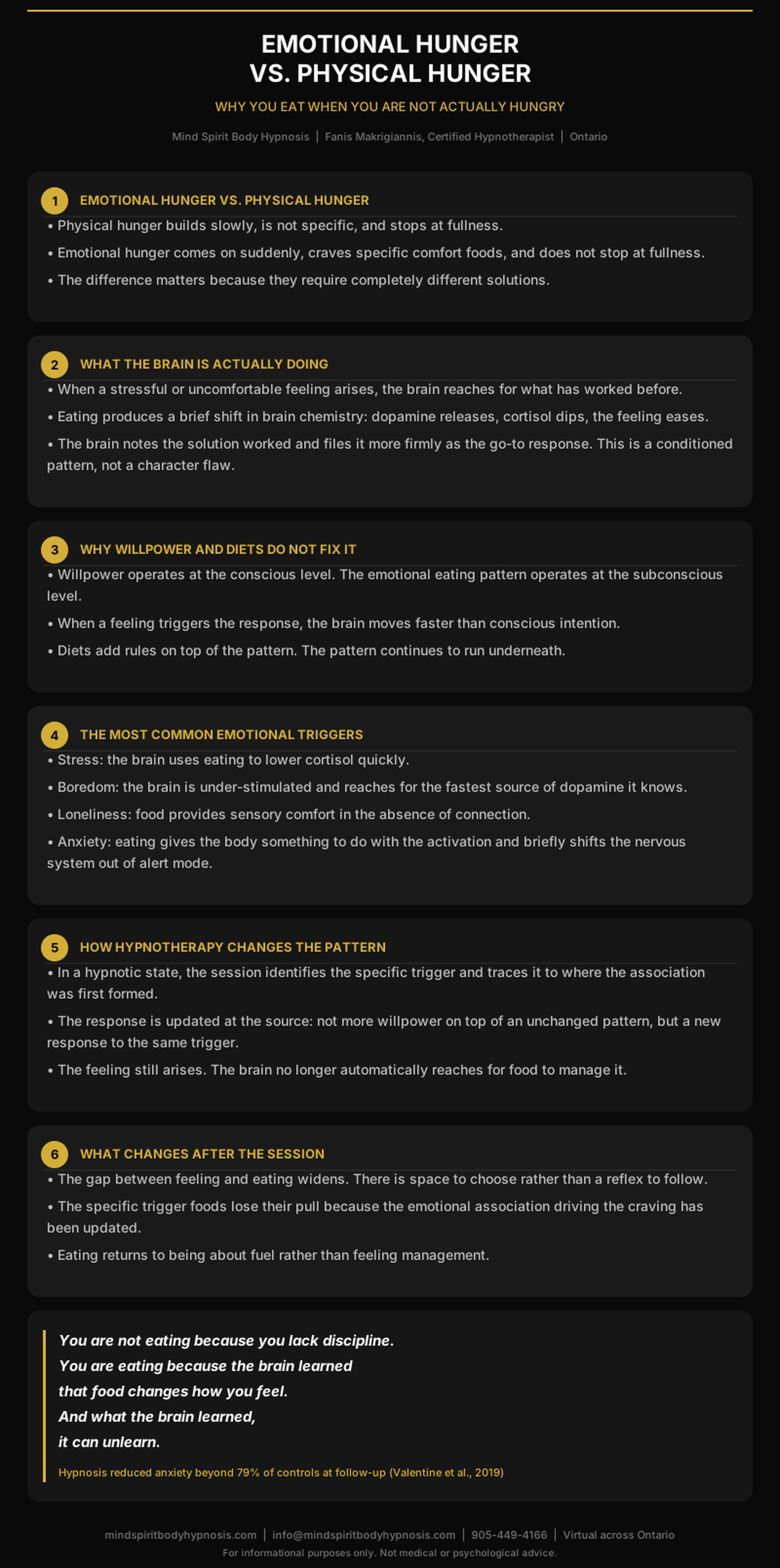
Physical hunger builds slowly. It starts as a mild awareness and grows over time. It is not specific. Almost any food will satisfy it. And once you eat, it goes away.
Emotional hunger works differently. It comes on suddenly. It feels urgent. It is almost always specific: not food in general, but a particular food, usually something dense, sweet, salty, or comforting. It does not respond to fullness the way physical hunger does. You can eat past the point where the body is satisfied and still feel the pull to keep going.
Most content on emotional eating focuses on the symptoms: the specific foods, the times of day, the situations that trigger it. What that misses is the mechanism. Emotional hunger is not a craving. It is a learned emotional regulation strategy. The brain found, at some point, that eating reliably changed how you felt. And it filed that away as a solution.
The problem is not the food. The problem is what the brain is using food to manage.
What is emotional eating?
What the Brain Is Actually Doing
When a stressful or uncomfortable feeling arises, the brain scans for a fast solution. It does not evaluate solutions logically. It runs to what has worked before.
If eating has worked before, eating is what the brain reaches for. The food produces a brief shift in brain chemistry: dopamine releases, cortisol dips, the uncomfortable feeling eases. The brain notes that the solution worked and files it more firmly as the go-to response.
This is a conditioned pattern, not a character flaw. The brain is doing exactly what it was designed to do: find relief and repeat it.
Working with clients in Ontario on emotional eating, I see this clearly. The food is not the issue. The feeling that preceded it is. The pattern fires in the moment before the eating starts, where the trigger activates and the brain reaches for its learned solution.
Why Willpower and Diets Do Not Fix It
Willpower operates at the conscious level. The emotional eating pattern operates at the subconscious level. When a feeling triggers the response, the brain moves faster than conscious intention. The hand is in the bag before the decision has been made.
Diets add rules on top of the pattern. The pattern continues to run underneath. This is why someone can follow a food plan carefully during the day and undo it at night. The plan addresses what to eat. The emotional pattern addresses why eating is happening at all, and the plan has nothing to say about that.
The weight loss work that produces lasting change focuses on the subconscious pattern, not the food rules. Restricting what you eat while the emotional trigger is still running is trying to fix the output without changing the programme.
The Most Common Emotional Triggers
Emotional hunger does not come from one place. The most common triggers include:
Stress. The brain uses eating to lower cortisol quickly. Food that is dense in calories or sugar produces a faster shift than most other fast-access options.
Boredom. The brain is under-stimulated and reaches for the fastest source of dopamine it knows. Eating is accessible, predictable, and reliable.
Loneliness. Food provides sensory comfort in the absence of social connection. The warmth and taste of food can temporarily fill a space the brain has associated with connection.
Anxiety. The anxiety response creates physical tension and restlessness. Eating gives the body something to do with that activation and briefly shifts the nervous system out of alert mode.
Reward. The brain has learned that food means celebration, comfort, or kindness toward yourself. Eating in response to a hard day is not hunger. It is the brain running a reward programme.
None of these triggers are problems in themselves. The problem is that food has become the only or primary way the brain knows how to respond to them.
How Hypnotherapy Changes the Pattern
Hypnotherapy works for emotional hunger because it reaches the subconscious level where the pattern was formed.
In a relaxed, focused hypnotic state, the subconscious becomes open and accessible. The session identifies the specific trigger: the feeling, situation, or internal state that fires the eating response. It traces that trigger back to where the association was first formed and updates the response at the source.
This is what hypnosis for emotional hunger makes possible: not more willpower applied on top of an unchanged pattern, but a new response to the same trigger. The feeling still arises. The brain no longer automatically reaches for food to manage it.
A 2019 meta-analysis across 17 trials found hypnosis produced significant anxiety reduction beyond what 79 percent of control participants experienced, with gains maintained at follow-up (Valentine et al., International Journal of Clinical and Experimental Hypnosis). For the habit side of the pattern, where the eating has become automatic and near-daily, that work builds on the same foundation.
A Simple Exercise to Try
The next time you feel the urge to eat outside of a meal, pause for thirty seconds before you act on it.
Ask yourself one question: "What am I actually feeling right now?"
Not what you want to eat. What you are feeling. Stressed. Bored. Tired. Anxious. Lonely. Flat.
You do not have to fix the feeling. You do not have to stop eating. Just name it before you reach for the food.
Over time, naming the feeling before eating creates a small gap between the trigger and the response. That gap is where change becomes possible. The pattern needs no gap to run. Even a few seconds is enough to begin disrupting it.
If you want to work on what is underneath that feeling, reach out at info@mindspiritbodyhypnosis.com or book at calendly.com/mindspiritbodyhypnosis.
Self-Assessment: Is This Emotional Hunger?
Is This Emotional Hunger?
5 questions. Takes about 60 seconds. No sign-up needed.
Five questions. No sign-up. Instant result with a personalized next step based on your score.
WHAT MY CLIENTS SAY
“I really needed help with pre-operation anxiety, pain, and a very long-standing sugar addiction. I am greatly appreciative that Fanis at Mind Spirit Body Hypnosis has helped me to eliminate both from my life in a very short period of time. I felt desperate to find something to help but I didn’t fully believe in the mechanics of hypnosis. It was extremely successful and I am so very grateful for the experience.” — Donna W. via Google
Frequently Asked Questions
What is the difference between emotional hunger and physical hunger? Physical hunger builds slowly, is not specific to one food, and goes away when you eat enough. Emotional hunger comes on suddenly, is often specific to a comfort food, and does not respond to fullness in the same way. Eating past the point where the body is satisfied but still feeling the pull to continue is a strong sign the hunger is emotional rather than physical.
Why do I eat when I am not hungry? Because the brain has learned that eating changes how you feel. At some point, eating reliably reduced stress, boredom, loneliness, or anxiety. The brain filed it as a solution and has been running it automatically ever since. It is a conditioned pattern, not a willpower problem.
Why do diets not stop emotional eating? Because diets address what you eat, not why you are eating. The emotional pattern continues to run underneath the food rules. This is why someone can follow a plan carefully during the day and undo it in the evening. The plan has nothing to say to the emotional trigger that fires when the day gets hard.
Is emotional eating the same as binge eating? They overlap but are not the same. Emotional eating is eating in response to a feeling rather than physical hunger. Binge eating involves eating large amounts rapidly, often with a loss of control and significant distress afterwards. Emotional eating can become binge eating over time if the pattern intensifies, but many people eat emotionally without it reaching that level.
What foods do people usually reach for during emotional eating? Most commonly, dense, calorie-rich foods that produce a fast shift in brain chemistry: sweet foods, salty snacks, bread, pasta, cheese, chocolate. These produce a quicker dopamine and serotonin response than lighter foods, which is why the brain reaches for them specifically.
Can hypnotherapy help if I have been eating this way for years? Yes. The length of time a pattern has been running does not determine whether it can change. It may affect how many layers the session work needs to address. What matters is that the pattern is subconscious, and hypnotherapy works at the subconscious level regardless of how long the pattern has been in place.
What does a session look like? Sessions begin with a conversation about the specific triggers, the foods involved, the times and situations where the pattern runs most strongly, and what has been tried before. Hypnotic induction then creates a relaxed, focused state. The session work is tailored to the specific trigger and history. Sessions at Mind Spirit Body Hypnosis are virtual and available across Ontario, including Durham Region.
Is this different from your weight loss hypnotherapy page? Yes. The weight loss page covers the broader picture of using hypnotherapy for body weight goals. This page focuses specifically on the emotional eating pattern: the gap between feeling and food, what the brain is doing in that gap, and how hypnotherapy changes the response at the subconscious level.
RECOMMENDED READING
Ready to Take the Next Step?
If you have been eating in response to feelings rather than hunger, and trying harder has not changed it, that is not a willpower problem. The pattern is running below the level where willpower operates.
I offer a free 30-minute virtual strategy session for new clients. No pressure. Just a conversation about what is running and whether this kind of work fits.
Book your free session: calendly.com/mindspiritbodyhypnosis
Call or text: 905-449-4166
Email: info@mindspiritbodyhypnosis.com
Visit: mindspiritbodyhypnosis.com
Serving clients virtually across Ontario, including Durham Region, Toronto, Canada, and beyond.
Disclaimer: This article is for informational purposes only and does not constitute medical or psychological advice. Hypnotherapy and NLP are complementary approaches and are not a substitute for diagnosis or treatment by a qualified healthcare provider. If you are experiencing significant distress, please consult a licensed professional.
Written by Fanis Makrigiannis | Certified Hypnotherapist and NLP Master Practitioner | Mind Spirit Body Hypnosis.