Hypnosis for Avoidance Habits: Why You Keep Putting It Off
TL;DR: Avoidance is not a character flaw or a motivation problem. It is a nervous system habit that reinforces itself every time it works. Each time you avoid something uncomfortable and the discomfort goes away, the brain logs that as a successful strategy and runs it again. Hypnosis for avoidance habits works by updating that subconscious pattern at the source, so the automatic response to discomfort stops being to escape it.
Quick Answer
Hypnosis for avoidance habits is a subconscious-focused approach that works by identifying the specific discomfort signals that trigger avoidance and updating the nervous system's automatic response before it generates the behaviour. An umbrella review of 49 meta-analyses found hypnosis produced medium to large effects across a wide range of behavioural and health outcomes (Rosendahl et al., 2024). Fanis Makrigiannis, a Certified Hypnotherapist and NLP Master Practitioner at Mind Spirit Body Hypnosis in Oshawa, Ontario, works virtually with clients across Ontario who are stuck in avoidance loops that insight and willpower have not been able to shift.
Questions This Article Answers
Why do I keep avoiding things even when I know the avoidance is making it worse?
Why does willpower not fix avoidance?
What is the nervous system actually doing when I avoid?
Why does avoidance get stronger over time instead of weaker?
How does hypnotherapy help with avoidance as a habit?
What can I do right now to start interrupting the pattern?
In this article
There is a task you have been meaning to do for weeks. A conversation you have been putting off. A decision that sits in the back of your mind and does not move. Every time it comes up, something pulls you away from it. You tell yourself you will do it tomorrow.
Tomorrow does the same thing.
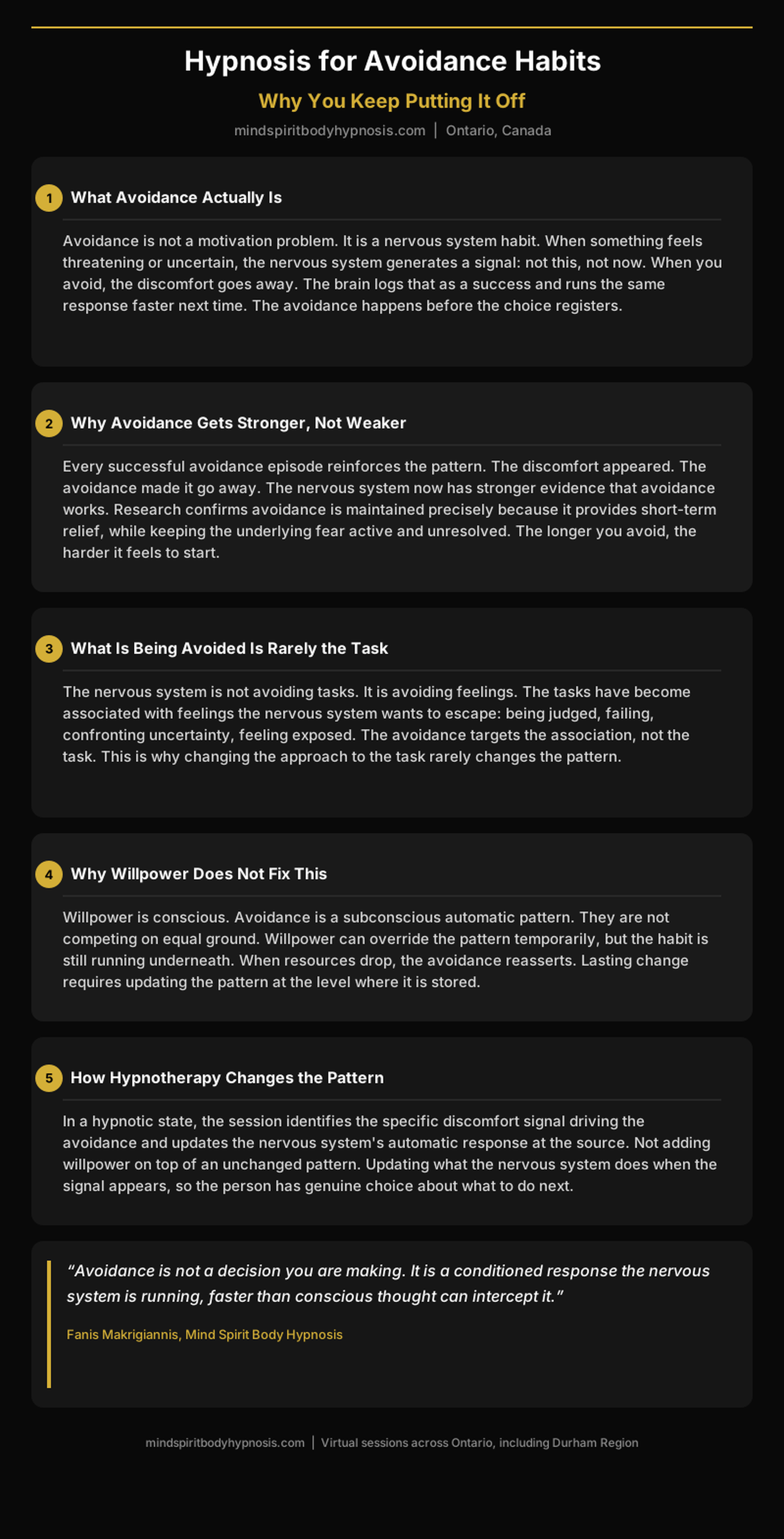
What Avoidance Actually Is
Most people understand avoidance as a motivation problem: they should want to do the thing, they do not, and that gap is the problem. But avoidance is not a motivation problem. It is a nervous system habit.
The nervous system is built to protect. When something feels threatening, overwhelming, or uncertain, it generates a signal: not this, not now. That signal is uncomfortable. When you avoid the thing, the discomfort goes away. The nervous system logs that outcome as a success. Next time the same signal appears, it runs the same response faster, with less deliberation.
Most content on avoidance focuses on strategies: break the task into smaller steps, set a timer, use accountability. These can help at the edges. What they miss is the structural layer underneath. Avoidance is not a decision the person is making. It is a conditioned response the nervous system is running, and it runs faster than the conscious mind can intercept it. The person does not choose to open their phone instead of the tax return. The avoidance has already happened before the choice registers.
Working with clients in Ontario on habit patterns, I see this clearly. The person is not lacking motivation or discipline. They understand exactly what they are doing and why it is a problem. The understanding has not changed the pattern because the pattern is not stored in understanding.
I love it, soI avoid it.
Why Avoidance Gets Stronger, Not Weaker
This is the part most people do not expect: avoidance compounds.
Every successful avoidance episode reinforces the pattern. The discomfort appeared. The avoidance made it go away. The nervous system now has stronger evidence that avoidance works. It runs the response more readily, with a lower threshold, in more situations.
A 2022 review in Frontiers in Psychiatry found that avoidance behaviour is maintained precisely because it provides short-term relief, and that this relief reinforces the avoidance while keeping the underlying fear or discomfort active and unresolved (Labrenz et al., Frontiers in Psychiatry, 2022). The thing you avoid does not feel less threatening over time. It feels more threatening, because the anxiety that drives the avoidance has never had the chance to discover that the threat is manageable.
This is why people who have been avoiding something for months find it harder to start than people who have been avoiding it for days. The habit is more deeply grooved. The threshold for discomfort has dropped. Things that were only mildly uncomfortable now feel impossible to approach.
What Is Being Avoided Is Rarely What It Looks Like
Here is something that consistently surprises clients: the surface-level thing being avoided is rarely the real source of the avoidance.
A person avoids sending the email. It looks like email avoidance. Underneath it is a fear of being judged, rejected, or found inadequate. A person avoids the difficult conversation. It looks like conflict avoidance. Underneath it is a learned association between confrontation and loss of safety or connection.
The nervous system is not avoiding tasks. It is avoiding feelings. The tasks are associated with those feelings, and the avoidance targets the association, not the task itself. This is why changing the task rarely changes the pattern. The person switches to a different approach to the email, a different framing of the conversation, and the avoidance migrates with them.
The habit lives in the association between the trigger, the feeling, and the escape. Changing the surface does not touch the association.
Why Willpower Does Not Fix This
Willpower operates at the conscious level. Avoidance operates at the subconscious level. They are not competing on equal ground.
When a person uses willpower to push through avoidance, they are asking the conscious mind to override a signal the nervous system is generating automatically. This can work, temporarily, in conditions of low stress and high energy. But the nervous system's signal does not go away because willpower overrode it once. The habit is still running underneath. When resources are lower, when stress is higher, when attention is split, the pattern reasserts.
This is not weakness. It is the basic architecture of how habits work. Habits are stored in the nervous system precisely because they are more efficient than conscious deliberation. The brain offloads repeated patterns to automatic processing so that conscious attention is free for other things. Willpower is conscious. The habit is automatic. Trying to change an automatic pattern with a conscious effort is structurally mismatched.
How Hypnotherapy Works With Avoidance
Hypnotherapy works for avoidance habits because the pattern is subconscious. In a relaxed, focused hypnotic state, the subconscious becomes open and accessible. The session identifies the specific association driving the avoidance: what discomfort signal triggers it, what feeling the nervous system is trying to escape, and what the avoidance has been protecting against. It then updates the response at the source.
This is not about forcing the person to do the avoided thing. It is about updating what the nervous system does when the discomfort signal appears. When the automatic response to that signal is no longer escape, the person has genuine choice about what to do next, rather than a willpower contest against an automatic pattern.
An umbrella review of 49 meta-analyses published in Frontiers in Psychology found hypnosis produced medium to large effects across behavioural and health outcomes, including habit-related targets such as smoking cessation and weight management (Rosendahl et al., Frontiers in Psychology, 2024). The mechanism is the same for avoidance: a conditioned behavioural response accessed and updated at the subconscious level.
The confidence shift that follows is a secondary effect clients often notice: when the avoidance pattern lifts, the accumulated evidence of tasks completed and conversations had begins to change how the person experiences their own capacity.
A Simple Exercise to Try
The next time you notice yourself pulling away from something, pause before the avoidance completes.
Ask one question: "What am I actually afraid will happen if I do this?"
Not what you think will happen logically. What the nervous system seems to believe will happen. What feeling is it trying to protect you from?
You do not have to do the thing. You just have to name the feeling the avoidance is protecting against. Getting underneath the task to the feeling begins to separate the two, and that separation is where the pattern starts to loosen.
If the same avoidance keeps returning despite understanding it clearly, the pattern is running at the subconscious level. Reach out at info@mindspiritbodyhypnosis.com or book at calendly.com/mindspiritbodyhypnosis.
Self-Assessment: How Strong Is Your Avoidance Habit?
Five questions. No sign-up. Instant result with a personalized next step based on your score.
How Strong Is Your Avoidance Habit?
5 questions. Takes about 60 seconds. No sign-up needed.
What my clients say
“I really needed help with pre-operation anxiety, pain, and a very long-standing sugar addiction. I am greatly appreciative that Fanis at Mind Spirit Body Hypnosis has helped me to eliminate both from my life in a very short period of time. I felt desperate to find something to help but I didn’t fully believe in the mechanics of hypnosis. It was extremely successful and I am so very grateful for the experience.” — Donna W. via Google
Frequently Asked Questions
What is hypnosis for avoidance habits? Hypnosis for avoidance habits is a subconscious-focused approach that identifies the discomfort signal that triggers avoidance and updates the nervous system's automatic response before it triggers the behaviour. Rather than adding willpower on top of an unchanged pattern, it works at the level where the habit is stored, so the response to discomfort stops being automatic escape.
Why do I keep avoiding things even when I know it is making it worse? Because avoidance is a nervous system habit, not a conscious decision. The pattern runs faster than the conscious mind can intercept it. By the time you are aware of the avoidance, it has usually already happened. Understanding the pattern does not change it, because the pattern is not stored in understanding. It is stored in the nervous system's conditioned response to a particular discomfort signal.
Why does the avoided thing feel more impossible the longer I put it off? Because every successful avoidance episode reinforces the habit. The nervous system logs the avoidance as a successful strategy and runs it more readily next time. Meanwhile, the discomfort signal for the avoided thing grows stronger because it has never been resolved. Time without action does not reduce avoidance. It compounds it.
Is avoidance the same as procrastination? They overlap significantly. Procrastination is often avoidance in disguise: the task is postponed not because of poor time management but because approaching it generates a discomfort the nervous system is trying to escape. The key distinction is that true time-management problems respond to scheduling and structure. Avoidance-driven procrastination reasserts itself regardless of structure, because the underlying habit is still running.
What am I actually avoiding when I avoid a task? Almost always a feeling, not the task itself. The task has become associated with a feeling the nervous system wants to escape: being judged, failing, confronting uncertainty, feeling exposed or inadequate. The avoidance targets the feeling, not the task. This is why changing the approach to the task rarely changes the avoidance.
Why does willpower not fix avoidance? Willpower is conscious. Avoidance is a subconscious automatic pattern. Willpower can override the pattern temporarily in conditions of low stress and high energy, but the pattern is still running underneath. When resources drop, the avoidance reasserts. Lasting change requires updating the pattern at the level where it is stored.
How many sessions does it take? Every person and pattern is different. What I can say is that avoidance habits, once accessed at the subconscious level, often shift more quickly than people expect, because the pattern is relatively contained: a specific discomfort signal generating a specific escape response. The work is not about rebuilding a person from the ground up. It is about updating one conditioned association.
What does a session look like? Sessions begin with a conversation about the avoidance pattern: what gets avoided, what the approach feels like, what has been tried before. Hypnotic induction then creates a relaxed, focused state. The session work identifies the specific association driving the avoidance and updates the nervous system's response to it. Sessions at Mind Spirit Body Hypnosis are virtual and available across Ontario, including Durham Region.
Recommended reading
Ready to Take the Next Step?
If avoidance has become a consistent pattern and understanding it has not been enough to change it, the pattern is running at the subconscious level. That is where the work needs to happen.
I offer a free 30-minute virtual strategy session for new clients. No pressure. Just a conversation about what is running and whether this kind of work fits.
Book your free session: calendly.com/mindspiritbodyhypnosis
Call or text: 905-449-4166
Email: info@mindspiritbodyhypnosis.com
Visit: mindspiritbodyhypnosis.com
Serving clients virtually across Ontario, including Durham Region, Toronto, Canada, and beyond.
Disclaimer: This article is for informational purposes only and does not constitute medical or psychological advice. Hypnotherapy and NLP are complementary approaches and are not a substitute for diagnosis or treatment by a qualified healthcare provider. If you are experiencing significant distress, please consult a licensed professional.
Written by Fanis Makrigiannis | Certified Hypnotherapist and NLP Master Practitioner | Mind Spirit Body Hypnosis.