Hypnosis for Trauma Bonding: Why You Cannot Leave Even When You Want To
TL;DR: A trauma bond forms when the nervous system encodes a harmful relationship as a survival attachment. The person who causes the harm also becomes the source of relief, which creates a pull that logic and willpower cannot override. Hypnosis for trauma bonding works by updating that attachment pattern at the subconscious level, where it was formed, so leaving becomes possible rather than impossible.
Quick Answer
Hypnosis for trauma bonding is a subconscious-focused approach that works by identifying and updating the survival attachment the nervous system formed during a harmful relationship. Research shows hypnosis produces significant reductions in anxiety and distress patterns across multiple trial types (Valentine et al., 2019). Fanis Makrigiannis, a Certified Hypnotherapist and NLP Master Practitioner at Mind Spirit Body Hypnosis in Oshawa, Ontario, works virtually with clients across Ontario who know the relationship is harmful and cannot seem to make themselves leave it.
Questions This Article Answers
What is a trauma bond and why does it form?
Why can't I leave even when I know the relationship is harmful?
Why do I feel worse after leaving, not better?
Why does the pull come back strongest after the worst moments?
How does hypnotherapy help break a trauma bond?
What can I try right now?
In this article
You know the relationship is harmful. You have known for a while. You have made the decision to leave more than once. And then something happens: a moment of warmth, an apology, a return to how things used to feel, and the pull comes back stronger than the decision.
You tell yourself you are weak. You wonder what is wrong with you. And the cycle continues.
There is nothing wrong with you. There is a pattern running. And patterns have a source.
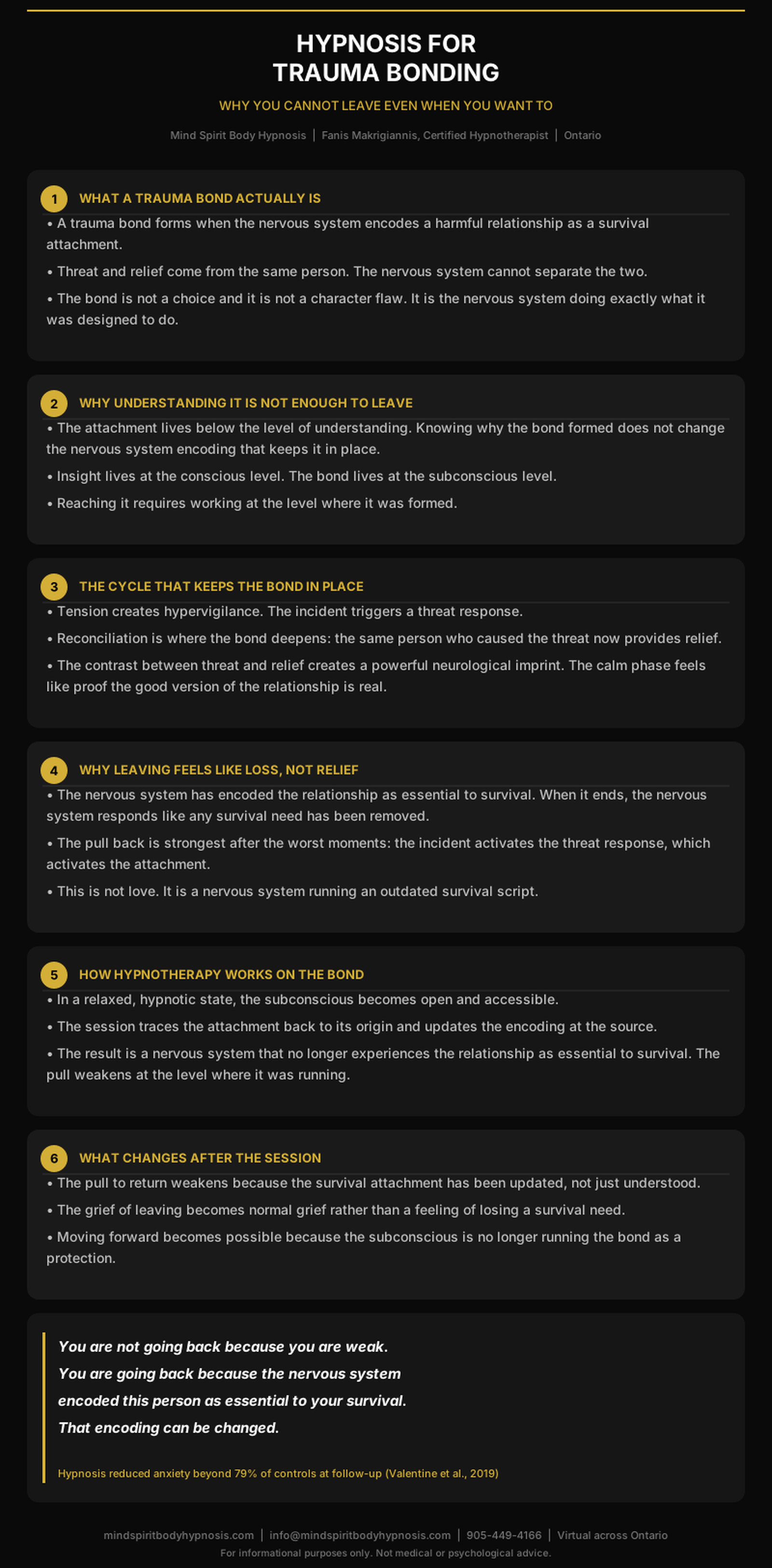
What a Trauma Bond Actually Is
A trauma bond is not love gone wrong. It is what happens when the nervous system forms a survival attachment to the person who is also the source of harm.
In a stable relationship, safety comes from a consistent source. In a trauma-bonded relationship, safety and threat come from the same person. The nervous system cannot distinguish between the two. It encodes the relationship as essential to survival, the same way it encodes oxygen and food, because the moments of relief and connection are real, even if the harm is also real.
Most pages on this topic focus on explaining the cycle of abuse and why it keeps people trapped. What they miss is what is happening neurologically: the nervous system does not evaluate relationships the way the conscious mind does. It does not weigh pros and cons. It tracks threat and relief. And when the same person delivers both, the attachment becomes extraordinarily difficult to break through conscious effort alone.
This is the core of what makes this pattern so hard to break through conscious effort alone: the bond is not a decision. It is a nervous system encoding. And that encoding can be updated.
Why Understanding It Is Not Enough to Leave
Most people who are in a trauma-bonded relationship understand it, at least in part. They have read about it. They have talked about it. They know the pattern has a name. And they still cannot leave.
This is not a failure of intelligence or will. The attachment lives below the level of understanding. Knowing why the bond formed does not change the nervous system encoding that keeps it in place. It is the same reason someone can know, consciously, that flying is statistically safe and still have the nervous system respond with full panic at the airport.
Working with clients in Ontario on this pattern, I see this constantly: people who can describe the dynamic in precise detail and who cannot make themselves act on what they know. The gap is not between knowing and understanding. It is between understanding and the subconscious.
Insight lives at the conscious level. The bond lives at the subconscious level. Reaching it requires working at the level where it was formed.
What is trauma bond?
The Cycle That Keeps the Bond in Place
Trauma bonds are maintained by a specific cycle: tension, incident, reconciliation, calm. Each stage plays a role in reinforcing the attachment.
The tension phase creates hypervigilance. The nervous system is on alert, scanning for signs of what is coming. This is exhausting and keeps the person focused entirely on managing the relationship.
The incident creates a threat response. The nervous system activates as it would to any danger.
The reconciliation phase is where the bond is deepened. The same person who caused the threat now provides relief: an apology, affection, a return to how things used to be. The contrast between the threat and the relief creates a powerful neurological imprint. This is not manipulation in the calculated sense. It is the nervous system doing exactly what it was designed to do: encoding the source of relief as essential.
The calm phase feels like proof that the good version of the relationship is real. And it is real. That is part of what makes the cycle so difficult to step out of.
The anxiety driving the hypervigilance is not incidental to the bond. It is structural. The nervous system stays activated because deactivating would mean releasing the vigilance that feels protective.
Why Leaving Feels Like Loss, Not Relief
One of the most disorienting parts of a trauma bond is that leaving often feels worse than staying, at least at first.
The nervous system has encoded the relationship as a survival attachment. When the relationship ends, it responds the way it would respond to any loss of something it has categorized as essential: grief, withdrawal, panic, an overwhelming pull to return.
This is not evidence that the relationship was right or that leaving was a mistake. It is the nervous system running a protective pattern that formed in a very different context. The attachment was real. The loss is real. What is not real is the conclusion the nervous system draws from the loss: that returning is the path back to safety.
This is also why the pull comes back strongest after the worst moments. The incident triggers the threat response. The threat response activates the attachment. The nervous system reaches for the source of relief it has encoded, which is the same person who caused the threat. The cycle reinforces itself at the moment it appears most likely to end.
Understanding this reframe matters. The pull back is not love. It is a nervous system running an outdated survival script. And survival scripts can be updated. This is exactly what the trauma-focused work addresses at its core.
How Hypnotherapy Works on the Attachment Pattern
Hypnotherapy works for trauma bonding because it reaches the subconscious level where the survival attachment was encoded.
In a relaxed, focused hypnotic state, the subconscious becomes open and accessible. The session work traces the attachment pattern back to its origin: the specific emotional context where the nervous system first learned that this person meant safety, even alongside harm. It revisits that context with the awareness and resources of the adult and updates the encoding at the source.
This is what hypnosis for trauma bonding makes possible: not an intellectual decision to leave, but a nervous system that no longer experiences the relationship as essential to survival. The pull does not disappear immediately. But it weakens. And it weakens at the level where it was running, not just at the surface.
A 2019 meta-analysis across 17 trials found hypnosis produced significant anxiety reduction beyond what 79 percent of control participants experienced, with gains maintained at follow-up (Valentine et al., International Journal of Clinical and Experimental Hypnosis). For the self-worth piece that often underlies why the bond formed in the first place, the confidence and self-sabotage work builds on this foundation.
A Simple Exercise to Try
This will not break the bond. But it can help you separate the attachment from the relationship.
When the pull comes, before you act on it, ask yourself one question slowly:
"Am I being pulled toward this person, or toward the relief I associate with them?"
The relief is real. The warmth, the connection, the sense that things could go back to how they were at the beginning: those feelings are real. The question is whether the person is the only source of those things, or whether the nervous system has simply learned to associate them with that person.
You do not have to answer the question. Just let it sit for a moment before the pull becomes an action.
If you would like to explore what this looks like in a session, reach out at info@mindspiritbodyhypnosis.com or book at calendly.com/mindspiritbodyhypnosis.
Self-Assessment: Is This a Trauma Bond?
Is This a Trauma Bond?
5 questions. Takes about 60 seconds. No sign-up needed.
Five questions. No sign-up. Instant result with a personalized next step based on your score.
WHAT MY CLIENTS SAY
“I found Fanis of Mind Spirit Body Hypnosis through ChatGPT. I typed in what I was going through and it pointed me toward hypnotherapy for trauma. I wasn’t sure at first, but desperate enough to try. I booked a free strategy session and within the first conversation I already felt something different. Fanis listened in a way I had not experienced before, no judgment, no rushing to fix me, just genuine presence. The sessions are virtual which made it easier for me. What surprised me most was the speed. I had been carrying this for a long time and within a few sessions, the weight of it had genuinely shifted. I am not the same person I was when I started. I did not expect results this fast and I would not hesitate to recommend this to anyone who has been sitting with unresolved trauma and wondering if anything will actually help. It will. Thank you Fanis.” — Papa C. via Google
Frequently Asked Questions
What is a trauma bond? A trauma bond is a strong attachment that forms when a person's nervous system encodes a harmful relationship as a source of safety. It happens when threat and relief come from the same person repeatedly. The bond is not a choice, and it is not a character flaw. It is the nervous system doing exactly what it was designed to do in a situation that paired harm with comfort.
Why can't I leave even when I know the relationship is harmful? Because the bond is not held in place by understanding. It is held in place by a subconscious survival attachment. The nervous system has encoded this relationship as essential, the same way it encodes other survival needs. Knowing why the bond formed does not change that encoding. Working at the subconscious level is what does.
Why do I feel worse after leaving, not better? Because the nervous system is responding to the loss of something it categorized as essential to survival. That response feels like grief, withdrawal, and panic. It is not evidence that leaving was wrong. It is the nervous system running an outdated script. That script can be updated.
Why does the pull come back strongest after the worst moments? Because the incident activates the threat response, and the threat response activates the survival attachment. The nervous system reaches for the source of relief it has encoded, which is the same person who caused the threat. This is the cycle reinforcing itself. It is not love. It is a nervous system pattern.
Is a trauma bond the same as loving someone too much? No. A trauma bond is a specific pattern tied to cycles of threat and relief with the same person. It can coexist with genuine feelings, but those feelings are not what creates the difficulty in leaving. The difficulty comes from the survival attachment the nervous system formed, not from the depth of the relationship.
How is hypnotherapy different from therapy for trauma bonding? Talk therapy works at the conscious level: insight, narrative, understanding the pattern. Hypnotherapy works at the subconscious level where the attachment was encoded. Both can be valuable. Hypnotherapy specifically addresses the nervous system encoding that keeps the pull in place even after the person understands the dynamic fully.
How many sessions does this take? Every person's history is different, so a fixed number does not apply. What I can say is that the first session is a free 30-minute virtual strategy session where we look at the pattern, its history, and what the work would involve. That conversation will give you a much clearer sense of what is needed.
Do I have to have left the relationship to work on this? No. The session work focuses on the nervous system pattern, not on a particular decision. Some clients work on this while still in the relationship. Others work on it after leaving, to address the pull to return. Where you are in the process does not determine whether this work is useful.
RECOMMENDED READING
Ready to Take the Next Step?
If you have been trying to leave, or trying to understand why you cannot, the answer is not more willpower. The attachment lives below the level where willpower operates.
I offer a free 30-minute virtual strategy session for new clients. No pressure. Just a conversation about where you are and whether this kind of work is a good fit.
Book your free session: calendly.com/mindspiritbodyhypnosis
Call or text: 905-449-4166
Email: info@mindspiritbodyhypnosis.com
Visit: mindspiritbodyhypnosis.com
Serving clients virtually across Ontario, including Durham Region, Toronto, Canada, and beyond.
Disclaimer: This article is for informational purposes only and does not constitute medical or psychological advice. Hypnotherapy and NLP are complementary approaches and are not a substitute for diagnosis or treatment by a qualified healthcare provider. If you are experiencing significant distress, please consult a licensed professional.
Written by Fanis Makrigiannis | Certified Hypnotherapist and NLP Master Practitioner | Mind Spirit Body Hypnosis.