Hypnosis for Catastrophizing: Why Your Brain Always Expects the Worst
TL;DR: Catastrophizing is not a character flaw or a pessimistic personality. It is a learned threat-detection pattern running at the subconscious level. The brain scans for worst-case outcomes automatically, faster than conscious reasoning can catch it. Hypnosis for catastrophizing works by updating that pattern at the source, so the brain stops treating every uncertainty as a threat and returns to realistic, proportionate assessment.
Quick Answer
Hypnosis for catastrophizing is a subconscious-focused approach that identifies the learned threat-detection pattern behind worst-case thinking and updates the brain's default response to uncertainty. Research shows hypnosis produces significant anxiety reduction across multiple trial types, with gains maintained at follow-up (Valentine et al., 2019). Fanis Makrigiannis, a Certified Hypnotherapist and NLP Master Practitioner at Mind Spirit Body Hypnosis in Oshawa, Ontario, works virtually with clients across Ontario who want to stop defaulting to the worst possible outcome every time something feels uncertain.
Questions This Article Answers
Why does my brain always go straight to the worst-case scenario?
Is catastrophizing a mental illness or a learned pattern?
Why does knowing I am catastrophizing not stop it?
What is the brain actually doing when it catastrophizes?
How does hypnotherapy help with catastrophic thinking?
What can I try right now to interrupt the pattern?
In this article
You get a text that says "we need to talk." Before you have read a second word, your mind is already at the end: fired, broken up with, someone is dead, everything is falling apart.
The message turns out to be about rescheduling lunch.
This is catastrophizing. And if it runs in your life, you already know that knowing this does not stop it.
What Catastrophizing Actually Is
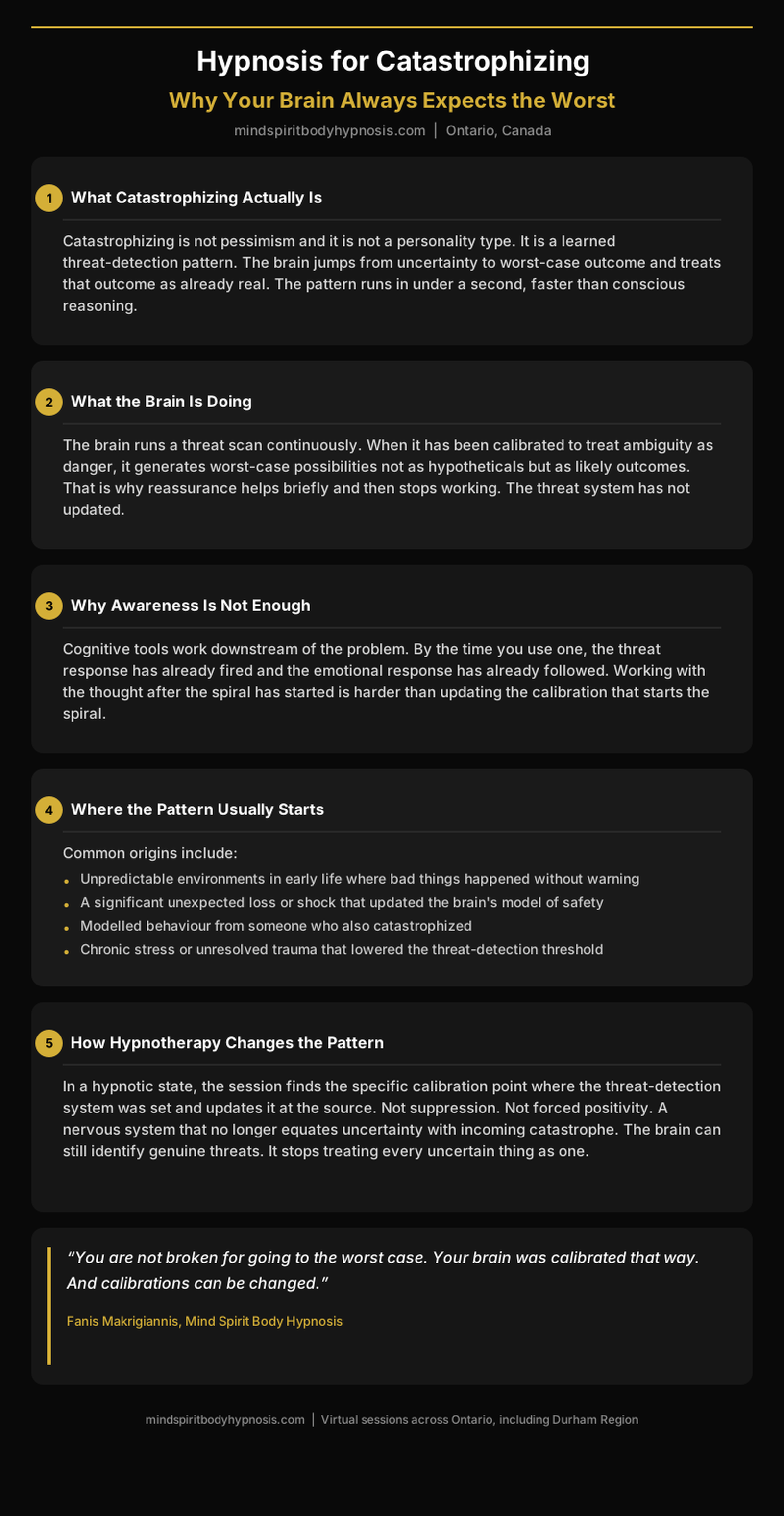
Catastrophizing is the brain's pattern of jumping from an uncertain or mildly negative situation to its worst possible outcome, treating that outcome as the most likely one, and then responding emotionally as though it has already happened.
Most content on catastrophizing focuses on the thoughts themselves: the spirals, the what-ifs, the disaster scenarios. What that misses is the mechanism. Catastrophizing is not pessimism. It is not an anxiety disorder. It is not a thinking style you were born with. The brain is not defaulting to worst-case thinking because something is broken. It is doing exactly what a threat-detection system does when it has been calibrated to treat uncertainty as danger.
The information gain here is worth stating plainly: catastrophizing is the output of an over-tuned threat-response system, not a character trait. That distinction matters because character traits are hard to change and threat-detection patterns are not.
Working with clients in Ontario on anxiety and catastrophic thinking, I see this clearly. The spiral is not random. It follows a structure: uncertainty appears, the threat system fires, the brain scans for worst cases, the worst case is locked onto, and the emotional response treats the worst case as already real. The pattern runs in under a second. The catastrophe feels like a conclusion. It is actually the first reflex.
What the Brain Is Doing When It Catastrophizes
The brain runs a threat-detection scan continuously. Its job is to identify what could go wrong before it does. In a genuinely dangerous environment, this is a survival advantage. The problem is when the system becomes calibrated to treat ambiguity itself as a threat.
When the threat system fires, the brain does not wait for evidence. It moves fast. It generates worst-case possibilities not as hypotheticals but as likely outcomes, because a system built for survival would rather over-warn than under-warn.
This is what makes catastrophizing feel so convincing in the moment. The brain is not saying "here is a possible bad thing." It is saying "this is what is coming." The emotional response follows immediately: the anxiety, the dread, the racing heart, the urge to control or avoid. By the time the conscious mind catches up, the threat response has already run.
This is also why reassurance helps briefly and then stops working. Someone tells you everything will be fine. The conscious mind accepts it. The threat system has not updated. The next uncertainty triggers the same scan, the same worst-case landing, the same emotional response.
How to stop catastrophizing.
Why Awareness Is Not Enough
Understanding that you are catastrophizing does not stop it because the pattern is not operating at the level of understanding.
Cognitive tools give the conscious mind ways to challenge the catastrophic thought once it has already fired. That is useful. But the threat system runs faster than cognitive tools can intercept it. The pattern fires, the emotional response follows, and then the conscious mind starts trying to reason its way back to calm. This is working downstream of the problem.
The anxiety response itself compounds this. When the nervous system is already activated, the prefrontal cortex, which handles rational evaluation, has reduced influence. The brain in an anxious state is biologically less capable of thinking its way out of the anxiety. This is not a failure of willpower. It is how the nervous system works.
What changes catastrophizing at the source is working at the level where the threat-detection pattern is calibrated: the subconscious.
Where the Pattern Usually Starts
Catastrophizing does not emerge from nowhere. It is learned, usually through one of a few routes.
An environment where bad things happened without warning. If unpredictable negative events were part of early life, the brain learns that uncertainty means threat. Scanning for worst cases becomes protective. The pattern was adaptive at the time. It continues running after the environment has changed.
A significant unexpected loss or shock. When something genuinely terrible happened without any preceding signal, the brain updates its model: the worst can happen; it will not announce itself, so I must always be prepared. The catastrophizing is the brain trying to never be caught off guard again.
Modelled behaviour. Brains learn from their environment. Growing up around someone who catastrophized teaches the nervous system that this is how uncertainty is handled.
Chronic stress or unresolved trauma. A nervous system running in a prolonged state of alert will lower its threshold for threat detection. What would not trigger a threat scan in a regulated state triggers one easily in an exhausted or hypervigilant nervous system.
None of these origins make the pattern permanent. They explain where it was set. They do not determine where it stays.
How Hypnotherapy Changes the Pattern
Hypnotherapy works for catastrophizing because it reaches the subconscious level where the threat-detection calibration lives.
In a relaxed, focused hypnotic state, the subconscious becomes open and accessible. The session identifies the specific signature of the pattern: when it fires, what uncertainty it is most sensitive to, and where the calibration was originally set. It then updates the threat-detection response at the source, not by suppressing the awareness of risk, but by restoring proportionality. The brain can still identify genuine threats. It stops treating every uncertain thing as one.
This is what hypnosis for catastrophizing makes possible: not a forced positive outlook, not suppression, not more conscious effort applied on top of an unchanged pattern, but a nervous system that no longer equates uncertainty with incoming catastrophe.
A 2019 meta-analysis of 17 hypnosis trials found hypnosis produced anxiety reduction beyond what 79 percent of control participants experienced, with gains maintained at follow-up (Valentine et al., International Journal of Clinical and Experimental Hypnosis). For the confidence and self-perception side of catastrophizing, where the pattern includes expectations of personal failure or humiliation, that work builds on the same foundation.
A Simple Exercise to Try
The next time you notice the spiral starting, try this before engaging with the content of the thought.
Ask: "What is the actual next thing that will happen?"
Not the worst thing. Not what could happen in three weeks if everything goes wrong. The actual next thing.
The catastrophizing pattern works by skipping steps. It moves from "uncertain thing now" to "disaster outcome later" without filling in the middle. This question forces the brain back to what is immediately real and verifiable.
You will not always be able to do this in the heat of the spiral. But even catching it once and running this question starts to build a competing reflex. Over time, the gap between the trigger and the spiral widens. That gap is where the pattern loses its automatic quality.
If you want to work on the calibration underneath, reach out at info@mindspiritbodyhypnosis.com or book at calendly.com/mindspiritbodyhypnosis.
Self-Assessment: Is This Catastrophizing?
Five questions. No sign-up. Instant result with a personalized next step based on your score.
Is This a Catastrophizing Pattern?
5 questions. Takes about 60 seconds. No sign-up needed.
What my clients say
“A close family friend referred me to Fanis after I mentioned I had been struggling with insomnia, anxiety, and panic attacks for a couple of years. I had tried a few things before but nothing stuck. I was not entirely sure hypnotherapy was for me but I trusted the recommendation enough to book the free session. Fanis took the time to understand exactly what I was dealing with before we ever started. The sessions themselves were calm and completely virtual, which I appreciated. The panic attacks have stopped. My sleep is better than it has been in years.” — Jihad H. via Google
Frequently Asked Questions
What is catastrophizing? Catastrophizing is the pattern of jumping from an uncertain or mildly negative situation directly to its worst possible outcome, and then responding emotionally as if that outcome is already happening or is the most likely result. It is a subconscious threat-detection pattern, not a personality type or a thinking choice.
Is catastrophizing the same as anxiety? They are closely related but not the same. Catastrophizing is a specific cognitive pattern that feeds anxiety. Anxiety is the emotional and physical state that results. Many people with anxiety catastrophize, but the two can also appear independently. Addressing the catastrophizing pattern directly often reduces the anxiety that follows from it.
Why does my brain always go straight to the worst case? Because the brain's threat-detection system has been calibrated to treat uncertainty as danger. This calibration usually develops in response to past experience: unpredictable environments, unexpected loss, chronic stress, or modelled behaviour from early life. The brain is doing its job as designed. The problem is that the settings are no longer matched to the current situation.
Why doesn't it help when people tell me everything will be fine? Because reassurance reaches the conscious mind but does not update the subconscious threat-detection system. The rational mind may accept the reassurance. The pattern continues to run underneath because it was not operating at the rational level to begin with. This is why the reassurance helps briefly, and then the pattern fires again at the next uncertainty.
Is catastrophizing something I can think my way out of? Cognitive tools help, but they work downstream of the pattern. By the time you are using a cognitive tool, the threat response has already fired, and the emotional response has already followed. Working with the thought after the spiral has started is harder than updating the calibration that starts the spiral in the first place. Subconscious approaches work upstream.
Can catastrophizing get worse over time? Yes. When the pattern runs frequently and the worst cases it generates turn out to be wrong, there is usually some relief, but the pattern does not self-correct. It continues to fire because it is not receiving feedback from outcomes in the same way. Without intentional work at the subconscious level, catastrophizing tends to become more entrenched and to spread to more areas of life over time.
How long does the pattern take to change with hypnotherapy? The length of time varies depending on how long the pattern has been running, how many contexts it fires in, and what its origin points are. What is consistent is that changes happen at the subconscious level, which means they can occur faster than you would expect from a purely conscious approach. Many clients notice a qualitative shift in how the pattern fires within the first few sessions.
What does a session for catastrophizing look like? The session begins with a conversation about when the pattern fires, what the most common triggers are, how long it has been running, and what has been tried before. Hypnotic induction then creates a relaxed, focused state. The session work is tailored to the specific calibration behind the pattern. Sessions at Mind Spirit Body Hypnosis are virtual and available across Ontario, including Durham Region.
Recommended reading
Ready to Take the Next Step?
If your brain is running to the worst-case outcome faster than you can stop it, and knowing that has not changed it, the pattern is not at the level of knowing. It is subconscious. And that is where it needs to be addressed.
I offer a free 30-minute virtual strategy session for new clients. No pressure. Just a conversation about what is running and whether this kind of work fits.
Book your free session: calendly.com/mindspiritbodyhypnosis
Call or text: 905-449-4166
Email: info@mindspiritbodyhypnosis.com
Visit: mindspiritbodyhypnosis.com
Serving clients virtually across Ontario, including Durham Region, Toronto, Canada, and beyond.
Disclaimer: This article is for informational purposes only and does not constitute medical or psychological advice. Hypnotherapy and NLP are complementary approaches and are not a substitute for diagnosis or treatment by a qualified healthcare provider. If you are experiencing significant distress, please consult a licensed professional.
Written by Fanis Makrigiannis | Certified Hypnotherapist and NLP Master Practitioner | Mind Spirit Body Hypnosis.