What are the signs of childhood trauma?
Can Childhood Trauma Be Healed With Hypnotherapy?
TL;DR: Childhood trauma does not stay in the past. It gets stored in the subconscious and shapes how you feel, react, and relate to people well into adulthood, often without any clear connection to what originally happened. Childhood trauma hypnotherapy Ontario clients ask about is not about reliving painful memories. It is about locating where the subconscious filed those experiences and updating the response pattern attached to them. Fanis Makrigiannis at Mind Spirit Body Hypnosis in Oshawa works with clients across Ontario to do exactly that, virtually and without a referral.
Quick Answer
Childhood trauma hypnotherapy Ontario is a subconscious-focused approach that works with the stored emotional and nervous system responses left behind by difficult early experiences, rather than requiring clients to analyse or repeatedly revisit those experiences in detail. Research suggests that hypnotherapy may help reduce the hypervigilance, emotional reactivity, and negative self-belief that often persist long after the original events have passed. Fanis Makrigiannis, a Certified Hypnotherapist (ABH, NGH) and NLP Master Practitioner (ABNLP) at Mind Spirit Body Hypnosis in Oshawa, Ontario, offers virtual sessions across Ontario for clients ready to work with the subconscious patterns that childhood trauma leaves behind.
Questions This Article Answers
How does childhood trauma show up in adult life?
Who is most likely to carry unresolved childhood trauma into adulthood?
What is actually happening in the nervous system when old trauma gets triggered?
When does a difficult childhood become something that needs professional support?
Why does talking about trauma not always make it better?
In this article:
You are an adult with a full life. And sometimes, out of nowhere, something small pulls you back. A tone of voice. A certain kind of silence. Someone looking at you with disappointment. And before your conscious mind has caught up, your body has already responded. Heart rate up. Chest tight. Defensive, shut down, or flooded.
That is not overreaction. That is a nervous system that learned something a long time ago and has never been told the situation has changed.
In my practice in Oshawa, I work with many clients who arrive not identifying as trauma survivors at all. They come in for anxiety, or anger, or an inability to trust, or a pattern of relationships that keep failing. And underneath, almost always, there is an early experience that the subconscious has been organising around ever since.
Who Carries Childhood Trauma Into Adulthood?
More people than most realise. And not only people who experienced what they would describe as serious trauma.
The word trauma often brings to mind catastrophic events. But the subconscious does not grade experiences by their severity according to adult standards. It records the emotional impact of what happened at the time, through the nervous system of a child who had limited resources, no adult perspective, and a strong biological need to feel safe with the people they depended on.
A parent's chronic absence can be as formative as a single acute event. Ongoing criticism, emotional unpredictability, or an atmosphere of tension in the home gets recorded just as thoroughly as a dramatic incident. Children who grew up in households with addiction, mental illness, domestic conflict, or chronic instability carry those experiences even when they cannot point to a specific moment that changed things.
The same is true for children who were bullied persistently, who lost a parent or sibling early, who were made to feel responsible for an adult's emotional state, or who simply never felt seen or safe in the way that children need to in order to develop a stable sense of self.
The common thread is not the type of experience. It is the way the nervous system stored it, and what conclusions the developing mind drew from it about safety, worth, and connection.
What Is Actually Happening When Old Trauma Gets Triggered?
The nervous system is not responding to the present. It is responding to a match.
When something in the current environment resembles the original threatening experience, even loosely, the subconscious identifies it as the same category of threat and activates the same protective response that was learned then. This happens faster than conscious thought. By the time the prefrontal cortex has a chance to evaluate the situation, the body is already in defence mode.
This is why people describe feeling like a child again in certain moments, even when they are adults in circumstances that are objectively different. The response is coming from the stored memory, not the current situation.
What the body does: The nervous system shifts into fight, flight, or freeze. Muscles tighten. Breathing shallows. The thinking part of the brain becomes less available. The response that protected the child in the original situation gets activated in the adult, regardless of whether it is useful now.
What the mind does: The subconscious runs the emotional and behavioural script attached to the stored experience. This can show up as disproportionate anger, sudden shutdown, intense anxiety in situations that others find manageable, difficulty trusting, or a persistent sense that something bad is about to happen.
A 2022 study in Frontiers in Psychology found that unresolved childhood adversity was significantly associated with heightened threat detection, emotional dysregulation, and negative self-schema in adults, operating through subconscious processing rather than conscious recall. The memories did not need to be actively remembered to influence how people felt and behaved.
This is why the trauma and therapy page focuses on the nervous system response rather than the narrative of what happened.
When Does a Difficult Childhood Become Something to Address?
When the past is shaping the present in ways that are limiting your life.
Not every difficult childhood requires professional support. Resilience is real, and many people integrate early hardship in ways that do not significantly restrict their adult functioning. But there are patterns that suggest the subconscious is still organizing around something that happened a long time ago.
Signs it may be worth addressing:
You react to certain people or situations with an intensity that surprises even you
You find it hard to trust people even when they have given you no reason not to
You feel chronically on guard, as if something is always about to go wrong
Close relationships feel unsafe in ways you cannot fully explain
You struggle to feel present, calm, or safe in your own body
You know where the patterns come from but cannot seem to change how they feel
The distinction is not about how bad the childhood was. It is about whether the stored responses are interfering with the life you are trying to live now.
A 2020 review in the Journal of Traumatic Stress found that adults with unresolved childhood adversity reported significantly higher rates of relationship difficulty, anxiety, and self-worth challenges, and that these outcomes were meaningfully reduced through approaches targeting the subconscious storage of early experience rather than conscious reprocessing alone.
For more on how anxiety connects to stored early experience, the hypnotherapy for anxiety page covers the overlap in detail.
Why Talking Alone Does Not Always Resolve It
Because trauma is stored in the body and the subconscious, not primarily in the narrative.
Talk therapy is valuable. Understanding what happened, naming it, and placing it in context can be an important part of healing. But understanding an experience intellectually and being free of its effects are two different things. Many people can tell you exactly what happened in their childhood, exactly how it affected them, and exactly why they react the way they do, and still find themselves in the grip of those reactions when the trigger comes.
That gap exists because the stored response is subconscious and somatic. It lives in the body's nervous system, and in the subconscious patterns that formed around the experience, not in the conscious narrative the person has built to explain it.
As a certified hypnotherapist, I find this is one of the most important distinctions to make with clients who arrive having done significant work already. They are not failing. They have been working at the level of understanding, and the stored pattern is operating at a different level entirely.
Hypnotherapy works at that level directly. In a relaxed trance state, the subconscious becomes accessible in a way it is not in ordinary conversation. The stored experience can be approached, the responses attached to it examined, and new information introduced at the level where the original pattern was formed.
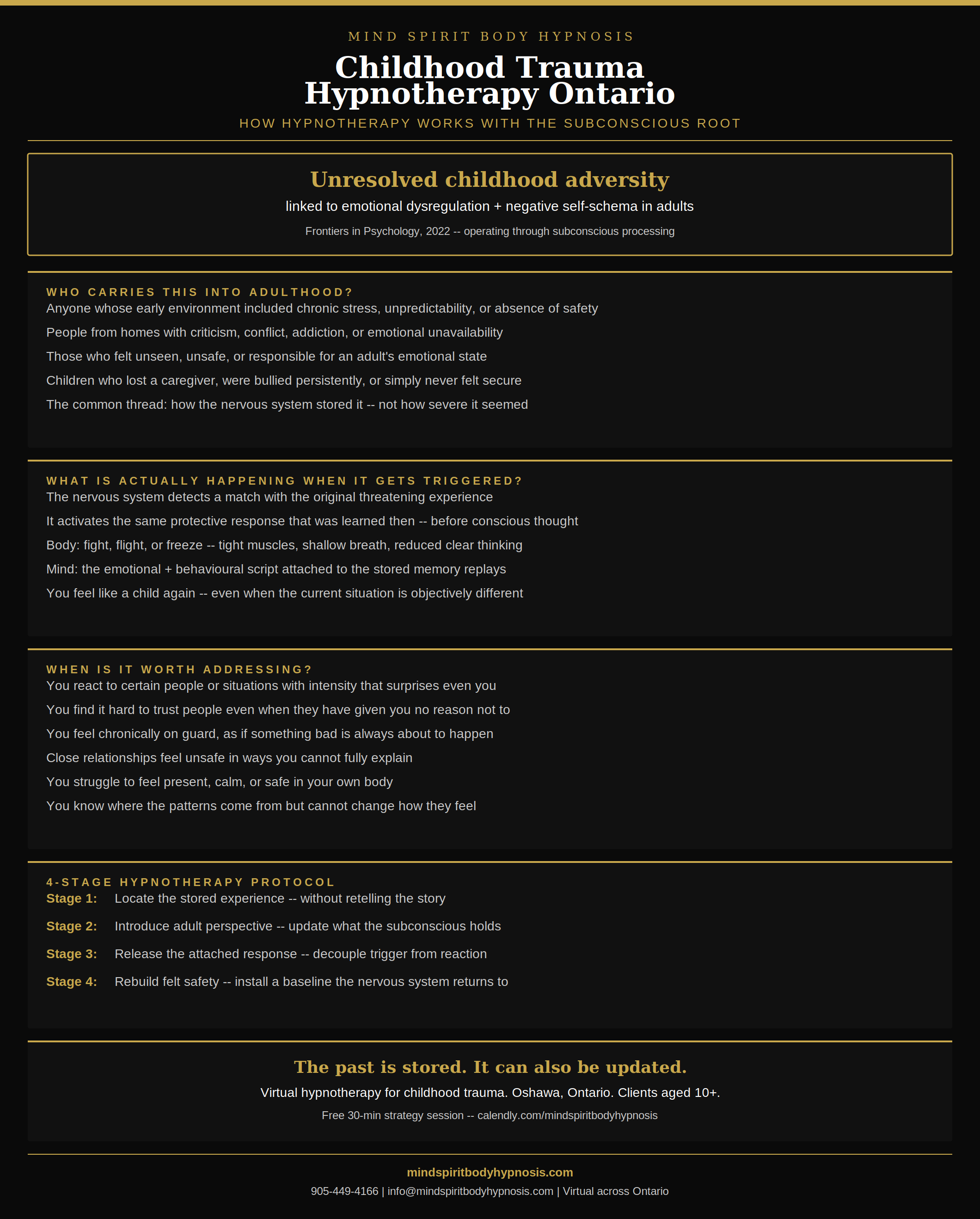
How Hypnotherapy Works With Childhood Trauma at the Source
At Mind Spirit Body Hypnosis, childhood trauma hypnotherapy for Ontario clients is structured around four stages.
Stage 1: Locate the stored experience. This is not about telling the story again. In trance, the subconscious reveals what it has been organizing around, often with more clarity and less distress than a conscious recounting would produce. The aim is to find where the belief or response pattern was first filed, not to re-traumatize.
Stage 2: Introduce the adult perspective. The child who stored the original experience did not have the resources, context, or understanding that the adult now has. In trance, those resources can be brought into contact with the stored experience. The subconscious can update its response when it receives information it did not have at the time.
Stage 3: Release the attached response. The emotional and physical response pattern attached to the stored experience can be decoupled from the trigger. The memory does not need to be erased. What changes is the charge and the automatic response it produces.
Stage 4: Rebuild a sense of safety. Many clients who carry childhood trauma hypnotherapy Ontario practitioners work with have never had a baseline of felt safety in their nervous system. Hypnotherapy installs that experience directly, not as a concept but as a felt state the subconscious learns to return to.
More about Fanis's approach and background is on the about page.
Frequently Asked Questions
How does childhood trauma show up in adult life if I do not remember it clearly? The subconscious stores emotional and sensory information even when conscious memory is incomplete. Adults often carry the effects of early experiences as patterns of reaction, physical sensation, or chronic emotional states, without clear narrative recall. You do not need to remember the details for the stored response to be active.
Who is most likely to carry unresolved childhood trauma into adulthood? Anyone whose early environment included chronic stress, emotional unpredictability, loss, criticism, conflict, or a significant absence of safety or attunement. This is more common than people expect and is not limited to people who experienced dramatic or acute events. Subtle but persistent early experiences can be just as formative.
What actually happens in the body when an old trauma gets triggered? The nervous system identifies a match between the current situation and the stored threat memory and activates the same protective response that was learned then. This produces physical changes, including a faster heart rate, tighter breathing, and reduced access to clear thinking, before conscious awareness has a chance to evaluate the situation.
When should I consider hypnotherapy for childhood experiences? When past experiences are producing patterns in the present that you cannot change through understanding alone. When you find yourself reacting in ways that feel disproportionate or automatic. When you have talked about what happened, but the reactions persist. That gap between knowing and feeling is exactly where hypnotherapy is designed to work.
Why does talking about childhood trauma not always make it better? Because trauma is stored subconsciously and in the body, not primarily in the story. Talking builds understanding at the conscious level, which is valuable but does not always reach the stored pattern underneath. Hypnotherapy works at the subconscious level where the response was originally filed.
Is hypnotherapy safe for trauma? Yes, when conducted by a trained practitioner who understands how to work with stored experience without retraumatizing. My approach does not require clients to re-live or repeatedly recount what happened. The aim is to access and update the stored response, not to intensify it.
How is hypnotherapy different from talk therapy for trauma? Talk therapy primarily works at the conscious and emotional level, building insight and narrative integration. Hypnotherapy works directly with the subconscious, where the stored response pattern lives. The two approaches are complementary. Hypnotherapy is not a replacement for talk therapy but addresses a level that talk therapy does not always reach.
Can adults heal from things that happened decades ago? Yes. The subconscious does not have a deadline for updating a stored pattern. The original experience may have happened forty years ago, but the subconscious is operating in the present, and it is accessible in the present. Clients often describe a shift that happens faster than they expected once the work is targeted at the right level.
Do I have to talk about what happened in detail? No. Hypnotherapy does not require a detailed account of the original experience. In trance, the subconscious can access and work with what it holds without the client needing to narrate every detail consciously. Many clients find this a significant relief, particularly those who have told their story many times without finding it helped.
WHAT MY CLIENTS SAY
“Thank you so much Fanis for your enduring commitment to my health and well being. You are truly dedicated to your craft and to your clients. You stuck with me well beyond the initial timeline set for my progress and worked with me during travel cancellations, time changes and even a hurricane! Your belief in me, in yourself and in the process established a steady and stable foundation for my continued growth and recovery. And if I ever need a little support or boost, I trust you will be there if I come knocking. Mahalo nui loa! In gratitude.” — Jill R.
Ready to Take the Next Step?
If you are ready to stop carrying something that happened a long time ago into every day of the life you are living now, I would love to help.
I offer a free 30-minute virtual strategy session for new clients across Ontario. No pressure. Just an honest conversation about what you are experiencing and whether hypnotherapy might be the right next step.
Book your free session: calendly.com/mindspiritbodyhypnosis
Call or text: 905-449-4166
Email: info@mindspiritbodyhypnosis.com
Visit: mindspiritbodyhypnosis.com
RECOMMENDED READING
Serving clients virtually across Ontario, including Durham Region, Toronto, Canada, and beyond.
Disclaimer: This article is for informational purposes only and does not constitute medical or psychological advice. Hypnotherapy, NLP, and EMDR are complementary approaches and are not a substitute for diagnosis or treatment by a qualified healthcare provider. Please consult a licensed professional if you have concerns about your mental or physical health.
Written by Fanis Makrigiannis | Certified Hypnotherapist & NLP Master Practitioner | Mind Spirit Body Hypnosis.