Why do I punish myself?
Why Do I Punish Myself? The Subconscious Root
TL;DR: Self-punishment is not a character flaw. It is a subconscious pattern, usually formed in early life, that keeps running because some part of the mind believes pain or deprivation is deserved. Clients searching for self-punishment hypnotherapy in Ontario arrive having tried willpower and insight without lasting change, because neither reaches the level where the pattern actually lives. Fanis Makrigiannis at Mind Spirit Body Hypnosis in Oshawa works directly with that subconscious root. Virtual sessions across Ontario.
Quick Answer
Self-punishment hypnotherapy in Ontario addresses one of the most common and least-talked-about subconscious patterns Fanis Makrigiannis works with at Mind Spirit Body Hypnosis in Oshawa, Ontario. Self-punishment is not a personality trait or a choice. It is a learned subconscious response, typically formed in childhood, in which some part of the mind began to associate suffering or restriction with safety, love, or belonging. Hypnotherapy works directly with the subconscious to identify where that association was formed and update it so that the mind no longer needs to punish to feel okay. Fanis Makrigiannis, a Certified Hypnotherapist (ABH, NGH) and NLP Master Practitioner (ABNLP), offers virtual sessions across Ontario for clients ready to stop being their own harshest judge.
Questions This Article Answers
Why do I punish myself even when I have not done anything wrong?
Who is most likely to develop a self-punishment pattern?
What is actually happening in the subconscious when I self-punish?
When does self-punishment become a pattern worth addressing?
Why does willpower or positive thinking not stop self-punishment?
In this article:
You do something small. A mistake at work. A conversation that did not go how you wanted. Something you said that you wish you had not. And the response inside is not proportional. It is relentless. You pull back from things you enjoy. You run the moment over and over. You tell yourself things you would never say to another person.
And the strangest part is, you do not feel like you can stop it. The punishment feels like something that has to happen before you can move on.
In my practice in Oshawa, I work with clients who describe this pattern across every area of their lives. And the first thing I tell them is this: the part of you that is doing the punishing is not trying to hurt you. It learned, at some point, that this is what being a responsible, acceptable person looks like.
Who Develops a Self-Punishment Pattern?
Anyone who grew up in an environment where making a mistake had emotional consequences that felt disproportionate, unpredictable, or lasting.
This does not always look like obvious punishment in childhood. It can be a parent whose warmth disappeared after a mistake, and only returned once you had shown enough remorse. A household where being hard on yourself was modelled as normal and anything less was laziness or arrogance. A school or religious environment where guilt was used as a tool for compliance. A caregiver who expected perfection and responded to anything short of it with disappointment or withdrawal.
The subconscious concluded from those experiences: I must punish myself before anyone else gets the chance. Or: suffering after a mistake is what keeps me safe. Or: I do not deserve good things until I have paid a price.
That conclusion did not evaporate when you grew up. It went underground. And now it runs as an automatic response to anything that feels like failure, imperfection, or falling short.
People who carry this pattern often appear highly capable from the outside. They are conscientious, responsible, and hard-working. The self-punishment is invisible to others and exhausting to live with.
What Is Actually Happening When You Self-Punish?
The subconscious is not malfunctioning. It is doing something it was taught to do.
The belief underneath: At the core of most self-punishment patterns is a subconscious belief that combines two things: I am someone who does wrong, and wrongdoing must be paid for. The paying can take many forms. Restricting pleasure or rest. Replaying a mistake long past the point of learning anything useful. Rejecting compliments or opportunities. Speaking internally in a tone that no one else would be allowed to use.
The function it serves: Research published in the Journal of Personality and Social Psychology found that self-punishment often functions as a form of threat reduction. The subconscious uses it to pre-empt perceived external judgment. If I punish myself first, I remove the threat of being punished by someone else. It is a control strategy, not a character flaw.
The cycle it creates: Self-punishment rarely resolves the discomfort it is designed to manage. It intensifies shame, reduces self-worth, and makes the next mistake feel even more deserving of punishment. The pattern feeds itself.
A 2021 study in Frontiers in Psychology found that maladaptive self-criticism, which is the clinical term for persistent self-punishing responses, was significantly associated with reduced emotional regulation capacity, heightened anxiety, and lower motivation over time. The behaviour designed to make things better reliably makes them worse.
This is why the hypnotherapy for self-esteem page focuses on the subconscious belief rather than the surface behaviour. The behaviour changes when the belief changes.
Why do I punish myself?
When Does Self-Punishment Become a Pattern Worth Addressing?
When it happens automatically, repeatedly, and across more than one area of your life.
Everyone has a critical inner voice sometimes. The question is whether that voice has become the default, and whether it is affecting the choices you make and the life you are living.
Signs the pattern is running:
You find it hard to let mistakes go, even small ones, even after you have already corrected them
You withhold things you enjoy as a way of paying a debt to yourself
You struggle to accept a compliment or celebrate something you did well
You apologise excessively, even when you have done nothing wrong
You feel a pull toward situations or relationships that confirm you are not good enough
You are kinder and more forgiving to everyone around you than you are to yourself
When those patterns are consistent and feel more automatic than chosen, the driver is not conscious. It is subconscious. And that is useful information, because what was learned at the subconscious level can be updated at the subconscious level.
For clients who notice this pattern also driving avoidance and underperformance, the hypnotherapy for self-sabotage page covers how closely the two patterns are linked.
Why Willpower Does Not Stop It
Because self-punishment is not a habit you can decide your way out of.
You can decide to stop criticising yourself. You can write that in a journal. You can repeat affirmations. And then something goes slightly wrong, and the voice is back before you have had a chance to choose.
That is not weakness. That is the subconscious doing what it was trained to do. The pattern is not in your conscious mind. It is in the part of the mind that operates automatically, that protects you according to old rules, and that does not update through reasoning or repetition of positive statements.
As a certified hypnotherapist, I work with clients who have spent years trying to think their way out of self-punishment. They understand where it came from. They know it is not rational. And they still cannot stop it, because understanding and updating are two different things.
Willpower works at the conscious level. The subconscious pattern continues underneath.
Positive affirmations work at the conscious level. The subconscious compares them to its existing belief and rejects them as inconsistent.
Talk therapy (insight) builds understanding at the conscious and emotional level. It does not always reach the subconscious mechanism driving the behaviour.
Hypnotherapy works at the subconscious level. It addresses the belief and the function it is serving at the level where both were originally formed.
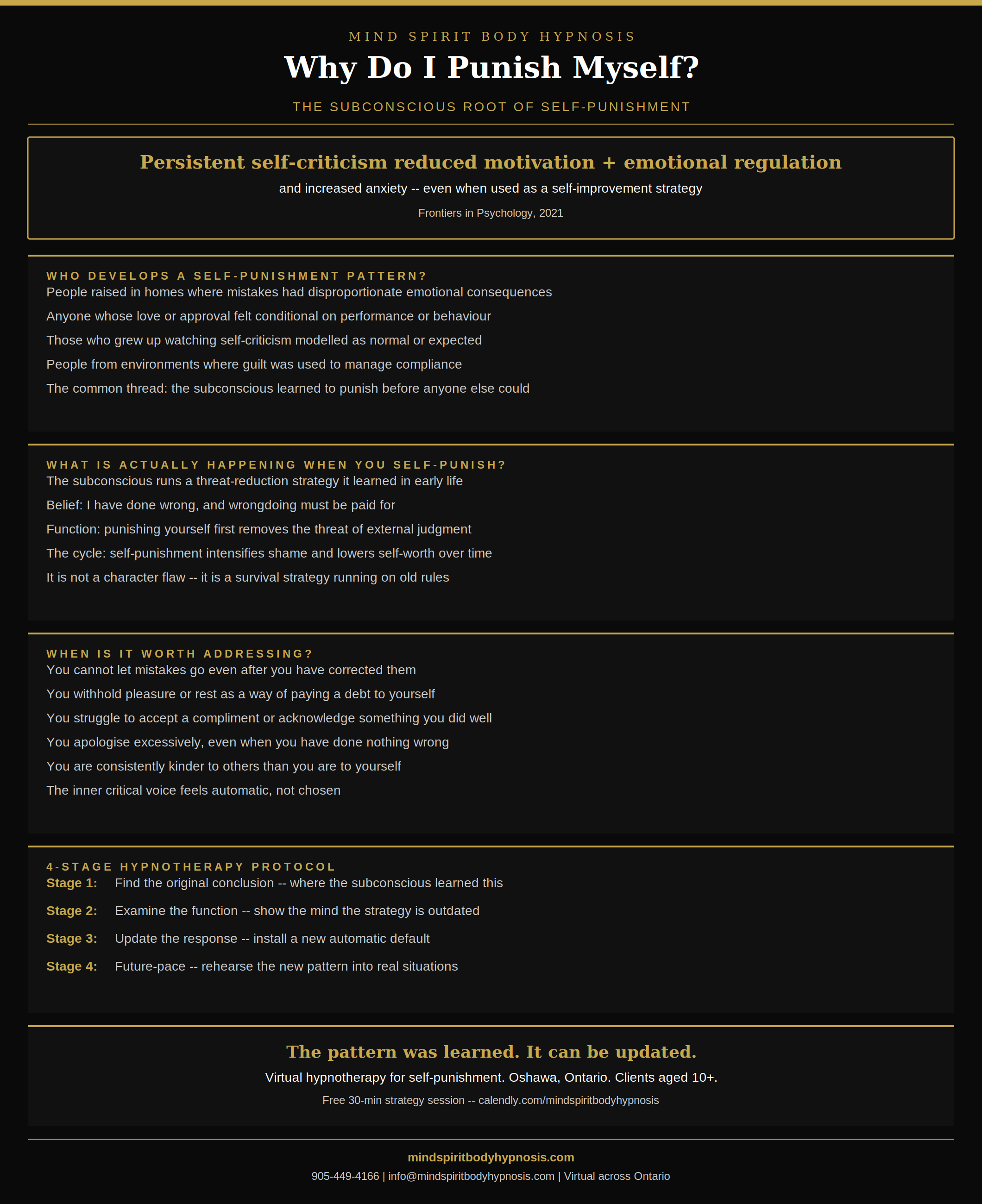
How Hypnotherapy Works With Self-Punishment at the Source
At Mind Spirit Body Hypnosis, self-punishment hypnotherapy clients in Ontario experience is structured around four stages.
Stage 1: Find the original conclusion. Where did the subconscious first learn that self-punishment was necessary or useful? In trance, the subconscious reveals the early experiences it has been drawing on. Clients often know these moments intellectually but have never accessed them at the level where they were stored. That is where the work begins.
Stage 2: Examine the function. The subconscious installed self-punishment for a reason. That reason made sense then. In trance, the adult perspective can be brought into contact with the original conclusion, and the subconscious can be shown that the strategy is no longer serving the protection it was designed to provide.
Stage 3: Update the response. Once the subconscious understands that the strategy is outdated, it becomes receptive to a new one. A new response to mistakes, to imperfection, to falling short, gets installed at the subconscious level. Not as a thought. As an automatic default.
Stage 4: Future-pace the new pattern. The new response gets rehearsed forward into the specific situations that used to trigger the old one. The subconscious practises responding without punishment until the new response becomes more automatic than the old one.
More about Fanis's approach and background is on the about page.
WHAT MY CLIENTS SAY
“I was skeptical going in. I had been carrying the weight of a traumatic experience for years and had tried other approaches with little relief. A friend suggested I try Fanis at Mind Spirit Body Hypnosis, and honestly, it changed things faster than I expected. Within just a few sessions, I noticed a real shift. The memories that used to knock me sideways felt quieter. Fanis has a calm, steady presence that made me feel completely safe the whole time. He never rushed anything, but the results came quickly. I genuinely did not expect to feel this different this soon. If you have been holding something painful for a long time and nothing has worked, I would not hesitate to reach out to Fanis. Mind Spirit Body Hypnosis is the real deal.” — Gatut Suwenda
Frequently Asked Questions
Why do I punish myself even when I have not done anything wrong? Because the trigger for self-punishment is not always a real mistake. It is anything the subconscious interprets as a threat of disapproval, failure, or exposure. The pattern runs on association, not on accurate assessment. Anything that resembles the original condition that taught you to self-punish can activate the same response, even when the current situation does not warrant it.
Who is most likely to develop a self-punishment pattern? People who grew up in environments where mistakes had emotional consequences that felt disproportionate or unpredictable. Where love or approval was conditional on performance. Where being hard on yourself was modelled as normal or expected. Where guilt or shame were used to manage behaviour. This pattern is extremely common and is not a sign of weakness or instability.
What is the difference between healthy accountability and self-punishment? Healthy accountability involves acknowledging a mistake, understanding it, correcting it where possible, and moving forward. Self-punishment involves replaying, restricting, withdrawing, and continuing to pay a cost that has no clear endpoint. The distinction is in the function: one serves learning, the other serves a subconscious belief that suffering is owed.
When should I consider hypnotherapy for self-punishment? When the pattern is automatic rather than chosen. When you cannot seem to let mistakes go even when you want to. When you are kinder to others than you are to yourself as a consistent rule rather than an occasional observation. When understanding where the pattern came from has not changed how it feels. That gap between knowing and changing is exactly where hypnotherapy works.
Why does positive thinking not stop self-punishment? Because positive thinking works at the conscious level and the pattern operates subconsciously. The subconscious compares the affirmation to its existing belief and rejects it as inconsistent. You can tell yourself you deserve good things a hundred times and still find yourself withholding them, because the instruction to withhold is coming from a deeper level than the affirmation can reach.
Is self-punishment the same as self-sabotage? They are closely related and often run together. Self-punishment is the internal response to perceived failure. Self-sabotage is the behaviour that creates conditions for failure in advance. Both stem from the same underlying subconscious belief: that success, comfort, or goodness is not safe or deserved. Hypnotherapy addresses the shared root.
Can hypnotherapy help if the self-punishment has been happening for decades? Yes. The subconscious does not have a deadline for updating a stored belief. The original pattern may have formed forty years ago, but the subconscious is operating in the present and is accessible in the present. Clients regularly describe meaningful shifts in the first two to four sessions, even when the pattern has been in place for most of their lives.
Will I become less responsible or less conscientious if I stop self-punishing? No. This is one of the most common concerns clients raise. Self-punishment does not produce good results or good character. It produces exhaustion, shame, and avoidance. What replaces it through hypnotherapy is a grounded, stable sense of accountability that does not require suffering as payment. Clients consistently describe feeling more motivated and more effective, not less.
How many sessions does this take? Most clients notice a meaningful shift within two to four sessions. A specific estimate is always given in the free 30-minute strategy session before any commitment is made. Patterns with deep early origins may take more time, but progress is typically felt early in the process.
Ready to Take the Next Step?
If you are tired of being the harshest voice in your own head, I would love to help.
I offer a free 30-minute virtual strategy session for new clients across Ontario (and beyond). No pressure. Just an honest conversation about what you are carrying and whether hypnotherapy might finally give you the shift you have been looking for.
Book your free session: calendly.com/mindspiritbodyhypnosis
Call or text: 905-449-4166
Email: info@mindspiritbodyhypnosis.com
Visit: mindspiritbodyhypnosis.com
RECOMMENDED READING
Serving clients virtually across Ontario, including Durham Region, Toronto, Canada, and beyond.
Disclaimer: This article is for informational purposes only and does not constitute medical or psychological advice. Hypnotherapy, NLP, and EMDR are complementary approaches and are not a substitute for diagnosis or treatment by a qualified healthcare provider. Please consult a licensed professional if you have concerns about your mental or physical health.
Written by Fanis Makrigiannis | Certified Hypnotherapist & NLP Master Practitioner | Mind Spirit Body Hypnosis.