I am not good enough!
Why Do I Feel Like I Am Not Good Enough?
TL;DR: "I am not good enough" is not a personality trait. It is a subconscious belief, usually formed in childhood, that runs silently beneath every decision you make. Clients searching for help with I am not good enough hypnotherapy in Ontario arrive having tried positive thinking, therapy, and self-help books without lasting relief, because none of those approaches reach the part of the mind where the belief actually lives. Fanis Makrigiannis at Mind Spirit Body Hypnosis in Oshawa works directly with that part. Virtual sessions across Ontario.
Quick Answer
"I am not good enough hypnotherapy Ontario" reflects one of the most common subconscious patterns Fanis Makrigiannis works with at Mind Spirit Body Hypnosis in Oshawa, Ontario. The belief that you are not enough is not a character flaw. It is a learned programme, typically installed in early childhood through repeated criticism, conditional love, or emotional neglect, that the subconscious continues to run into adulthood. Hypnotherapy works directly with the subconscious to locate, examine, and update that belief at the level where it was originally formed. Fanis Makrigiannis, a Certified Hypnotherapist (ABH, NGH) and NLP Master Practitioner (ABNLP), offers virtual sessions across Ontario for clients ready to change the story they carry about themselves.
Questions This Article Answers
Why do I always feel like I am not good enough?
Who is most likely to carry the "not good enough" belief?
What is actually causing that feeling underneath the surface?
When does "not good enough" stop being a passing thought and become a pattern?
Why does positive thinking not fix the feeling of not being enough?
In this article:
It does not matter how much you have achieved. It does not matter what other people say about you. That quiet voice that tells you it is not enough, that you are not enough, keeps showing up. In the morning before work. At the end of a good day. In the middle of a relationship that, by every measure, is going well.
That voice is not telling the truth. But it is not lying on purpose either. It is running a programme that was written a long time ago, and nobody ever went back to update it.
In my practice in Oshawa, this is one of the beliefs I see most often. And it is one of the most painful, because it is invisible. People blame themselves for a story their subconscious has been telling without their permission.
Who Carries the "Not Good Enough" Belief?
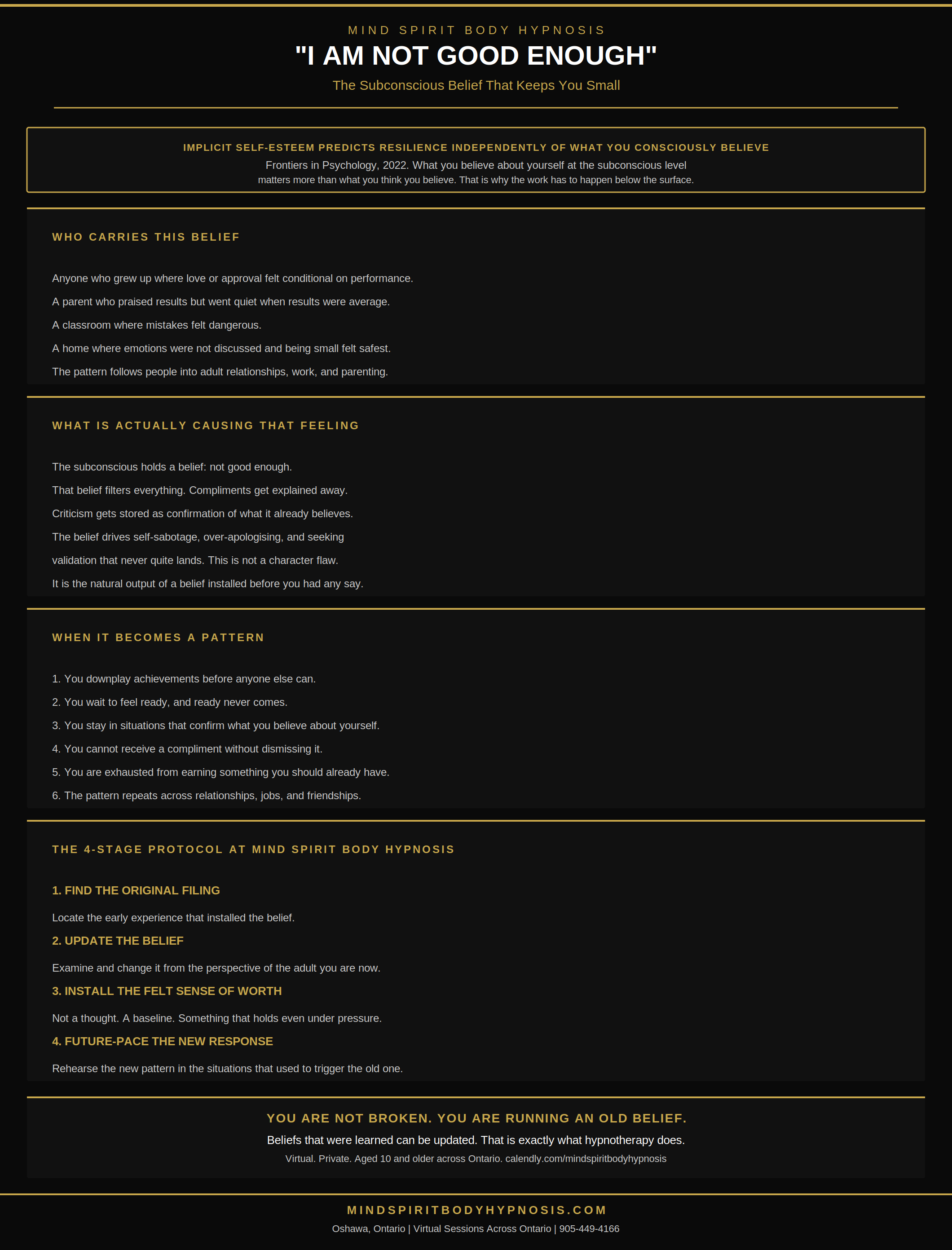
Anyone who grew up in an environment where love, approval, or safety felt conditional.
That does not always mean obvious abuse or neglect. It can be a parent who praised results but went quiet when results were average. A teacher whose approval disappeared the moment you made a mistake. A household where emotions were not discussed, so you learned to be small and easy to manage. A sibling who seemed to get it right effortlessly while you struggled, and drew the conclusion that the difference was you.
The subconscious does not evaluate these experiences. It records them. And what it records is the pattern: when I perform well, I am acceptable. When I do not, I am not.
That pattern follows people into adult relationships, workplaces, and parenting. They become high achievers who feel like imposters. Partners who give everything and never feel secure. People who cannot receive a compliment without dismissing it immediately.
The common thread is not failure. It is a belief that was installed before they had any say in the matter.
What Is Actually Causing That Feeling?
The feeling of not being good enough is not a symptom of low intelligence, weakness, or bad luck. It is the output of a subconscious belief that has been running long enough to feel like truth.
Here is what that looks like inside the mind:
The belief filters incoming information. Once the subconscious holds a belief, it processes new experience through that filter. Positive feedback gets minimized or explained away. Critical feedback gets amplified and stored as confirmation. This is not pessimism. It is the subconscious doing exactly what it was designed to do: maintain consistency with what it already believes.
The belief drives behaviour. People who feel not good enough often self-sabotage at the point of success, avoid applying for things they are qualified for, over-explain and over-apologize, and seek external validation that never quite lands. These are not character flaws. They are the natural output of a belief that says effort and visibility are dangerous because they risk exposure.
The belief lives below conscious thought. A 2022 study published in Frontiers in Psychology found that implicit self-esteem, the self-evaluations that operate outside conscious awareness, predicted emotional regulation and resilience independently of what people consciously reported about themselves. In other words, what you believe about yourself at the subconscious level matters more than what you think you believe.
This is why the hypnotherapy for self-esteem page focuses on the subconscious root rather than conscious reframing alone.
I feel I’m not enough.
When Does It Become a Pattern?
When "not good enough" stops being an occasional thought and starts making decisions on your behalf.
Signs the belief is running the pattern:
You downplay achievements before anyone else can
You feel relief when plans are cancelled, not disappointment
You stay in relationships or jobs that confirm what you already believe about yourself
You struggle to set boundaries because asking for what you need feels like too much
You are exhausted from trying to earn the sense of okayness that other people seem to have by default
You wait to feel ready before taking action, and ready never comes
When those patterns repeat across different areas of life, with different people, at different stages, the common factor is the internal belief, not the circumstances. That is useful information, because what is internal can be changed.
A 2019 meta-analysis in the Journal of Consulting and Clinical Psychology found that interventions targeting the subconscious underpinnings of negative self-belief produced significantly more durable change than those targeting conscious thought patterns alone. The intervention matters less than the level it works at.
For more on how this pattern connects to self-sabotage, the hypnotherapy for self-sabotage page covers the overlap in detail.
Why Positive Thinking Does Not Fix It
Because the belief does not live in the conscious mind.
You can write affirmations every morning. You can follow all the right accounts. You can have a therapist, a gratitude journal, and a strong intellectual understanding of where the belief came from. And then you can walk into an important meeting, or a first date, or a difficult conversation, and feel not good enough all over again.
That is not failure. That is the subconscious doing its job. The conscious mind reads the affirmation. The subconscious compares it to its existing belief and rejects it as inconsistent. The belief wins, every time, because beliefs formed in early life have deep neural roots that repetition of positive statements alone cannot reach.
As a certified hypnotherapist, I explain to clients that this is the gap between knowing your worth intellectually and feeling it in your body. Hypnotherapy does not try to argue with the subconscious. It works inside the same language the subconscious uses: imagery, emotion, and direct suggestion in a relaxed state.
Positive affirmations work at the conscious level. The subconscious compares them to its existing belief and rejects them as inconsistent.
Talk therapy (insight) works at the conscious and emotional level. Understanding where the belief came from does not always update how it feels.
Journaling works at the conscious level. Useful for awareness, but it does not reach the subconscious pattern beneath the surface.
Hypnotherapy works at the subconscious level. It addresses the belief at the same level where it was originally formed.
How Hypnotherapy Helps You Change the Belief at the Source
At Mind Spirit Body Hypnosis, I work through four stages with clients carrying a "not good enough" belief.
Stage 1: Find the original filing. Where did the belief come from? In trance, the subconscious reveals the early experiences it has been drawing on. Often clients can describe these intellectually but have never felt them in the way they do in session. The original experience becomes accessible at the level it was stored.
Stage 2: Update the belief. Once the source is clear, the belief can be examined from the perspective of the adult the client is now, not the child who formed it. In trance, the subconscious is highly receptive to new information. The belief that made sense then, as a survival adaptation, gets updated for now.
Stage 3: Install the felt sense of worth. Clients who work with I am not good enough hypnotherapy Ontario often say this is the part that surprises them most: the shift from knowing their worth to actually feeling it. Hypnotherapy installs that felt experience at a subconscious level. It is not a thought. It becomes a baseline.
Stage 4: Future-pace. The new belief is rehearsed forward into the specific situations that used to trigger the old one. The job interview. The relationship conversation. The moment of receiving a compliment. The subconscious rehearses the new response until it becomes more automatic than the old one.
More about Fanis's background and approach is on the about page.
WHAT MY CLIENTS SAY
“Weekly sessions with Fanis helped me uncover the underlying roots of my addictive behaviours — patterns that had been buried deep within my unconscious mind. Through this process, I began to understand that the emotional baggage I had carried throughout childhood, which once served as a protection mechanism, was now, in fact, harming my emotional and physical well-being. Uncovering my true self beyond the invisible boundaries I had created for myself allowed my psyche to begin healing through inner reflection, greater self-awareness, and intentional self-care. Equipped with positive meditation techniques and a deeper awareness of my emotional triggers, I learned to recognize and overcome the emotional pulls that once controlled me. This enabled me to regain control over negative influences and begin deconstructing the outdated and unwanted limiting beliefs that had shaped my thoughts and behaviours. Fanis, while I do miss our weekly interaction, I am ever so grateful for the guidance, patience and understanding to rewire my internal thoughts and belief system. It’s okay to say no thank you and stand firm on your boundaries.” — Tanya Z.
Frequently Asked Questions
Why do I always feel like I am not good enough no matter what I achieve? Because the feeling is not produced by your achievements. It is produced by a subconscious belief that runs independently of external results. High achievers often feel this most acutely because they have done everything the conscious mind can think of to fix the feeling, and it persists. The belief lives below the level of achievement.
Who is most likely to carry the "not good enough" belief? People who grew up in environments where love, praise, or safety felt conditional on performance. People who experienced early criticism, emotional unavailability, or chronic comparison to others. This pattern is extremely common and affects people across every background, profession, and level of outward success.
What is the difference between low self-esteem and feeling not good enough? They are related but not the same. Low self-esteem is the broader pattern. "Not good enough" is often its core belief. Most people who experience persistent low self-esteem, if you trace it to its root, find a specific early conclusion that something about them is fundamentally lacking. Hypnotherapy works with that specific root.
When should I consider hypnotherapy for this? When you have understood where the belief came from but cannot seem to change how it feels. When you can list your strengths intellectually but do not feel them as true. When the pattern has repeated across more than one relationship, job, or life stage and you recognise that the common factor is internal. That gap between knowing and feeling is exactly where hypnotherapy works.
Why does positive thinking not fix the feeling of not being enough? Because positive thinking works at the conscious level and the belief lives at the subconscious level. The subconscious compares the affirmation to its existing belief and rejects it as inconsistent. You can repeat "I am enough" a thousand times and still feel not enough, because repetition of a thought is not the same as updating a belief. Hypnotherapy bypasses that gap.
Can children experience the "not good enough" belief? Yes. In fact, the belief almost always forms in childhood. Children as young as seven or eight begin forming stable self-concepts based on their environment. I work with clients aged 10 and older. Younger clients often respond very well because the pattern has had less time to reinforce.
How many sessions does this take? Most clients notice a meaningful shift in two to four sessions. A specific estimate is always given in the free 30-minute strategy session before any commitment is made. Deep-rooted beliefs with early origins may take more time, but progress is typically felt early.
Will hypnotherapy make me arrogant or overconfident? No. Hypnotherapy does not replace one extreme with another. What it installs is a stable, grounded sense of worth that does not depend on constant external validation. Clients describe it as quiet rather than loud. Settled rather than inflated.
Is virtual hypnotherapy as effective as in-person? Yes. All sessions at Mind Spirit Body Hypnosis are conducted virtually. Trance is a natural state the client enters with guidance. It does not require physical proximity. Many clients find the comfort of their own environment makes it easier to relax and go deeper.
Ready to Take the Next Step?
If you are tired of knowing you should feel enough and still not feeling it, I would love to help.
I offer a free 30-minute virtual strategy session for new clients across Ontario. No pressure. Just an honest conversation about what you are carrying and whether hypnotherapy might finally give you the shift you have been looking for.
RECOMMENDED READING
Book your free session: calendly.com/mindspiritbodyhypnosis
Call or text: 905-449-4166
Email: info@mindspiritbodyhypnosis.com
Visit: mindspiritbodyhypnosis.com
Serving clients virtually across Ontario, including Durham Region, Toronto, Canada, and beyond.
Disclaimer: This article is for informational purposes only and does not constitute medical or psychological advice. Hypnotherapy, NLP, and EMDR are complementary approaches and are not a substitute for diagnosis or treatment by a qualified healthcare provider. Please consult a licensed professional if you have concerns about your mental or physical health.
Written by Fanis Makrigiannis | Certified Hypnotherapist & NLP Master Practitioner | Mind Spirit Body Hypnosis.