Why Do I Stay?
Why Do I Stay in Situations That Are Bad for Me?
TL;DR: Staying in a painful relationship, job, or friendship isn’t weakness or stupidity. It is a subconscious pattern, often formed long before the current situation ever existed. Understanding why? I stay in bad relationships: clients ask about starts with the part of the mind that makes decisions below the level of conscious thought. Hypnotherapy works directly with that part. Fanis Makrigiannis at Mind Spirit Body Hypnosis in Oshawa offers virtual sessions across Ontario for clients ready to understand and change what is keeping them stuck.
Quick Answer
"Why do I stay in bad relationships?" is one of the most common questions people arrive with, and the answer is rarely what they expect. Staying in a harmful situation is not a failure of willpower. It results from subconscious programming, often rooted in early experiences, that associates familiarity with safety and change with threat. Fanis Makrigiannis, a Certified Hypnotherapist (ABH, NGH) and NLP Master Practitioner (ABNLP) at Mind Spirit Body Hypnosis in Oshawa, Ontario, works with clients across Ontario to identify and update the subconscious patterns that keep people in relationships, jobs, and friendships that no longer serve them.
Questions This Article Answers
Why do I keep staying in relationships that hurt me?
Who is most likely to get stuck in bad situations?
What is actually happening in the mind when we can't leave?
When does staying become a pattern rather than a choice?
Why is leaving so much harder than it looks?
In this article:
Why leaving feels impossible even when you know you should go
How hypnotherapy helps you understand and change the pattern
Most people who are stuck in a bad situation already know it is bad. They have known for a while. They have talked about it. They have made lists. They have had the conversation a hundred times in their head. And they are still there.
That is not confusion. That is not weakness. In my practice in Oshawa, it is one of the most painful things people carry, because they blame themselves for something that is not actually a choice they are making consciously.
Who Gets Stuck in Bad Situations?
Anyone can. But there are patterns.
People who grew up in environments where love felt conditional, unpredictable, or tied to performance tend to have a higher threshold for what they accept. Not because they do not know better. Because their nervous system learned, early on, that this is what closeness feels like.
People who were taught that their needs come last, that conflict is dangerous, or that loyalty means staying no matter what, carry those lessons into every relationship they have as adults. Those lessons live in the subconscious, not in the part of the mind that reads self-help books or listens to podcasts about setting boundaries.
This is not limited to romantic relationships. The same pattern shows up at work, where someone stays in a job that is draining them because leaving feels selfish or ungrateful. It shows up in friendships, where a person keeps showing up for someone who consistently lets them down, because saying "this is not working" feels like abandonment.
The common thread is not the situation. It is the internal programme running underneath it.
What Is Actually Keeping You There?
It is rarely just love. Or habit. Or finances. Those are the reasons that feel logical. The real reasons tend to be older.
Fear of the unknown. The current situation is painful, but it is familiar. Familiarity, to the subconscious, registers as safe. Change, even change toward something better, registers as a threat. The nervous system chooses the familiar pain over the uncertain possibility of something different.
A belief that this is what you deserve. This one rarely sounds like a belief. It sounds like a feeling. A quiet sense that maybe the other person is right. That maybe you are too much, not enough, or lucky to have what you have. That belief was installed somewhere, and it runs the decisions without announcing itself.
The sunk cost. The more time, energy, and identity you have invested in a situation, the harder it is to leave. The subconscious interprets leaving as admitting that all of that was wasted. Staying feels like protecting the investment, even when the investment has stopped paying back.
The hope that it will change. This is one of the most powerful hooks. The situation is not always bad. There are good moments, good days, good versions of the person or the job. The subconscious holds onto those and uses them as evidence that leaving would be premature.
A 2023 study published in the Journal of Personality and Social Psychology found that people consistently underestimate how much their emotional state in the moment influences their decision to stay in or leave a difficult relationship. When the emotional brain is activated, the rational mind has much less influence than people assume.
For a deeper look at how anxiety and stress patterns maintain situations like this, the hypnotherapy for anxiety and stress page covers the underlying nervous system response in detail.
Why we stay.
When Does Staying Become a Pattern?
When it happens more than once with different people, different jobs, or different friendships, and the common factor is always you.
That is not an accusation. It is actually useful information. It means the pattern is internal, which means it is changeable.
How the pattern becomes self-reinforcing:
A subconscious belief forms early (I am not enough / love requires sacrifice/conflict is dangerous)
The belief attracts situations that feel familiar and match the belief
Staying in those situations confirms the belief
The belief grows stronger, and the pattern becomes harder to see from the inside
Most people reach a point where they can name the pattern clearly. They can describe it to a therapist, write it in a journal, explain it to a friend. And then they stay anyway. That gap, between knowing and doing, is where the subconscious pattern is operating. Understanding it at the conscious level is not enough to change it.
What you can change consciously:
Recognizing the pattern
Setting an intention to leave
Understanding your worth intellectually
Planning the practical steps
What requires subconscious work:
Changing the emotional response to triggers
Following through when fear activates
Feeling your worth as true at a gut level
Tolerating the discomfort of actually taking those steps
Why Leaving Feels Impossible Even When You Know You Should Go
Because knowing and feeling are processed in completely different parts of the brain.
The prefrontal cortex, the rational thinking part, can read every article about toxic relationships, understand exactly what is happening, and construct a clear logical case for leaving. But the limbic system, the emotional and survival part, does not care about logic. It cares about threat, familiarity, and experience. When leaving triggers the limbic system, it floods the body with the same response as a physical threat. Racing heart, tight chest, inability to think clearly. In that state, leaving does not feel like freedom. It feels like danger.
This is why people say "I know I should leave but I just can't." They are being completely accurate. The knowing is real. The can't is also real. They are happening in different systems that are not communicating effectively.
Willpower alone does not bridge that gap. Neither does more information. What changes the pattern is working directly with the system that is running it.
As a certified hypnotherapist, I find this is one of the most important things to explain to clients who come in feeling ashamed about staying. You are not failing to make a choice. Your subconscious is making a very old choice on your behalf, and it is doing it fast.
For more on how the subconscious pattern of self-sabotage connects to staying stuck, the hypnotherapy for confidence and self-sabotage page covers this directly.
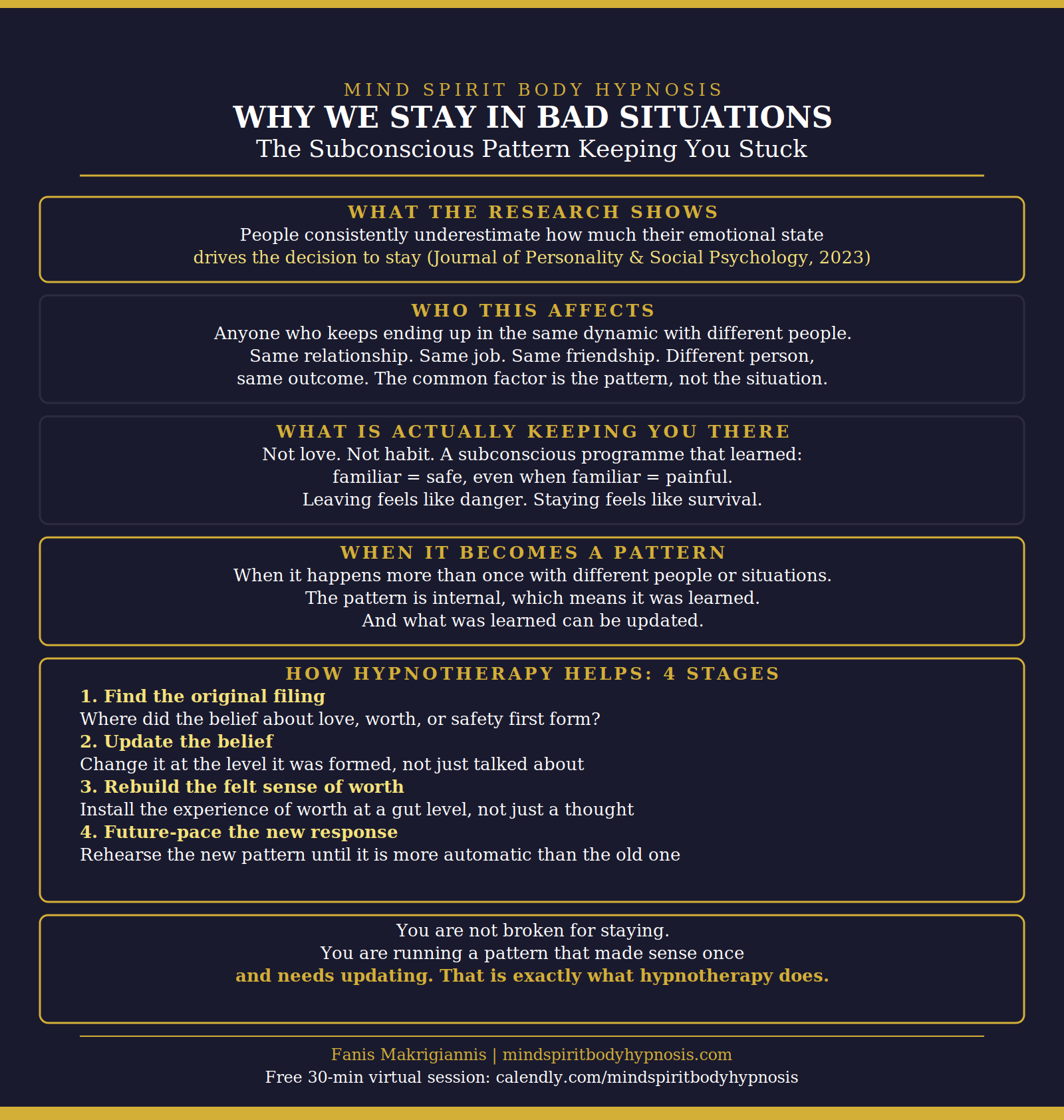
How Hypnotherapy Helps You Understand and Change the Pattern
Hypnotherapy works at the level where the pattern actually lives.
At Mind Spirit Body Hypnosis, I work through four stages with clients who are stuck in situations they cannot seem to leave.
Stage 1: Find the original filing. Where did the belief come from? What did a younger version of you learn about love, loyalty, worth, or safety? In trance, those early experiences are accessible in a way they often are not in a standard conversation. The subconscious reveals what it has been working from.
Stage 2: Update the belief. Once the original source is clear, the belief can be examined and changed at the level it was formed. Not argued with. Not talked out of. Updated. The subconscious responds to experience and suggestion in trance the same way it responded to the original experience that formed the belief.
Stage 3: Rebuild the felt sense of worth. Knowing you are worthy is different from feeling it. Hypnotherapy installs the felt experience of worth, safety, and self-trust at a subconscious level. Clients often describe this as the first time something they already knew intellectually became something they actually felt.
Stage 4: Future-pace the new response. The new pattern is rehearsed forward into the specific situations that previously triggered the old one. The difficult conversation. The moment of deciding. The morning after. The subconscious rehearses the new response until it is more automatic than the old one.
Clients across Ontario working through why I stay in bad relationships in Ontario often report that the shift is not a sudden dramatic decision. It is a quieting of the internal resistance, followed by clarity they had been waiting a long time for. More about my approach and background is on the about page.
Frequently Asked Questions
Why do I keep going back to a relationship I know is bad for me? Because the subconscious pattern that is driving the decision was formed before the current relationship existed. It associates the familiar, even when the familiar is painful, with safety. Going back is not irrational from the subconscious point of view. It is the safest option it knows. Hypnotherapy works to update what "safe" means at that level.
Who is most likely to get stuck in bad situations? People who grew up in environments where love felt conditional, unpredictable, or tied to performance tend to have a higher tolerance for painful situations. But this pattern can affect anyone. The subconscious learns from experience, and most people have had at least some experiences that taught them to accept less than they deserve.
What is the difference between choosing to stay and being stuck? A choice involves genuine options that feel equally available. Being stuck means one option, leaving, feels emotionally unavailable even when it is practically possible. Most people who are stuck can describe exactly what they should do. The issue is that the emotional system is not on board with what the rational mind knows.
When should I consider hypnotherapy for this kind of issue? When you have understood the pattern clearly but cannot seem to change it. When you know what you need to do but feel paralyzed when you try to do it. When you have repeated the same dynamic in more than one relationship, job, or friendship and recognise that the common factor is internal. That gap between knowing and doing is exactly where hypnotherapy works.
Is this just about romantic relationships? No. The same subconscious patterns show up in friendships where one person consistently gives more, in jobs where someone stays long past the point it stopped being good for them, and in family dynamics where someone keeps showing up for people who do not reciprocate. The relationship type is different. The underlying pattern is usually the same.
Can hypnotherapy help even if I am not ready to leave yet? Yes. In fact, most clients who come in are not ready to leave. They come in because they are tired of feeling stuck, not because they have made a decision. Hypnotherapy does not push you toward any outcome. It helps you understand what is actually running the pattern and gives your authentic self more access to the decision.
How many sessions will this take? Most clients notice a meaningful shift in two to four sessions. A specific estimate is always given in the free 30-minute strategy session before any commitment is made. Long-standing patterns with deep roots may need more time, but progress is usually felt early.
Will hypnotherapy make me leave a relationship? No. Hypnotherapy does not make decisions for you. It removes the subconscious interference that has been making genuine choice difficult. What you do with that clarity is entirely yours.
Can children or teenagers access this kind of support? Yes. I work with clients aged 10 and older. Younger clients who are in difficult friendship dynamics or family situations often respond very well to hypnotherapy because the patterns are less deeply reinforced and trance comes naturally to them.
WHAT MY CLIENTS SAY
“Thank you so much Fanis for your enduring commitment to my health and well being. You are truly dedicated to your craft and to your clients. You stuck with me well beyond the initial timeline set for my progress and worked with me during travel cancellations, time changes and even a hurricane! Your belief in me, in yourself and in the process established a steady and stable foundation for my continued growth and recovery. And if I ever need a little support or boost, I trust you will be there if I come knocking. Mahalo nui loa! In gratitude.” — Jill R.
Ready to Take the Next Step?
If you are tired of knowing what you should do and still not being able to do it, I would love to help.
I offer a free 30-minute virtual strategy session for new clients across Ontario. There is no pressure, just an honest conversation about what is keeping you stuck and whether hypnotherapy might finally give you the clarity you have been looking for.
Book your free session: calendly.com/mindspiritbodyhypnosis
Call or text: 905-449-4166
Email: info@mindspiritbodyhypnosis.com
Visit: mindspiritbodyhypnosis.com
recommended
Serving clients virtually across Ontario, including Durham Region, Toronto, Canada, and beyond.
Disclaimer: This article is for informational purposes only and does not constitute medical or psychological advice. Hypnotherapy, NLP, and EMDR are complementary approaches and are not a substitute for diagnosis or treatment by a qualified healthcare provider. Please consult a licensed professional if you have concerns about your mental or physical health.
Written by Fanis Makrigiannis | Certified Hypnotherapist & NLP Master Practitioner | Mind Spirit Body Hypnosis.