Can hypnosis help me feel lovable?
Why Do I Feel Like I Am Not Lovable?
TL;DR: Feeling unlovable is not a personality flaw, and it is not the truth. It is a subconscious belief, usually formed in early childhood, that shapes how you move through every close relationship you have as an adult. People searching for help with the fear of not being loved hypnotherapy Ontario often arrive having tried everything at the conscious level and finding that the feeling persists. Fanis Makrigiannis at Mind Spirit Body Hypnosis in Oshawa works at the subconscious level, where the belief actually lives. Virtual sessions across Ontario.
Quick Answer
The fear of not being loved hypnotherapy Ontario clients ask about is one of the most deeply rooted subconscious patterns Fanis Makrigiannis works with at Mind Spirit Body Hypnosis in Oshawa. Feeling unlovable is not a reflection of who you are. It is a belief that was formed, usually in early childhood, in response to experiences that taught the developing mind that love was conditional, inconsistent, or absent. Hypnotherapy works directly with the subconscious to locate the source of that belief and update it at the level where it was installed. Fanis Makrigiannis, a Certified Hypnotherapist (ABH, NGH) and NLP Master Practitioner (ABNLP), offers virtual sessions across Ontario for clients who are ready to stop carrying a story that was never truly theirs.
Questions This Article Answers
Why do I feel like I am not lovable even in a good relationship?
Who is most likely to carry the belief that they cannot be loved?
What is actually driving the fear of not being loved?
When does the feeling of being unlovable become a pattern?
Why does being loved by someone else not fix the feeling inside?
In this article:
You are in a relationship with someone who tells you they love you. And you cannot quite believe it. You wait for it to end. You look for the signs that they are about to leave. You do things to push them away and then panic when they start to go. Or you shut down entirely because getting close feels like setting yourself up to lose something.
This is not about the relationship. It is about a belief that has been running underneath every relationship you have ever had.
In my practice in Oshawa, the fear of not being loved is one of the most common things people carry in without naming it directly. It comes dressed as jealousy, or clinginess, or emotional unavailability, or a pattern of choosing people who confirm the belief. What it actually is, underneath all of that, is a subconscious conclusion formed a long time before the current person ever came into the picture.
Who Carries the Belief That They Are Not Loveable?
People who received early messages, directly or indirectly, that love had conditions attached.
That can look like an obvious absence: a parent who left, an emotionally unavailable caregiver, a childhood where nobody asked how you were feeling or responded when you said. It can also look like something subtler. A parent who loved deeply but expressed it through criticism. A household where affection was given when you performed well and withdrawn when you did not. A childhood where you were loved, but something happened that made you feel, at some level, that the love was fragile.
Children cannot evaluate those experiences the way an adult can. They cannot say: this is about my parent's limitations, not about my worth. What they conclude instead is simpler and more devastating: there is something about me that makes me hard to love.
That conclusion does not dissolve when childhood ends. It goes into the subconscious, and from there it shapes every relationship the person enters.
The pattern is not limited to romantic relationships. The same belief shows up in friendships, where a person gives far more than they receive because they do not feel entitled to equal care. It shows up at work, where someone cannot advocate for themselves because asking feels like risking rejection. It shows up in the relationship with themselves, as a chronic inability to extend the same kindness they give others.
What Is Actually Driving That Feeling?
The fear of not being loved is not produced by the current relationship or the current person. It is produced by a subconscious belief that was formed before any of those people existed.
Here is what is happening beneath the surface:
The belief creates a filter. Once the subconscious holds the belief that you are not lovable, it processes every interaction through that lens. Warmth gets explained away. Distance gets amplified. A partner who is simply tired becomes evidence of withdrawal. A friend who does not reply quickly becomes evidence of rejection. The belief is not looking for the truth. It is looking for confirmation of what it already knows.
The belief drives attachment behaviour. People who carry the fear of not being loved often develop anxious or avoidant attachment patterns. They either pursue connection desperately and feel relief that evaporates quickly, or they keep people at a distance to avoid the pain of eventual loss. Both strategies are the subconscious trying to manage a threat it has decided is real.
The belief sits below awareness. A 2021 study published in Attachment and Human Development found that early attachment patterns predicted adult relationship behaviour independently of conscious awareness or intention. People in the study could not explain why they responded the way they did. The pattern operated below the level of conscious choice.
This is why the hypnotherapy for anxiety page addresses attachment anxiety as part of the broader subconscious anxiety pattern, not as a separate problem.
Why do I feel unlovable?
When Does It Become a Pattern?
When the same dynamic repeats across different relationships with different people, and the only constant is you.
Signs the belief is making decisions on your behalf:
You choose partners who are emotionally unavailable or inconsistent, and feel most drawn to the ones who keep you uncertain
You feel safest when you are needed, not when you are loved
You sabotage relationships that feel too stable because you are waiting for them to end anyway
You cannot receive care, compliments, or affection without deflecting or dismissing it
You feel anxious when a partner or friend is simply quiet or busy, and interpret it as a sign that something is wrong
You stay in relationships that confirm what you already believe rather than challenging it
When those patterns keep appearing, they are not bad luck or poor choices. They are the subconscious organizing your life around the belief it holds.
A 2020 review in the Journal of Social and Personal Relationships found that negative implicit beliefs about one's own lovability predicted relationship dissatisfaction and instability more strongly than any external relationship factor. The problem was consistently internal, not situational.
For a deeper look at how this pattern connects to self-worth, the hypnotherapy for self-esteem page covers the underlying belief structure in detail.
Why Being Loved by Others Does Not Fix It
Because the belief does not update through experience alone.
Someone can love you consistently, warmly, and reliably for years, and the feeling of not being lovable can persist. This is one of the most confusing and painful parts of carrying this belief. The evidence is right there. And it does not land.
That is because the subconscious is not updating itself based on current experience. It formed a conclusion at a time when the child's survival felt dependent on reading the emotional environment correctly. That conclusion was filed as a core truth. Now, incoming experience gets filtered through that truth rather than updating it. The love your partner shows you enters the mind, gets compared to the core belief, and gets filed as temporary, luck, or a mistake they will correct when they see you more clearly.
Willpower does not change this. Understanding does not change this. Being loved by the right person does not change this, though many people spend years trying to find the one whose love would finally be enough to feel real.
As a certified hypnotherapist, the most important thing I explain to clients carrying the fear of not being loved that hypnotherapy in Ontario is looking for is this: the update has to happen at the level the belief was formed. That is the subconscious. And that is exactly where hypnotherapy works.
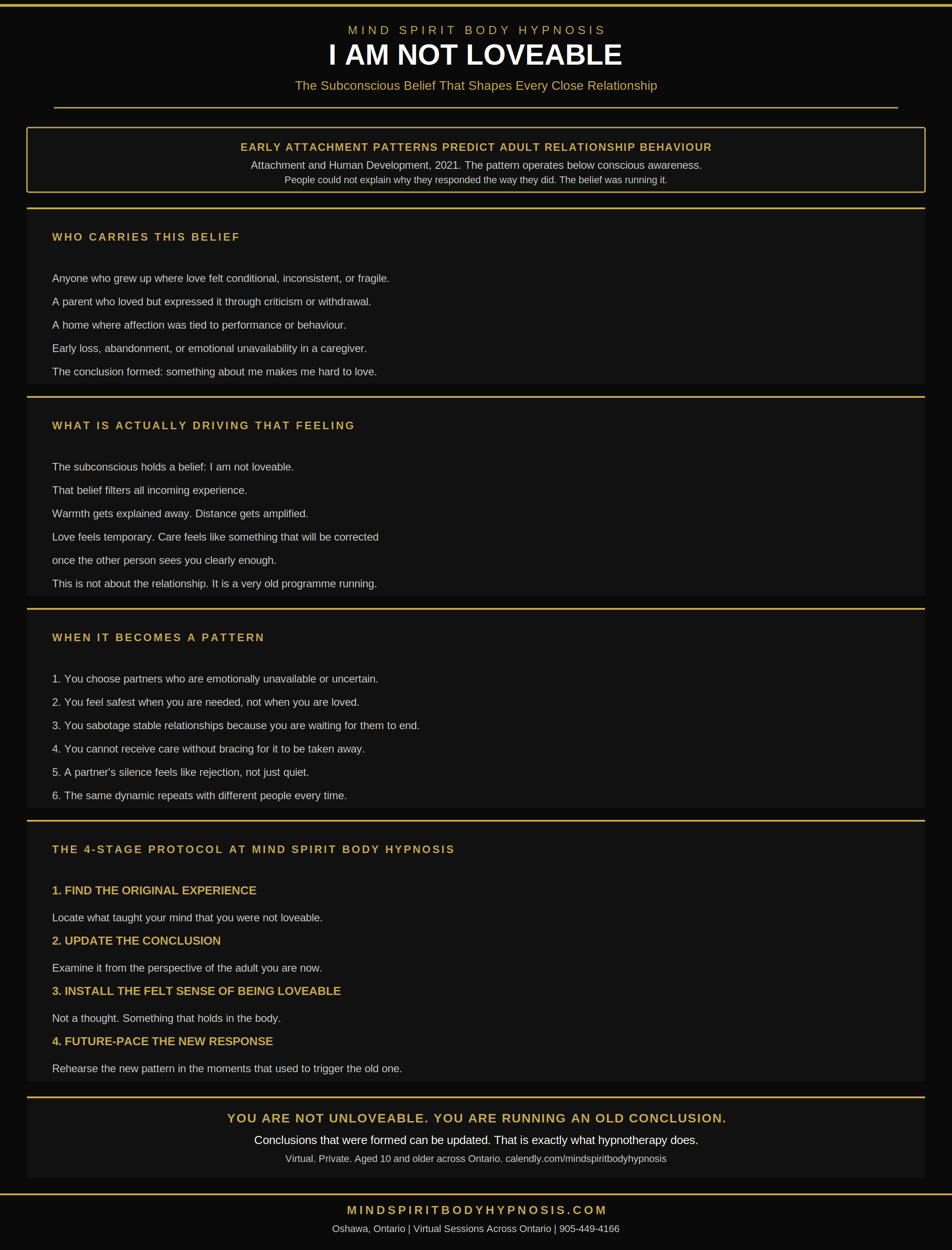
How Hypnotherapy Works With the Belief at Its Source
At Mind Spirit Body Hypnosis, I work through four stages with clients carrying the belief that they are not lovable.
Stage 1: Find the original experience. Where did the belief come from? What did a younger version of you conclude about love, about yourself, and about what you were allowed to expect from close relationships? In trance, the subconscious reveals what it has been working from. Often clients are surprised by what comes up, not because it is unfamiliar but because they have never connected it to the present pattern before.
Stage 2: Update the conclusion. The original conclusion was formed by a child with limited information and no adult perspective. In trance, that conclusion can be examined with the resources of the adult you are now. The subconscious is highly receptive to new information in this state. The belief that made sense as a survival strategy gets updated for the life you are actually living.
Stage 3: Install a felt sense of being lovable. There is a difference between knowing you are lovable and feeling it. Most clients can argue the case intellectually. What hypnotherapy installs is the felt experience, something that holds in the body, not just in the mind. Clients describe this as the first time they could actually receive care without immediately bracing for it to be taken away.
Stage 4: Future-pace the new response. The new belief is rehearsed forward into the specific situations that used to trigger the old one. The moment a partner goes quiet. The pause before a friend replies. The vulnerability of saying what you actually need. The subconscious rehearses the new response until it becomes more available than the old one.
More about Fanis's approach and background is on the about page.
WHAT MY CLIENTS SAY
“I don’t write many reviews, but Fanis truly earned this one. I came in skeptical. What I got was a practitioner who takes the work seriously while being incredibly supportive. He asked the right questions up front, actually listened to the answers, and explained his approach in plain language before starting. No theatrics, no vague promises. The sessions themselves were comfortable and easy to settle into. I felt a shift after the first one and it held. He also gave me practical things to do between sessions, which made the progress stick rather than fade after a few days. He’s honest about what hypnotherapy can and can’t do, which is exactly why I trusted him. If you’re considering it, go see Fanis. Thank you Fanis for helping me and approaching it in the manner you did!” — Faisal H.
Frequently Asked Questions
Why do I feel unlovable even when someone clearly loves me? Because the feeling is not produced by the current relationship. It is produced by a subconscious belief that formed before any of your current relationships existed. That belief filters incoming experience, so love that is genuinely offered gets interpreted through a lens that says it cannot be real or cannot last. The feeling persists because the belief has not been updated, not because the love is not there.
Who is most likely to carry the belief that they are not lovable? People who grew up in environments where love felt conditional, inconsistent, or absent. This includes people who experienced emotional unavailability, early loss, chronic criticism, or households where affection was tied to performance. It also affects people who experienced subtle rather than obvious forms of neglect, and who have spent years feeling like something is wrong with them without being able to name it.
What is the difference between low self-worth and feeling unlovable? They overlap but are not identical. Low self-worth is a broad belief about your value. Feeling unlovable is specifically about whether you are capable of being loved, of having that love last, and of deserving it without conditions. Most people who feel unlovable also carry low self-worth, but the lovability belief tends to be most activated in close relationships.
When should I consider hypnotherapy for this? When you can see the pattern clearly but cannot seem to change it. When you have been in good relationships that did not fix the feeling. When the same dynamic keeps repeating with different people. When you understand intellectually where it came from but still feel it in your body every time someone gets close. That gap between knowing and feeling is exactly where hypnotherapy works.
Why does being in a loving relationship not fix the feeling of being unloveable? Because the subconscious does not update through conscious experience alone. It formed the belief at a time when the conclusion felt like a survival necessity. Incoming evidence of love gets filtered through the existing belief rather than replacing it. Hypnotherapy works by going directly to the belief itself and updating it at the level where it lives.
Can children and teenagers carry the belief that they are not loveable? Yes. In fact, this belief almost always forms in childhood. I work with clients aged 10 and older. Younger clients often respond well to hypnotherapy because the pattern has had less time to reinforce and the subconscious is naturally more fluid at younger ages.
How many sessions does this take? Most clients notice a meaningful shift within two to four sessions. A specific estimate is always given in the free 30-minute strategy session before any commitment is made. Long-standing beliefs with deep early roots may take more time, but progress is usually felt early.
Will hypnotherapy make me stop caring whether I am loved? No. What it removes is the fear and the defensive behaviour that comes from the belief. What remains is the natural human desire for connection, but without the anxiety, the bracing, or the need to test whether the love is real. Clients describe it as being able to simply be in a relationship rather than constantly managing the risk of it ending.
Is virtual hypnotherapy as effective for emotional beliefs like this? Yes. All sessions at Mind Spirit Body Hypnosis are conducted virtually. The subconscious responds to trance regardless of physical location. Many clients find the comfort and privacy of their own space make it easier to access the deeper material that needs to shift.
RECOMMENDED READING
Ready to Take the Next Step?
If you are tired of feeling like love is always one step away from being taken, I would love to help.
I offer a free 30-minute virtual strategy session for new clients across Ontario. No pressure. Just an honest conversation about what you are carrying and whether hypnotherapy might finally give you the shift you have been looking for.
Book your free session: calendly.com/mindspiritbodyhypnosis
Call or text: 905-449-4166
Email: info@mindspiritbodyhypnosis.com
Visit: mindspiritbodyhypnosis.com
Serving clients virtually across Ontario, including Durham Region, Toronto, Canada, and beyond.
Disclaimer: This article is for informational purposes only and does not constitute medical or psychological advice. Hypnotherapy, NLP, and EMDR are complementary approaches and are not a substitute for diagnosis or treatment by a qualified healthcare provider. Please consult a licensed professional if you have concerns about your mental or physical health.
Written by Fanis Makrigiannis | Certified Hypnotherapist & NLP Master Practitioner | Mind Spirit Body Hypnosis.