I don’t Belong!
Why Does Rejection Hurt So Much, and What Can You Do About It?
TL;DR: Rejection hurts everyone. But for some people, the pain is disproportionate to what happened, and it lingers far longer than it should. Fear of rejection: Ontario clients bring to Mind Spirit Body Hypnosis is rarely just about one situation. It is a deep subconscious pattern, often formed early in life, that turns ordinary disappointment into something that feels like a threat to survival. Fanis Makrigiannis, Certified Hypnotherapist and NLP Master Practitioner at Mind Spirit Body Hypnosis in Oshawa, offers virtual sessions across Ontario to help clients understand and change that pattern for good.
Quick Answer
Fear of rejection in Ontario is one of the most common patterns Fanis Makrigiannis works with at Mind Spirit Body Hypnosis in Oshawa, Ontario. Rejection sensitivity is not a personality flaw. It is a learned subconscious response, often rooted in early experiences where belonging felt conditional, or love felt like something that could be withdrawn. When that pattern is active, even minor rejection in relationships, work, or friendships can trigger a response far bigger than the situation warrants. Hypnotherapy works directly with the subconscious filing behind that response, updating it so that rejection no longer carries the emotional weight of a survival threat. Fanis offers virtual sessions for clients aged 10 and older across Ontario, with no referral required.
Questions This Article Answers
Why does being rejected feel so much worse than it should?
Who is most likely to struggle with fear of rejection?
What is actually happening in the mind and body when we are rejected?
When does rejection sensitivity become a pattern that affects daily life?
Why does the fear of rejection often hurt more than the rejection itself?
In this article:
Most people have been rejected at some point. A relationship that ended. A job they did not get. A friend who pulled away. A message that went unanswered. For some people, those moments sting and then pass. For others, they land like something much larger. Something that reopens an old wound, triggers days of replaying what happened, and quietly starts to shape what they are willing to try next.
In my practice in Oshawa, I hear this described in a lot of different ways. "I am too sensitive." "I take things too personally." "I know it is not a big deal, but I cannot stop thinking about it." What all of those descriptions have in common is that the reaction feels bigger than the person thinks it should be. And that gap between what happened and how it feels is exactly where the subconscious pattern lives.
Who Struggles Most With Fear of Rejection?
Anyone can be affected. But there are patterns that make rejection land harder.
People who grew up in environments where approval was inconsistent tend to develop a heightened sensitivity to disapproval as adults. If love or acceptance felt like something you had to earn, or something that could be taken away without warning, the nervous system learns to scan constantly for signs of rejection. It becomes alert to tone, to silence, to a slight shift in someone's behaviour. That alertness is exhausting, and it is not a choice.
People who experienced early losses, whether through a parent leaving, a close friendship ending badly, or being left out repeatedly as a child, sometimes develop a subconscious belief that rejection is inevitable. They expect it before it happens. They may avoid situations where it is possible, or they may overextend themselves to prevent it, giving more than they should, saying yes when they mean no, staying smaller to avoid drawing the wrong kind of attention.
This does not only show up in romantic relationships. The same pattern surfaces at work, where someone avoids putting their ideas forward because the thought of being dismissed is too uncomfortable. It shows up in friendships, where someone pulls away first rather than risk being the one left. It shows up in creative work, in job applications, in everyday conversations where a person edits themselves before they even start.
What Is Actually Happening When Rejection Hits?
More than most people realize.
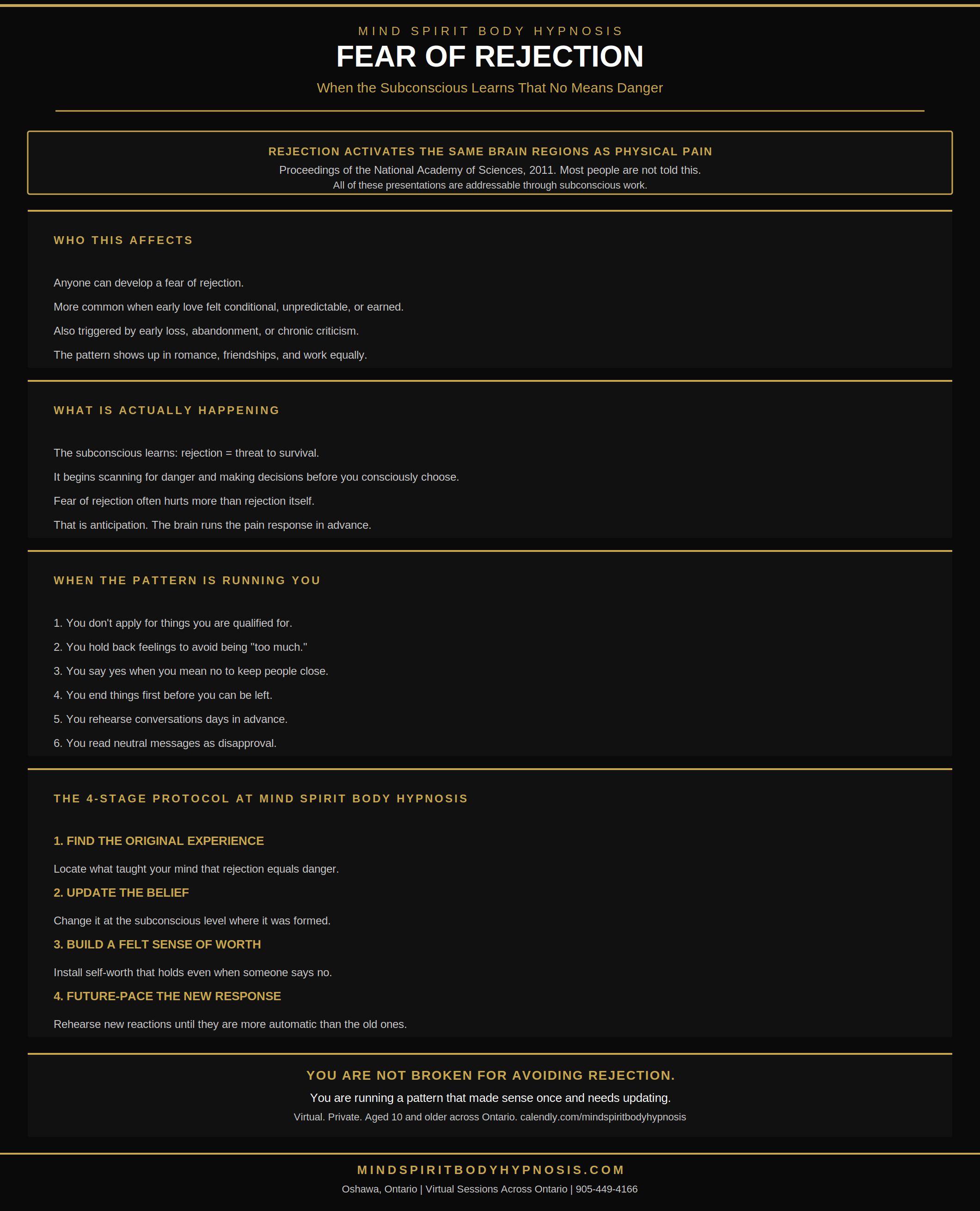
Rejection activates the same neural pathways as physical pain. A 2011 study published in the Proceedings of the National Academy of Sciences found that social rejection and physical pain share overlapping brain regions, including the secondary somatosensory cortex and the dorsal posterior insula. This is why rejection does not feel like a thought. It feels like something physical. Because in the brain, it partly is.
When the rejection hits, the brain registers it as a threat. The body responds accordingly. Heart rate increases. Cortisol rises. The mind narrows its focus onto the rejection, replaying it and analyzing it the way it would analyze a physical danger. This is useful when the threat is real. It is less useful when the threat is a text message that went unreturned or a job application that was declined.
For people with a heightened fear of rejection, this response fires harder and lasts longer than it does for others. The brain has essentially been trained to treat rejection as a high-level threat, and it responds in proportion to that training, not in proportion to what actually happened.
What rejection can trigger:
Intrusive replaying of the situation
Withdrawal from people or opportunities
Emotional eating or other numbing behaviours
A drop in self-worth that feels immediate and total
Anger that feels disproportionate and is hard to explain
The connection between rejection and emotional eating is significant. For many clients at Mind Spirit Body Hypnosis, the urge to eat in response to emotional pain is directly tied to rejection experiences. The hypnotherapy for anxiety and stress page covers how the stress response connects to comfort-seeking behaviours in more detail.
Fear of rejection
When Does Rejection Sensitivity Become a Life Pattern?
When it starts making decisions for you.
A single painful rejection is not a pattern. It is an experience. The pattern forms when the fear of future rejection begins to quietly organize your choices: the relationships you avoid, the opportunities you do not take, the version of yourself you present to the world, the things you never say out loud.
Signs the fear of rejection has become a pattern:
You avoid applying for things you want because you cannot stand the idea of being turned down
You interpret neutral behaviour from others as disapproval
You people-please consistently, even when it costs you
You rehearse conversations before they happen to make sure you will not be rejected
You end relationships or friendships before the other person has a chance to
You feel a drop in your sense of worth whenever someone does not respond the way you hoped
A 2019 study in the Journal of Personality and Social Psychology found that people with high rejection sensitivity were significantly more likely to interpret ambiguous social situations as rejecting, even when no rejection was intended. The pattern does not just respond to real rejection. It creates the experience of rejection where none exists.
For more on how self-sabotage and rejection sensitivity interweave, the hypnotherapy for confidence and self-sabotage page goes deeper into how the subconscious protects itself by keeping you small.
Why the Fear of Rejection Often Hurts More Than Rejection Itself
Because the fear activates before anything has happened.
The anticipation of rejection, the moment before you send the message, before you walk into the room, before you ask the question, can carry as much emotional weight as the rejection itself. Sometimes more. The mind runs the scenario. It imagines the outcome. It feels the pain of that imagined outcome as if it is real. And then the person either avoids the situation entirely, or they go through with it already braced for the worst.
That bracing posture affects everything. The way you speak. The way you hold yourself. The signals you send. In some cases, the expectation of rejection actually influences the outcome, because the person presents themselves as already half-rejected before anyone has had a chance to respond.
The subconscious is trying to protect you. If it can predict the rejection before it happens, it believes it can prepare for it. But the cost of that preparation is an ongoing low-level experience of rejection even in situations where none is happening.
This is where I find hypnotherapy most useful. Working with clients across Ontario, I have seen this pattern clearly. The work is not about building a thicker skin. It is about updating what rejection means at the level where the original meaning was assigned.
How Hypnotherapy Helps You Change the Pattern
Hypnotherapy works at the level where the pattern was formed, which is the subconscious, not the conscious thinking mind.
At Mind Spirit Body Hypnosis, I work through four stages with clients carrying fear of rejection patterns in Ontario.
Stage 1: Find where the belief was formed. In trance, we go to the earliest experiences that taught the subconscious that rejection equals danger, or that belonging is conditional. Those early feelings are accessible in ways they often are not in regular conversation. Identifying the source changes how the current pattern is understood.
Stage 2: Update the original meaning. The experience that formed the belief is revisited from an adult perspective, with the resources the person did not have at the time. The subconscious updates its filing. Rejection stops carrying the meaning of the original wound.
Stage 3: Build a stable sense of worth that does not depend on other people's responses. This is the core of the work. When worth is internally grounded, rejection hurts less because it is no longer evidence of something about you. It is just information about a situation.
Stage 4: Future-pace the new response. The new pattern is projected forward into the specific situations that previously triggered the old one. The job application. The difficult conversation. The moment before sending the message. The subconscious rehearses responding from a place of stability rather than threat.
Clients across Ontario consistently describe this shift not as becoming someone who does not care about rejection, but as becoming someone for whom rejection no longer feels like proof of something. More about my background and approach is on the about page.
WHAT MY CLIENTS SAY
“I had a great experience with Fanis at Mind Spirit Body Hypnosis. He is very understanding, patient, and genuinely takes the time to provide personal attention to your individual needs. The sessions have helped me work through anxiety and build more confidence. I also really appreciate the convenience of the virtual sessions, which make it easy to attend from home. I highly recommend Fanis to anyone looking for a caring and understanding hypnotherapist.” — Otibo E.
Frequently Asked Questions
Why does rejection hurt so much even when I know it should not? Because rejection activates the same brain regions as physical pain. Research published in the Proceedings of the National Academy of Sciences confirmed this overlap. The pain is real, not an overreaction. The question is whether the intensity of the response matches the situation, and for people with rejection sensitivity, it often does not, because the brain is responding to the pattern, not just the current event.
Who is most likely to struggle with fear of rejection? People who grew up in environments where love or belonging felt conditional, inconsistent, or earned rather than given freely. People who experienced early losses or social exclusion. People who learned that keeping others happy was the safest way to stay connected. Any of these experiences can train the nervous system to treat disapproval as a serious threat.
What is the difference between normal rejection pain and rejection sensitivity? Normal rejection pain is proportionate to what happened and fades within a reasonable time. Rejection sensitivity involves a response that feels bigger than the situation warrants, lasts longer than expected, and begins to shape future behaviour, causing avoidance, people-pleasing, or hypervigilance to signs of disapproval.
When should I consider getting help for rejection sensitivity? When the fear of rejection is making decisions on your behalf. When you are avoiding opportunities, editing yourself, or ending relationships early to protect yourself from the possibility of being rejected. When the pattern is visible to you but you cannot change it through awareness alone.
Can hypnotherapy help with rejection sensitivity at work? Yes. The pattern shows up at work just as clearly as in relationships. Not speaking up in meetings, avoiding applying for promotions, over-delivering to prevent criticism, interpreting neutral feedback as personal dismissal — all of these are rejection sensitivity in a professional context, and all of them respond well to hypnotherapy.
Does hypnotherapy make you stop caring about rejection? No. The goal is not indifference. Caring about connection and belonging is healthy and human. The goal is to make rejection feel like information rather than evidence. Something that happened, not proof of something about your worth.
How many sessions will this take? Most clients notice a meaningful shift within two to four sessions. A specific estimate is always given in the free 30-minute strategy session before any commitment is made. Deep-rooted patterns connected to early childhood experiences may take a little longer, but progress is usually felt early.
Can this help with the emotional eating that comes after rejection? Yes. For many clients, emotional eating is directly connected to rejection experiences. The urge to eat is a way the nervous system tries to soothe the pain of feeling unwanted or not enough. Addressing the rejection pattern at the subconscious level tends to reduce the emotional eating that follows it.
Can children and teenagers access this support? Yes. I work with clients aged 10 and older. Rejection is particularly painful in younger years, and the patterns formed then tend to persist into adulthood. Early intervention makes a real difference.
Ready to Take the Next Step?
If rejection is landing harder than it should, and you are ready to understand why and change it, I would love to help.
I offer a free 30-minute virtual strategy session for new clients across Ontario. There is no pressure, just an honest conversation about what you have been experiencing and whether hypnotherapy might help you finally change the pattern.
RECOMMENDED READING
Book your free session: calendly.com/mindspiritbodyhypnosis
Call or text: 905-449-4166
Email: info@mindspiritbodyhypnosis.com
Visit: mindspiritbodyhypnosis.com
Serving clients virtually across Ontario, including Durham Region, Toronto, Canada, and beyond.
Disclaimer: This article is for informational purposes only and does not constitute medical or psychological advice. Hypnotherapy, NLP, and EMDR are complementary approaches and are not a substitute for diagnosis or treatment by a qualified healthcare provider. Please consult a licensed professional if you have concerns about your mental or physical health.
Written by Fanis Makrigiannis | Certified Hypnotherapist & NLP Master Practitioner | Mind Spirit Body Hypnosis.