Your guide to hypnosis for trauma relief
Hypnosis for Trauma Relief: Why the Body Stays Stuck After Something Hard Happens
TL;DR: Trauma doesn't stay with you because you're weak or broken. It stays because the brain filed a difficult experience as an unfinished survival response: a still-active threat that was never resolved. The body has been holding that file open ever since. Hypnosis for trauma relief works at the subconscious level where that file lives. That is below the reach of talking about it, thinking through it, or trying to move on.
Quick Answer
Hypnosis for trauma relief is a subconscious-focused approach that helps the brain complete what the original trauma response left unfinished, reducing the automatic physical and emotional reactions that persist long after a difficult experience ends. Research by Valentine et al. (2019) in the International Journal of Clinical and Experimental Hypnosis found that hypnotherapy produced significant reductions in PTSD intrusion and avoidance symptoms, with effect sizes comparable to first-line trauma therapies. Fanis Makrigiannis, a Certified Hypnotherapist and NLP Master Practitioner at Mind Spirit Body Hypnosis in Oshawa, Ontario, offers virtual sessions across Ontario for clients whose trauma responses have not resolved on their own.
Questions This Article Answers
Why do trauma symptoms keep happening even when I know I'm safe now?
Why does talking about what happened not make it stop?
What does trauma actually do to the brain and body?
Can hypnosis help with trauma?
What does hypnosis for trauma look like in practice?
How is this different from other trauma therapies?
How many sessions before I notice a difference?
In this article:
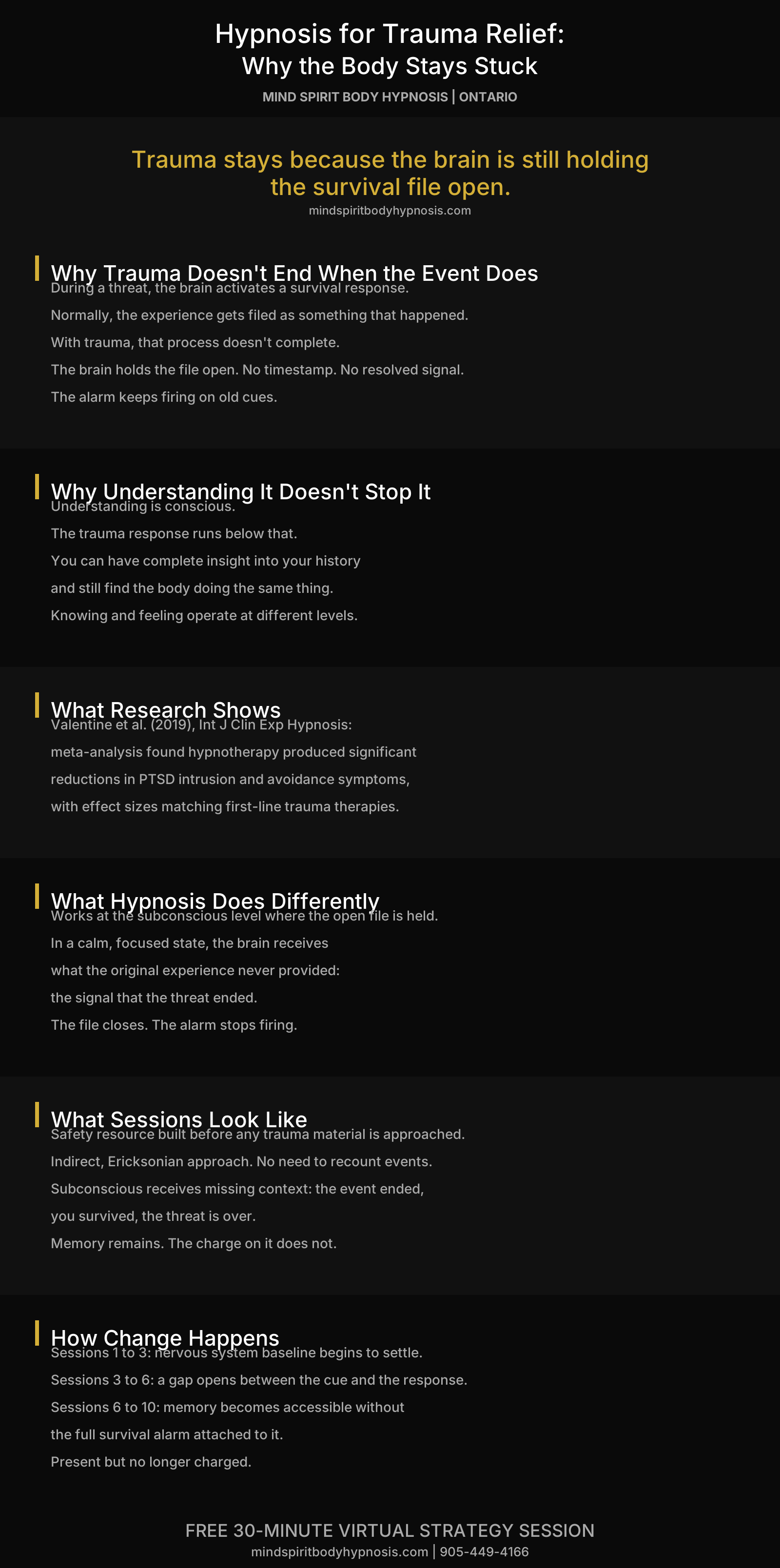
Why Trauma Doesn't End When the Event Does
A car crash ends in seconds. A difficult childhood ends when you leave. A single threatening incident ends the moment it's over. But the body doesn't always get that message.
People who have been through something hard often describe the same pattern: they know, rationally, that they are safe. They understand the event is over. They can explain it clearly. And still, the body keeps responding as if it isn't over: the startle that won't settle, the sleep that won't come, the moment a smell or a sound brings everything flooding back as if no time has passed at all.
This is one of the most disorienting parts of trauma. You can see clearly that you are safe. You cannot stop feeling as though you aren't.
That gap between what you know and what your body does is exactly where trauma lives. And it tells you something important about what actually needs to change.
What the Brain Does During a Threatening Experience
When something threatening happens, the brain activates a survival response. Stress hormones flood the body. Heart rate climbs. Attention narrows to the threat. Everything non-essential shuts down.
This is a well-designed system. In a real threat, it keeps you alive.
The problem is how the brain files that experience afterward. Under extreme stress, the normal memory process, where an experience gets encoded, contextualized, and stored as something that happened in the past, doesn't always complete properly. The experience gets filed without its timestamp. Without the signal that it's finished. The brain holds it as still-active, still-relevant, still potentially happening.
This is why trauma symptoms aren't memories in the ordinary sense. They're replays. The brain encounters a cue that matches something in the unresolved file. The survival response fires again with the same physiological alarm and emotional intensity. At the subconscious level, the threat was never marked as resolved.
In my work with clients in Ontario, I often use this description: the brain isn't misremembering. It's doing exactly what it's designed to do: keeping an active threat file at the ready. The problem is that the file should have been closed years ago, and nobody sent the signal to close it.
What is trauma?
Why Talking About It Has Limits
Talk therapy is often the first place people go after trauma, and for good reason. It provides structure, support, and a framework for making sense of an experience that felt senseless. Many people find it genuinely helpful.
But there is a specific limitation worth understanding. It explains why some people can spend years in therapy, understand exactly what happened to them and why, and still find the body responding the same way it always has.
Understanding happens at the conscious level. The trauma response runs at the subconscious level. Those are not the same place, and insight in one does not automatically update the other.
A person can have complete understanding of their trauma history: where it came from, why it affected them, what it meant. And still startle at a sound. Still freeze in a situation that echoes the original event. Still find themselves emotionally back in a moment they thought they'd processed.
This isn't a therapy failure. It's a level mismatch. The conscious mind got the update. The subconscious survival file didn't.
The anxiety and stress work I do with clients often reveals the same structure: the conscious mind fully aware that a situation is not dangerous, the nervous system responding as though it is. Trauma and anxiety share this architecture. The approach that works for both reaches below the conscious level.
What Research Shows About Hypnosis and Trauma
The evidence base for hypnosis and trauma is more solid than most people realize, and considerably stronger than the competitor pages on this topic suggest.
Valentine, Milling, Clark, and Moriarty (2019) published a systematic review and meta-analysis in the International Journal of Clinical and Experimental Hypnosis. They found that hypnotherapy produced significant reductions in PTSD intrusion and avoidance symptoms. The effect sizes were clinically meaningful and comparable to those produced by first-line trauma therapies.
Abramowitz and Lichtenberg (2010), in the same journal, found that hypnotherapy alongside existing treatment for combat-related PTSD produced significant improvements in sleep, intrusion, and avoidance symptoms, at treatment end and at follow-up.
The research consistently points to the same mechanism: hypnosis creates a state in which the subconscious becomes more accessible, which allows the brain to revisit an unresolved experience at a depth that conscious processing does not reach. The goal is not to erase the memory. It is to help the brain finally file it as something that happened in the past, with a timestamp, with context, and without the survival alarm still attached to it.
Talk therapy works at the conscious level: understanding, narrative, and coping skills. Valuable, but doesn't reach the subconscious survival file.
Medication works at the physiological level: managing symptoms without addressing the stored pattern underneath.
Mindfulness works at the conscious and body-awareness level: present-moment regulation, but not resolution of the unresolved file.
Hypnosis for trauma works at the subconscious level: the only layer where the unresolved survival file is actually held.
What Hypnosis Does in Practice
Hypnosis works in a relaxed, focused state. It is not sleep. Clients remain fully aware, hear everything, and can end the session at any point. What changes in that state is access: the conscious mind quiets enough for the subconscious material to become reachable.
As a certified hypnotherapist trained through the American Board of Hypnotherapy, the trauma work I do with clients is careful and paced. The goal is never to push someone back into the full intensity of a difficult experience. It is to approach the material at a level and pace the client can tolerate, and to give the subconscious what it needs to finally mark the experience as resolved.
In practice, this typically involves:
Establishing safety first. Before approaching any traumatic material, the client builds a reliable internal resource: a felt sense of calm and safety that they can access during the session. This is not a visualization exercise. It is a subconscious anchor.
Approaching the material indirectly. Ericksonian hypnosis, which informs my practice, works with metaphor and indirect suggestion rather than requiring a client to describe events in detail. This reduces the risk of retraumatization.
Providing the missing context. The unresolved file was stored under extreme stress, without full context. The subconscious receives what it didn't have at the time: the knowledge that the threat ended, that you survived, that the person you are now is different from the person the event happened to.
Closing the file. The survival response loses its automatic connection to the cue. The memory becomes something that happened, rather than something that is still happening.
If sleep has been disrupted by trauma (which is common, and which compounds everything else), the sleep and insomnia work often runs alongside the trauma work, because both are addressing the same overactive subconscious alarm.
I offer a free 30-minute virtual strategy session for new clients across Ontario. If you're not sure this is the right approach for where you are, that conversation is the place to find out.
What Sessions Look Like
The first session is always a conversation. I want to understand how the trauma response shows up now. Not a full account of what happened, but how it lands in daily life. The startle response. The situations that bring it back. The quality of sleep. The way certain sensory cues pull you somewhere you didn't choose to go.
This tells me what the subconscious is treating as still-active, and what kind of resolution it hasn't received.
From the second session, we work in hypnosis. The stages tend to follow this sequence:
Safety resource. Before anything else, we build a reliable felt sense of safety the client can access at any point in the session or outside of it.
Approaching the material. Carefully, at the client's pace, and often indirectly through the Ericksonian framework. No pressure to recount events in detail.
Providing context. The subconscious receives what it was missing: that the event ended, that you are safe now, that the survival file can be marked as closed.
Integration. The memory is still there. The alarm attached to it is not. Clients often describe this as the memory becoming flat, present but no longer charged.
The trauma pillar on the main site covers the broader range of trauma types I work with. This article focuses specifically on the subconscious mechanism and how hypnosis addresses it.
Sessions are virtual, so clients across Ontario, including Durham Region, can access this work from wherever they are.
How Change Happens Over Time
Trauma work is not linear, and the pace varies significantly depending on the complexity of the history and how long the responses have been running. What clients consistently describe, though, is a particular quality of shift that is different from what they experienced in conscious-level work.
Sessions 1 to 3: The startle response may begin to settle slightly. Sleep sometimes improves before the deeper trauma work has fully progressed, because the nervous system starts to register that something is different.
Sessions 3 to 6: The automatic quality of the trauma response begins to change. A cue appears that would previously have pulled them straight back into the experience, and there is a pause. A gap. The response still fires, but it doesn't close all the way.
Sessions 4 to 6: The memory becomes accessible without the full survival alarm. Clients describe thinking about what happened without being inside it. The memory is present. The charge is not.
This is not the same as forgetting. The experience remains part of the person's history. What changes is the body's relationship to it: no longer treated as an active, unresolved threat, but as something that happened and ended.
Try This Now
This is not a technique for working with active trauma material. Please do that with support. But here is something worth noticing.
The next time a trauma cue appears, a sound, a smell, a situation that echoes something from before, try to notice what happens in the body before the thought forms. A tightening. A shift in breathing. A sense of something dropping.
That physical response is the survival alarm firing. It arrived before the thought, before any assessment, because it runs below the level where thinking happens.
Noticing that sequence, body first and thought second, doesn't stop the response. But it creates a small amount of distance from it. And distance is the beginning of change.
WHAT MY CLIENTS SAY
“Found Fanis through a Google search when I was at my wit’s end with insomnia. The nail biting was a bonus issue I figured I would mention. Did not expect much for either, honestly. Three sessions (three hours only) in and I am sleeping. Like actually sleeping. The nail biting is basically gone too. Fast results, great experience, highly recommended.” — Kennedy O. via Google
Frequently Asked Questions
Why do trauma symptoms keep happening even when I know I'm safe? Because knowing you are safe is a conscious process, and the trauma response runs at the subconscious level. The brain filed the original experience as an unfinished survival response: a still-active threat that was never marked as resolved. When a cue matches the original event, the alarm fires automatically, below conscious reasoning. Knowing you are safe doesn't update the subconscious file. That's the gap hypnosis addresses.
Why doesn't talking about what happened make it stop? Talk therapy works at the conscious level: understanding, narrative, and coping. Those are genuinely valuable. But the trauma response runs at the subconscious level, which is beyond the reach of insight. A person can have complete understanding of their trauma history and still find the body responding the same way. Understanding in one place doesn't automatically update the other.
What does trauma do to the brain and body? During a threatening experience, the brain activates a survival response, flooding the body with stress hormones, narrowing attention, and shutting down non-essential functions. After the event, the brain normally files the experience with a timestamp: something that happened in the past. In trauma, that process doesn't always complete properly. The experience gets filed without the signal that it's finished, and the brain holds it as still-active. This is why trauma responses feel like replays rather than memories.
Can hypnosis help with trauma? Research supports hypnosis as an effective approach for trauma symptoms. A meta-analysis published in the International Journal of Clinical and Experimental Hypnosis (Valentine et al., 2019) found significant reductions in PTSD intrusion and avoidance symptoms through hypnotherapy, with effect sizes comparable to first-line trauma treatments. Hypnosis is particularly well-suited to trauma work because it reaches the subconscious level where the unresolved survival file is held, below the reach of conscious-level approaches.
Is hypnosis safe for trauma? When conducted by a trained and certified hypnotherapist, yes. The key safety factors are pacing, the establishment of a felt sense of safety before approaching any difficult material, and an indirect approach that does not require the client to recount events in detail. In my practice, I build a safety resource in the first hypnosis session before we approach any trauma material. The client is always in control and can end the session at any point.
What if my trauma is complex or has been going on for a long time? Complex trauma (ongoing, repeated, or early-life experiences) typically requires more sessions and a more gradual approach than single-incident trauma. The work is the same in kind but different in pace. The subconscious has more material to update, and the survival responses are more deeply ingrained. That said, the mechanism is the same: the brain is holding files open that were never marked as resolved, and the goal is to provide the missing signal.
How is this different from EMDR or CBT for trauma? EMDR uses bilateral stimulation to help the brain reprocess traumatic memories. CBT uses structured cognitive and behavioural techniques to reduce avoidance and change thought patterns. Hypnosis works in a different state, one in which the subconscious becomes more directly accessible through focused relaxation, allowing material to be approached and updated without requiring the same level of deliberate cognitive processing. Some clients find that hypnosis is gentler than approaches that require more direct engagement with the traumatic material. Others use hypnosis alongside their existing therapy. They are complementary approaches, not competing ones.
Do I have to talk about what happened in detail? No. The Ericksonian approach I use works with metaphor and indirect suggestion. It does not require a detailed account of events. You can do meaningful trauma work without narrating what happened.
How many sessions will it take? Single-incident trauma often shows meaningful change within up to six sessions. Complex or long-standing trauma typically requires more. The first indicator is usually a settling in the nervous system's baseline, typically a slight reduction in the startle response or an improvement in sleep, before the deeper material has been fully addressed. A free 30-minute strategy session is a good place to get an honest sense of what to expect for your specific situation.
Is this a substitute for clinical mental health care? No. Hypnotherapy is a complementary approach. If you are currently working with a psychologist, psychiatrist, or trauma therapist, hypnotherapy works best alongside that care, not instead of it. If you are in crisis or experiencing severe symptoms, please get in touch with a mental health professional or crisis service first.
RECOMMENDED READING
Ready to Take the Next Step?
If the trauma response has stayed with you longer than it should have, and if you've tried to understand it, talk through it, or simply wait it out, and it's still running, this is the work that goes to where it lives.
I offer a free 30-minute virtual strategy session for new clients across Ontario. It's a straightforward conversation about where you are, what you've already tried, and whether this approach is the right fit for you.
Book your free session: calendly.com/mindspiritbodyhypnosis
Call or text: 905-449-4166
Email: info@mindspiritbodyhypnosis.com
Visit: mindspiritbodyhypnosis.com
Serving clients virtually across Ontario, including Durham Region, Toronto, Canada, and beyond.
Disclaimer: This article is for informational purposes only and does not constitute medical or psychological advice. Hypnotherapy and NLP are complementary approaches and are not a substitute for diagnosis or treatment by a qualified healthcare provider. If you are experiencing severe trauma symptoms or are in crisis, please contact a licensed mental health professional or crisis service. Please consult a licensed professional if you have concerns about your mental or physical health.
Written by Fanis Makrigiannis | Certified Hypnotherapist & NLP Master Practitioner | Mind Spirit Body Hypnosis.