I hate the mirror
Hypnosis for Body Image: The Mirror Isn't the Problem
TL;DR: Hating what you see in the mirror is rarely about what you actually look like. It is the surface moment where a subconscious story about your body and your worth shows up most visibly. That story was usually written early, reinforced over time, and runs automatically below your conscious awareness. Hypnosis for body image works at the level where the story lives, not at the level of the reflection.
Quick Answer
Hypnosis for body image is a subconscious-focused approach that identifies and updates the core beliefs driving chronic body dissatisfaction by working at the level where those beliefs were first formed. Research on negative body image thinking as a mental habit (Verplanken & Velsvik, 2008, Body Image) found that automatic negative body thoughts predict self-esteem and eating disturbance beyond body dissatisfaction alone. Fanis Makrigiannis, a Certified Hypnotherapist and NLP Master Practitioner at Mind Spirit Body Hypnosis in Oshawa, Ontario, offers virtual sessions across Ontario for clients whose relationship with their body hasn't shifted through conscious effort alone.
Questions This Article Answers
Why do I feel bad about my body even when nothing has changed?
Why does changing my body not make me feel better about it?
Where does chronic body dissatisfaction actually come from?
Can hypnosis help with negative body image?
What does hypnosis do that self-compassion exercises and positive affirmations can't?
How many sessions does it take to notice a real shift?
In this article:
The Part the Mirror Doesn't Show You
Standing in front of a mirror and feeling something sink in your chest. Avoiding reflective glass in shops. Catching a photo of yourself and immediately looking away. Putting on three different outfits before giving up.
These are moments most people recognize. And most people treat them as a body problem. If the body were different, the feeling would go away.
The truth is that the feeling was there before the mirror. The mirror is just the moment it becomes hard to ignore.
In my practice, I work with clients across Ontario who have changed their bodies significantly and still feel the same standing in front of the glass. The number on the scale moved. The size changed. The voice didn't. Because the voice was never about the body. It was about a story the subconscious has been running for a long time, and the body was just its current target.
Where the Story Was Written
Negative body image is not formed in adulthood by looking in the mirror too critically. It is usually established much earlier, through a combination of:
Comments made about your body, your eating, or your appearance by people whose opinion mattered
Environments where a certain body type was explicitly or implicitly valued
Experiences of comparison, teasing, or being made to feel that your body was somehow wrong
Media and cultural messaging absorbed during a period when identity was still being formed
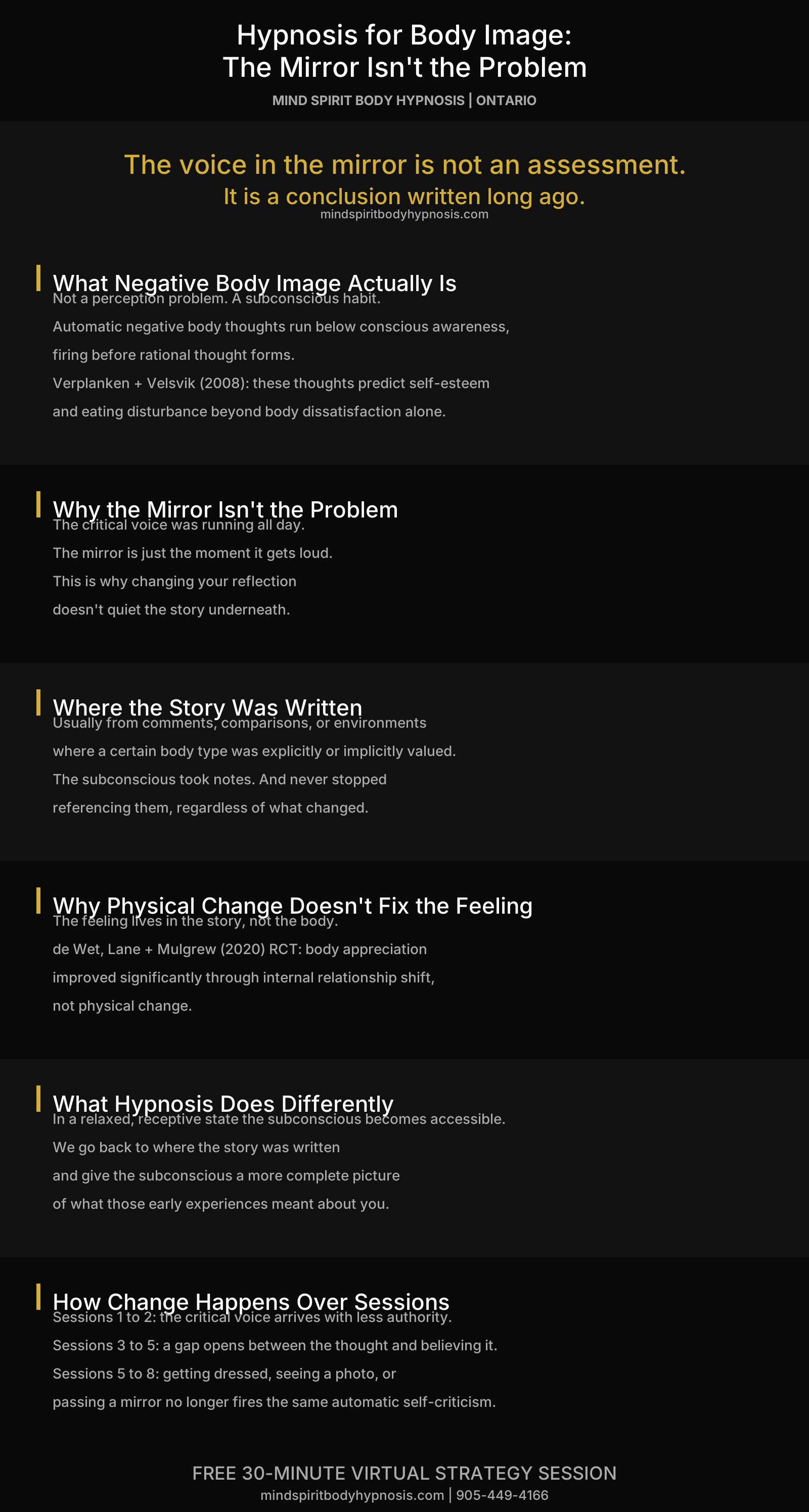
Research by Verplanken and Velsvik (2008), published in the journal Body Image, found that negative body image thinking behaves as a mental habit. The thoughts are automatic, frequent, and run below conscious awareness. They predict self-esteem and disordered eating patterns beyond body dissatisfaction alone. In other words, it is not just disliking your body. It is an ingrained pattern of automatic negative thoughts that has become self-sustaining.
This is the layer most body image work never reaches.
The Window, Not the Wall
Here is the way I explain this to clients.
The mirror is not the problem. It is a window onto a story that was written long before you stood in front of it.
When you look in the mirror and feel the familiar drop, that is not an accurate assessment of what you look like. It is the subconscious story surfacing at the moment it has the most visual material to attach to. The story runs all day. The mirror just makes it loud.
This is why changing the reflection doesn't quiet the story. The story generates new material. New angles that are wrong. New comparisons. A new detail to focus on. The mind looking for evidence to confirm a conclusion it already holds.
Hypnosis for body image doesn't try to change what you see in the mirror. It goes back to where the story was written and provides the subconscious with a different version of events.
The struggle with body image.
Why Changing Your Body Doesn't Fix the Feeling
This is the part that no one explains in diet plans or fitness programs.
The feeling of body dissatisfaction doesn't live in the body. It lives in the subconscious story about the body, and that story is independent of the body's actual state. This is why people at very different body sizes can carry the same quality of self-criticism. The story is the constant. The body is the variable it projects onto.
Research confirms this. A randomized controlled trial by de Wet, Lane, and Mulgrew (2020), published in Body Image, found that even small, meaningful improvements in body appreciation and self-compassion came not from changing the body but from shifting the internal relationship to it. Relaxation and reframing, not physical change, moved the needle.
The weight loss work I do with clients in Ontario addresses this dynamic directly. Clients who focus only on physical change and skip the internal story often find that achieving their goal doesn't produce the relief they expected. The work that lasts addresses both.
If you want to understand whether this kind of subconscious work is the right fit for where you are, I offer a free 30-minute virtual strategy session for new clients across Ontario. There's no pressure. It's a conversation.
What ADVANCED Hypnosis Does Differently
Most conscious-level approaches to body image, including affirmations, journaling, and positive self-talk, work by asking you to think differently about your body. The difficulty is that the subconscious story that drives body dissatisfaction doesn't respond to being told something different. It has weighted evidence, reinforced over years, and a new thought applied at the surface doesn't compete.
Hypnosis works in a relaxed, focused state where the conscious mind steps back. This creates access to the subconscious layer where the body story was established. As a certified hypnotherapist trained through the American Board of Hypnotherapy, I work with clients to:
Identify the original experiences from which the body story was formed
Separate the subconscious conclusion ("my body is wrong") from the experiences that produced it
Provide the subconscious with a more complete and accurate interpretation of those experiences
Build a new reference point for the body that is based on function, presence, and neutrality rather than comparison and inadequacy
This is not about learning to love every part of your body. It is about quieting the automatic critical voice enough that you can be in your body without the running commentary.
The confidence and self-sabotage work often connects directly to this, because the same subconscious story that produces body criticism also shapes how much space you allow yourself to take up in relationships, at work, and in daily life.
What Sessions Look Like
The first session is a conversation. I want to understand when the critical voice started, what the original environment looked like, and how the body story shows up now. Clients often describe it in very specific moments: getting dressed in the morning, passing a mirror in a changing room, seeing a tagged photo, sitting next to someone and doing a comparison that happens before they can stop it.
These specific moments are useful. They tell me what the subconscious is scanning for and what kind of resolution it hasn't yet received.
From the second session, we work in a relaxed hypnotic state. Clients remain fully aware throughout. The process typically includes:
Identifying the earliest experience from which the body-is-wrong conclusion was drawn
Providing the subconscious with a different interpretation of that experience
Reducing the automatic quality of the negative body thought so there is a gap between the trigger and the reaction
Building a subconscious reference to the body that is grounded in the present, not in early comparison
Work on anxiety and self-criticism frequently runs alongside this, since the same overactive self-monitoring that drives anxiety also drives the hyper-focus on perceived physical flaws.
Sessions are virtual, so clients across Ontario, including Durham Region, can do this work from home.
How Change Happens Over Time
Hypnosis for body image does not produce a single breakthrough. It produces a gradual quieting.
Sessions 1 to 2: Clients often notice that the critical voice arrives but doesn't land quite as hard. A small delay between the mirror moment and the familiar drop.
Sessions 3 to 5: The automatic comparison thinking becomes less constant. Clients describe catching themselves in the middle of a negative thought, rather than only noticing it after the fact. The gap between trigger and reaction is widening.
Sessions 5 to 8: Getting dressed, seeing a photo, or passing a mirror no longer automatically produces the same quality of self-criticism. Clients describe this as a neutrality they didn't expect. Not enthusiasm. Quietness.
The timeline depends on how long the story has been running and how it was originally formed. What clients consistently describe is that the change doesn't feel like effort. It feels like the volume finally turned down.
Try This Now
The next time you look in the mirror and the voice starts, don't argue with it. Instead, ask: whose voice is that? How old does it sound?
If you can locate a specific tone, a specific era, a specific person's way of speaking about bodies, you have found the origin of the story. That voice is not your current self's assessment. It is the subconscious replaying a conclusion from another time.
The distance between that voice and your present self is exactly where hypnosis works.
WHAT MY CLIENTS SAY
“I really couldn’t recommend Fanis more highly. He helped me push through barriers I didn’t even realize were there. He’s incredibly down to earth, patient, and makes you feel completely at ease while working with you. The experience has made such a meaningful difference for me. You truly couldn’t be in better hands. Highly recommend!” — Daniela G. via Google
Frequently Asked Questions
What is negative body image? Negative body image is a persistent pattern of automatic critical thoughts about your body, your appearance, and how others perceive you. It is not simply dissatisfaction with a specific feature. It is a habitual, subconscious pattern of self-evaluation that colours how you experience your body throughout the day. Research has shown it behaves like a mental habit: automatic, frequent, and self-sustaining.
Why do I hate what I see in the mirror even though I know I'm being too hard on myself? Because knowing you're being too hard on yourself is a conscious observation. The critical voice comes from the subconscious, where a story about your body's worth was established long ago. That story runs automatically, below the level of conscious reasoning. You can know something is unfair and still feel it, because the knowing and the feeling are operating at different levels.
Why doesn't losing weight or changing my body fix the way I feel about it? Because the feeling doesn't live in the body. It lives in the subconscious story about the body, and that story is largely independent of the body's actual state. This is why people at very different sizes can carry exactly the same quality of self-criticism. The story generates new targets regardless of what changes. Addressing the story, not just the body, is what produces lasting relief.
Can hypnosis help with negative body image? Hypnosis for body image works at the subconscious level, where the habitual negative body thoughts were established. Rather than trying to override the critical voice with positive self-talk, it accesses the original context from which the body story was formed and provides the subconscious with a more complete interpretation of those experiences. Research on self-compassion and body image interventions supports the idea that internal relationship shifts, not physical changes, produce meaningful and lasting improvements.
Is this appropriate if I have a history of disordered eating? Hypnotherapy is a complementary approach and not a replacement for clinical treatment. If you have a history of disordered eating or are currently receiving treatment for an eating disorder, I would work alongside your existing care team, not in place of them. The subconscious work that addresses body image can be a useful complement to clinical support, but your safety and care come first. A free 30-minute strategy session is a good place to have this conversation.
How is this different from therapy for body image? Talk-based therapy is often excellent at helping people understand where body image issues came from and how they operate. Hypnotherapy works at the subconscious level where the habitual pattern still runs, regardless of how well it is understood consciously. Many clients come to this work having already done significant therapy. They understand the story clearly. What they haven't been able to do is stop the automatic voice. That is the gap this work addresses.
What does a session feel like? A calm, focused state. Not unconsciousness, not sleep. Most clients describe it as similar to the feeling just before falling asleep, where the mind is quiet and receptive but still fully aware. You hear everything, remember everything, and remain in control at all times. In that state, the subconscious is more accessible and less defended, which is what allows the body story to be updated rather than simply overridden.
How many sessions does it take? Most clients working on body image notice meaningful shifts within five to eight sessions. The first two to three sessions establish the origin and begin addressing the subconscious pattern. Later sessions focus on reducing the automaticity of the critical voice and building a neutral, stable internal relationship with the body. The exact number depends on how long the pattern has been running and how it was originally formed.
Do I have to talk about difficult past experiences? Not in detail, and not in an overwhelming way. The work doesn't require you to relive experiences. It requires enough context to understand where the story was formed, and then the focus moves to the present. Many clients find the process much gentler than they expected.
What if the critical voice comes back after sessions end? Some of the pattern may resurface under stress, because the nervous system returns to familiar responses under pressure. Later sessions focus on building resilience for exactly this situation: when the voice returns, the gap between the thought and your identification with it is wide enough that it quickly loses its authority. This is different from the voice disappearing entirely. It is the voice losing its power.
RECOMMENDED READING
Ready to Take the Next Step?
If the mirror has been a difficult place for a long time and nothing has shifted the feeling at the root, this is the work that goes there.
I offer a free 30-minute virtual strategy session for new clients across Ontario. It's a conversation about where you are, what you've tried, and whether subconscious-focused work is the right fit for you.
Book your free session: calendly.com/mindspiritbodyhypnosis
Call or text: 905-449-4166
Email: info@mindspiritbodyhypnosis.com
Visit: mindspiritbodyhypnosis.com
Serving clients virtually across Ontario, including Durham Region, Toronto, Canada, and beyond.
Disclaimer: This article is for informational purposes only and does not constitute medical or psychological advice. Hypnotherapy, NLP, and EMDR are complementary approaches and are not a substitute for diagnosis or treatment by a qualified healthcare provider. Please consult a licensed professional if you have concerns about your mental or physical health.
Written by Fanis Makrigiannis | Certified Hypnotherapist & NLP Master Practitioner | Mind Spirit Body Hypnosis.