Quit Smoking Hypnosis: Why the Urge Is Automatic and How to Reach It
TL;DR: The urge to smoke isn't about willpower. It's a pattern the subconscious learned and runs on cue, below the level of conscious decision-making. Quit smoking hypnosis works at that level. It doesn't fight the craving. It changes what the subconscious reaches for in the first place.
Quick Answer
Quit smoking hypnosis is a subconscious-focused approach that targets the automatic habit pattern driving the urge to smoke, rather than relying on willpower or symptom management alone. A randomized trial by Carmody et al. (2008), published in Nicotine and Tobacco Research, found hypnotherapy produced quit rates comparable to standard behavioural counselling, with stronger results in a specific subgroup. Fanis Makrigiannis, a Certified Hypnotherapist and NLP Master Practitioner at Mind Spirit Body Hypnosis in Oshawa, Ontario, offers virtual sessions across Ontario for clients who want to quit smoking and have found that knowing they should quit is not the same as being able to stop.
Questions This Article Answers
Why is quitting smoking so hard even when you really want to stop?
What does the urge to smoke actually feel like in the body?
How does hypnosis for quitting smoking work?
Is there research supporting hypnosis for quitting smoking?
Do I need to be a "good hypnotic subject" for this to work?
How is this different from patches, gum, or medication?
What happens in a hypnosis session for smoking?
In this article:
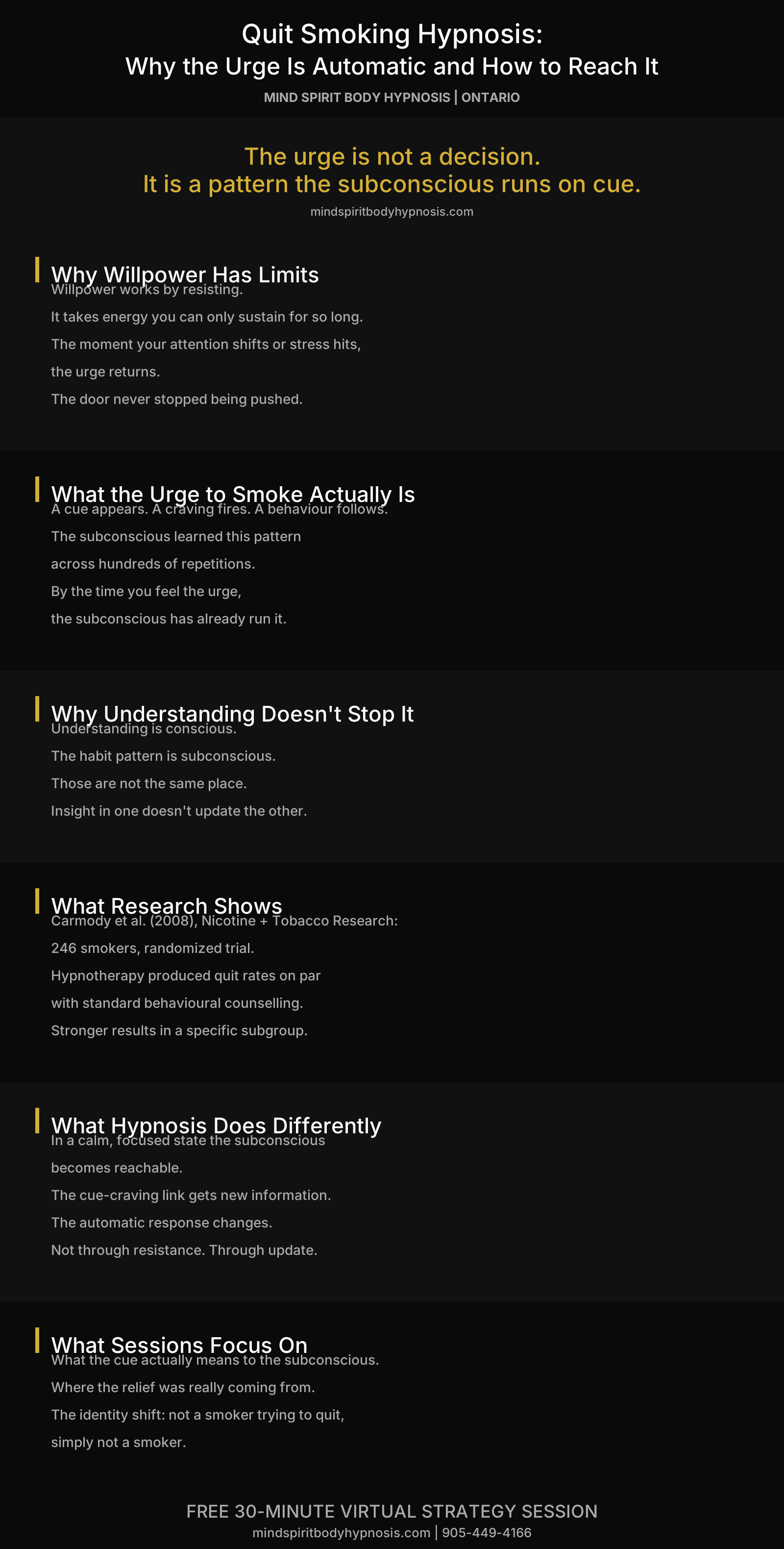
Why Willpower Alone Has Limits
Most people who want to quit smoking already know they should quit. They know what it costs them, in money, in health, in how they feel. They have tried to stop. Some have tried many times.
And yet the urge comes back.
The common explanation is that this is a willpower problem. But willpower is a conscious resource. It works by resisting. And resisting something takes energy you can only sustain for so long.
Quitting smoking through willpower is like standing at a door trying to keep it shut while something on the other side keeps pushing. It works while you are actively holding the door. The moment your attention shifts, or you get tired, or something stressful happens, the door opens.
The real question isn't how to hold the door shut harder. It's why the thing on the other side is still pushing.
What the Urge to Smoke Actually Is
The urge to smoke doesn't come from nowhere. It's a learned response, and it follows a simple pattern: a cue appears, a craving fires, a behaviour follows, and relief arrives.
The cue can be almost anything. Finishing a meal. Getting in the car. Having a stressful conversation. Seeing someone else light up. Feeling bored. Feeling good.
The craving isn't a random feeling. It's a trained signal. The subconscious learned, across hundreds or thousands of repetitions, that this cue predicts this relief. It doesn't ask permission. It just fires.
By the time you're consciously aware of the urge, the subconscious has already run the pattern. The craving exists before you've made any decision. The decision to resist comes after.
This is why the urge can feel so physical. It isn't a thought. It's a pattern running in the body.
In my work with clients in Ontario, the people who struggle most aren't the ones who don't want to quit. They want to quit very much. The pattern just runs faster than the wanting.
Why Understanding Isn't Enough
You can understand exactly why you smoke, when it started, what it gives you, and what it costs you, and still find the urge appearing on cue.
This is not a character flaw. It's a level mismatch.
Understanding happens at the conscious level. The habit pattern runs at the subconscious level. These are not the same place. Insight in one doesn't automatically update the other.
This is the same reason people find the anxiety and stress work useful even when they fully understand what's making them anxious. Knowing what's happening doesn't always stop it from happening. The automatic response needs to be reached directly.
Patches and gum address the physiological pull of nicotine. Medication changes the chemistry. But neither one reaches the automatic pattern the subconscious is running. The ritual, the relief, the trained cue-craving sequence. That layer is where quit smoking hypnosis works.
Why is smoking so bad for you?
What Research Shows
The evidence for hypnosis and smoking cessation is more solid than most people expect.
A randomized controlled trial by Carmody et al. (2008), published in Nicotine and Tobacco Research, compared hypnotherapy with standard behavioural counselling in 246 smokers. At one year, 22% of the hypnotherapy group had stopped smoking, compared with 15% in the counselling group. The difference was not statistically significant overall, which the researchers interpreted as hypnotherapy performing on par with an established treatment. Among participants with a history of depression, hypnotherapy produced notably stronger results: 27% abstinence versus 16% for counselling.
What the research consistently points to is a specific mechanism. Hypnosis works in a calm, focused state in which the subconscious becomes more accessible. In that state, the trained cue-craving link can be approached and changed at the level where it's actually stored.
This is why the habits and addictions work I do draws heavily on this approach. The goal is not to resist the urge from the outside. It's to change what the subconscious does when the cue arrives.
What Hypnosis Does Differently
In hypnosis, you remain fully aware. You hear everything. You can end the session at any point. What changes is the level of access: the busy, analytical conscious mind quiets, and the subconscious becomes more reachable.
In that state, several things can happen that willpower and patches cannot accomplish:
The cue-craving link can be interrupted. The subconscious can receive new information about what the cue means and what response it warrants, before the craving fires automatically.
The relief the cigarette provided can be separated from the cigarette. In many cases, smoking delivers something: calm, a pause, a reward, a boundary. Hypnosis can help the subconscious find that same thing through a different route.
The identity around smoking can be updated. Many long-term smokers think of themselves as smokers who are trying to quit. Hypnosis works at the level where identity is held, and can shift the internal story from resistance to change.
As a certified hypnotherapist trained through the American Board of Hypnotherapy, the approach I use is Ericksonian: indirect, metaphor-based, and tailored to the person in front of me rather than a script. No two people smoke for the same reasons, and the sessions reflect that.
I offer a free 30-minute virtual strategy session for new clients across Ontario. If you're not sure whether this is the right fit, that is the right place to find out.
What Sessions Look Like
The first session is always a conversation. I want to understand when the urge is strongest, what it feels like in the body before you light up, and what smoking is actually providing. Is it a pause? A reward? A way to manage stress? That picture shapes everything that follows.
From the second session, we work in hypnosis. The approach is calm and guided. Nothing dramatic happens. Clients often describe it as deeply relaxing, like the gap between awake and asleep where the mind is still but the body has let go.
The work typically focuses on:
What the cue means. The subconscious has decided that this cue predicts this relief. We give it new information.
Where the relief actually comes from. In most cases, the relief was never in the cigarette. It was in the pause, the breath, the moment of stepping outside. The subconscious can learn to access that without the cigarette attached to it.
Who you are without smoking. For long-term smokers, the identity shift is often the most meaningful part. Not a smoker trying to quit. Simply not a smoker.
The confidence and self-sabotage work often runs alongside quit smoking sessions, because the two are frequently connected. The belief that you can change is part of whether change happens.
Sessions are virtual, so clients across Ontario, including Durham Region, can access this work from home.
WHAT MY CLIENTS SAY
“I really needed help with pre-operation anxiety, pain, and a very long-standing sugar addiction. I am greatly appreciative that Fanis at Mind Spirit Body Hypnosis has helped me to eliminate both from my life in a very short period of time. I felt desperate to find something to help but I didn’t fully believe in the mechanics of hypnosis. It was extremely successful and I am so very grateful for the experience.” — Donna W. via Google
Frequently Asked Questions
Why is quitting so hard even when I really want to stop? Because the urge to smoke is a subconscious pattern, not a conscious decision. By the time you're aware of the craving, the subconscious has already run the cue-craving sequence. Willpower works at the conscious level. It can resist, but it can't reach the pattern and change it. That's the gap this approach addresses.
Do I need to be a good hypnotic subject for this to work? No. Most people who believe they "can't be hypnotized" have based that on a misunderstanding of what hypnosis is. It is not sleep and not a loss of control. It is a focused, relaxed state that most people enter without difficulty. If you can follow a guided relaxation, you can be hypnotized.
Is this backed by research? Yes. A randomized controlled trial published in Nicotine and Tobacco Research (Carmody et al., 2008) found that hypnotherapy produced quit rates at one year comparable to standard behavioural counselling, and significantly better results in participants with a history of depression. The evidence base is still growing, and hypnosis works best alongside a genuine commitment to stopping.
How is this different from patches or medication? Patches and medication address the physiological side of nicotine dependence. They reduce withdrawal symptoms and chemical cravings. They don't address the trained habit pattern: the cues, the rituals, the relief the subconscious has learned to expect. Hypnosis works at the pattern level. Many clients find it works best as a standalone approach, though it can complement other methods.
Will I have to talk about why I started smoking or go back to difficult memories? Not necessarily. The sessions focus on the present pattern: what happens in the body when the urge arrives, and what the subconscious needs to run a different response. You won't be asked to narrate your history in detail.
What if I've tried to quit many times before? That's very common, and it doesn't reduce the likelihood of success with hypnosis. Multiple previous attempts usually mean the conscious approach has been tried repeatedly. Hypnosis works at a different level and with a different mechanism.
Is this safe? Yes. Hypnosis is a natural state that happens to most people spontaneously at some point during the day. In a session with a trained and certified hypnotherapist, it is guided and paced. You remain in control throughout.
What if I only want to cut back, not quit completely? The sessions can be tailored. Some clients come in with a goal of cutting back significantly rather than stopping entirely. That goal can be worked with. The most important thing is that the goal is yours, not one you feel you're supposed to have.
Is this a substitute for medical support? No. If you have been prescribed medication for smoking cessation, please continue working with your physician. Hypnotherapy works best alongside medical support, not instead of it. If you have underlying health concerns related to smoking, please consult your doctor.
RECOMMENDED READING
Ready to Take the Next Step?
If you've tried to quit and found that knowing you should stop wasn't enough to make it stick, this is the work that goes where willpower can't reach.
I offer a free 30-minute virtual strategy session for new clients across Ontario. It's a straightforward conversation about your pattern, what you've already tried, and whether hypnosis is the right fit for you.
Book your free session: calendly.com/mindspiritbodyhypnosis
Call or text: 905-449-4166
Email: info@mindspiritbodyhypnosis.com
Visit: mindspiritbodyhypnosis.com
Serving clients virtually across Ontario, including Durham Region, Toronto, Canada, and beyond.
Disclaimer: This article is for informational purposes only and does not constitute medical or psychological advice. Hypnotherapy and NLP are complementary approaches and are not a substitute for diagnosis or treatment by a qualified healthcare provider. If you are currently receiving medical treatment for smoking cessation, please continue that care and consult your physician. Please consult a licensed professional if you have concerns about your mental or physical health.
Written by Fanis Makrigiannis | Certified Hypnotherapist & NLP Master Practitioner | Mind Spirit Body Hypnosis.