Can hypnosis help with my low self-worth?
Hypnosis for Self-Worth: Why Affirmations Don't Stick (And What Actually Reaches the Belief)
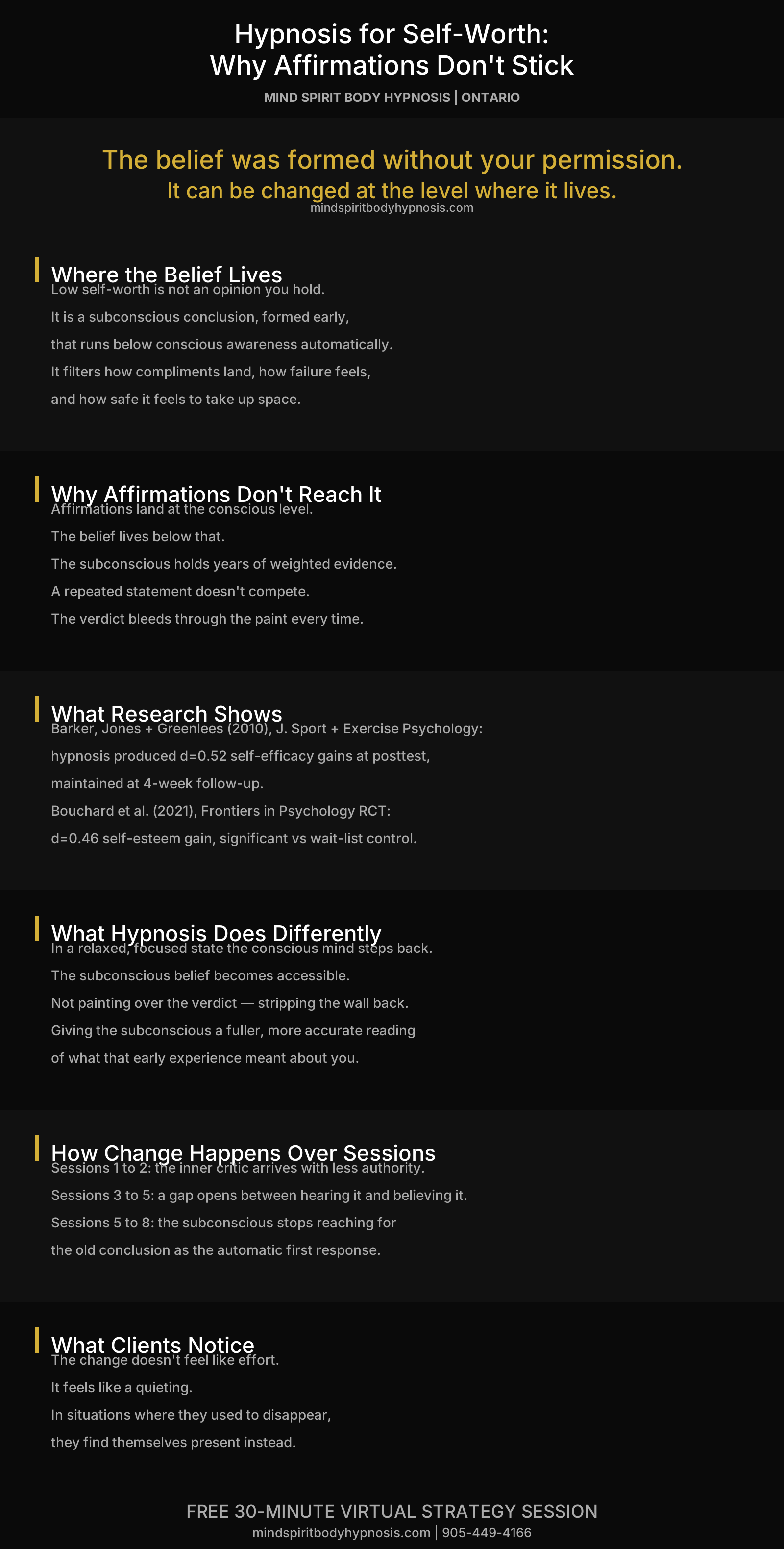
TL;DR: Low self-worth is not an opinion you hold about yourself. It is a subconscious conclusion, usually formed early in life, that continues running below your conscious awareness. Affirmations and positive thinking work at the conscious level and can't reach it. Hypnosis for self-worth works at the subconscious level, where the original conclusion was formed, and where it can actually be updated.
Quick Answer
Hypnosis for self-worth is a subconscious-focused approach that identifies and updates the core beliefs driving low self-esteem by working at the level where those beliefs were first established. A randomized controlled trial published in Frontiers in Psychology found that hypnosis enhanced self-efficacy with a medium effect size (d = 0.52) at posttest and maintained the gains at four-week follow-up (Barker, Jones & Greenlees, 2010). Fanis Makrigiannis, a Certified Hypnotherapist and NLP Master Practitioner at Mind Spirit Body Hypnosis in Oshawa, Ontario, offers virtual sessions across Ontario for clients whose sense of self-worth hasn't responded to conscious-level approaches.
Questions This Article Answers
Why doesn't my self-worth improve even when things go well?
Why do affirmations feel hollow or don't stick?
Where does low self-worth actually come from?
Can hypnosis help with low self-worth?
How does hypnosis reach a belief that conscious effort can't?
How many sessions does it take to notice a real shift?
In this article:
The Part Nobody Explains
People with low self-worth are not usually short on information. They know their inner critic is harsh. They've been told they're capable, likeable, worthy. Some of them have read the books, done the journaling, said the affirmations.
And the feeling doesn't shift.
This is the gap that almost no content on self-worth addresses. The belief doesn't live where the affirmations land. Telling yourself "I am enough" is a conscious act. The conclusion that you are not enough lives in the subconscious, and it was formed long before you had a say in it.
In my practice, I work with clients across Ontario who are articulate, self-aware, often professionally successful people. They can describe their low self-worth in precise detail. They can trace it back to specific experiences. They understand it. And they still feel it, automatically, in situations that should feel neutral. That is the nature of a subconscious belief. Understanding it is not the same as changing it.
Where Low Self-Worth Actually Lives
Self-worth is not an opinion you consciously form and update. It is a conclusion the subconscious mind reached, usually during a period when your sense of yourself was being shaped by people and experiences around you.
For some people, it was a home environment where love felt conditional on performance. For others, it was repeated criticism, comparison, or being made to feel like a burden. For others still, it was subtler: an absence of being truly seen, over a long enough period that the subconscious drew its own conclusion.
These conclusions become part of the subconscious operating system. They run automatically. They filter how compliments land, how failure feels, and how safe it feels to take up space. They are not updated by being told something different. They update when something reaches them at the level where they live.
The Verdict Written on the Wall
Here is the most useful way I know to explain this to clients.
Imagine a verdict written on the wall of a room. Someone has painted over it. The room looks fine. But within a short time, the writing bleeds through the paint. You paint it again. It bleeds through again.
That is what it feels like to try to layer positive self-talk over a subconscious belief. The belief bleeds through. Not because you're weak, or not trying hard enough, but because you're applying the fix at the wrong level.
Hypnosis for self-worth doesn't paint over the verdict. It strips the wall back to bare plaster. The belief is accessed at the subconscious level, examined in the relaxed, focused state where it was formed, and updated with information it never had: that the conclusion drawn then no longer applies, that the environment has changed, and that the person you are now is not what that early experience suggested.
What is self-worth?
Why Affirmations Don't Work at the Root
This is the question most content about self-worth never directly answers.
Affirmations are a conscious-level tool. They ask you to repeat a new statement until it feels true. The problem is that the subconscious, when it holds a strong belief, treats contradicting conscious statements as irrelevant. It has weighted evidence built up over years. A statement repeated for ten minutes doesn't compete.
This is not a new idea. It is how the subconscious is understood to process conflicting information. When a deeply held subconscious belief and a conscious statement conflict, the subconscious tends to win, especially under pressure. This is why the belief resurfaces strongest in high-stakes moments, job interviews, relationships, new opportunities, precisely when you most want it to be quiet.
The confidence and self-sabotage work I do with clients in Ontario often reveals this dynamic clearly. The sabotage isn't random. It's the subconscious acting in line with the belief it holds about what the person deserves or is capable of.
If you want to explore whether this kind of subconscious work fits what you're dealing with, I offer a free 30-minute virtual strategy session for new clients across Ontario. It's a conversation, not a commitment.
What Hypnosis Does Differently
Hypnosis creates a relaxed, focused state in which the conscious, analytical mind steps back. This is not sleep, and it is not the absence of awareness. Clients remain fully conscious throughout. What changes is the degree of access to the subconscious layer where the belief lives.
As a certified hypnotherapist trained through the American Board of Hypnotherapy, I work with clients to identify the original experience or pattern from which the low self-worth belief was drawn, and to provide the subconscious with a different interpretation of that experience. Not a forced positive replacement, but a more complete and accurate reading of what happened and what it means about the person.
Research supports this approach to belief change and self-efficacy. A controlled study by Barker, Jones and Greenlees (2010) in the Journal of Sport & Exercise Psychology found that hypnosis produced a medium effect on self-efficacy (d = 0.52) at posttest and that the gains continued at four-week follow-up, with performance improvements following. A randomized controlled trial on self-hypnosis combined with structured self-care (Bouchard et al., 2021, Frontiers in Psychology) found significant self-esteem gains (d = 0.46) in the intervention group, with no significant change in the wait-list control.
The anxiety dimension of low self-worth is also often addressed in the same sessions, since the two are closely linked. The inner critic that produces low self-worth also tends to fuel the anxiety response, particularly social anxiety and performance anxiety.
What Sessions Look Like
The first session is a conversation. I want to understand when the belief started, what the original environment looked like, and how the low self-worth shows up now. Clients often describe it as a background voice that narrows the choices they allow themselves, the relationships they feel they deserve, the success they permit.
From the second session, we work in a relaxed hypnotic state. The process typically involves:
Identifying the earliest context in which the subconscious formed the belief
Providing the subconscious with a fuller, more accurate reading of that experience
Separating the person from the conclusion that was drawn about them in that context
Building a subconscious reference point for self-worth that isn't dependent on performance, approval, or specific outcomes
Work on trauma and its effect on self-perception often connects directly to this process. Many of the experiences that formed low self-worth were not dramatic in the way trauma is usually described. They were quiet, repeated, and cumulative. And they had the same kind of effect.
Sessions are virtual. Clients across Ontario, including Durham Region, can access this from home, at a time that works around their week.
How Change Happens Over Time
Hypnosis for self-worth does not produce an overnight transformation. What it produces is a different relationship to the belief.
Sessions 1 to 2: You may notice the inner critic's voice arriving with slightly less authority. It's still there. But there is a small gap between hearing it and believing it.
Sessions 3 to 5: Clients often describe a shift in how they explain things to themselves. Where they would previously have interpreted a setback as evidence of their inadequacy, they find themselves reaching for a more neutral explanation first. The belief is still present but no longer automatic.
Sessions 5 to 8: The reference point begins to change. In situations that previously triggered the strongest low self-worth response, the subconscious no longer reaches for the old conclusion as readily. Clients describe this as feeling like themselves in situations where they usually disappear.
The timeline varies. What clients consistently report is that the change doesn't feel like effort. It feels like a quieting.
Try This Now
The next time the inner critic is loud, don't argue with it. Instead, notice: how old does this voice feel? Is it speaking in the tone of a specific experience or time in your life?
That observation alone is useful. The critic is not your current self's assessment. It is a conclusion drawn by the subconscious at an earlier time, in an earlier context. Noticing the distance between that voice and your present self is the beginning of the gap hypnosis works to widen.
WHAT MY CLIENTS SAY
“I don’t even know where to begin! Fanis saved my life! I have battled over 5 decades of trauma. After 5 sessions and a final negative moment in my life I felt the shift. I can’t thank you enough Fanis. I have tried therapy and felt it was not really helping too much. Hypnosis was the answer. I am SO happy. I feel better than ever. I will be recommending Fanis to so many people I know struggling with different issues. A++” — Helen R.
Frequently Asked Questions
What is low self-worth? Low self-worth is the subconscious belief that you are fundamentally less than, not enough, or undeserving of good things. It differs from situational low confidence, which comes and goes. Low self-worth is persistent. It operates as a background filter that affects how you read success, relationships, and opportunity. It was usually formed through early experience and runs automatically below conscious awareness.
Why don't affirmations fix low self-worth? Affirmations are a conscious-level tool. They ask the thinking mind to assert something new. But the belief producing low self-worth lives in the subconscious, which doesn't update through repetition of a statement that contradicts what it already holds as established. The subconscious has weighted evidence from years of experience. A daily affirmation doesn't compete. This is why the belief resurfaces most strongly under pressure, when it matters most.
Can hypnosis help with low self-worth? Hypnosis for self-worth works at the subconscious level, where the core belief was established, rather than at the level of conscious thought. It identifies the original context from which the belief was formed and provides the subconscious with a more complete interpretation of that experience. Research supports the approach: controlled studies have found that hypnosis produces meaningful gains in self-efficacy and self-esteem that are maintained over time.
How is low self-worth different from low confidence? Low confidence is usually situational and task-specific. You may feel confident in one area and not another. Low self-worth is about your fundamental sense of value as a person, independent of performance or outcomes. Someone can be highly competent and professionally successful while carrying a deep subconscious belief that they are not truly worthy or deserving. The two often coexist, but they have different roots and respond to different approaches.
Where does low self-worth come from? Usually from a period in which the subconscious was drawing conclusions about its environment and the person's place in it. This can include conditional love or approval in early relationships, chronic criticism or comparison, being made to feel like a burden, or a long period of not being truly seen. These experiences don't have to be dramatic. Cumulative, subtle patterns produce the same result: a subconscious conclusion about the person's inherent worth.
Is this the same as working on self-esteem? They overlap closely. Self-esteem is often described as the evaluative dimension of how you see yourself. Self-worth is the deeper layer: whether you believe you are fundamentally valuable, regardless of what you achieve or how others respond. In practice, the hypnotherapy work addresses both simultaneously, because the subconscious belief driving low self-worth is the same one producing the low self-esteem.
How many sessions does it take? Most clients working on self-worth notice meaningful shifts within five to eight sessions. The first two to three sessions are used to understand the original context and begin accessing the belief. Later sessions focus on updating the subconscious reference point and building a stable, internal sense of worth that isn't dependent on external validation. The exact number depends on how long the pattern has been running and how complex the original environment was.
Does it work if I've already done therapy? Yes. Hypnotherapy and talk therapy work at different levels. Therapy is often excellent at helping people understand where the belief came from and how it has operated. Hypnotherapy works at the subconscious level where the belief still runs, regardless of how well it's understood. Many clients come to hypnotherapy having done significant therapeutic work already. They understand their low self-worth clearly. What they haven't been able to do is stop feeling it. That is the gap hypnotherapy is designed to address.
What does a session actually feel like? A relaxed, focused state. Not sleep, not a loss of control. Most clients describe it as similar to the state just before falling asleep, where the mind is calm and receptive but still aware. You hear everything, remember everything, and remain in control throughout. The difference from ordinary conversation is that in this state, the subconscious is more accessible and less defended, which is what makes the belief-change work possible.
Is this appropriate for serious mental health concerns? Hypnotherapy is a complementary approach, not a replacement for mental health treatment. If your low self-worth is connected to depression, trauma, or other clinical concerns, I would work alongside any existing professional support rather than in place of it. If you're unsure whether this is appropriate for your situation, a free 30-minute virtual strategy session is a good place to start the conversation.
RECOMMENDED READING
Ready to Take the Next Step?
If you've tried the conscious-level approaches and the belief is still there, this is the work that reaches a different level.
I offer a free 30-minute virtual strategy session for new clients across Ontario. It's a conversation about where you are, what you've already tried, and whether subconscious-focused work is the right fit for what you're dealing with.
Book your free session: calendly.com/mindspiritbodyhypnosis
Call or text: 905-449-4166
Email: info@mindspiritbodyhypnosis.com
Visit: mindspiritbodyhypnosis.com
Serving clients virtually across Ontario, including Durham Region, Toronto, Canada, and beyond.
Disclaimer: This article is for informational purposes only and does not constitute medical or psychological advice. Hypnotherapy, NLP, and EMDR are complementary approaches and are not a substitute for diagnosis or treatment by a qualified healthcare provider. Please consult a licensed professional if you have concerns about your mental or physical health.
Written by Fanis Makrigiannis | Certified Hypnotherapist & NLP Master Practitioner | Mind Spirit Body Hypnosis.