Why am I always hypervigilant?
Hypnosis for Hypervigilance: Why Your Nervous System Won't Switch Off
TL;DR: Hypervigilance is not a personality trait or a bad habit. It is a nervous system pattern, usually formed in response to past threat or unpredictability, in which the subconscious continues scanning for danger long after the threat has passed. Coping strategies help manage the output but don't reach the source. Hypnosis for hypervigilance works at the subconscious level where the scanning pattern was set, not at the level of conscious effort.
Quick Answer
Hypnosis for hypervigilance is a subconscious-focused approach that addresses the nervous system's overactive threat-detection pattern by working at the level where that pattern was established. Research on threat-related attentional bias (Bar-Haim et al., 2007, Psychological Bulletin) found this bias operates largely below conscious awareness, which is why logic and reassurance rarely resolve it on their own. Fanis Makrigiannis, a Certified Hypnotherapist and NLP Master Practitioner at Mind Spirit Body Hypnosis in Oshawa, Ontario, offers virtual sessions across Ontario for clients whose nervous systems haven't been able to settle.
Questions This Article Answers
What is hypervigilance and why does it happen?
Why can't I relax even when nothing is wrong?
Why don't breathing exercises and coping tips stop the constant scanning?
Can hypnosis help with hypervigilance?
How does hypnosis reach the subconscious threat-detection pattern?
How many sessions does it take to notice a difference?
In this article:
The Part Most People Miss
You are not tense because you are anxious. You are scanning because your nervous system learned, at some point, that scanning was necessary.
People who live with hypervigilance often describe it the same way: a constant low-level hum of alertness, even in safe situations. They notice every change in tone in someone's voice. They sit with their back to the wall. They startle easily and take a long time to come down. They feel exhausted but can't fully rest.
What most coping advice misses is that this is not a thinking problem. The scan is happening below the level of thought. By the time you notice you're tense, the assessment has already been made.
In my practice, I work with clients across Ontario who are smart, self-aware people. They know they're safe. They know the relationship is stable, the situation is manageable, the threat is not there. And the scanning continues anyway. Understanding why is the first step toward something that actually helps.
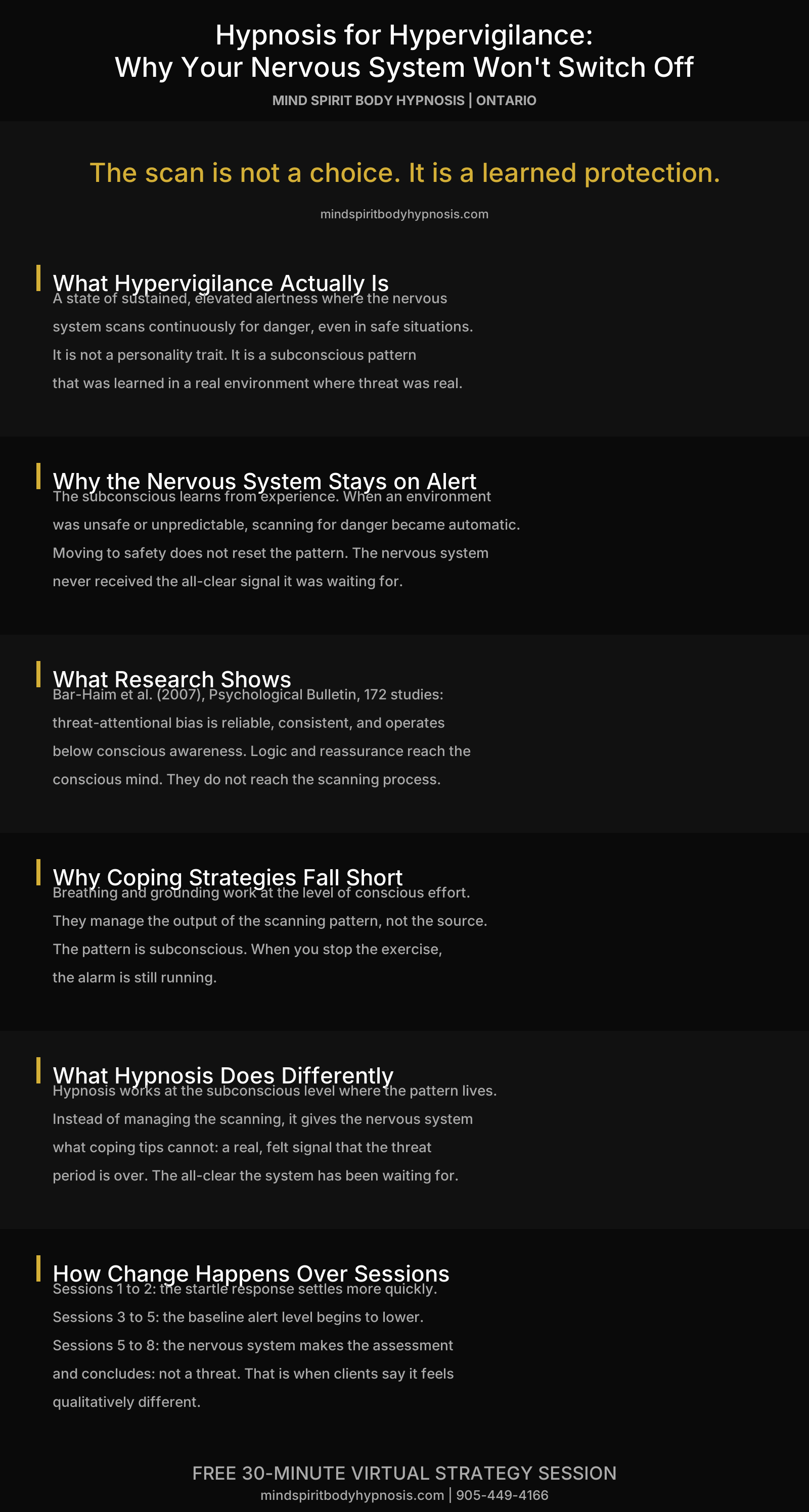
What Hypervigilance Actually Is
Hypervigilance is a state of sustained, elevated alertness in which the nervous system continuously scans the environment for potential threat. It is not the same as being generally anxious or worried. It is a specific pattern in which the threat-detection system is running in the background, constantly, even in the absence of an actual threat.
A meta-analysis of 172 studies by Bar-Haim and colleagues, published in Psychological Bulletin in 2007, found that threat-related attentional bias operates below conscious awareness. The brain registers and flags potential threats before conscious thought has any input. In anxious individuals, this bias is consistent and measurable. In non-anxious individuals, it is largely absent.
This matters because it tells us where the pattern lives. It is not a belief you can talk yourself out of. It is a subconscious process running on a program established earlier, often in response to an environment where danger really was unpredictable.
What is hypervigilance?
Why the Nervous System Stays on Alert
The nervous system learns from experience. When a person spends a significant period in an environment where threat was real, frequent, or unpredictable, the subconscious adapts. Scanning for danger becomes automatic, because in that context, it was useful.
The problem is that the subconscious doesn't automatically update when circumstances change. Moving to a safe relationship, a stable home, or a less stressful environment doesn't reset the pattern. The nervous system keeps running the protocol it learned, because no clear signal has been received that the protocol is no longer needed.
This is why hypervigilance can persist for years after the source of threat is gone. Clients I work with in Ontario often tell me they moved away, left the relationship, changed jobs, and still feel like they're waiting for something bad to happen. The subconscious is not ignoring the new circumstances. It simply hasn't received the information at the level where the pattern lives.
The Smoke Alarm with a Stuck Battery
Here is the most useful way I know to explain this to clients.
Imagine a smoke alarm with a stuck battery. It keeps beeping. You can explain to it that there's no fire. You can open a window, clear the air, demonstrate that the room is safe. The beeping continues. Not because the alarm is broken. Because it hasn't received the reset signal it's designed to respond to.
Your nervous system's threat-detection process works similarly. It is doing exactly what it was designed to do. It learned, through real experience, that the environment required constant monitoring. And it is still running that program.
Breathing exercises, mindfulness, and grounding techniques work at the level of the output. They help manage the beeping in the moment. They do not reach the battery. Hypnosis works differently, because it communicates directly with the subconscious process that determines whether the alarm should be running at all.
Why Coping Strategies Fall Short
This is the gap that most content on hypervigilance misses entirely.
Breathing exercises, grounding techniques, and mindfulness practices are genuinely useful. They engage the parasympathetic nervous system and reduce the physiological arousal that comes with sustained alertness. Used consistently, they can lower the baseline level of tension.
But they operate at the level of conscious effort. You apply them when you notice the scanning. You bring your attention to your breath. You name five things you can see. These are not small things. They help.
What they don't do is reach the subconscious process that is producing the scanning in the first place. The threat-detection pattern runs below the level where those tools operate. When you stop the breathing exercise, the pattern is still there.
This is the level where trauma-focused hypnotherapy is designed to reach. Not the output of the pattern. The source.
If you want to explore what that kind of work looks like, I offer a free 30-minute virtual strategy session for new clients across Ontario.
What Hypnosis Does Differently
Hypnosis works at the subconscious level. In a session, the conscious mind quiets. The analytical, evaluating part of your thinking steps back. This creates access to the patterns and processes that are running below your awareness, including the threat-detection setting that is producing the hypervigilance.
As a certified hypnotherapist trained through the American Board of Hypnotherapy, I work with clients to identify the original context in which the scanning pattern was established, and to provide the subconscious with the information it never received: that the threat is over, that the environment is different now, and that sustained high-alert monitoring is no longer necessary.
This is not about talking the nervous system out of anything. It is about communicating with the subconscious in the language it processes, which is imagery, sensation, and felt experience rather than logic and explanation.
Research on hypnotherapy for anxiety and stress supports this approach. Valentine et al. (2019) in the International Journal of Clinical and Experimental Hypnosis found that adding hypnotherapy to standard care produced an effect size of 0.99 at long-term follow-up for anxiety. Hypervigilance, as a subconscious alertness pattern, sits within the same territory.
Work on sleep and the overactive mind often runs alongside hypervigilance sessions, since the same scanning pattern that runs during the day also prevents full rest at night.
What Sessions Look Like
The first session is a conversation. I want to understand when the pattern started, what the original environment looked like, and how the hypervigilance shows up now in daily life. Clients often describe specific moments: not being able to concentrate because they're tracking the room, muscles that don't fully release even after sleep, a sense of waiting that never fully resolves.
These descriptions are useful information. They tell me what the nervous system is scanning for and what kind of resolution it hasn't yet received.
From the second session, we work in a relaxed, focused hypnotic state. Clients remain fully aware throughout. The work typically involves:
Identifying the subconscious context in which high-alert scanning was established
Providing the nervous system with a clear, experiential signal that the threat period has ended
Building an internal felt-sense of safety that isn't dependent on the external environment staying predictable
Reducing the automatic startle response and recovery time after triggers
Sessions are virtual, so clients across Ontario, including Durham Region, can access this from home.
How Change Happens Over Time
Hypnosis for hypervigilance does not produce a single session shift. But the changes, when they come, are felt rather than just understood.
Sessions 1 to 2: You may notice the startle response arrives but settles more quickly. A small increase in the time between trigger and return to baseline.
Sessions 3 to 5: The baseline itself begins to lower. Instead of starting the day at a high level of alertness, there is a quieter starting point. The scanning is still there but less constant.
Sessions 5 to 8: Clients often describe noticing that they sat through a situation they would have found difficult, and the alarm didn't escalate. The assessment was made, and the system concluded: not a threat. This is the moment clients say feels qualitatively different.
The timeline depends on how long the pattern has been running and what the original context was. What clients consistently report is that the change doesn't feel like effort. It feels like the alarm finally got the signal it was waiting for.
Try This Now
Next time you notice the scanning, try to locate where it lives in your body before you think about what you're scanning for. A tightening across the chest. Tension through the shoulders. A held quality in the breath.
That physical sensation is the nervous system's alertness signal arriving in your body. It is there before the thought forms. That tells you where the pattern begins. That is the level where hypnosis works.
What my clients say
“Found Fanis through a Google search when I was at my wit’s end with insomnia. The nail biting was a bonus issue I figured I would mention. Did not expect much for either, honestly. Three sessions (three hours only) in and I am sleeping. Like actually sleeping. The nail biting is basically gone too. Fast results, great experience, highly recommended.” — Kennedy O. via Google
Frequently Asked Questions
What is hypervigilance? Hypervigilance is a state of sustained heightened alertness in which the nervous system scans continuously for potential threat, even in safe situations. It is not a personality trait or a sign of weakness. It is a learned subconscious pattern, usually developed in response to a period when real threat or unpredictability made constant monitoring necessary.
Why does my nervous system stay on alert even when I know I'm safe? Because knowing you are safe is a conscious process, and the scanning is subconscious. The threat-detection pattern runs below conscious thought. Research published in Psychological Bulletin found this attentional bias to threat operates largely outside conscious awareness. Logic and reassurance reach the conscious mind. They don't reach the subconscious pattern producing the scan.
Can hypnosis help with hypervigilance? Hypnosis for hypervigilance targets the subconscious threat-detection pattern directly, by working in the relaxed state where the conscious mind steps back and the underlying process becomes accessible. Rather than managing the output of the pattern, it works at the level where the pattern was established. For many clients, this produces a different quality of change than coping strategies alone.
Is hypervigilance the same as anxiety? They overlap, but they are not the same thing. Anxiety is often about specific worries or future-oriented fear. Hypervigilance is a state of constant environmental scanning that happens automatically, regardless of whether there is anything specific to worry about. Many people with hypervigilance don't feel particularly anxious in the conventional sense. They feel tired, on edge, and unable to fully relax.
What causes hypervigilance? Hypervigilance typically develops in response to an environment where threat was real, frequent, or unpredictable. This includes emotionally unsafe childhood environments, relationships involving abuse or instability, high-pressure or unsafe work environments, and experiences of loss or shock. The nervous system adapted well to those circumstances. The difficulty is that it continues the pattern after those circumstances have changed.
How long does hypervigilance last without treatment? Without addressing the subconscious pattern, hypervigilance can persist for many years after the source of threat is gone. The nervous system does not automatically update when the external environment changes. Many clients have been managing symptoms for a decade or more before finding an approach that addresses the source rather than the output.
How many sessions of hypnosis are needed? Most clients working on hypervigilance notice meaningful shifts within five to eight sessions. The first two to three sessions identify and begin addressing the original context. Later sessions focus on lowering the baseline alert level and building a stable internal sense of safety. The exact number depends on how long the pattern has been running and how complex the original environment was.
Do I have to remember specific past experiences in sessions? No. Sessions do not require detailed memory recall or revisiting specific events painfully. The work focuses on providing the subconscious with a clear present-tense signal, not on excavating the past. Many clients find this the most surprising and welcome aspect of the process.
Is this a replacement for therapy or other mental health support? Hypnosis is a complementary approach, not a replacement for therapy or medical care. It can run alongside other support effectively. If you are already working with a therapist, hypnotherapy can address the subconscious layer that talk-based approaches sometimes don't fully reach.
Is hypervigilance the same as being highly sensitive? They can look similar from the outside but have different origins. High sensitivity is a trait involving heightened sensory processing. Hypervigilance is a learned pattern in which the nervous system specifically scans for threat. Some people experience both, but hypervigilance, unlike sensitivity, tends to have a traceable starting point and can be meaningfully reduced with the right approach.
recommended reading
Ready to Take the Next Step?
If your nervous system hasn't been able to fully switch off, regardless of how much you understand about why, I'd like to help.
I offer a free 30-minute virtual strategy session for new clients across Ontario. It's not a sales call. It's a conversation about where you are, what you've already tried, and whether this kind of subconscious work is a good fit for what you're going through.
Book your free session: calendly.com/mindspiritbodyhypnosis
Call or text: 905-449-4166
Email: info@mindspiritbodyhypnosis.com
Visit: mindspiritbodyhypnosis.com
Serving clients virtually across Ontario, including Durham Region, Toronto, Canada, and beyond.
Disclaimer: This article is for informational purposes only and does not constitute medical or psychological advice. Hypnotherapy, NLP, and EMDR are complementary approaches and are not a substitute for diagnosis or treatment by a qualified healthcare provider. Please consult a licensed professional if you have concerns about your mental or physical health.
Written by Fanis Makrigiannis | Certified Hypnotherapist & NLP Master Practitioner | Mind Spirit Body Hypnosis.