Why I can’t leave a narcissist
Why You Can't Just Leave a Narcissist (And What Hypnotherapy Does About It)
TL;DR: Staying in a narcissistic relationship is not a sign of weakness. Intermittent reinforcement (unpredictable cycles of hurt and warmth) conditions the brain's reward system the same way a slot machine does. The attachment forms below conscious awareness, which is why advice and willpower rarely work. Hypnotherapy for narcissistic abuse targets the subconscious level where the bond was built.
Quick Answer
Hypnotherapy for narcissistic abuse is a subconscious-focused approach that addresses the trauma bond (the conditioned attachment formed through cycles of punishment and reward) by working at the level where that bond was created. Research on trauma bonding (Dutton & Painter, 1993) identifies intermittent reinforcement as the core mechanism that makes these relationships hard to leave, and a meta-analysis published in the International Journal of Clinical and Experimental Hypnosis found hypnotherapy produced large effect sizes for trauma symptom relief (d = 1.17 at posttest). Fanis Makrigiannis, a Certified Hypnotherapist and NLP Master Practitioner at Mind Spirit Body Hypnosis in Oshawa, Ontario, offers virtual sessions across Ontario for clients working through narcissistic abuse recovery.
Questions This Article Answers
Why is it so hard to leave a narcissistic relationship?
What is a trauma bond and how does it form?
Why doesn't logic or advice help me move on?
Can hypnotherapy help with narcissistic abuse recovery?
How many hypnotherapy sessions does it take to break a trauma bond?
Why do I still miss someone who hurt me?
In this article:
The Part Nobody Talks About
People who have never been in a narcissistic relationship will tell you it's simple. Just leave. Cut contact. Stop going back.
They don't understand that leaving feels like ripping out something load-bearing. Not because you are weak. Not because you lack self-respect. But because your brain has been conditioned in a way that has nothing to do with your conscious choices.
In my practice, I work with clients across Ontario who are intelligent, self-aware people. They know the relationship is damaging. They've read the articles. They've had the conversations with friends. And yet something pulls them back, or keeps them stuck in grief long after it's over. Understanding why that happens is the first step toward something that actually helps.
Why Leaving Feels Impossible
There is a specific psychological mechanism that makes narcissistic relationships so hard to exit. It is called a trauma bond, and it is not a character flaw. It is a learned attachment.
Traumatic bonding was first described by researchers Dutton and Painter in their work on abusive relationships. Their 1993 study in the American Journal of Orthopsychiatry found that intermittent reinforcement (the unpredictable alternation between punishment and warmth) was a stronger predictor of post-relationship distress than the abuse itself. The bond isn't formed by the good times or the bad times. It is formed by the unpredictability between them.
That finding matters. It tells us that the reason leaving is so hard is not that the relationship was mostly good. It is that the reward was unpredictable. And unpredictable rewards produce the strongest conditioning in the human brain.
What a Trauma Bond Actually Is
A trauma bond is an emotional attachment that forms through repeated cycles of tension, abuse, and reconciliation. It is not built on consistent care. It is built on contrast.
The cycle typically looks like this:
Idealization: You feel seen, chosen, special. The relationship feels almost too good.
Devaluation: The warmth disappears. Criticism, withdrawal, or cruelty take its place.
Discard or rupture: You are pushed away, ignored, or punished.
Reconciliation: The warmth returns. Relief floods in.
That relief is the problem. When the threat is removed and comfort returns, the nervous system associates the source of the threat with safety. The brain doesn't weigh this consciously. It simply registers: the person who hurts me also makes the pain stop. And it attaches.
What is narcissism?
The Slot Machine Your Brain Got Attached To
Here is the most useful way I know to explain trauma bonding to clients.
Imagine a slot machine. You pull the lever. Sometimes nothing happens. Sometimes you win. You never know when. And because the reward is unpredictable, you keep pulling.
Now imagine you are chained to that machine. You can't walk away even when you want to. Your hands keep reaching for the lever. Not because you are addicted to losing. Because your brain has learned that the next pull might be the one.
Narcissistic relationships work exactly this way. The warmth, attention, or affection doesn't come on a schedule. It arrives unpredictably, after periods of withdrawal or cruelty. And unpredictable rewards produce a stronger and more persistent behavioural pattern than consistent rewards do. This is not a metaphor. It is how reinforcement conditioning works.
The problem is that this conditioning happened below the level of conscious thought. You didn't choose it. It was wired in through repetition, long before your rational mind had a chance to weigh in.
Why Advice Doesn't Work
This is the gap that most content on this topic misses.
Every article about narcissistic abuse recovery eventually gets to the advice section. Go no contact. Write in a journal. Rebuild your support network. These are not bad suggestions. They work at the level of behaviour and thought.
But the trauma bond doesn't live there.
The attachment was formed in the subconscious. It is the part of your mind that responds before you think, that pulls you toward a familiar pattern even when your rational mind knows it's harmful. When a friend says "you deserve better," your conscious mind agrees. And then the old pull comes anyway.
That gap between knowing and feeling is where most people get stuck. And it is exactly the level where hypnotherapy for anxiety and stress and trauma-focused hypnotherapy are designed to work.
What Hypnotherapy Does Differently
Hypnotherapy works at the subconscious level. That is not a vague claim. It is the practical reason it can reach what other approaches can't.
In a hypnotherapy session, the conscious mind becomes quieter. The critical, analytical part of your thinking steps back. This creates access to the subconscious patterns that formed through the relationship: the associations, the emotional responses, the conditioned pulls, without triggering the same defences that make those patterns hard to examine when you're fully alert.
As a certified hypnotherapist trained through the American Board of Hypnotherapy, I work with clients in Ontario to identify the specific subconscious beliefs and emotional loops that keep the bond active. Common ones include: "I am not complete without this person," "the pain means the connection was real," and "if I just do it differently, it will go back to the good times."
These beliefs don't respond to reassurance. They respond to direct subconscious work.
A meta-analysis in the International Journal of Clinical and Experimental Hypnosis found hypnotherapy produced a large effect size for trauma symptom relief, with d = 1.17 at posttest and d = 1.58 at four-week follow-up. That is meaningful for clients whose symptoms have persisted despite other approaches.
Work with the hypnotherapy for confidence and self-worth pillar often runs alongside narcissistic abuse recovery, since the two are closely connected.
What Sessions Look Like
The first session is mostly a conversation. I want to understand the relationship pattern, when it started, what the cycle looked like, and what has already been tried. Clients often arrive having already done significant work on the conscious level: therapy, reading, journaling. They feel frustrated that the emotional pull remains.
We are not starting over. We are going deeper.
From the second session, we begin working in a relaxed, focused hypnotic state. Clients remain fully aware of what is happening. The work typically involves:
Identifying and updating the core subconscious belief that sustains the bond
Reducing the emotional charge around specific memories or triggers
Building a felt sense of self-worth that doesn't depend on the other person's behaviour
Installing a new internal response to the familiar pull when it arrives
Sessions are virtual, so clients across Ontario, including Durham Region, can access this work from home.
How Change Happens Over Time
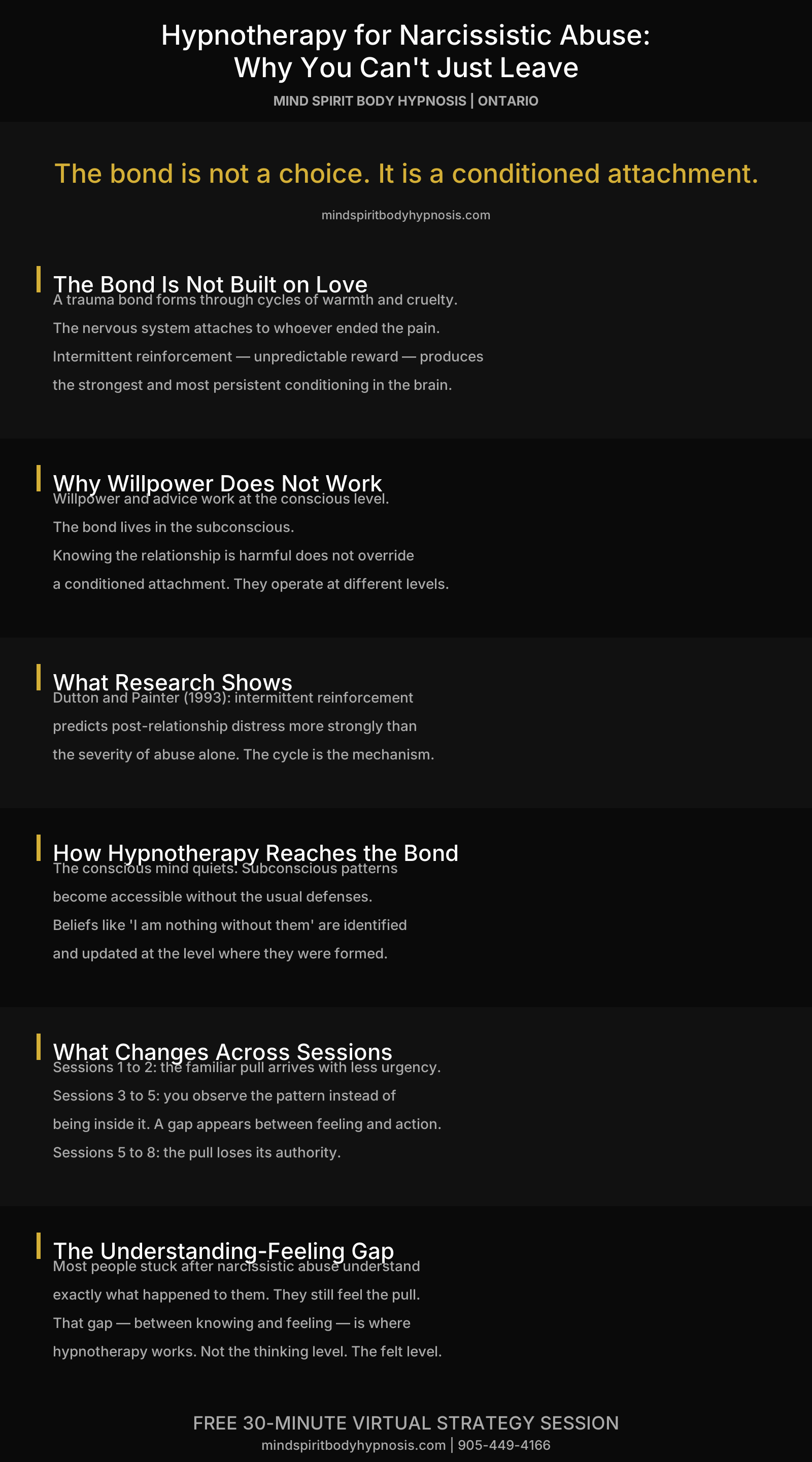
Hypnotherapy for narcissistic abuse recovery is not a one-session process. But the changes, when they come, are experiential rather than just intellectual.
Sessions 1 to 2: You may notice the familiar pull arriving but feeling slightly less urgent. There is a small gap between the feeling and the action it used to produce.
Sessions 3 to 5: The gap widens. You may find yourself observing the old pattern rather than being inside it. "I notice I want to reach out" is different from reaching out.
Sessions 5 to 8: The pull loses its authority. It may still appear, but it no longer carries the same weight. This is the shift clients describe as finally feeling free. Not because the relationship is forgotten, but because it no longer runs in the background.
The timeline varies by person and by how long the relationship lasted. What clients consistently report is that the change feels qualitatively different from anything they achieved through conscious effort alone.
WHAT MY CLIENTS SAY
“Found Fanis through a Google search when I was at my wit’s end with insomnia. The nail biting was a bonus issue I figured I would mention. Did not expect much for either, honestly. Three sessions (three hours only) in and I am sleeping. Like actually sleeping. The nail biting is basically gone too. Fast results, great experience, highly recommended.” — Kennedy O. via Google
Frequently Asked Questions
What is a trauma bond? A trauma bond is an emotional attachment that forms through cycles of punishment and reward in an abusive relationship. The bond is built by intermittent reinforcement (unpredictable alternation between cruelty and warmth) rather than by consistent care. Research by Dutton and Painter (1993) identified this mechanism as the core reason victims stay and find it hard to recover after leaving.
Why can't I leave even though I know the relationship is harmful? Because knowing and feeling are processed in different parts of your mind. The conscious mind understands the harm. The subconscious has been conditioned to associate this person with relief and comfort, particularly through the reconciliation phase of the abuse cycle. Logic doesn't override subconscious conditioning. That is why willpower and advice often fall short.
Why do I still miss someone who treated me badly? Missing them is not a sign that you loved them the wrong way or that the relationship was secretly good. It is the predictable result of intermittent reinforcement. Your nervous system bonded to the cycle, not just the person. The grief is real, and it is also a conditioned response that can shift.
Is hypnotherapy effective for narcissistic abuse recovery? Hypnotherapy for narcissistic abuse targets the subconscious level where the trauma bond was formed. A published meta-analysis found hypnotherapy produced large effect sizes for trauma symptoms (d = 1.17 at posttest). It is typically used alongside or after other forms of support, not as a standalone replacement for professional mental health care.
What happens in a hypnotherapy session for this issue? In a relaxed, focused state, we work to identify and update the subconscious beliefs that sustain the bond. Things like "I am not enough without them" or "if I just do better, it will return to the good times." You remain aware throughout. The session is calm, not dramatic. Most clients find it quieter than they expected.
How many sessions will I need? Most clients working on narcissistic abuse recovery find meaningful shifts within five to eight sessions. The first two to three sessions address the most active emotional charge. Later sessions focus on rebuilding a stable internal sense of self-worth. The timeline depends on how long the relationship lasted and how embedded the patterns are.
Do I need to be in the relationship or have recently left to benefit? No. Clients seek hypnotherapy for narcissistic abuse at different stages: some still in the relationship and wanting support building internal strength, some freshly out, and some months or years later still feeling stuck. The subconscious patterns don't expire. They can be worked with at any stage.
Is this therapy? Do I still need a therapist? Hypnotherapy is a complementary approach, not a replacement for therapy or medical care. If you are working with a therapist, hypnotherapy can run alongside that work effectively. If you are not, a free 30-minute strategy session with me can help you understand what kind of support makes the most sense for your situation.
Can I do this virtually? Yes. All sessions are virtual, which means clients across Ontario, including Durham Region, Toronto, Ottawa, and beyond, can access this work from home. Many clients find the privacy and comfort of their own space helpful for this kind of work.
What if I am not ready to fully leave the relationship? That is a more common starting point than people expect. You do not need to have made a final decision to benefit from this work. The goal of early sessions is often simply to reduce the emotional chaos and build enough internal steadiness to think clearly about your own situation.
RECOMMENDED READING
Ready to Take the Next Step?
If you are stuck in a pattern you understand but can't seem to shift, or if you left and still feel the pull, I would like to help.
I offer a free 30-minute virtual strategy session for new clients across Ontario. It is not a sales call. It is a conversation about where you are, what you have already tried, and whether hypnotherapy is a good fit for what you are going through.
Book your free session: calendly.com/mindspiritbodyhypnosis
Call or text: 905-449-4166
Email: info@mindspiritbodyhypnosis.com
Visit: mindspiritbodyhypnosis.com
Serving clients virtually across Ontario, including Durham Region, Toronto, Canada, and beyond.
Disclaimer: This article is for informational purposes only and does not constitute medical or psychological advice. Hypnotherapy, NLP, and EMDR are complementary approaches and are not a substitute for diagnosis or treatment by a qualified healthcare provider. Please consult a licensed professional if you have concerns about your mental or physical health.
Written by Fanis Makrigiannis | Certified Hypnotherapist & NLP Master Practitioner | Mind Spirit Body Hypnosis.