Why do I ruminate?
Hypnosis for Rumination: Why the Loop Keeps Running
TL;DR: Rumination is not a thinking problem. It is an attention-capture problem: the mind gets locked into a loop that runs faster and deeper than conscious effort can reach. Hypnosis for rumination works because it operates at the subconscious level where the loop is maintained, making it possible to loosen the grip on attention that keeps it going. Fanis Makrigiannis at Mind Spirit Body Hypnosis in Oshawa, Ontario, works with clients across Ontario who have found that trying to think their way out of the loop only adds more loops.
Quick Answer
Hypnosis for rumination is a subconscious-focused approach that addresses the attention-capture pattern driving repetitive negative thinking, rather than trying to reason with the content of the thoughts. Research identifies rumination as a causal mechanism in depression, anxiety, and several other conditions, not just a symptom of them. Fanis Makrigiannis, a Certified Hypnotherapist and NLP Master Practitioner at Mind Spirit Body Hypnosis in Oshawa, Ontario, offers virtual sessions across Ontario for clients whose minds keep replaying the same conversations, mistakes, or worst-case scenarios regardless of how much they try to stop.
Questions This Article Answers
What is rumination and why is it so hard to stop?
Can hypnosis help with rumination and overthinking?
What makes rumination different from normal worry?
Why does trying to stop ruminating often make it worse?
How does hypnosis reach the level where rumination lives?
How many sessions does it take to see a shift?
In this article:
Most people who come looking for help with rumination have already tried the obvious things. They have told themselves to stop. They have distracted themselves with work, with exercise, with screens. They have journalled, meditated, talked it through with people they trust. And then, usually at night or in a quiet moment, the loop starts again.
The same conversation replayed. The same mistake turned over. The same worst-case scenario running from the beginning. Not because they want it to. Not because they are weak or dramatic or broken. But because the loop does not live at the level where conscious effort can easily reach it.
What Rumination Actually Is
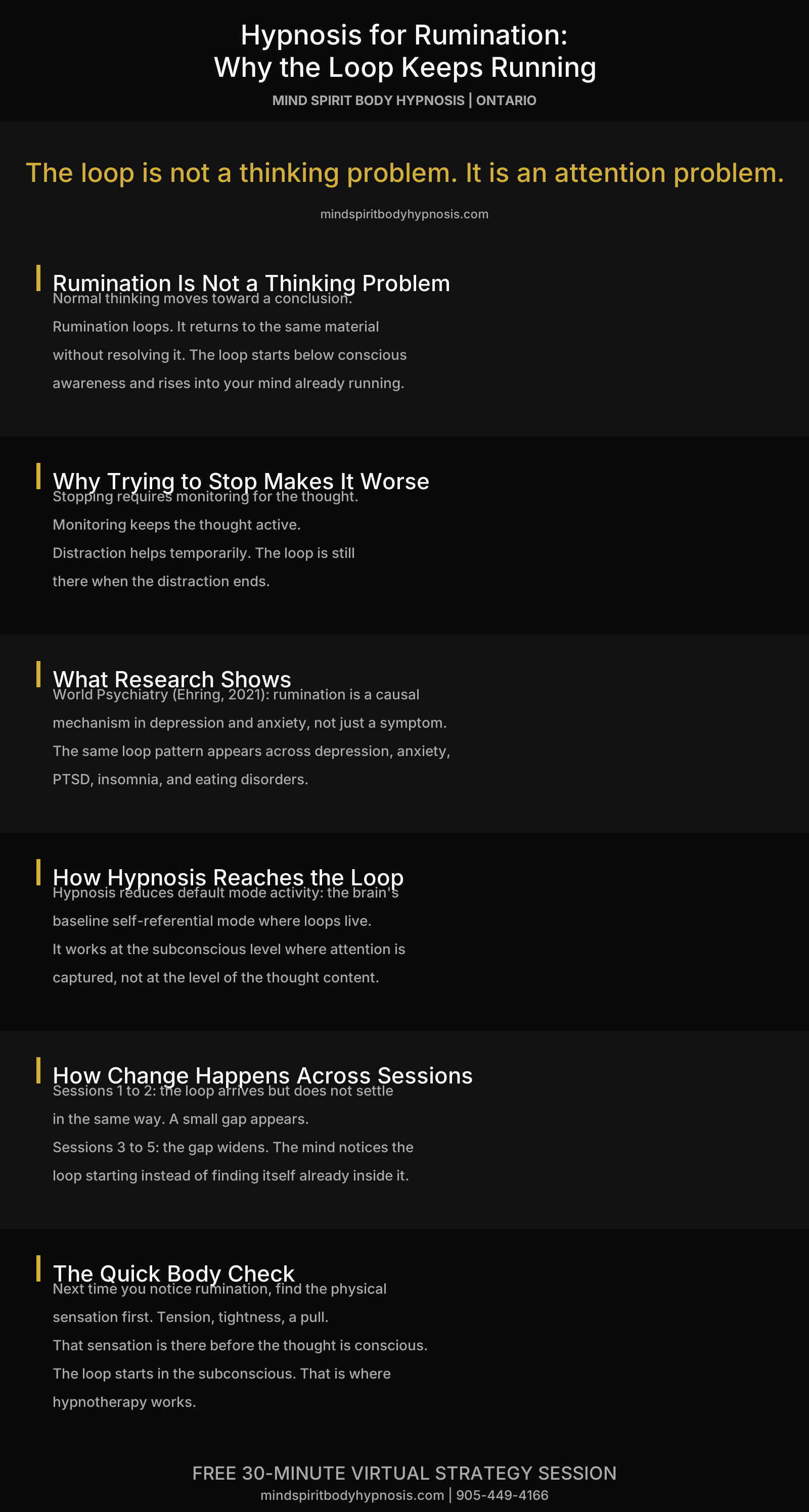
Rumination is not the same as thinking through a problem. Thinking through a problem moves. It goes somewhere. It produces a conclusion, even if that conclusion is uncertainty.
Rumination cycles. It returns to the same material again and again without resolving it. The technical definition used in clinical psychology describes it as repetitive negative thinking that is persistent, intrusive, and difficult to disengage from. It captures mental capacity in a way that crowds out other processing.
A 2021 paper in World Psychiatry by Thomas Ehring at Ludwig-Maximilians-Universität Munich argues that rumination is not simply a symptom of depression or anxiety but "a causal mechanism involved in the development and maintenance of psychopathology" (Ehring, 2021). That distinction matters. It means rumination is not what depression looks like from the inside. It is part of what keeps depression going. Treating the loop itself, not just the mood it produces, is what changes the pattern.
Ehring also notes that the same repetitive thinking process shows up across depression, anxiety disorders, PTSD, insomnia, and eating disorders. The content changes. The structure is the same. A looping mind replaying a past conversation and a looping mind rehearsing a future disaster are running the same underlying programme.
Why Trying to Stop It Usually Doesn't Work
There is a well-known effect in psychology: try not to think about something, and you will think about it more. The instruction to suppress a thought requires monitoring for that thought to know whether it has appeared. The monitoring keeps the thought active.
This is one reason why "just stop thinking about it" is advice that does not work. It is not a failure of willpower. It is how mental suppression operates.
But there is a deeper reason, and it is one that most people struggling with rumination have felt without having words for it. The loop does not feel like a choice. It does not feel like something they are doing. It feels like something that is happening to them. That is because it largely is. Rumination runs as an automatic pattern, below the level of conscious intention. The mind gets pulled back into the loop before the conscious decision to avoid it has had time to form.
Think of it like a drain in a sink. You can keep bailing water out. But until you address the drain itself, the water keeps pulling toward the same place. Conscious effort is the bailing. Hypnotherapy works with the drain.
In my work with clients in Ontario dealing with rumination, the pattern I see most often is not a lack of insight. They know what they are doing. They know the thoughts are not fully rational. They know the scenario they keep replaying is not going to resolve itself by replaying it again. The knowledge is completely intact. The loop runs anyway. That gap between knowing and stopping is the signature of a subconscious pattern.
Breathing exercises for rumination.
What Hypnosis Does Differently
The focused, receptive state used in hypnotherapy is not sleep, and it is not unconsciousness. It is a state in which the subconscious is more accessible than in ordinary waking life, and in which attention can be redirected in ways that feel natural rather than forced.
A 2010 paper in the International Journal of Clinical and Experimental Hypnosis described hypnosis as "a promising catalyst of attention and mindfulness-based treatments" for rumination, noting that it can modulate attention, imagination, and motivation toward therapeutic goals in ways that enhance what other approaches achieve alone. The mechanism proposed is that hypnosis reduces the automatic quality of the ruminative loop by working at the level where that automaticity is maintained.
Neuroimaging research adds a related finding. Studies using fMRI have found that hypnosis reduces activity in the default mode network, which is the brain's baseline self-referential activity, the mode it shifts into when not focused on an external task. Rumination is default mode activity that has become stuck. Reduced default mode activity during hypnosis corresponds to what participants report as quieting of mental chatter and reduced analytic self-focus (Deeley et al., 2012, cited in Fox et al., 2015).
What this means in practice is that hypnotherapy does not ask the ruminative mind to stop and reason with itself. It works at the level where the attention-capture pattern is maintained. The loop loses some of its automatic pull. The mind becomes able to disengage from the material rather than being caught in it again before it notices what happened.
A free 30-minute strategy session is available to explore what this would look like for your specific pattern before you commit to anything.
What the Research Says
The research on rumination as a treatment target is detailed. Interventions that directly address repetitive negative thinking produce better outcomes than those that address mood or behaviour without targeting the loop itself. Mindfulness-based cognitive therapy, metacognitive therapy, and rumination-focused CBT all show evidence in this direction.
The research on hypnosis as an addition to these approaches is earlier-stage but consistent in direction. The 2010 IJCEH paper argues that hypnosis can catalyze attention-based treatments, enhancing what they achieve by making the subconscious more available during the process. This is not a claim that hypnosis alone is a complete treatment for clinical depression or severe anxiety. It is a claim that the subconscious-level access hypnotherapy provides may enhance what other approaches do.
What the research is also clear about: rumination is a transdiagnostic process. The same loop pattern appears across conditions. This means that someone whose rumination feeds their anxiety, someone whose rumination feeds their depression, and someone whose rumination keeps them awake at night are all working with the same underlying mechanism. Hypnotherapy addresses the mechanism rather than the condition it feeds.
The honest caveat: research on hypnotherapy specifically for rumination is limited in volume. The strongest evidence base is for anxiety and depression, both of which are sustained by rumination. For the loop itself, the evidence is more mechanistic than trial-based. What exists points in the right direction.
How Change Happens Across Sessions
Rumination that has been running for years does not resolve in one session. What most clients notice after the first session or two is a subtle shift in the quality of the loop. It arrives as usual. But it does not quite settle in the same way. There is a small but real gap between the trigger and the full capture of attention that did not exist before.
Over subsequent sessions, that gap widens. The mind begins to notice the loop starting, rather than finding itself already inside it. That noticing is not dramatic. It is quiet. But it changes everything, because you cannot redirect attention you do not know has been captured.
My training through the American Board of Hypnotherapy gave me a grounding in why this progression matters: the subconscious updates through repeated experience, and what hypnotherapy provides is a new felt experience of disengagement. Each session builds on the last. The new pattern, which is the ability to let a thought pass rather than follow it, becomes more available each time it is practised at the subconscious level.
For anxiety and stress, the ruminative loop is often what keeps the anxious response running between triggers. For confidence and self-sabotage, rumination is frequently how self-doubt gets reinforced after the fact. And for habits and patterns that have not responded to insight, rumination about the habit is often what maintains the emotional charge that drives it.
A Quick Exercise to Try Right Now
This is not a fix. It is an observation that tells you something useful about how your loop works.
The next time you notice you are ruminating, do not try to stop. Instead, notice where in your body you feel it first. Not the thought content, the physical sensation. Is there tension? Tightness? A kind of pull?
Stay with the sensation for a moment without following the thought. Just the physical signal.
What most people find is that the sensation is there before they are consciously aware of the loop. The body is already in the loop before the mind has registered it. That sequence matters, because it tells you the loop is starting below conscious awareness. You don’t decide to do it. It starts in the subconscious and rises into awareness already running.
That is the level hypnotherapy is designed to reach.
WHAT MY CLIENTS SAY
“My closest friend referred me to Fanis after she had worked with him for a few weeks. I was dealing with a few things at once. Some trauma that had been sitting with me for years, a confidence issue that was affecting my work and relationships, and a fear of heights that had been limiting me in embarrassing ways. I did not think one person could help with all of it, and honestly I booked mostly because I trust my friend completely and she would not stop talking about him. I am so glad I listened. Fanis has a way of working that is completely calm, relaxed and a complete pro. He helped me connect the dots. He does not make you feel like a project. Within just a few sessions, I started noticing real differences. The trauma felt like it had less weight to it. I started showing up differently at work. And the height thing, I tested it recently, and I genuinely could not believe my own reaction. Or I should say, my lack of reaction. The results came faster than anything I have tried before. If a friend or family member is pointing you here, stop hesitating. Thank you Fanis.” — Dhamrai B via Google
Frequently Asked Questions
What is rumination? Rumination is repetitive negative thinking that cycles rather than resolves. It returns to the same material, the same conversation, the same fear, the same regret, without producing a conclusion. Research identifies it as a causal mechanism in depression, anxiety, and other conditions, not just a symptom. It captures attention in a way that crowds out other mental activity.
Can hypnosis help with rumination? For many people, yes. Hypnosis for rumination works by addressing the attention-capture pattern that keeps the loop running, rather than engaging with the content of the thoughts. Research describes hypnosis as a promising catalyst for attention-based treatments for rumination, and neuroimaging studies show that hypnosis reduces default mode activity, the brain's baseline self-referential mode, which is where ruminative loops live.
Why is rumination so hard to stop? Because it runs as an automatic subconscious pattern, not a conscious choice. The loop starts below the level of conscious awareness and rises into consciousness already running. Trying to stop it using conscious willpower is working against the current. The most effective approaches work at the automatic level where the loop is maintained, not at the level of reasoning with its content.
What is the difference between rumination and normal worry? Normal worry is often future-focused and moves toward problem-solving. Rumination is more often past-focused and cycles without resolution. The clinical distinction is less about the content and more about the structure: worry that leads somewhere is not the same as repetitive thinking that returns to the same place without resolving it. Both can become problematic when they are frequent and difficult to disengage from.
Is hypnosis for rumination the same as being put to sleep? No. The state used in hypnotherapy is a focused, receptive state, not sleep or unconsciousness. You remain aware throughout. The difference from ordinary waking consciousness is that the subconscious is more accessible, and attention can be redirected in ways that feel natural rather than forced. Most clients describe it as deeply calm but not absent.
Does hypnotherapy treat depression or anxiety caused by rumination? Hypnotherapy is a complementary approach, not a replacement for treatment of clinical depression or anxiety. It works well alongside other support, and research suggests it may enhance what attention-based therapies achieve when added to them. If you are managing a diagnosed condition, a strategy session is the right place to explore how hypnotherapy fits alongside your existing care.
How many sessions does it take? It varies by how long the ruminative pattern has been running and how central it is to other patterns. Most clients notice a shift in the quality of the loop after two to three sessions. Three to five sessions is where the shift tends to become self-sustaining. Some patterns with deeper roots take more time.
Can hypnotherapy make rumination worse? Not in the clinical sense. However, early sessions occasionally bring material into clearer awareness before the shift settles in. This is usually brief and is part of the process of the subconscious becoming more available to change. A good practitioner will pace sessions in a way that feels manageable, not destabilizing.
What if I have been ruminating for years? Years of rumination mean the pattern is well-established in the subconscious. That makes it more persistent, but not unreachable. The subconscious that built the loop through repeated experience can update through repeated experience of something different. Hypnotherapy provides that experience at the right level. The shift takes more sessions for long-standing patterns, but it is possible.
How do I know if hypnotherapy is right for my situation? A free 30-minute virtual strategy session is the right place to find out. There is no pressure. It is a direct conversation about what your pattern looks like, what you have already tried, and whether hypnotherapy or NLP is a good fit for where you are.
RECOMMENDED READING
Ready to Take the Next Step?
If the loop keeps running no matter what you try, I would like to help.
I offer a free 30-minute virtual strategy session for new clients across Ontario. No pressure. Just an honest conversation about what you are dealing with and how hypnotherapy or NLP might help.
Book your free session: calendly.com/mindspiritbodyhypnosis
Call or text: 905-449-4166
Email: info@mindspiritbodyhypnosis.com
Visit: mindspiritbodyhypnosis.com
Serving clients virtually across Ontario, including Durham Region, Toronto, Canada, and beyond.
Disclaimer: This article is for informational purposes only and does not constitute medical or psychological advice. Hypnotherapy and NLP are complementary approaches and are not a substitute for diagnosis or treatment by a qualified healthcare provider. Please consult a licensed professional if you have concerns about your mental or physical health.
Written by Fanis Makrigiannis | Certified Hypnotherapist & NLP Master Practitioner | Mind Spirit Body Hypnosis.