Can Hypnotherapy Help Change My Life?
Can Hypnotherapy Help Change My Life?
TL;DR: Hypnotherapy can help change your life, but not in the way most people picture it. It does not rewrite your personality or produce overnight transformation. What it does is reach the subconscious level where habits, beliefs, and emotional patterns actually live, and work with them directly. That is a different kind of change than insight or willpower produces, and for many people it reaches places nothing else has. Fanis Makrigiannis at Mind Spirit Body Hypnosis offers virtual sessions across Ontario for people who are ready to work at that level.
Quick Answer
Can hypnotherapy help change my life? For many people, yes. Research shows hypnotherapy can produce significant improvements in anxiety, confidence, sleep, habits, and patterns that have not responded to other approaches. What makes it different is not the relaxed state itself, but what becomes accessible in that state: the subconscious conclusions about who you are and what you are capable of, which drive behaviour faster than conscious thought can intervene. Fanis Makrigiannis, a Certified Hypnotherapist and NLP Master Practitioner at Mind Spirit Body Hypnosis in Oshawa, Ontario, works with clients across Ontario who have found that understanding their patterns was not enough to change them.
Questions This Article Answers
Can hypnotherapy really change your life?
What kind of change does hypnotherapy produce?
How is hypnotherapy different from talking about problems?
What does hypnotherapy actually change in the brain or behaviour?
What conditions does hypnotherapy help with?
How many sessions does it take to see change?
Is hypnotherapy permanent?
In this article:
Most people who ask "can hypnotherapy help change my life" have already tried the obvious things. They have read the books. They know what the pattern is and where it came from. They have set goals, made plans, journalled their way through it. And then the same feeling arrives again, in the same situations, doing the same thing it always does.
The gap between knowing what you want to change and actually changing it is one of the most frustrating things a person can experience. And it is the gap hypnotherapy is specifically designed to work with.
What Kind of Change Hypnotherapy Produces
Change comes in two varieties, and it is worth knowing which one you are after.
The first kind is behavioural. You stop a habit, start a routine, respond differently in a situation that used to trigger you. This is visible change. Other people might notice it. You can track it. It is real.
The second kind is experiential. The feeling underneath the behaviour shifts. The anxiety that used to arrive uninvited gets quieter. The self-doubt that coloured every decision loses its grip. The old story about who you are stops feeling like a fact. This is harder to measure, but it is what makes behavioural change durable rather than temporary.
Hypnotherapy works at both levels, but it is particularly suited to the second. The focused, receptive state it uses is not just relaxation. It is a state in which the subconscious is more accessible than in ordinary waking life, and that matters because the subconscious is where both kinds of change are ultimately decided.
Think of your conscious mind as the driver and your subconscious as the road conditions. You can be the most skilled, intentional driver in the world. But if the road conditions say ice, you are going to slide no matter how much you try to steer differently. Hypnotherapy works with the road conditions, not just the driver.
Why Some Changes Are Hard to Make Consciously
The subconscious processes roughly 11 million bits of information per second. The conscious mind handles about 40. Most of what drives your behaviour, your emotional responses, your reflexive reactions in familiar situations, happens before conscious awareness catches up.
Habits, in particular, are subconscious programmes. A habit does not ask for your permission before it runs. It responds to a cue, executes a pattern, and delivers a reward, all before the conscious mind has a chance to intervene. Willpower is a conscious tool applied to a subconscious process. It works for a while, but it is working against the current, not with it.
The same is true for beliefs. A belief about your own worth, your capability, your safety in relationships, was not formed through reasoning. It was formed through felt experience, often early in life, and it was absorbed into the subconscious before the mind had tools to examine it. Reasoning with it afterwards rarely updates it. That is why you can know a belief is not entirely accurate and still feel it running.
In sessions with clients in Ontario, I see this distinction most clearly with people who have done significant insight-based work. They are not lacking understanding. What they are looking for is a way to reach the level where the pattern lives, rather than the level where they think about the pattern. That is exactly where hypnotherapy operates.
Most common phobias.
What the Research Actually Shows
The honest version of the research is that hypnotherapy has stronger evidence for some concerns than others, and the quality of the studies varies.
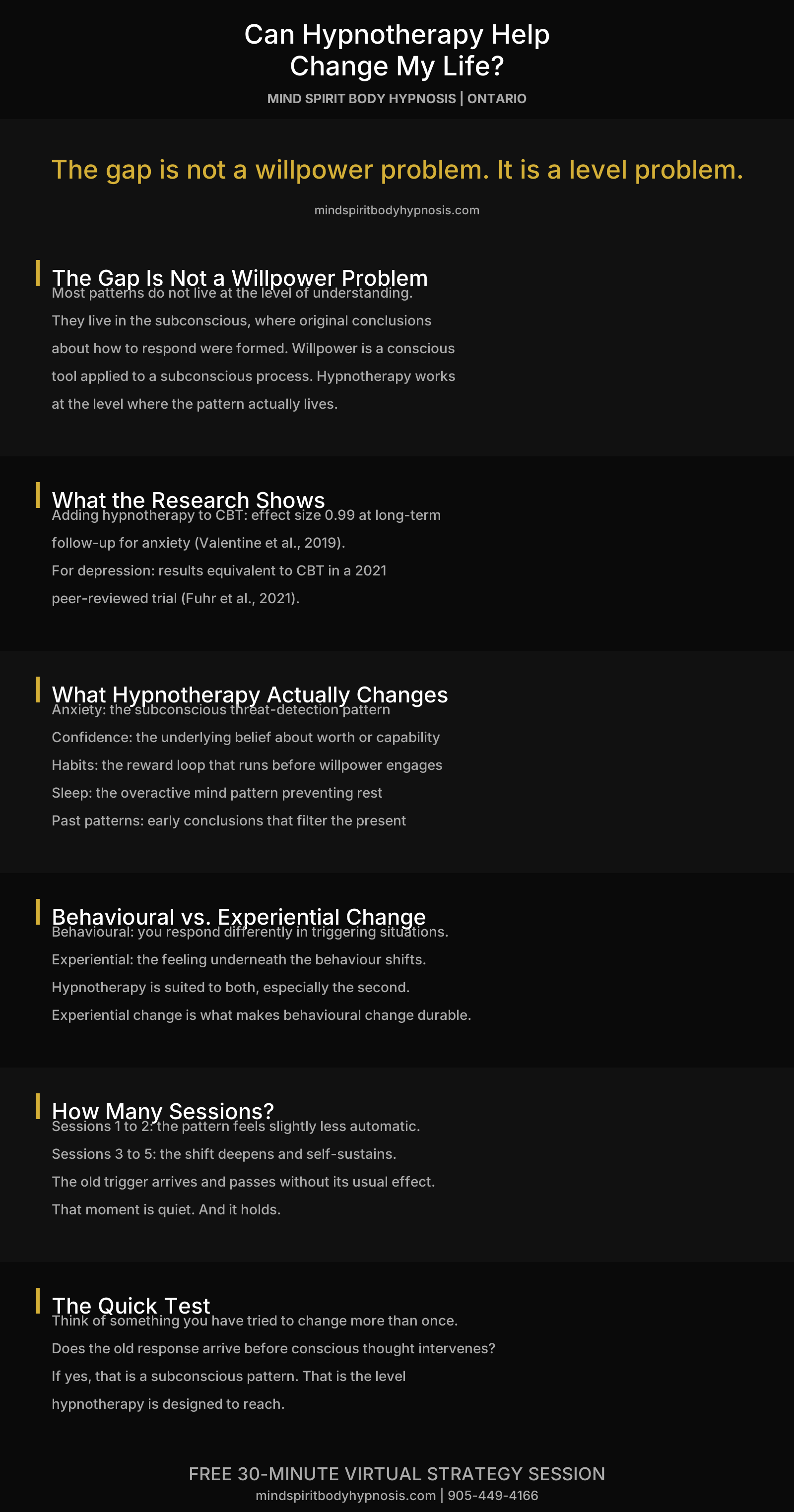
For anxiety, a meta-analysis found that adding hypnotherapy to cognitive behavioural therapy produced a mean effect size of 0.87 standard deviations. In studies with longer follow-up periods, that effect size rose to 0.99, suggesting the benefits were maintained over time (Valentine et al., 2019). For context, an effect size above 0.8 is considered large in psychological research.
For depression, a 2021 study in the Journal of Affective Disorders found hypnotherapy was non-inferior to CBT, meaning it produced equivalent results to the most widely recommended talking therapy for depression (Fuhr et al., 2021).
For habits, sleep, confidence, and the subconscious patterns that drive self-sabotage, the research base is smaller but consistently points in the same direction. Hypnotherapy does not do something magical. It works by making the subconscious level more available for change, which is particularly useful for patterns that have not responded to conscious-level approaches.
The caveat the research is clear about: hypnotisability varies between individuals, outcomes depend on the quality of the practitioner and the fit of the method to the person's concern, and hypnotherapy works best as part of a broader approach rather than in isolation. It is not a single session fix for a lifetime of patterning.
What Hypnotherapy Works On and What It Does Not
The concerns that respond well to hypnotherapy tend to share a common feature: they are driven by a subconscious pattern rather than a conscious choice. Here is how the most common ones line up:
Anxiety and stress. The subconscious threat-detection pattern that triggers the anxious response, often before conscious thought has a chance to intervene.
Low confidence and self-sabotage. The underlying belief about worth or capability that drives avoidance, hesitation, and the quiet self-defeating moves most people make without realizing it.
Habits and addictions. The subconscious reward loop that runs the habit before willpower engages. Willpower works against the current. Hypnotherapy works with the current.
Sleep difficulties. The overactive mind pattern that prevents the nervous system from settling. The conscious desire to sleep is there. The subconscious pattern keeps the system alert.
Fears and phobias. The conditioned fear response attached to a specific trigger. The reaction was learned. It can be updated.
Patterns from the past. The conclusions absorbed from early experience that continue to filter the present. Not the memory itself, but the felt conclusion the memory left behind.
Hypnotherapy is less suited to concerns that are primarily medical, require medication management, or involve active psychiatric conditions. It is a complementary approach, not a replacement for medical care. If you are unsure whether it is the right fit for what you are dealing with, a strategy session is the right place to explore that.
For anxiety and stress specifically, hypnotherapy for anxiety and stress explains how the subconscious-level approach works for what drives the anxious response. For confidence and self-sabotage, hypnotherapy for confidence covers how subconscious belief work reaches the layer below conscious intention. And for habits and compulsive patterns, hypnotherapy for habits and addictions explains the mechanism in more detail.
How Change Happens Across Sessions
Change in hypnotherapy is not typically a single breakthrough. It is more like the turning of a dial than the flipping of a switch.
In the first one or two sessions, most clients notice a shift in how the pattern feels, even if the behaviour has not fully changed yet. The anxious response is slightly less intense. The habit feels slightly less automatic. The old belief arrives but does not settle in the way it used to. These are signs that the subconscious is beginning to update.
Over subsequent sessions, those shifts deepen and stabilize. The new response becomes the default rather than the exception. The old pattern loses its automatic quality. There is a point in most clients' experience where they notice the old trigger arrive and then pass without producing its usual effect. That moment is not dramatic. It is quiet. And it is durable.
My training through the American Board of Hypnotherapy gave me a grounding in why change often resists single-session approaches: the subconscious updated the original pattern through repeated experience, and it updates the same way again. One session is a beginning. Three to five is where most people find the shift becomes self-sustaining.
A free 30-minute strategy session is available for anyone who wants to understand what this would look like for their specific concern before committing to anything.
A Simple Test to Try Right Now
This takes about two minutes and tells you something useful about where your change is happening.
Think of something you have tried to change more than once. A habit, a response, a way of thinking about yourself. Something you have made progress on at the level of understanding.
Now ask: when the situation arrives in real life, how fast does the old response show up? Before you have a chance to apply what you know, or after?
If it shows up before, that is a subconscious pattern. Conscious tools applied to a subconscious pattern produce effort, not ease. The change that feels effortless and lasting happens when the pattern itself updates, not when you work harder to override it.
That gap between knowing and responding is exactly what hypnotherapy is designed to reach.
WHAT MY CLIENTS SAY
“I don’t even know where to begin! Fanis saved my life! I have battled over 5 decades of trauma. After 5 sessions and a final negative moment in my life I felt the shift. I can’t thank you enough Fanis. I have tried therapy and felt it was not really helping too much. Hypnosis was the answer. I am SO happy. I feel better than ever. I will be recommending Fanis to so many people I know struggling with different issues. A++” — Helen R.
Frequently Asked Questions
Can hypnotherapy really change your life? For many people, yes. It reaches the subconscious level where habits, emotional patterns, and beliefs actually live, which is the level where lasting change is decided. What it produces is not transformation as entertainment but genuine, durable shifts in how you feel and respond in the situations that matter to you. The research supports its use for anxiety, confidence, sleep, habits, and other concerns where conscious-level approaches have plateaued.
What kind of change does hypnotherapy produce? Both behavioural and experiential. Behavioural change means you respond differently in situations that used to trigger you. Experiential change means the feeling underneath the behaviour shifts. Hypnotherapy is particularly well-suited to the experiential level, which is what makes behavioural change durable rather than a white-knuckle effort of will.
How is hypnotherapy different from just talking about problems? Talking works at the conscious level. It builds understanding, which is valuable. But many patterns do not live at the level of understanding. They live in the subconscious, where the original conclusions about what to expect and how to respond were formed. Hypnotherapy works in the receptive state where those conclusions are more accessible, and it can introduce a different felt experience at that level, not just a different thought.
What does hypnotherapy actually change? It works with the subconscious patterns that drive behaviour faster than conscious thought. In practice, it changes the automatic quality of habitual responses, the intensity of anxiety or fear triggers, the grip of limiting beliefs, and the felt sense of what is possible. These are not small things. They are what most people mean when they say they want to change their life.
Is hypnotherapy permanent? Durable, yes. Permanent in the absolute sense, not necessarily. The subconscious that updated in one direction can update again. What hypnotherapy produces is a new default response that becomes increasingly stable across sessions. Most clients find that once the shift has settled, it does not require ongoing maintenance, but occasional sessions can reinforce it or address new layers as life changes.
How many sessions does it take? It varies by concern and by how long the pattern has been running. Three to five sessions is where most people notice the shift becoming self-sustaining. Some concerns resolve more quickly. Others with deeper roots take more time. A strategy session is the right way to get a realistic sense of what your situation involves.
Does hypnotherapy work for everyone? Not for everyone, and no honest practitioner claims otherwise. Outcomes depend on hypnotisability, motivation, the fit between the method and the concern, and the quality of the therapeutic relationship. People who arrive wanting to be changed passively, without their own participation, tend to get less from it than those who come ready to engage with the process. It also is not appropriate for everyone. A strategy session is the place to work out whether it is the right fit for you.
Can I be hypnotized against my will or made to do things I do not want to do? No. The receptive state used in hypnotherapy is not unconsciousness. You remain aware throughout. You cannot be made to act against your values, reveal things you do not want to reveal, or stay in the state if you choose to come out of it. The popular picture of hypnosis as mind control is entertainment, not clinical practice.
What happens in a typical session? Sessions usually begin with a conversation about what the client wants to work on and what has already been tried. The therapist then induces a focused, receptive state, followed by the session content, which varies depending on the concern and the method. The session closes with a gradual return to full alertness. Most clients feel calm and clear afterwards, not groggy or confused. Virtual sessions follow the same structure as in-person ones.
How do I know if hypnotherapy is right for my situation? The best way is to talk directly about what you are dealing with and what you have already tried. A free 30-minute virtual strategy session covers exactly that, with no pressure and no obligation. If hypnotherapy is not the right fit, the conversation will make that clear too.
RECOMMENDED READING
Ready to Take the Next Step?
If you have been asking whether hypnotherapy can help change your life and you are ready to find out what that would look like for your specific situation, I would like to help.
I offer a free 30-minute virtual strategy session for new clients across Ontario. No pressure. Just an honest conversation about what you are dealing with and whether hypnotherapy or NLP is the right fit.
Book your free session: calendly.com/mindspiritbodyhypnosis
Call or text: 905-449-4166
Email: info@mindspiritbodyhypnosis.com
Visit: mindspiritbodyhypnosis.com
Serving clients virtually across Ontario, including Durham Region, Toronto, Canada, and beyond.
Disclaimer: This article is for informational purposes only and does not constitute medical or psychological advice. Hypnotherapy and NLP are complementary approaches and are not a substitute for diagnosis or treatment by a qualified healthcare provider. Please consult a licensed professional if you have concerns about your mental or physical health.
Written by Fanis Makrigiannis | Certified Hypnotherapist & NLP Master Practitioner | Mind Spirit Body Hypnosis.