Sleep hypnosis: Does it actually work?
Sleep Hypnosis: Does It Actually Work?
TL;DR: Sleep hypnosis is a real, evidence-backed approach that may help with insomnia and poor sleep quality. Research suggests it can increase deep sleep, reduce the time it takes to fall asleep, and ease the anxiety that keeps many people awake. It is not a sedative, and it does not put you to sleep on the spot. What it does is work with your subconscious to change the thoughts and patterns that get in the way of rest. This article explains what the research actually shows, what a session is like, and who is most likely to benefit.
Quick Answer
Sleep hypnosis is a form of guided hypnotherapy that uses focused attention and suggestion to help the subconscious mind let go of the habits, worries, and patterns that disrupt sleep. Research suggests it may reduce how long it takes to fall asleep, increase slow-wave (deep) sleep, and improve overall sleep quality. Fanis Makrigiannis, a Certified Hypnotherapist (ABH, NGH) and NLP Master Practitioner at Mind Spirit Body Hypnosis in Oshawa, Ontario, offers sleep hypnosis sessions virtually to clients across Ontario looking for a non-medication approach to restful sleep.
Questions This Article Answers
What is sleep hypnosis and how does it work?
Is there real research supporting sleep hypnosis?
What happens during a sleep hypnosis session?
How is sleep hypnosis different from listening to a sleep track on YouTube?
Who benefits most from sleep hypnosis?
How many sessions does it take to see results?
In this article:
What Is Sleep Hypnosis?
Sleep hypnosis is not what most people picture when they hear the word hypnosis. You do not fall asleep on a couch while someone waves a watch in front of you. You stay awake, aware, and in control the entire time.
What changes is your level of focus. During a session, the mind enters a deeply relaxed, attentive state. In that state, it becomes more open to new ideas and suggestions. A trained hypnotherapist uses that window to work with the patterns that disrupt sleep: racing thoughts, the habit of lying awake worrying, the quiet dread that starts building every evening before bed.
Sleep hypnosis works with the subconscious because that is where most of those patterns live. You have probably noticed that willpower alone does not fix poor sleep. You lie down and tell yourself to stop thinking, and the thoughts get louder. That is because the instruction comes from the conscious mind, and the restlessness comes from somewhere deeper. Sleep hypnosis addresses that layer directly.
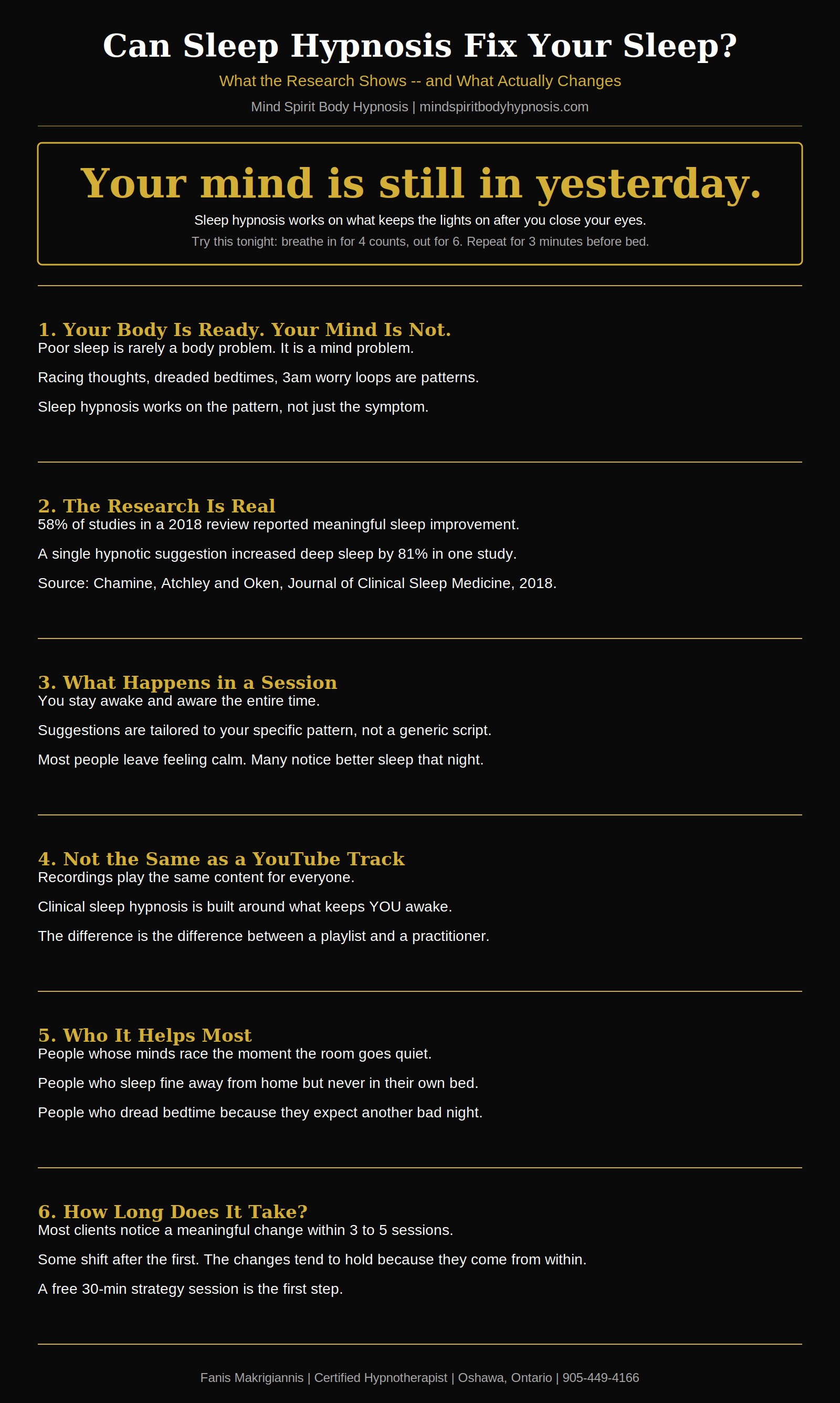
Think of it like a city that has lost its sense of when it is day and when it is night. The lights stay on because that became the default, not because anyone made a decision to keep them on. Sleep hypnosis is not a switch. It is a slow dimmer, working with the system that set the default in the first place.
What Does the Research Show?
The honest answer is: the evidence is promising, but not yet definitive. There are no large-scale clinical trials, and hypnotherapy is not a standard first-line treatment for insomnia. What does exist is worth knowing about.
A 2018 systematic review in the Journal of Clinical Sleep Medicine examined 24 studies on hypnosis and sleep outcomes. Across those studies, about 58 percent reported that hypnosis produced meaningful sleep benefits, including reduced time to fall asleep and improved sleep quality. The review found few adverse effects. (Chamine, Atchley and Oken, 2018)
One of the more striking individual findings comes from a University of Fribourg study published in the journal Sleep. Healthy young women who listened to a hypnotic suggestion to "sleep deeper" before a nap increased their slow-wave sleep by 81 percent compared to a neutral recording. Time spent awake dropped by 67 percent. The researchers suggested hypnotic suggestion could be a lower-risk alternative to pharmacological sleep aids for extending deep sleep. (Cordi, Schlarb and Rasch, 2014)
A meta-analysis of randomized controlled trials in Complementary Therapies in Medicine found that hypnotherapy significantly shortened sleep latency compared to waitlist controls. The effect was less clear when compared to sham interventions, suggesting some of the benefit may overlap with relaxation more broadly. (Lam et al., 2015)
What the research does not yet tell us is who benefits most, how many sessions are needed, or whether results hold over many months. Those are still open questions. What is clear is that sleep hypnosis appears safe, and for many people it produces real improvement.
In my practice, the clients who see the clearest results are those whose sleep is disrupted by anxiety or mental chatter rather than a physical condition. Their body wants to rest. Their mind has not caught up.
What causes insomnia?
What Happens in a Session?
A sleep hypnosis session is different from general relaxation. It has structure and intent.
Sessions at Mind Spirit Body Hypnosis typically run 60 to 75 minutes. The first part is a conversation: what your sleep looks like, when the problems started, what runs through your mind when you lie down. This matters because sleep hypnosis is not one-size-fits-all. A person who wakes at 3 a.m. replaying a difficult conversation needs something different from a person who cannot switch off after a stressful day at work.
The session itself begins with an induction, a process of guided focus that brings the mind into a relaxed, receptive state. From there, suggestions are introduced that are specific to your pattern. These might address the body's tension response to bedtime, the mental loop that starts when the room goes quiet, or the fear of another bad night that makes bad nights more likely.
After the session, most people describe feeling rested and calm. Some report that their sleep improves that night. Others notice changes over two or three weeks as the suggestions take hold.
One simple thing you can try before bed tonight: sit in a comfortable chair and breathe in slowly for four counts, out for six. Do this for three minutes. This activates the parasympathetic nervous system, the part of the body responsible for rest. It will not replace a full session, but it gives your nervous system a clear signal that the day is done.
If you want to explore what a full session feels like before committing, I offer a free 30-minute virtual strategy session for new clients across Ontario. It is a conversation, not a sales call. Book here.
How Is This Different From a YouTube Sleep Track?
This is one of the most common questions I hear, and it matters.
Sleep tracks on YouTube and in apps are passive recordings. They cannot respond to you. They do not know whether your sleep issues are rooted in anxiety, in unresolved stress, in a pattern that formed years ago, or in a habit that developed last month. They offer the same content to everyone.
Clinical sleep hypnosis is responsive. The session is built around your specific pattern. The language, the pacing, and the focus of the suggestions are shaped by what came up in your initial conversation. That difference is significant, because the subconscious tends to respond better to content that feels personally relevant.
That said, audio recordings are not useless. They are a low-cost way to introduce your nervous system to a hypnotic state, and some people find them genuinely helpful as a maintenance tool between sessions. The 2018 systematic review noted modest benefits from recorded self-hypnosis formats. Just know that they are not the same as working with a trained practitioner.
Many clients I see in Ontario have tried the apps and found them relaxing but not transformative. The relaxation was real. What was missing was the work underneath it.
Who Benefits Most?
Sleep hypnosis tends to work best for people whose sleep problems have a psychological component. This includes:
People whose minds race as soon as the room goes quiet
People who sleep well on holiday but poorly at home
People whose insomnia started after a stressful event
People who wake at 3 a.m. with anxious thoughts and cannot return to sleep
People who dread going to bed because they expect another sleepless night
If your sleep problems are caused by a physical condition such as sleep apnea, restless leg syndrome, or a medication side effect, hypnotherapy may help with the anxiety around sleep, but addressing the physical cause with a medical provider should come first.
Hypnotic suggestibility varies between people. Research suggests roughly 15 percent of people are highly responsive, about a third are less responsive, and most fall somewhere in between. People with active psychosis or untreated serious mental illness are generally not suitable candidates. For everyone else, the main variable is motivation and openness, which can be developed even if you start out skeptical.
If you have been managing anxiety and stress alongside your sleep issues, that combination is common and very workable. Anxiety and poor sleep tend to reinforce each other. Addressing both at once often produces faster results than treating either in isolation.
How Many Sessions Does It Take?
Most clients notice a meaningful change within three to five sessions. Some notice a shift after the first. A small number need more time, especially if the sleep pattern has been in place for years or is tied to something deeper, like chronic stress or unresolved worry.
This is one area where sleep hypnosis differs from medication. A sleeping pill can produce an effect on night one. Hypnotherapy works by helping the subconscious establish a new default. That takes repetition, not just one experience. The changes tend to feel more stable over time because they come from within the pattern itself, not from an external substance managing it.
I typically recommend starting with a block of three sessions and reassessing from there. Some clients maintain the change on their own. Others find it helpful to check in once a month. Many find that the habit-level changes from hypnotherapy extend to other areas of their life as well, which is a welcome side effect.
If you have been dealing with trauma or unresolved stress that shows up most clearly at night, the work may take a little longer. But it is among the most rewarding to do, because better sleep changes everything else.
WHAT MY CLIENTS SAY
“I was desperately seeking help for insomnia and was tired of relying on a substance or a pill to help me sleep. I've suffered from insomnia for 9 years and was nearly hospitalized from being awake for over 72 hours. I'm now sleeping with zero substance and zero pills. Fanis is absolutely amazing and I felt comfortable right from the beginning. He's helped change my life in such a short period of time.” — Holly G.
Frequently Asked Questions
What is sleep hypnosis? Sleep hypnosis is a form of guided hypnotherapy that uses focused attention and suggestion to address the subconscious patterns behind poor sleep. Sessions are done awake, not asleep. The goal is to help the mind and body return to restful sleep more easily and consistently.
Does sleep hypnosis actually work? Research suggests it can. A 2018 systematic review found that about 58 percent of studies reported meaningful sleep benefits. A Swiss sleep study found an 81 percent increase in slow-wave (deep) sleep after a single hypnotic session. Results vary by person, but the evidence is encouraging and adverse effects are rare.
Will I fall asleep during the session? Most people do not fall asleep during a session. You stay aware and in a deeply relaxed but alert state. A small number of people do drift off briefly, which is fine. The suggestions can still take effect. The goal is not to make you sleep in the session but to help your mind re-learn how to sleep after it.
Is sleep hypnosis safe? Yes. Research consistently finds few to no adverse effects from clinical sleep hypnosis when provided by a trained practitioner. It is a non-invasive, non-pharmaceutical approach. People with active psychosis or severe dissociative conditions should consult their mental health provider first.
How many sessions will I need? Most people see meaningful change within three to five sessions. Some notice improvement after the first. The number depends on how long the sleep problem has been in place, what is driving it, and how quickly your subconscious responds to the suggestions.
Can I use sleep hypnosis alongside medication? Yes. Sleep hypnosis does not interfere with sleep medication. If you are working toward reducing medication use, doing so gradually and under your doctor's guidance is recommended. Hypnotherapy can support that process by building a natural sleep pattern alongside the reduction.
What if I am not very hypnotizable? Suggestibility exists on a spectrum. Most people fall in the moderate range. Low suggestibility does not mean hypnosis will not work at all. Motivation, openness, and a skilled practitioner who can adjust the approach all make a significant difference. A free strategy session is a good way to find out whether it is a good fit before committing.
How is sleep hypnosis different from meditation? Meditation trains the mind to observe thoughts without attachment. Hypnotherapy goes a step further by introducing specific suggestions while the mind is in a receptive state. Both involve relaxation, but hypnotherapy is more directive. Many clients find they get faster results from hypnotherapy, especially when the sleep problem is rooted in a specific pattern or belief.
Do I have to come in person? No. All sessions at Mind Spirit Body Hypnosis are offered virtually, which means you can access support from anywhere in Ontario. Many clients prefer virtual sessions for sleep work because they can transition directly to bed afterwards.
Can sleep hypnosis help with nightmares? It can. Recurring nightmares are often tied to unresolved stress or anxiety, both of which hypnotherapy addresses well. If your nightmares are connected to a traumatic experience, that is also workable, though that layer of the work typically takes more time and care.
RECOMMENDED READING
Ready to Take the Next Step?
If restless nights, racing thoughts, or chronic tiredness are affecting your days, I would love to help.
I offer a free 30-minute virtual strategy session for new clients across Ontario. There is no pressure. It is a conversation about what your sleep looks like and how hypnotherapy, NLP, or a combination of approaches might support you.
Book your free session: calendly.com/mindspiritbodyhypnosis
Call or text: 905-449-4166
Email: info@mindspiritbodyhypnosis.com
Visit: mindspiritbodyhypnosis.com
Serving clients virtually across Ontario, including Durham Region, Toronto, Canada, and beyond.
Disclaimer: This article is for informational purposes only and does not constitute medical or psychological advice. Hypnotherapy, NLP, and EMDR are complementary approaches and are not a substitute for diagnosis or treatment by a qualified healthcare provider. Please consult a licensed professional if you have concerns about your mental or physical health.
Written by Fanis Makrigiannis | Certified Hypnotherapist & NLP Master Practitioner | Mind Spirit Body Hypnosis.