Is it normal to feel worse after Hypnotherapy?
Is It Normal to Feel Worse After a Hypnotherapy Session?
TL;DR: Yes, feeling temporarily more emotional, tired, or slightly unsettled after a hypnotherapy session is normal and usually a sign that real subconscious work happened. Most of these reactions resolve within one to three days. Knowing when to feel reassured and when to reach out to your therapist makes all the difference. This article explains exactly what to expect, why it happens, and when to take it seriously.
Quick Answer
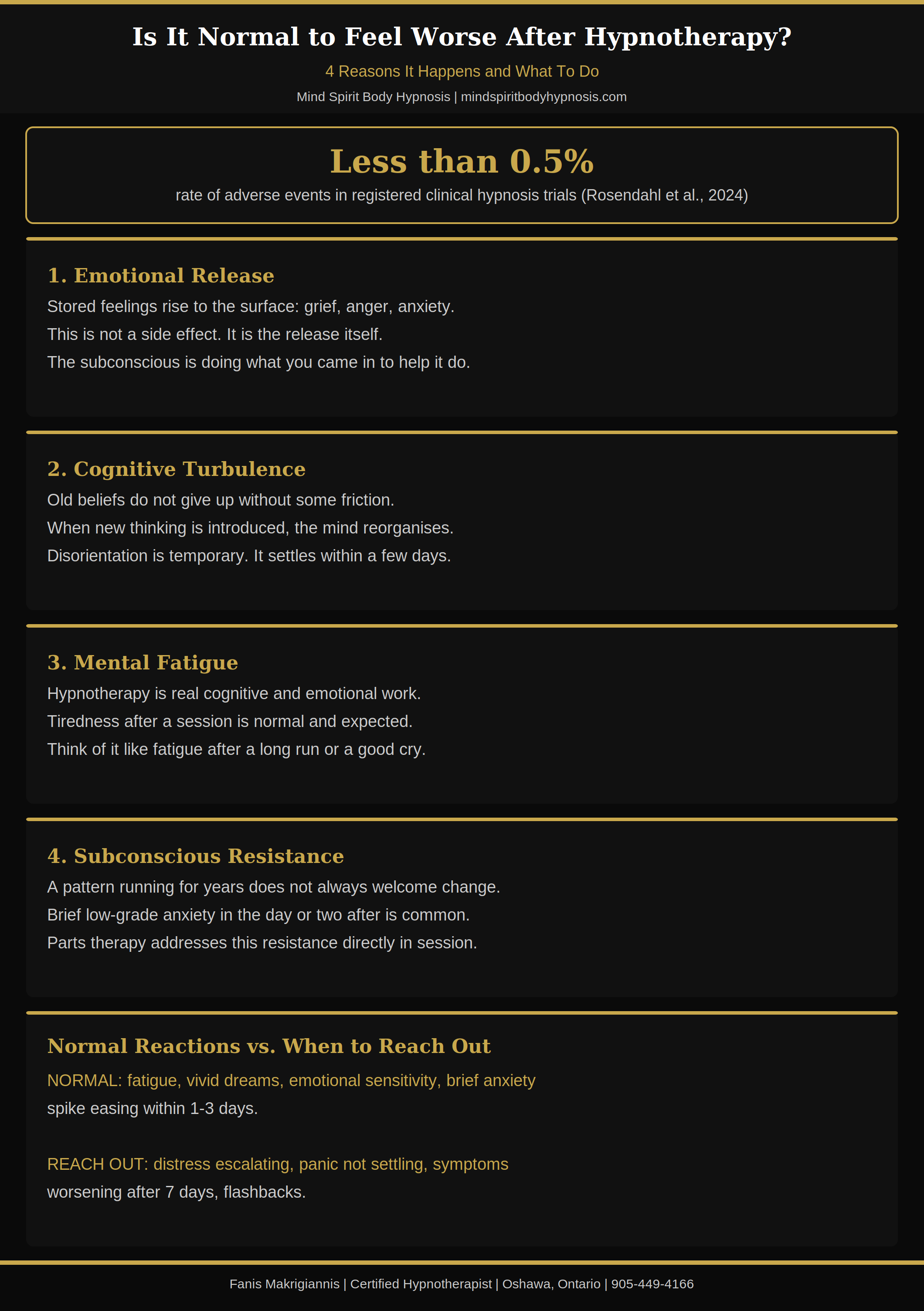
It is common to feel worse after hypnotherapy in the short term. Temporary emotional release, fatigue, vivid dreams, or a brief spike in sensitivity are typical responses as the subconscious processes material that has been brought to the surface. A meta-analysis published in Frontiers in Psychology (Rosendahl et al., 2024) found zero serious adverse events attributable to hypnosis across registered clinical trials, with other adverse events occurring in less than 0.5% of participants. Fanis Makrigiannis, a Certified Hypnotherapist and NLP Master Practitioner at Mind Spirit Body Hypnosis in Oshawa, Ontario, prepares all clients for what to expect after sessions and offers follow-up support between appointments.
Questions This Article Answers
Is it normal to feel emotional, tired, or anxious after hypnotherapy?
Why do some people feel worse before they feel better?
What reactions after hypnotherapy are normal versus concerning?
How long does it take to feel better after a difficult session?
When should I contact my hypnotherapist after a session?
In this article:
Why Some People Feel Worse After a Session
If you came out of a hypnotherapy session feeling unexpectedly emotional, drained, or a little raw, you are not alone. And you are probably not in trouble.
In my practice, I talk to clients across Ontario about this often. The short version: hypnotherapy works by helping the subconscious surface and process things that have been stored below everyday awareness. When that material moves, it can stir up feelings on its way out. That stirring is part of the process, not a sign that something went wrong.
Think of it like this. If you have been carrying a heavy bag for years and someone finally helps you set it down, your arms might ache for a day. The ache is not the problem. It is the proof that you were holding something.
Here are the four most common reasons people feel worse after hypnotherapy, and what is actually happening in each case.
Emotional Release
Hypnotherapy often accesses feelings that have been stored without conscious acknowledgment: grief that was never fully expressed, anger that was pushed down, anxiety that was managed rather than resolved. When those feelings rise to the surface, they can show up as unexpected sadness, irritability, or a sense of emotional rawness in the hours or days after a session.
This is not a side effect. It is the release itself. The subconscious is doing what you came in to help it do.
Cognitive Turbulence
Old beliefs and patterns do not give up without some friction. When hypnotherapy introduces a new way of thinking or relating to a problem, the existing structure has to reorganize around it. That reorganization can feel disorienting, like the mental equivalent of rearranging furniture. Things feel unfamiliar for a moment before they feel better.
Mental Fatigue
A hypnotherapy session involves sustained subconscious focus. Even though your body is relaxed, the processing happening beneath the surface is real cognitive and emotional work. Coming out of a deep session and feeling tired is completely normal. Many clients compare it to feeling the way they do after a long run, a good cry, or a meaningful conversation. The tiredness signals that something was actually engaged.
Subconscious Resistance
Sometimes the part of the mind that has been running a pattern for years does not immediately welcome a new one. There can be a brief period where part of you is adjusting to a changed landscape. This can feel like low-grade anxiety or unease in the day or two after a session. As a Certified Hypnotherapist trained through the American Board of Hypnotherapy, I use parts therapy to address this resistance directly in session, which reduces the likelihood of a difficult adjustment period afterward.
The science behind hypnosis.
Normal Reactions vs. Concerning Ones
Knowing the difference between a normal post-session response and something worth calling your therapist about is important.
Normal reactions include:
Mild fatigue or a need to rest
Feeling more emotional than usual for one to three days
Vivid or unusual dreams in the nights following a session
Brief irritability or sensitivity
A temporary spike in anxiety that settles within a few days
Feeling mentally quiet or slightly spaced-out immediately after
Reactions that warrant reaching out to your therapist include:
Severe distress that does not ease within a week
Panic that does not respond to grounding or breathing techniques
Symptoms that worsen steadily rather than gradually resolving
Intrusive memories or flashbacks that feel destabilizing
Research supports the safety of well-conducted hypnotherapy. A large meta-analysis published in Frontiers in Psychology (Rosendahl et al., 2024) reviewed clinical trials covering hundreds of participants and found zero serious adverse events attributable to hypnosis, with adverse events of any kind occurring at a rate below 0.5%. Serious reactions in clinical hypnotherapy are rare. Mild, temporary ones are common, normal, and generally a sign that meaningful work is happening.
For clients working through deeper material, the hypnotherapy for trauma and EMDR page covers how trauma-informed approaches are used to pace the work and reduce post-session distress.
How Long Does It Last?
For most people, any difficult feelings after a session resolve within one to three days. The pattern typically looks like this:
Day of session: Some clients feel lighter immediately. Others feel tired, emotional, or quietly contemplative.
Day one to two after: The most common window for emotional processing. This may include vivid dreams, unexpected memories surfacing, or heightened sensitivity.
Day three onward: Most clients report feeling noticeably better than before the session, often with a clearer sense of the pattern that was addressed.
If you are still feeling significantly worse after seven days, that is worth discussing with your hypnotherapist. Not as cause for alarm, but as useful information for how to adjust the approach in the next session.
What to Do After a Difficult Session
The right response after a challenging session is rest and gentle self-care, not analysis or forcing yourself to feel fine.
Specifically:
Give yourself the rest of the day. Avoid scheduling anything demanding immediately after a session. Your subconscious needs time to integrate.
Hydrate. The relaxation response can leave some people feeling dehydrated. Drink water.
Do not try to intellectualize what came up. The subconscious does not always communicate in a logical narrative. Let the feelings move without needing to explain them.
Journal if it helps. Some clients find it useful to write down images, emotions, or fragments that arose during the session. Others prefer to let it settle quietly.
Contact your therapist if anything feels destabilizing. A good hypnotherapist will build in follow-up support. At Mind Spirit Body Hypnosis, clients always have a way to reach me between sessions.
The hypnotherapy for anxiety and stress page covers how to work with the nervous system between sessions when anxiety is part of the picture.
Who Is Most Likely to Experience This?
Not everyone feels worse after hypnotherapy. Some clients walk out feeling immediately lighter. But a few factors tend to make a stronger post-session response more likely:
You are working on emotionally significant material such as grief, trauma, or long-held shame
You have a high level of emotional sensitivity or score high in hypnotic suggestibility
The session went deeper than previous ones
You have suppressed a lot of feeling over a long period, and this is an early session
None of these are reasons to avoid hypnotherapy. If anything, a strong response often indicates that the work is reaching the material it needs to reach. What it does mean is that pacing matters. In my practice, sessions are designed with this in mind: we go at the depth that produces results without overwhelming the system.
WHAT MY CLIENTS SAY
“I don’t even know where to begin! Fanis saved my life! I have battled over 5 decades of trauma. After 5 sessions and a final negative moment in my life I felt the shift. I can’t thank you enough Fanis. I have tried therapy and felt it was not really helping too much. Hypnosis was the answer. I am SO happy. I feel better than ever. I will be recommending Fanis to so many people I know struggling with different issues. A++” — Helen R.
Frequently Asked Questions
Is it normal to cry during or after a hypnotherapy session? Yes, completely. Crying is one of the most common forms of emotional release during and after hypnotherapy. It means stored feelings are moving. Clients often describe feeling much lighter after crying in session than they expected to feel.
Why do I feel unsettled or emotional after a session that felt calm? The subconscious processes material on its own timeline, not the session's. You may feel calm during the session and notice emotional or physical responses emerging over the next twelve to forty-eight hours as integration continues. This is normal.
Can hypnotherapy make anxiety worse? Temporarily, in some cases. A brief spike in anxiety after a session, particularly one that touched on anxious patterns, can happen as part of the adjustment. If anxiety escalates significantly and does not settle within a week, contact your therapist to discuss pacing.
I feel unusually tired after my session. Is that normal? Yes. Mental and emotional processing during hypnotherapy is real work, even though it happens in a relaxed state. Post-session tiredness is very common, particularly after deeper sessions. Rest is the right response.
Why am I having vivid dreams after hypnotherapy? Dreams are one of the ways the subconscious continues to process material after a session. Vivid, unusual, or emotionally charged dreams in the one to three nights following a session are common and generally a positive sign that integration is happening.
Should I tell my hypnotherapist I felt worse after a session? Always. This information is useful, not alarming. It helps your therapist understand how deeply the session landed, what the subconscious is working on, and how to calibrate the next session for best results.
How do I know if what I am experiencing is serious? The key distinction is trajectory. Normal post-session responses ease within a few days. If distress is escalating, does not respond to rest or grounding, or persists beyond a week, reach out to your hypnotherapist. If at any point you feel unsafe, contact a mental health crisis line or a licensed healthcare provider immediately.
Does feeling worse after hypnotherapy mean it is not working? Usually the opposite. A temporary difficult response often signals that real subconscious work took place. Clients who feel nothing after a session sometimes report that less appeared to shift. That said, a strong response does not guarantee a good outcome either. Progress in hypnotherapy is measured over sessions, not in a single post-session window.
Is it safe to drive after hypnotherapy? Most people are fine to drive after a session, but it is worth checking in with yourself. If you feel very tired, spacey, or emotionally activated immediately after, wait until you feel grounded before getting behind the wheel. Many clients prefer to arrange transport for their first few sessions until they know how they respond.
What if difficult feelings persist for longer than a week after a session? Contact your hypnotherapist to discuss what came up in the session and how you have been feeling. This is useful clinical information. Depending on what is happening, your therapist may suggest adjusting the depth or pacing of sessions, integrating another modality such as EMDR, or recommending additional support.
RECOMMENDED READED
Ready to Take the Next Step?
If you have had a difficult post-session experience, or if you are considering hypnotherapy and want to understand what to expect, I am happy to talk it through.
I offer a free 30-minute virtual strategy session for new clients across Ontario. There is no pressure, just a conversation about what you are going through and how hypnotherapy, NLP, or EMDR might support you.
Book your free session: calendly.com/mindspiritbodyhypnosis
Call or text: 905-449-4166
Email: info@mindspiritbodyhypnosis.com
Visit: mindspiritbodyhypnosis.com
Serving clients virtually across Ontario, including Durham Region, Toronto, Canada, and beyond.
Disclaimer: This article is for informational purposes only and does not constitute medical or psychological advice. Hypnotherapy and NLP are complementary approaches and are not a substitute for diagnosis or treatment by a qualified healthcare provider. Please consult a licensed professional if you have concerns about your mental or physical health.
Written by Fanis Makrigiannis | Certified Hypnotherapist & NLP Master Practitioner | Mind Spirit Body Hypnosis.