Can Hypnotherapy help me eat less?
7 Reasons Diets Fail (And How Hypnotherapy Tackles Each One)
TL;DR: Most diets fail because they target the conscious mind while leaving subconscious habits untouched. Weight loss hypnotherapy Ontario addresses the root patterns: cravings, emotional eating, and self-sabotage that no meal plan can reach. If you've tried "eating less and moving more" without lasting results, your subconscious may be the missing piece.
Quick Answer
Weight loss hypnotherapy in Ontario is a subconscious-focused approach that helps people change the eating habits, emotional triggers, and thought patterns that cause weight to return after dieting. Rather than relying on willpower, hypnotherapy works at the level where habits are formed and stored. Research published in the Journal of Consulting and Clinical Psychology found that patients who added hypnotherapy to a weight management programme lost significantly more weight and maintained those results longer than those who dieted alone. Fanis Makrigiannis, a Certified Hypnotherapist and NLP Master Practitioner at Mind Spirit Body Hypnosis in Oshawa, Ontario, offers virtual sessions across Ontario for clients who want lasting change beyond the next diet.
Questions This Article Answers
Why do diets fail even when I try really hard?
Can hypnotherapy actually help with weight loss?
What does a weight loss hypnotherapy session feel like?
How is hypnotherapy different from willpower or a meal plan?
Who is a good candidate for weight loss hypnotherapy in Ontario?
In this article:
Why Most Diets Miss the Point
You've probably heard the advice: eat less, move more. And you've probably tried it. Maybe it worked for a few weeks. Then something shifted. Stress crept in, old habits returned, and the weight came back.
This isn't a willpower problem. It's a subconscious pattern problem.
In my practice, I see this constantly. Clients arrive having done everything "right": tracked calories, cut sugar, joined a gym. The conscious mind knows exactly what to do. But the subconscious, which drives 95% of our automatic behaviour, is still running an older programme. That's where hypnotherapy comes in.
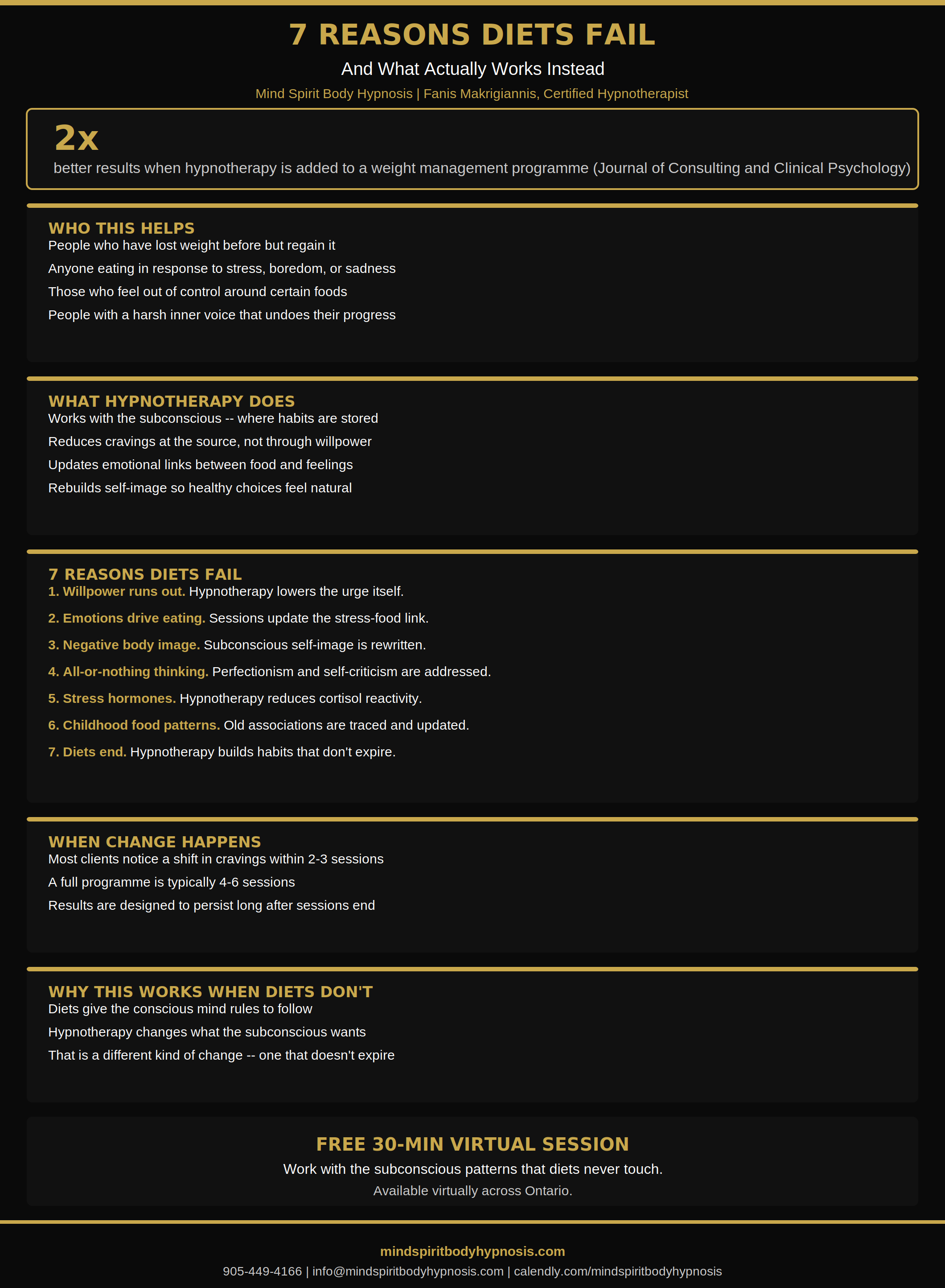
7 Reasons Diets Fail and How Hypnotherapy Addresses Each One
Here are the seven most common reasons diets don't stick, and what weight loss hypnotherapy in Ontario does about each one.
1. Diets Rely on Willpower: A Finite Resource
Willpower is conscious effort. It gets used up across the day. By evening, after a stressful workday, most people's willpower is spent. And that's exactly when snacking tends to happen.
Hypnotherapy doesn't ask you to resist urges. It works to reduce the strength of those urges at a subconscious level. Clients I work with in Ontario often say that certain foods simply stop calling to them the way they used to. The desire weakens because the pattern beneath it has shifted.
2. Stress and Emotions Drive Eating, Not Hunger
For many people, eating is connected to comfort, boredom, anxiety, or emotional numbing. A diet can tell you what to eat, but it can't stop you from reaching for food when you're overwhelmed.
Hypnotherapy addresses the emotional link directly. Using a mix of hypnosis and NLP techniques, sessions help the subconscious find other, healthier responses to stress so food is no longer the default coping tool.
3. Negative Body Image Keeps Patterns Locked In
If someone believes deep down that they'll "always be this way," that belief acts as a self-fulfilling programme. The subconscious works to confirm what it already believes.
As a Certified Hypnotherapist trained through the American Board of Hypnotherapy, I use suggestion work and parts therapy to update the self-image stored at the subconscious level. When someone genuinely starts to see themselves as someone who makes healthy choices, the behaviour follows far more naturally than it does through rules and restriction.
4. Diets Create an "All or Nothing" Mindset
One missed day becomes one missed week. One piece of cake becomes a reason to abandon the whole plan. This black-and-white thinking is one of the most common reasons people stop dieting entirely.
Hypnotherapy addresses the perfectionism and self-criticism driving that mindset. Sessions can help build a more flexible, forgiving relationship with food where a slip is just a slip, not a failure.
5. Sleep and Stress Hormones Undermine Progress
Poor sleep raises cortisol and ghrelin: the hormones that increase hunger and fat storage. Stress has the same effect. You can follow a meal plan perfectly and still find your body working against you.
Hypnotherapy's well-documented relaxation effect helps regulate the stress response. A 2020 study in Frontiers in Psychology found that hypnosis significantly reduced cortisol reactivity in participants under stress conditions. Lower stress means less hormonal interference with weight management.
6. Old Childhood Associations with Food Run Deep
"Clean your plate." "Food is love." "Sweets are a reward." Many eating patterns were wired in during childhood, long before logic had a say.
Hypnotherapy can trace these associations back and update them. This isn't about blame. It's about recognizing that an old pattern learned at age seven doesn't have to run the show at age forty.
7. Diets End. Habits Don't.
A diet has a start and a finish. A habit is just how you live. The problem with diet culture is that it frames change as temporary.
Hypnotherapy for weight loss in Ontario works at the habit level, which means changes are designed to persist after sessions end. The goal isn't a number on a scale during a twelve-week plan. It's a different relationship with food, body, and self. One that doesn't expire.
Binge eating disorder
What Happens in a Weight Loss Hypnotherapy Session?
Sessions are relaxed and conversational. There's no swinging pendulum, no loss of control.
A typical session with me at Mind Spirit Body Hypnosis includes:
Intake conversation: understanding your history with food, dieting, and the emotions involved
Guided relaxation: helping the conscious mind step back so the subconscious becomes more receptive
Suggestion and imagery work: introducing new associations with food, movement, and self-worth
NLP techniques: reshaping the thought patterns that drive self-sabotage
A take-home anchor: a simple cue you can use between sessions to reinforce the work
Most clients notice a shift in cravings and emotional eating within the first two to three sessions. You can explore the hypnotherapy for habits and addictions page for more on how this process works for compulsive patterns.
Research supports this approach. A meta-analysis published in the Journal of Consulting and Clinical Psychology found that adding hypnotherapy to a behavioural weight loss programme produced outcomes roughly twice as strong as the programme alone, and those results held at eighteen-month follow-up.
Who Benefits Most?
Weight loss hypnotherapy works especially well for people who:
Have tried multiple diets and lost weight, only to regain it
Eat in response to stress, boredom, sadness, or anxiety
Feel out of control around certain foods
Have a harsh inner voice that undermines their progress
Struggle with confidence or body image alongside their weight
It also pairs well with other changes: nutrition coaching, exercise programmes, or therapy. Hypnotherapy doesn't replace healthy habits; it makes them easier to keep. For clients dealing with deeper confidence blocks, the hypnotherapy for confidence and self-sabotage page covers how those patterns connect to eating behaviour.
Virtual sessions are available to anyone in Ontario, whether you're in Durham Region, Toronto, Ottawa, or anywhere in between.
WHAT MY CLIENTS SAY
“I booked a session with Fanis mostly because my wife wouldn’t stop suggesting him. Heights have terrified me my whole life; I’m talking can’t stand near a second-floor railing, refused to fly for fifteen years. I figured hypnotherapy was probably nonsense and I’d have a story to tell. Three sessions later I stood on the observation deck at CN Tower. I genuinely did not expect that to happen. Fanis doesn’t oversell it, doesn’t make wild promises, he just does the work and the results speak for themselves. Completely shocked. Highly recommend.” — Mohamed G.
Frequently Asked Questions
Can hypnotherapy really help me lose weight? Research suggests it can, particularly when emotional eating, cravings, or self-sabotage are part of the picture. A meta-analysis in the Journal of Consulting and Clinical Psychology found that people who added hypnotherapy to a weight management programme lost significantly more weight and kept it off longer compared to those who relied on the programme alone. Hypnotherapy is most effective when combined with practical lifestyle support.
How is weight loss hypnotherapy different from a diet? A diet tells your conscious mind what to eat. Hypnotherapy works with your subconscious mind: the part that drives automatic behaviour, emotional responses, and cravings. Most diets fail because they never touch those deeper patterns. Hypnotherapy aims to change the programme underneath, not just the rules on top.
Will I lose control during a session? No. Hypnosis is a focused, relaxed state, similar to being absorbed in a book or daydream. You remain aware and in control throughout. You cannot be made to do or say anything against your will. Many clients describe it as the most relaxed they've felt in years.
How many sessions will I need? This varies by person. Many clients notice real shifts in cravings and emotional eating within two to three sessions. A full programme is typically four to six sessions, with follow-ups as needed. During your free strategy session, Fanis will give you a clearer picture based on your specific history and goals.
Is virtual hypnotherapy as effective as in-person? Yes. For many clients, being in their own home actually deepens relaxation. All sessions at Mind Spirit Body Hypnosis are delivered virtually, which also means there's no commute and you can book from anywhere in Ontario.
What if I've had disordered eating in the past? Hypnotherapy can be a supportive tool, but it's important to share your full history during the intake conversation. Fanis works in the self-improvement and stress management space and will let you know if another level of care is the right first step for your situation.
Does hypnotherapy work for cravings specifically? Yes. One of the most common things clients report after sessions is that specific cravings for sugar, junk food, or late-night snacking simply feel weaker or less urgent. This happens because the session directly addresses the subconscious associations driving those cravings.
What's the difference between hypnotherapy and NLP for weight loss? Hypnotherapy uses guided relaxation to access and update subconscious patterns. NLP (Neuro-Linguistic Programming) uses language and mental rehearsal to reshape how you think and respond. In practice, Fanis often uses both together: hypnosis to access the deeper pattern and NLP to install a new one. They work well in combination.
Do I have to believe in hypnotherapy for it to work? Not really. You do need to be willing to participate and open to the process. That's different from belief. Many clients arrive skeptical and still experience meaningful results within a few sessions. The key ingredient is a genuine desire to change.
Does insurance cover this? Some extended health benefit plans in Ontario cover hypnotherapy or complementary mental health services. It's worth checking your policy. Fanis can provide a receipt for sessions, which you can submit depending on your coverage.
RECOMMENDED READING
Ready to Take the Next Step?
If you're tired of diets that don't last and want to work on the patterns underneath, I'd love to help.
I offer a free 30-minute virtual strategy session for new clients across Ontario. There's no pressure, just a conversation about what you're going through and how hypnotherapy, NLP, or EMDR might support you.
Book your free session: calendly.com/mindspiritbodyhypnosis
Call or text: 905-449-4166
Email: info@mindspiritbodyhypnosis.com
Visit: mindspiritbodyhypnosis.com
Serving clients virtually across Ontario, including Durham Region, Toronto, Ottawa, and beyond.
Disclaimer: This article is for informational purposes only and does not constitute medical or psychological advice. Hypnotherapy and NLP are complementary approaches and are not a substitute for diagnosis or treatment by a qualified healthcare provider. Please consult a licensed professional if you have concerns about your mental or physical health.
Written by Fanis Makrigiannis | Certified Hypnotherapist & NLP Master Practitioner | Mind Spirit Body Hypnosis.