Will hypnotherapy help change my relationship with food?
Why Do I Eat When I Am Not Hungry? Emotional Eating and Hypnotherapy
TL;DR: Emotional eating is not a willpower problem. It is a subconscious coping pattern in which the mind learned, usually early in life, that food reliably changes how you feel. Clients searching for emotional eating hypnotherapy Ontario arrive having tried diets, meal plans, and apps without lasting change, because none of those approaches reach the part of the mind where the pattern is actually stored. Fanis Makrigiannis at Mind Spirit Body Hypnosis in Oshawa works directly with that subconscious root. Virtual sessions across Ontario.
Quick Answer
Emotional eating hypnotherapy Ontario addresses one of the most common habit patterns Fanis Makrigiannis works with at Mind Spirit Body Hypnosis in Oshawa, Ontario. Emotional eating is not a character flaw or a lack of discipline. It is a learned subconscious pattern in which food has become the primary tool for managing uncomfortable emotions, boredom, stress, or loneliness. Hypnotherapy works directly with the subconscious to identify where that association was formed, update it, and install new responses to the emotional triggers that used to send you to the fridge. Fanis Makrigiannis, a Certified Hypnotherapist (ABH, NGH) and NLP Master Practitioner (ABNLP), offers virtual sessions across Ontario for clients who are tired of the eat-regret-restrict cycle.
Questions This Article Answers
Why do I eat when I am not physically hungry?
Who is most likely to develop an emotional eating pattern?
What is actually happening in the brain and subconscious when I eat emotionally?
When does emotional eating become a cycle worth breaking?
Why do diets and meal plans not fix emotional eating?
In this article:
It does not start with hunger. It starts with something else. A stressful call. A difficult conversation. A Sunday afternoon that feels too quiet. And before the thought is even fully formed, you are in the kitchen.
And then comes the other familiar part. The brief relief. Followed almost immediately by the guilt. Followed by the resolve to do better. Followed, eventually, by the same kitchen, the same feeling.
In my practice in Oshawa, this is one of the patterns I work with most often. And the first thing I tell clients is that the cycle is not a character flaw. It is a very efficient subconscious programme that was installed because food genuinely worked. At some point, it solved a problem. The problem is that the subconscious never got the memo that the solution had become a new problem.
Who Develops Emotional Eating Patterns?
More people than most would expect. And the origins are more varied than the common story of childhood food comfort suggests.
Emotional eating can begin when food is used consistently to manage a child's emotional states. A parent who offers a treat to soothe upset. A household where food is how celebrations, grief, boredom, and connection are all expressed. A child who learned that eating was the most reliable way to change how they felt when nothing else was available or allowed.
But it can also develop without any of that. Adolescents who use eating as a response to social stress, academic pressure, or body-image distress. Adults who eat during television, not from hunger but from a habit of associating certain environments with certain behaviours. People who restrict heavily during the day and then eat past fullness in the evening, driven by a subconscious rebound response the body has learned to run.
The common thread is not childhood trauma or a difficult relationship with food in any dramatic sense. It is simply that the subconscious has paired a specific emotional state with eating as its go-to resolution. Once that pairing is established, it runs automatically. The decision happens before it feels like a decision.
What Is Actually Happening When You Eat Emotionally?
The subconscious is reaching for a tool that it knows works, even when the conscious mind does not want it to.
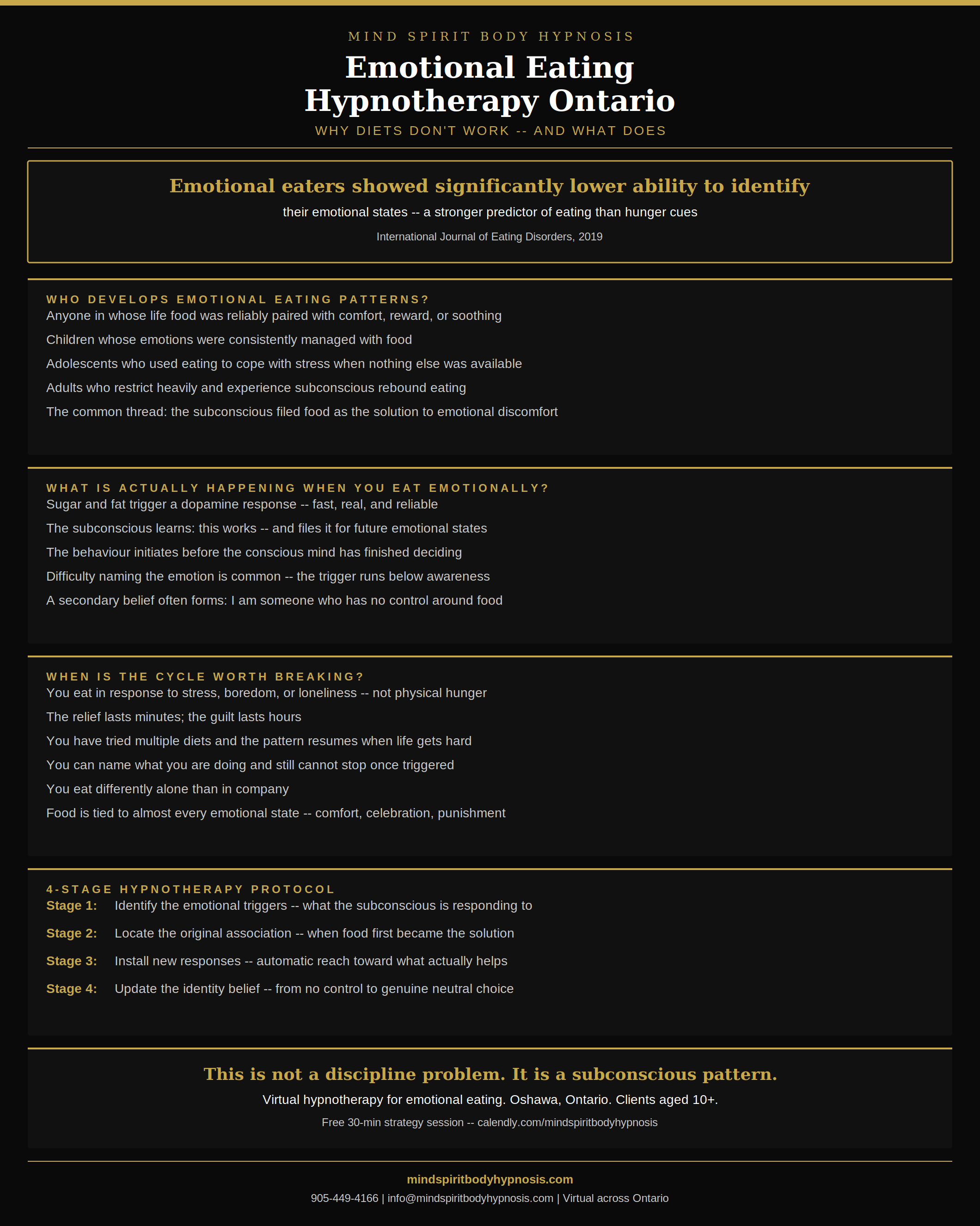
The neurological piece: Eating, particularly foods high in sugar and fat, triggers a dopamine response in the brain. That response is real, fast, and reliable. The subconscious learns quickly that eating resolves an uncomfortable emotional state, at least briefly, and files that solution for future use. Every time the pattern runs and delivers relief, even temporary relief, it strengthens the association.
The emotional regulation piece: Many emotional eaters describe not being consciously aware of the emotion that triggered the eating until after it has already happened. That is because the subconscious initiates the behaviour as a regulation move before the conscious mind has identified what is being regulated. A 2019 study in the International Journal of Eating Disorders found that emotional eaters showed significantly lower ability to identify and name their emotional states compared to non-emotional eaters, and that this difficulty in emotional awareness was a stronger predictor of eating behaviour than hunger cues.
The identity piece: Many people who struggle with emotional eating also carry a subconscious belief about themselves as someone who lacks control around food, or who is inherently unable to manage their emotional states without it. That belief is not a cause of emotional eating. It is an effect. But once established, it reinforces the pattern by making attempts to change feel futile before they begin.
This is why the hypnotherapy for weight loss page focuses on the subconscious drivers of eating behaviour rather than the food itself. The food is not the problem. The pattern running underneath is.
How the food you eat affects your brain.
When Does Emotional Eating Become a Cycle Worth Breaking?
When the eating is no longer about food, and the cycle is affecting more than your meals.
Occasional comfort eating is not a crisis. Most people eat something they enjoy when they are stressed or sad at some point. The question is whether the behaviour has become automatic, compulsive, and followed by a response of guilt or shame that itself becomes an emotional state requiring soothing.
Signs the cycle is running:
You eat in response to stress, boredom, loneliness, or anxiety rather than physical hunger
You feel relief during eating and guilt or regret shortly after
You have tried multiple diets or food plans and the emotional eating resumes each time
You eat past the point of fullness because stopping feels difficult once started
You hide eating from others, or eat differently when alone than in company
You use food to celebrate, reward, punish, or comfort yourself across almost every emotional state
When that list is familiar across most days rather than occasionally, the driver is subconscious. And subconscious patterns are precisely what hypnotherapy is designed to reach.
For clients who notice this pattern is also affecting their relationship with their body and overall confidence, the hypnotherapy for habits and addictions page covers how the same mechanism drives many compulsive patterns.
Why Diets and Meal Plans Do Not Fix Emotional Eating
Because they address the food. The pattern is not about the food.
A diet gives the conscious mind a structure to follow. And the conscious mind can follow it, for a while, when motivation is high, when nothing difficult happens, and when the emotional states that trigger the pattern stay manageable. But none of those conditions hold indefinitely.
The moment the emotional trigger arrives, the subconscious reaches for its established solution. The diet plan is a conscious instruction. The subconscious pattern is faster, older, and has a stronger track record of delivering relief in that moment. The subconscious wins.
This is why people describe the same experience repeatedly: the diet works until something stressful happens. The meal plan is followed perfectly until a difficult week arrives. And then the pattern resumes, often with more intensity than before, because restriction also primes the subconscious for a rebound.
As a certified hypnotherapist, I explain to clients that the goal of working with emotional eating is not to create new rules around food. It is to update the subconscious instruction that says food is the solution to emotional discomfort. Once that instruction changes, the pull toward emotional eating reduces or disappears without the person needing to white-knuckle their way through it.
Diets and meal plans work at the conscious level. The subconscious pattern continues underneath and resumes when conscious motivation drops.
Apps and calorie tracking work at the conscious level. They do not reach the emotional trigger or the subconscious association.
Hypnotherapy works at the subconscious level. It addresses the emotional trigger, the association, and the identity belief, at the level where all three were originally formed.
How Hypnotherapy Works With Emotional Eating at the Source
At Mind Spirit Body Hypnosis, emotional eating hypnotherapy Ontario clients experience is structured around four stages.
Stage 1: Identify the emotional triggers. What emotions, situations, or times of day consistently precede the eating? In trance, the subconscious reveals the specific states it has been responding to. Clients often have a general sense of their triggers but have not accessed them at the level where the subconscious actually files them. That specificity is what makes the work precise.
Stage 2: Locate the original association. When did the subconscious first file food as the solution to this particular emotional state? In trance, the original experience or pattern often becomes clear. Understanding the source does not fix the pattern, but it makes the update possible.
Stage 3: Install new responses. For each identified trigger, a new subconscious response gets installed. Not a rule, not a restriction, but an automatic reach toward something that actually addresses the emotional state rather than temporarily suppressing it. This is what changes the pull, rather than the willpower required to resist it.
Stage 4: Update the identity belief. The belief that emotional eating is just who you are gets examined and updated in trance. Clients consistently describe this as the part that surprises them most: the shift from fighting a habit to simply not feeling the pull in the same way.
More about Fanis's approach and background is on the about page.
WHAT MY CLIENTS SAY
“I had a wonderful experience working with Fanis and his hypnosis program to help me work through anxiety, fears, and past traumas. The results have been incredibly positive. I felt comfortable, supported, and understood throughout the entire process and noticed a meaningful shift in how I feel and respond to things that once caused me anxiety. I am very grateful for the experience and would highly recommend Fanis and his services.” — Tracy D.
Frequently Asked Questions
Why do I eat when I am not physically hungry? Because the eating is not being triggered by hunger. It is being triggered by an emotional state, and the subconscious has learned that eating is a reliable way to change that state quickly. The trigger is an emotion boredom, stress, loneliness, or something similar and the behaviour is the subconscious's automatic response to it. The physical hunger signal is not part of the equation.
Who is most likely to develop emotional eating patterns? Anyone in whose early life food was consistently associated with comfort, reward, celebration, or soothing. People who grew up in households where food was the primary way emotions were managed. Adolescents who used eating as a coping tool during stressful developmental periods. And people who have been through repeated cycles of restriction and rebound, which trains the subconscious to treat food scarcity as a threat and food availability as something to act on immediately.
What is the difference between emotional eating and binge eating? Emotional eating is the broader pattern of eating in response to emotional states rather than physical hunger. Binge eating involves consuming large amounts of food in a short time with a sense of loss of control, often followed by significant distress. Emotional eating can exist without meeting the clinical definition of binge eating. Both patterns have a subconscious emotional driver, though binge eating typically involves additional layers that may also benefit from clinical support alongside hypnotherapy.
When should I consider hypnotherapy for emotional eating? When you have followed multiple diets or eating plans and the emotional eating pattern resumes each time. When you can identify what you are doing and still cannot stop once the trigger has been activated. When the cycle of eating and guilt has been running long enough that it is affecting your relationship with food, your body, and yourself. The gap between knowing and changing is exactly where hypnotherapy works.
Why does willpower not fix emotional eating? Because the pattern runs subconsciously, faster than conscious choice can intervene. By the time you are aware that you are eating emotionally, the subconscious has already initiated the behaviour. Willpower is a conscious resource and it depletes, especially under the same stress conditions that trigger the eating in the first place. Hypnotherapy works at the level of the trigger and the association, not the level of resistance.
Do I need to follow a special diet alongside hypnotherapy? No. The aim of hypnotherapy for emotional eating is not to create new restrictions. It is to reduce or remove the subconscious pull toward emotional eating so that food choices become neutral again. Many clients find that their food choices shift naturally as the emotional driver reduces, without needing to follow specific rules.
Can hypnotherapy help if I have been an emotional eater my whole life? Yes. The length of time a pattern has been running does not determine whether it can be updated. The subconscious is operating in the present and is accessible in the present. Clients who have been emotional eaters since childhood regularly describe meaningful shifts in the pull and the cycle within a few sessions.
Is virtual hypnotherapy as effective for emotional eating as in-person? Yes. All sessions at Mind Spirit Body Hypnosis are conducted virtually. Trance is a natural state that the client enters with guidance from wherever they are. Many clients find that being in their own home, close to the environment where the eating pattern usually runs, actually makes the work more targeted and effective.
How many sessions does this take? Most clients notice a meaningful shift in two to four sessions. We always give a specific estimate in the free 30-minute strategy session before any commitment is made. Clients with longer histories of restriction and rebound cycles may benefit from additional sessions, but they typically feel progress early.
Ready to Take the Next Step?
If you are tired of the eat-regret-restrict cycle and want to change the pattern at the level it actually lives, I would love to help.
I offer a free 30-minute virtual strategy session for new clients across Ontario. No pressure. Just an honest conversation about what you are carrying and whether hypnotherapy might finally give you the shift you have been looking for.
RECOMMENDED READING
Book your free session: calendly.com/mindspiritbodyhypnosis
Call or text: 905-449-4166
Email: info@mindspiritbodyhypnosis.com
Visit: mindspiritbodyhypnosis.com
Serving clients virtually across Ontario, including Durham Region, Toronto, Canada, and beyond.
Disclaimer: This article is for informational purposes only and does not constitute medical or psychological advice. Hypnotherapy, NLP, and EMDR are complementary approaches and are not a substitute for diagnosis or treatment by a qualified healthcare provider. Please consult a licensed professional if you have concerns about your mental or physical health.
Written by Fanis Makrigiannis | Certified Hypnotherapist & NLP Master Practitioner | Mind Spirit Body Hypnosis.