Why am I a people pleaser?
Why Can't I Stop People-Pleasing? The Subconscious Root
TL;DR: People-pleasing is not a personality type. It is a subconscious survival strategy, usually formed in childhood, that taught you that keeping others happy was the safest way to stay loved, accepted, or out of trouble. Clients searching for people-pleasing hypnotherapy in Ontario arrive having tried setting boundaries and still finding themselves saying yes when they mean no, because the instruction to please is running below the level of conscious choice. Fanis Makrigiannis at Mind Spirit Body Hypnosis in Oshawa works directly with that subconscious root. Virtual sessions across Ontario.
Quick Answer
People-pleasing hypnotherapy in Ontario addresses one of the most searched patterns Fanis Makrigiannis works with at Mind Spirit Body Hypnosis in Oshawa, Ontario. People-pleasing is not a personality flaw or a kindness taken too far. It is a subconscious pattern in which the nervous system learned, early in life, that other people's emotional states determined your safety, belonging, or worth. Hypnotherapy works directly with the subconscious to locate where that pattern was installed and update it so that choosing yourself no longer feels like a threat. Fanis Makrigiannis, a Certified Hypnotherapist (ABH, NGH) and NLP Master Practitioner (ABNLP), offers virtual sessions across Ontario for clients who are exhausted from putting everyone else first.
Questions This Article Answers
Why do I keep saying yes when I want to say no?
Who is most likely to become a people pleaser?
What is actually happening in the subconscious when I people-please?
When does people-pleasing become a pattern worth changing?
Why does knowing I people-please not make it easier to stop?
In this article:
You know you do it. You have probably known for years. Someone asks something of you, and you feel the yes forming before you have even decided. You agree to things you resent. You apologize for things that were not your fault. You spend hours managing how other people feel, and very little time thinking about how you feel.
And when you try to stop, something tightens. Saying no feels dangerous in a way that is hard to explain. Not impolite. Dangerous.
In my practice in Oshawa, I work with clients who are some of the most capable, caring people I know. And they are exhausted. Not because they are weak. Because they have been running a subconscious programme that treats other people's approval as a survival requirement.
Who Becomes a People Pleaser?
Anyone who grew up in an environment where the emotional state of the people around them felt unpredictable, fragile, or directly tied to how they behaved.
This can look very different from one household to the next. A parent who became cold or withdrawn when displeased, so you learned to read the room and adjust constantly. A caregiver whose moods were unpredictable, so keeping the peace became your way of staying safe. A household where your needs were consistently placed below everyone else's, so asking for things felt selfish or risky. A parent who required you to be agreeable, easy, and uncomplaining to receive their warmth.
It can also come from early social environments. Being bullied or excluded as a child and learning that making yourself likable was the safest strategy. Being praised for being helpful, selfless, and accommodating until those traits became an identity.
The subconscious drew one conclusion from all of it: keeping other people happy keeps me safe. And it has been running that instruction ever since.
What makes this pattern particularly invisible is that it often looks like virtue from the outside. People pleasers are described as kind, easy to get along with, thoughtful, and generous. The cost is internal and rarely visible to the people they are working so hard to please.
8 Signs your a people pleaser.
What Is Actually Driving the Pattern?
The subconscious is not trying to make you a pushover. It is trying to protect you using the strategy that worked when you were young.
The belief underneath: At the core of most people-pleasing patterns is a subconscious belief that combines two things: my worth depends on how others feel about me, and disapproval or conflict is a threat to my safety. The behaviour flows from those two premises automatically, without conscious choice.
The nervous system response: People pleasing is not just a thought pattern. It is a physiological response. The body detects the possibility of someone's displeasure and activates a threat response. The people pleaser then acts to neutralize that threat, usually by agreeing, accommodating, or apologizing, and the nervous system settles. That cycle gets reinforced every time it runs.
A 2020 study in the Journal of Social and Personal Relationships found that people who scored high on self-silencing behaviours, which is the clinical term for suppressing your own needs to manage others' emotions, reported significantly higher rates of chronic stress, resentment, and emotional burnout than those with more balanced boundary patterns. The behaviour designed to preserve connection was quietly destroying it from the inside.
What it costs: People pleasers often describe a deep, quiet resentment that builds under their agreeableness. They give generously and then feel invisible. They avoid conflict and then feel trapped. The relationships they work hardest to protect rarely feel as safe as they look from the outside.
This is why the hypnotherapy for self-esteem page focuses on the subconscious belief rather than the surface behaviour. You cannot boundary your way out of a nervous system pattern.
When Does People Pleasing Become a Problem Worth Changing?
When the cost of keeping others comfortable is becoming your own discomfort as a permanent condition.
Not all accommodation is people pleasing. Choosing to be considerate of others is a healthy social behaviour. The difference is in the driver: is the choice coming from genuine care and volition, or from a fear response that does not give you a real option?
Signs the pattern is running:
You say yes and feel resentment immediately, but cannot bring yourself to change the answer
You apologize reflexively, even when you have done nothing wrong
You feel responsible for other people's emotions and work to manage them constantly
You find it easier to identify what others want than what you want
Conflict or disapproval triggers a physical response, not just discomfort
You feel exhausted by relationships that others describe as easy
When those signs are consistent and cross multiple relationships and situations, the driver is not your personality. It is a subconscious instruction. And instructions can be updated.
For clients who notice that this pattern also leads them to undermine their own goals and opportunities, the hypnotherapy for self-sabotage page covers how closely the two are linked.
Why Knowing About It Does Not Fix It
Because the pattern is subconscious and information lives in the conscious mind.
You can read every book about people pleasing. You can know every reason why you do it. You can have a therapist who has named it, a journal full of reflections on it, and a clear understanding of the childhood experiences that installed it. And then someone sends a message asking for something, and the yes is forming before you have finished reading the sentence.
That is not failure. That is a subconscious instruction overriding a conscious intention. The subconscious runs faster than conscious thought, operates on older rules, and does not update through insight or willpower alone.
As a certified hypnotherapist, I find this is one of the most important things to explain to clients who arrive feeling ashamed of the pattern. They are not choosing it. They have been trying not to. The reason it persists is not lack of effort. It is that the effort has been applied at the wrong level.
Understanding works at the conscious level. It builds insight. It does not update the subconscious instruction.
Boundary-setting techniques work at the conscious level. They help when the underlying nervous system response is mild. They fail when the threat response is strong enough to override them in the moment.
Hypnotherapy works at the subconscious level. It addresses the belief and the threat response at the level where both were originally formed.
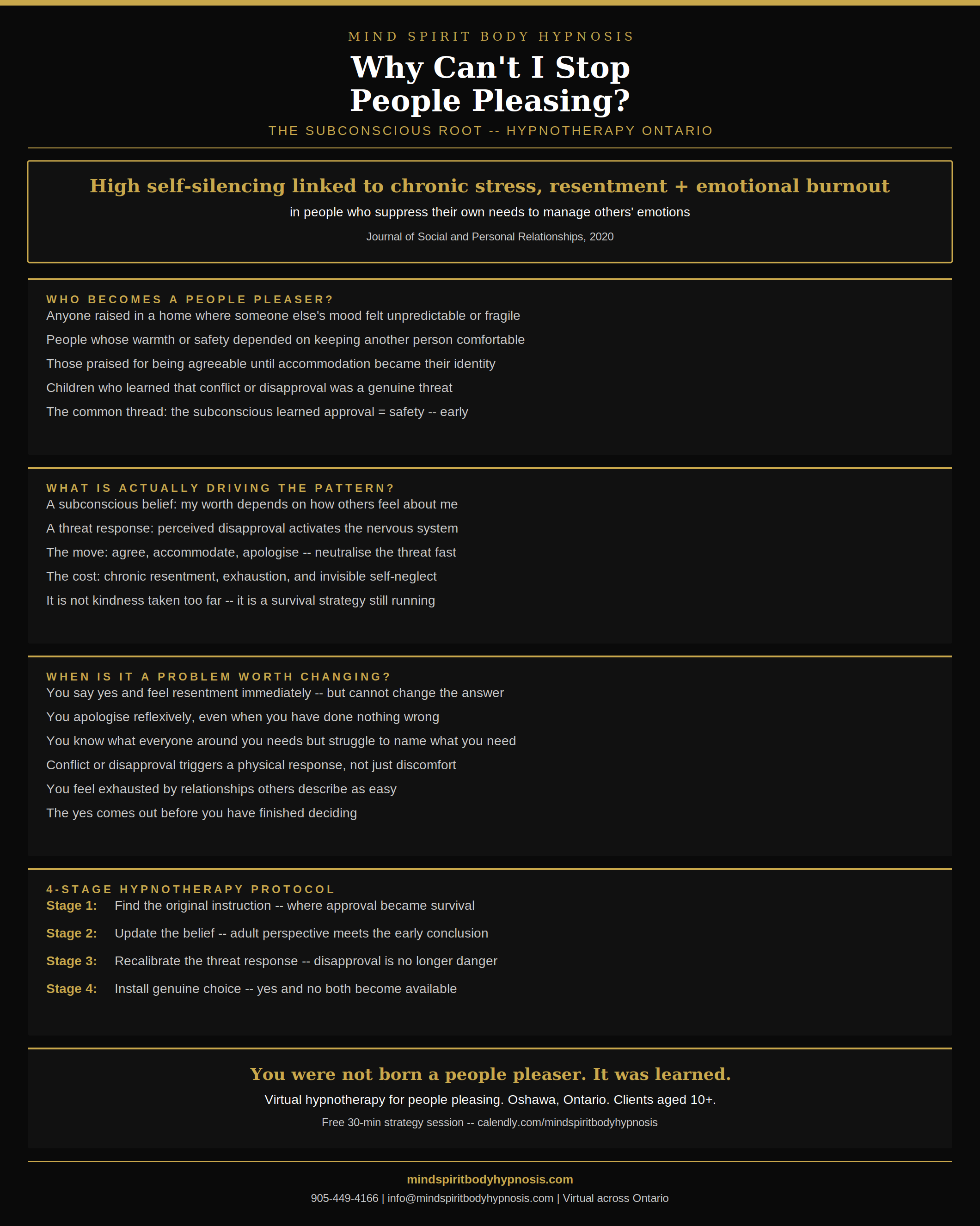
How Hypnotherapy Works With People-Pleasing at the Source
At Mind Spirit Body Hypnosis, people pleasing hypnotherapy Ontario clients experience is structured around four stages.
Stage 1: Find the original instruction. Where did the subconscious first learn that other people's approval was a survival requirement? In trance, the subconscious reveals the early experiences and conclusions it has been drawing on. Clients often recognize these moments intellectually but have never felt them at the level where they were stored. The original experience becomes accessible.
Stage 2: Update the belief. The child who formed the original conclusion did not have the resources, safety, or options that the adult now has. In trance, the adult perspective can meet the original experience. The belief that made sense then, as a survival adaptation in a specific environment, gets examined and updated for the life the client is actually living now.
Stage 3: Recalibrate the threat response. The nervous system response to perceived disapproval that tightening that overrides conscious intention can be recalibrated directly in trance. The subconscious is shown that another person's displeasure is not a threat to the adult's safety, belonging, or worth. The physiological response settles.
Stage 4: Install the felt sense of choice. What clients consistently describe after this work is not that they start saying no constantly, but that they notice they now have a choice. The yes that comes out is a genuine yes. The no, when it needs to come, is available without the physical distress that used to block it.
More about Fanis's approach and background is on the about page.
WHAT MY CLIENTS SAY
“I don’t write many reviews, but Fanis truly earned this one. I came in skeptical. What I got was a practitioner who takes the work seriously while being incredibly supportive. He asked the right questions up front, actually listened to the answers, and explained his approach in plain language before starting. No theatrics, no vague promises. The sessions themselves were comfortable and easy to settle into. I felt a shift after the first one and it held. He also gave me practical things to do between sessions, which made the progress stick rather than fade after a few days. He’s honest about what hypnotherapy can and can’t do, which is exactly why I trusted him. If you’re considering it, go see Fanis. Thank you Fanis for helping me and approaching it in the manner you did!” — Faisal H.
Frequently Asked Questions
Why do I keep saying yes when I want to say no? Because the instruction to say yes is running subconsciously, faster than conscious choice can intervene. The subconscious learned that other people's approval and emotional comfort are connected to your safety. So when the possibility of their displeasure arises, it activates a threat response and moves to neutralize it before the conscious mind has fully processed the situation.
Who is most likely to become a people pleaser? People who grew up in environments where another person's emotional state was unpredictable, fragile, or directly tied to how they behaved. People whose safety, warmth, or belonging depended on keeping someone else happy. Those who were praised for being agreeable and accommodating until those traits became a survival identity rather than a genuine choice.
Is people pleasing the same as being kind? No, though they can look identical from the outside. Genuine kindness is a choice made from a secure sense of self. People-pleasing is a compulsion driven by a threat response. The distinction is whether you have a real option to do otherwise and feel okay. If saying no triggers something that feels closer to fear than to discomfort, the driver is the pattern, not the choice.
When should I consider hypnotherapy for people pleasing? When understanding the pattern has not changed the pattern. When you can identify your people-pleasing in real time and still cannot interrupt it. When the cost of keeping others comfortable has become your own chronic discomfort, resentment, or exhaustion. When the yes comes out before you have decided. That gap between knowing and choosing is exactly where hypnotherapy works.
Why does setting boundaries feel so hard even when I know I should? Because the instruction to keep others comfortable is not coming from your thoughts. It is coming from a nervous system response that experiences disapproval or conflict as a genuine threat. Boundary-setting techniques work at the conscious level. When the threat response is strong enough, it overrides conscious technique in the moment. Hypnotherapy works at the level of the response itself.
Will hypnotherapy turn me into someone who does not care about others? No. What gets updated is the instruction that your worth and safety depend on others' approval, not your capacity for care or generosity. Clients consistently describe becoming more genuinely giving after this work, because their giving is no longer driven by fear. They choose it. That is a very different experience.
Can children be people pleasers? Yes. The pattern almost always begins in childhood. Children who grow up in environments where their emotional attunement to others is required for safety develop this pattern early. I work with clients aged 10 and older. Younger clients often respond quickly because the pattern has had less time to reinforce.
How is people pleasing related to low self-esteem? They share the same subconscious root: a belief that your worth is conditional on external approval. Low self-esteem is the internal experience of that belief. People pleasing is the behaviour it produces. Hypnotherapy addresses the shared root, which is why clients often find that both improve together.
How many sessions does this take? Most clients notice a meaningful shift in two to four sessions. A specific estimate is always given in the free 30-minute strategy session before any commitment is made. Patterns with deeper early origins may take more time, but a sense of having genuine choice typically begins to emerge early in the process.
Ready to Take the Next Step?
If you are tired of living life around everyone else's comfort while yours waits, I would love to help.
I offer a free 30-minute virtual strategy session for new clients across Ontario. No pressure. Just an honest conversation about what you are carrying and whether hypnotherapy might finally give you the shift you have been looking for.
RECOMMENDED READING
Book your free session: calendly.com/mindspiritbodyhypnosis
Call or text: 905-449-4166
Email: info@mindspiritbodyhypnosis.com
Visit: mindspiritbodyhypnosis.com
Serving clients virtually across Ontario, including Durham Region, Toronto, Canada, and beyond.
Disclaimer: This article is for informational purposes only and does not constitute medical or psychological advice. Hypnotherapy, NLP, and EMDR are complementary approaches and are not a substitute for diagnosis or treatment by a qualified healthcare provider. Please consult a licensed professional if you have concerns about your mental or physical health.
Written by Fanis Makrigiannis | Certified Hypnotherapist & NLP Master Practitioner | Mind Spirit Body Hypnosis.