Does hypnosis really help with anxiety?
Can Hypnotherapy Help With Anxiety? What Ontario Clients Need to Know
TL;DR: Anxiety is not random. It is a subconscious threat response that was trained by experience and continues to fire even when the threat is no longer present. Clients searching for anxiety hypnotherapy Ontario often arrive having tried medication, breathing techniques, and talk therapy with partial results, because those approaches manage the anxiety at the surface level without reaching the subconscious pattern driving it. Fanis Makrigiannis at Mind Spirit Body Hypnosis in Oshawa works directly with that pattern. Virtual sessions across Ontario.
Quick Answer
Anxiety hypnotherapy Ontario describes a subconscious-focused approach to anxiety relief that Fanis Makrigiannis offers at Mind Spirit Body Hypnosis in Oshawa, Ontario. Anxiety is not a personality trait or a chemical imbalance that has to be managed indefinitely. It is a learned threat-detection pattern in which the subconscious continues to respond to situations as dangerous long after the original threat has passed. Hypnotherapy works directly with the subconscious to identify where the pattern was formed, update the threat response, and install a genuine baseline of calm that does not require constant management. Fanis Makrigiannis, a Certified Hypnotherapist (ABH, NGH) and NLP Master Practitioner (ABNLP), offers virtual sessions across Ontario for clients ready to work with anxiety at the level it actually lives.
Questions This Article Answers
Why do I feel anxious even when nothing is wrong?
Who is most likely to develop an anxiety pattern?
What is actually happening in the nervous system when anxiety fires?
When does anxiety become something worth addressing with more than coping tools?
Why does managing anxiety not make it go away?
In this article:
You are not in danger. You know you are not in danger. And your body does not care.
The heart rate climbs anyway. The chest tightens. The mind starts running through scenarios that have not happened and may never happen. And the more you try to reason your way out of it, the stronger it seems to get.
That is not weakness. That is the subconscious doing exactly what it was trained to do. In my practice in Oshawa, I work with clients across Ontario who have lived with anxiety long enough that it feels like just the way they are. The first thing I tell them is that it is not who they are. It is a pattern. And patterns can change.
Who Develops an Anxiety Pattern?
Anyone whose nervous system learned, at some point, that the world was unpredictable, unsafe, or required constant vigilance to navigate.
That learning can come from many places. A childhood environment where unpredictability was the norm, so the nervous system stayed on alert to detect what was coming next. Early experiences of loss, conflict, or instability that taught the subconscious that bad things happen without warning. A period of prolonged stress or threat in which hypervigilance was genuinely useful for managing risk.
It can also come from experiences that did not look dramatic from the outside. A child who grew up with a highly anxious parent and absorbed that as a baseline. Someone who was criticised harshly enough and often enough that the body began treating evaluation or observation as a threat. A person who experienced a single frightening event that the subconscious generalized into a broader pattern of threat detection.
What all of these have in common is that the nervous system made a reasonable adaptation to the conditions it was in. The adaptation became a pattern. And the pattern kept running long after the conditions that produced it had changed.
People with anxiety are often highly capable, thoughtful, and perceptive. The same sensitivity that made them good at detecting risk in a difficult environment is the same system that is now firing in situations that do not require it.
What Is Actually Happening When Anxiety Fires?
The subconscious has detected something it associates with a previous threat and activated the body's protective response before the conscious mind has had a chance to evaluate the situation.
The threat detection piece: The subconscious is constantly scanning for patterns that match stored threat memories. When it finds a match, even a loose one, it activates the sympathetic nervous system. Heart rate increases. Breathing shallows. Muscles tighten. The thinking brain becomes less available. This is the anxiety response: a body preparing to deal with a threat that the subconscious believes is present.
The problem with the match: The original threat may have been very real. But the subconscious generalizes. A child who learned that conflict was dangerous may find their body responding to any raised voice, any sign of disagreement, or even a difficult email as if the original threat were present. The match does not have to be accurate. It just has to be close enough.
A 2021 review in the Journal of Anxiety Disorders found that anxiety disorders are characterized by an over-generalized threat response, in which the subconscious applies learned fear responses to stimuli that are only loosely similar to the original threat. The problem is not the threat-detection system itself. It is the calibration.
The maintenance loop: Anxiety is self-reinforcing. The body's response to a perceived threat- racing heart, tight chest, difficulty thinking clearly- is itself distressing. That distress signals to the subconscious that something dangerous is happening, which intensifies the response. People with anxiety often end up anxious about being anxious, which extends and deepens the original pattern.
This is why the hypnotherapy for anxiety and stress page focuses on the subconscious threat pattern rather than the symptoms it produces. Managing the symptoms without addressing the pattern is a maintenance strategy, not a resolution.
What is anxiety?
When Does Anxiety Become Worth Addressing at the Root?
When coping tools are consuming more energy than the situations themselves would warrant, and the pattern is affecting choices you would not otherwise make.
Everyone experiences anxiety at some level. It is a normal and adaptive response to genuine uncertainty or risk. The question is whether the anxiety you experience is proportional to the actual conditions, or whether the subconscious is responding to a level of threat that is no longer present in your current life.
Signs the pattern is running beyond what the situation requires:
You feel anxious regularly without being able to identify a specific cause
You avoid situations, relationships, or opportunities because of how they make you feel
Your body is in a state of tension or alertness most of the time, even when nothing is wrong
You run through worst-case scenarios automatically and find it difficult to stop
You rely on reassurance from others to feel temporarily settled, but it never lasts
Sleep is regularly disrupted by a mind that will not quieten
When those patterns are consistent, the nervous system is running a threat response that the current situation does not require. That is useful information, because the calibration of a nervous system is something that can be updated.
For clients whose anxiety is connected to specific past experiences, the hypnotherapy for trauma page covers the overlap between stored trauma and chronic anxiety responses.
Why Coping Tools Only Go So Far
Because coping tools work with the anxiety after it has already fired. They do not address the subconscious pattern that fired it.
Breathing exercises are genuinely useful. They activate the parasympathetic nervous system and can help the body settle more quickly once the response has been activated. Mindfulness can help a person observe the anxiety without being as fully swept into it. Cognitive reframing can help the conscious mind challenge the thought patterns that accompany the anxiety.
These are all valuable. And for many people, they are not enough, because the subconscious threat response fires faster than any conscious technique can intercept it. By the time you are applying the breathing exercise, the nervous system has already been running the response for several seconds. The tool is managing an already-active pattern.
As a certified hypnotherapist, I work with clients who have a full toolkit of coping strategies and are exhausted from using them. They are not doing anything wrong. They are applying conscious-level tools to a subconscious-level pattern. The gap between those two levels is where nothing seems to fully work.
Breathing and mindfulness manage the anxiety response after it activates. They do not update the subconscious trigger.
Cognitive behavioural techniques work at the level of conscious thought and belief. They are more durable than breathing alone but still work above the subconscious level where the threat pattern lives.
Hypnotherapy works at the subconscious level. It recalibrates the threat response at the level where it was originally calibrated.
How Hypnotherapy Works With Anxiety at the Source
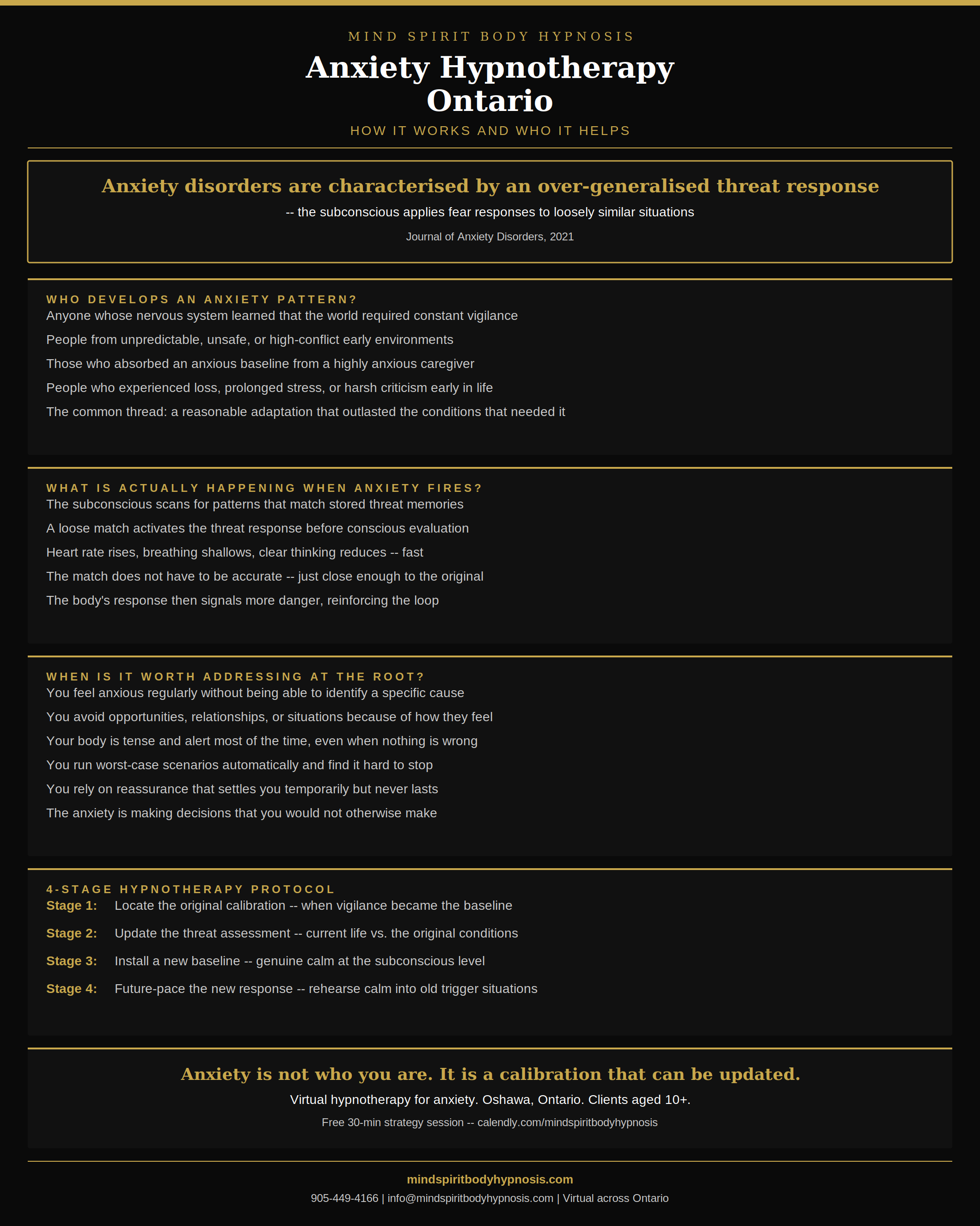
At Mind Spirit Body Hypnosis, anxiety hypnotherapy for clients in Ontario is structured around four stages.
Stage 1: Locate the original calibration. When did the nervous system first learn that this level of vigilance was required? In trance, the subconscious reveals the early experiences and conclusions that set the baseline. Clients often know these experiences intellectually but have not accessed them at the level where the nervous system stored its response. That is where the update becomes possible.
Stage 2: Update the threat assessment. In trance, the subconscious is highly receptive to new information. The original threat assessment, which was accurate for the conditions that existed then, gets examined from the perspective of the adult the client is now. The nervous system receives updated information about the actual level of threat present in the client's current life.
Stage 3: Install a new baseline. The felt sense of calm, of genuine safety in the body, can be installed at the subconscious level in trance. Not as a thought or an instruction to relax, but as an actual physiological baseline the nervous system can return to. Clients often describe this as the part that surprises them most.
Stage 4: Future-pace the new response. Rehearse the updated threat response in the specific situations that used to trigger the old one. The subconscious practises responding without the old level of alarm until the new response becomes more automatic than the original.
More about Fanis's approach and background is on the about page.
WHAT MY CLIENTS SAY
“My therapist referred me to Fanis after I’d been struggling with trauma responses for years. I’ll be honest, I wasn’t expecting much, just another thing to try. By the second session, I noticed something had shifted. By the fourth, the weight I’d been carrying for over a decade was just… gone. I don’t know how else to describe it. Fanis works differently than anyone I’d seen before. He’s calm, precise, and he gets to the root of things fast. If someone you trust sends you to Mind Spirit Body Hypnosis, listen to them. Best decision I made.” — Emmanuel M
Frequently Asked Questions
Why do I feel anxious even when nothing is wrong? Because the current situation is not triggering the anxiety. It is being triggered by the subconscious detecting a loose match with a stored threat memory. The nervous system responds to the match, not to the actual level of risk present right now. This is why the anxiety can feel completely disconnected from what is actually happening in your life.
Who is most likely to develop an anxiety pattern? Anyone whose nervous system learned at some point that constant vigilance was required to navigate their environment safely. People from unpredictable or unsafe early environments. Those who experienced prolonged stress, loss, or criticism during formative periods. People who absorbed an anxious baseline from a highly anxious caregiver. The nervous system is adaptive, and it learned what it needed to learn. The problem is the learning has outlasted the conditions that required it.
Is anxiety a chemical imbalance? Anxiety involves neurological processes and brain chemistry, and for some people medication is a helpful part of managing it. But framing anxiety purely as a chemical imbalance can obscure that the underlying threat response is a learned pattern. Many clients find that working with that pattern directly reduces or eliminates the anxiety in a way that medication management alone did not.
When should I consider hypnotherapy for anxiety? When coping tools are consuming significant energy and the anxiety is still affecting your choices, relationships, or quality of life. When you have understood where the anxiety comes from but cannot seem to change how it feels in the moment. When avoiding certain situations has become a strategy that is limiting more and more of your life. The gap between knowing and feeling is where hypnotherapy works.
How is hypnotherapy different from therapy for anxiety? Talk therapy primarily works at the conscious and emotional level, building insight and developing coping strategies. Hypnotherapy works directly with the subconscious, where the threat response was originally calibrated. The two approaches are complementary. Hypnotherapy addresses a level that talk therapy does not always reach, which is why some clients benefit from both.
Can hypnotherapy make anxiety worse? No. Hypnotherapy for anxiety works with relaxation and a gradual approach to the subconscious pattern. It does not involve flooding or forced exposure. Clients remain in control throughout the session, and the process is designed to reduce the threat response, not amplify it.
Does hypnotherapy work for all types of anxiety? Hypnotherapy is effective for generalized anxiety, social anxiety, performance anxiety, and anxiety connected to specific past experiences. It works best when there is a subconscious pattern maintaining the anxiety, which is the case for most persistent anxiety presentations. A free strategy session is the best way to assess whether your specific pattern is a good fit.
How many sessions does this take? Most clients notice a meaningful shift in two to four sessions. A specific estimate is always given in the free 30-minute strategy session before any commitment is made. Anxiety with deep or complex origins may take more time, but progress is typically felt early in the process.
Is virtual hypnotherapy as effective as in-person for anxiety? Yes. All sessions at Mind Spirit Body Hypnosis are conducted virtually. Trance is a natural state the client enters with guidance. Many clients find that being in the comfort of their own environment makes it easier to relax and access the subconscious work that needs to happen.
Ready to Take the Next Step?
If you are tired of managing anxiety and ready to work with it at the level it actually lives, I would love to help.
I offer a free 30-minute virtual strategy session for new clients across Ontario. No pressure. Just an honest conversation about what you are carrying and whether hypnotherapy might finally give you the shift you have been looking for.
RECOMMENDED READING
Book your free session: calendly.com/mindspiritbodyhypnosis
Call or text: 905-449-4166
Email: info@mindspiritbodyhypnosis.com
Visit: mindspiritbodyhypnosis.com
Serving clients virtually across Ontario, including Durham Region, Toronto, Canada, and beyond.
Disclaimer: This article is for informational purposes only and does not constitute medical or psychological advice. Hypnotherapy, NLP, and EMDR are complementary approaches and are not a substitute for diagnosis or treatment by a qualified healthcare provider. Please consult a licensed professional if you have concerns about your mental or physical health.
Written by Fanis Makrigiannis | Certified Hypnotherapist & NLP Master Practitioner | Mind Spirit Body Hypnosis.