Advanced Hypnotherapy for trauma relief
5 Ways Hypnotherapy Helps You Process Trauma (Without Reliving It)
TL;DR: Trauma therapy hypnotherapy in Ontario offers a gentle, subconscious-level approach to healing that doesn't require you to retell your story over and over. By working with the nervous system directly, hypnotherapy helps people reduce trauma responses, rebuild safety, and move forward without being stuck in the past.
Quick Answer
Trauma therapy hypnotherapy Ontario is a subconscious-focused approach that helps people process painful memories and nervous system responses without forcing them to relive traumatic events in full detail. Unlike traditional talk therapy, hypnotherapy communicates directly with the part of the mind where trauma is stored and re-activated. Research published in the International Journal of Clinical and Experimental Hypnosis found hypnotherapy to be significantly effective in reducing trauma symptoms, including hypervigilance, emotional numbing, and intrusive memories. Fanis Makrigiannis, a Certified Hypnotherapist and EMDR Practitioner at Mind Spirit Body Hypnosis in Oshawa, Ontario, offers virtual trauma sessions across Ontario for people who are ready to heal at their own pace.
Questions This Article Answers
Can hypnotherapy help with trauma?
Do I have to relive my trauma for hypnotherapy to work?
How is hypnotherapy different from talk therapy for trauma?
What does a trauma hypnotherapy session feel like?
Who is a good candidate for trauma therapy hypnotherapy in Ontario?
In this article:
Why Trauma Lives Below the Surface
Trauma isn't just a bad memory. It's a pattern stored in the body and the subconscious mind that keeps activating long after the event is over.
That's why someone can understand, on a conscious level, that they are safe now and still feel panic in certain situations. The knowing and the feeling are stored in different parts of the mind. Talk therapy works with the knowing. Hypnotherapy works with the feeling.
In my practice, clients often arrive having already done years of talking about their trauma. They understand it. They can explain it. But the triggers are still there, the body still reacts, and the subconscious pattern hasn't shifted. That's the gap trauma therapy hypnotherapy in Ontario is designed to fill.
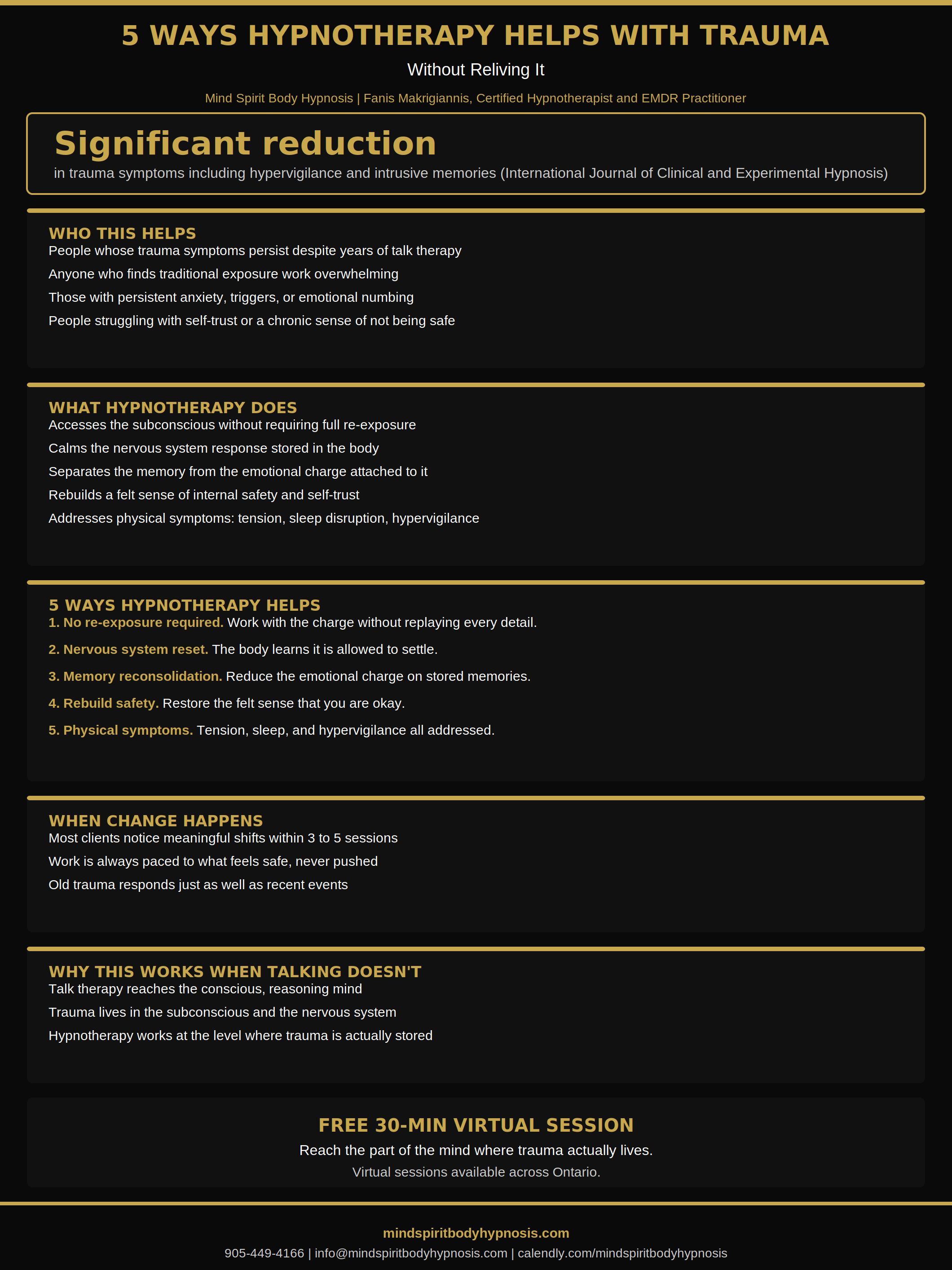
5 Ways Hypnotherapy Helps You Process Trauma
Here are five specific ways hypnotherapy addresses trauma at the level where it actually lives.
1. It Reaches the Subconscious Without Full Re-Exposure
Traditional exposure-based therapy asks people to revisit traumatic memories in detail. For some, that's effective. For others, it's retraumatizing.
Hypnotherapy takes a different route. In a relaxed, hypnotic state, the subconscious becomes accessible without requiring the conscious mind to replay every detail. Clients can work with the emotional charge of a memory without being flooded by it. The memory doesn't have to be re-experienced in full for the nervous system response attached to it to be updated.
This makes hypnotherapy a strong option for people who have found traditional exposure work too overwhelming.
2. It Calms the Nervous System Response
Trauma lives in the nervous system. The body learns to stay on alert: scanning for danger, bracing for impact, reacting before the conscious mind has a chance to think.
Hypnotherapy's deep relaxation effect directly interrupts this pattern. Research in the International Journal of Clinical and Experimental Hypnosis found that hypnotic relaxation significantly reduced hyperarousal symptoms in trauma survivors. When the nervous system learns to access a state of safety, the constant state of alertness begins to soften over time.
3. It Separates the Memory from the Emotional Charge
A traumatic memory often carries an overwhelming emotional weight. When it surfaces, so does the full force of what was felt at the time.
Using techniques like affect bridge and memory reconsolidation within hypnosis, it becomes possible to revisit the memory from a place of distance rather than immersion. The event doesn't get erased. But the emotional charge attached to it can be significantly reduced. Clients describe it as being able to think about what happened without being pulled back into it.
As a Certified Hypnotherapist and EMDR Practitioner, I find this combination particularly powerful: hypnosis to access the stored material, and EMDR principles to help the nervous system process and integrate it. You can learn more about how this works on the hypnotherapy for trauma and EMDR page.
4. It Rebuilds a Sense of Safety and Self-Trust
Trauma often damages more than memory. It damages how a person relates to themselves. Many people who have experienced trauma develop a deep distrust of their own reactions, judgments, and body.
Hypnotherapy can work directly on self-perception. Using suggestion and imagery work, sessions help rebuild an internal sense of safety: the felt sense that you are okay, that your reactions make sense, and that you are not broken. This matters because healing trauma isn't only about reducing distress. It's about restoring a relationship with yourself.
For clients dealing with the confidence and identity damage that often follows trauma, the hypnotherapy for confidence and self-sabotage page covers how that piece of the work unfolds.
5. It Addresses the Physical Symptoms Trauma Leaves Behind
Trauma doesn't stay in the mind. It shows up as chronic tension, sleep disruption, digestive issues, a startle response that won't settle, and a general sense of the body being unsafe.
Hypnotherapy's effect on the autonomic nervous system means it can help reduce these physical symptoms alongside the emotional ones. Clients working on trauma in Ontario often report improvements in sleep quality, a reduction in physical tension, and a calmer baseline in the body, in addition to shifts in how they relate to the memories themselves. These changes can also ease the anxiety and stress that so often travel alongside trauma.
What is trauma?
What a Trauma Session Actually Looks Like
Many people imagine trauma work as intense and emotionally gruelling. A session at Mind Spirit Body Hypnosis looks quite different.
Here is what a typical session includes:
Intake and pacing: We talk about where you are, what you're ready for, and what pace feels safe. Nothing is pushed.
Grounding: Before any trauma-focused work, we build a solid sense of safety in the session itself.
Hypnotic relaxation: A guided process that helps the conscious mind step back and the subconscious become more receptive.
Targeted work: Depending on what's right for you, this might involve reducing the charge on specific memories, working with the nervous system response, or rebuilding internal safety.
Integration: We bring you back gently, check in, and make sure you leave the session feeling grounded, not raw.
Fanis Makrigiannis works in Oshawa and delivers all sessions virtually across Ontario. Most clients begin to notice meaningful shifts within three to five sessions, though this varies depending on the nature and history of the trauma.
Who Benefits Most?
This approach works particularly well for people who:
Have experienced childhood trauma, relationship trauma, or single-incident events
Have tried talk therapy and found it helpful but incomplete
Find traditional exposure work too overwhelming to continue
Experience persistent anxiety, hypervigilance, or emotional numbing
Struggle with trust, self-worth, or a chronic sense of not being safe
It also works well alongside other trauma-informed approaches. Hypnotherapy doesn't replace therapy with a registered psychotherapist when that level of care is needed. But for many people, it fills a gap that talk-based approaches leave open.
Virtual sessions are available across Ontario, including Durham Region, Toronto, Ottawa, and beyond.
WHAT MY CLIENTS SAY
“My therapist referred me to Fanis after I’d been struggling with trauma responses for years. I’ll be honest, I wasn’t expecting much, just another thing to try. By the second session, I noticed something had shifted. By the fourth, the weight I’d been carrying for over a decade was just… gone. I don’t know how else to describe it. Fanis works differently than anyone I’d seen before. He’s calm, precise, and he gets to the root of things fast. If someone you trust sends you to Mind Spirit Body Hypnosis, listen to them. Best decision I made.” — Emmanuel M.
Frequently Asked Questions
Can hypnotherapy actually help with trauma? Research suggests it can. A study published in the International Journal of Clinical and Experimental Hypnosis found hypnotherapy to be significantly effective in reducing trauma symptoms, including intrusive memories, hypervigilance, and emotional numbing. Hypnotherapy is most effective for trauma when delivered by a trained practitioner who understands how to pace the work safely.
Do I have to relive my trauma for hypnotherapy to work? No. One of the advantages of hypnotherapy for trauma is that it doesn't require full re-exposure to the traumatic event. The work happens at a subconscious level, which means the emotional charge of a memory can be addressed without the conscious mind having to replay every detail. Many clients find this a significant relief compared to other approaches.
How is hypnotherapy different from talk therapy for trauma? Talk therapy works primarily with the conscious, rational mind. It helps you understand and process what happened. Hypnotherapy works with the subconscious mind, where trauma is stored and where automatic responses like triggers and body reactions originate. The two approaches address different levels of the same problem, and they can work well together.
What does a trauma hypnotherapy session feel like? Most clients describe it as deeply relaxing. You remain aware and in control throughout. The session is paced carefully, and nothing is pushed. Many people feel lighter after a session, though some need a little time to integrate what came up. Fanis always ensures clients leave feeling grounded, not raw.
Is virtual hypnotherapy effective for trauma? Yes. Many clients find that being in their own home actually supports the sense of safety that trauma work requires. All sessions at Mind Spirit Body Hypnosis are delivered virtually, making them accessible to anyone in Ontario without the stress of travel.
How many sessions will I need? This depends on the nature and history of the trauma. Some clients notice meaningful shifts within three sessions. Others benefit from a longer programme of six to eight sessions, sometimes more. During your free strategy session, Fanis will give you a realistic picture based on what you share.
Is hypnotherapy safe for complex trauma or PTSD? Hypnotherapy can be appropriate for complex trauma when delivered carefully and at the right pace. Fanis works in the self-improvement and stress management space and will always let you know if a higher level of clinical care is the right first step. Safety and pacing come before everything else in trauma work.
Can hypnotherapy help with trauma that happened a long time ago? Yes. The subconscious doesn't distinguish between recent and old trauma in terms of how it stores and activates responses. Old events can still carry significant emotional charge, and hypnotherapy can address that charge regardless of when the event occurred.
What is the difference between hypnotherapy and EMDR for trauma? EMDR (Eye Movement Desensitization and Reprocessing) uses bilateral stimulation to help the brain process and integrate traumatic memories. Hypnotherapy uses guided relaxation and subconscious suggestion to access and update stored patterns. Fanis is trained in both, and the two approaches are often used together for a more complete result.
Will I remember what happens during a hypnotherapy session? Yes, in most cases. Hypnosis is not unconsciousness. Most clients are aware of what is happening throughout and remember the session clearly afterwards. The depth of relaxation varies from person to person, but loss of memory is not a typical or intended part of the process.
Ready to Take the Next Step?
If you're carrying something that talk therapy hasn't fully reached, I'd love to help.
I offer a free 30-minute virtual strategy session for new clients across Ontario. There's no pressure, just a conversation about what you're going through and how hypnotherapy, NLP, or EMDR might support you.
RECOMMENDED READING
Book your free session: calendly.com/mindspiritbodyhypnosis
Call or text: 905-449-4166
Email: info@mindspiritbodyhypnosis.com
Visit: mindspiritbodyhypnosis.com
Serving clients virtually across Ontario, including Durham Region, Toronto, Canada, and beyond.
Disclaimer: This article is for informational purposes only and does not constitute medical or psychological advice. Hypnotherapy and EMDR are complementary approaches and are not a substitute for diagnosis or treatment by a qualified healthcare provider. Please consult a licensed professional if you have concerns about your mental or physical health.
Written by Fanis Makrigiannis | Certified Hypnotherapist and NLP Master Practitioner | Mind Spirit Body Hypnosis.