Why do all my diets fail no matter what I try?
Weight Loss Hypnotherapy in Ontario: Why the "I'll Start Monday" Cycle Keeps Happening
TL;DR: The "I'll start Monday" cycle is not a motivation problem. It is a subconscious identity problem. The part of the mind that controls habits and automatic behaviour has not been updated to match the conscious goal. An analysis of five weight loss studies in the Journal of Consulting and Clinical Psychology found that hypnosis can more than double the effects of traditional weight loss approaches. Fanis Makrigiannis at Mind Spirit Body Hypnosis in Oshawa, Ontario, offers virtual weight loss hypnotherapy Ontario sessions for clients aged 10 and older across the province.
Quick Answer
Weight loss hypnotherapy Ontario is a subconscious approach that addresses the identity patterns, emotional triggers, and habitual behaviours keeping people stuck in repeated start-fail-restart cycles. An analysis of five studies in the Journal of Consulting and Clinical Psychology found that hypnosis more than doubles the effects of traditional weight loss approaches. An 18-month follow-up study found the hypnotherapy group continued to lose an average of 8 additional pounds after treatment ended, while the control group did not. Fanis Makrigiannis, a Certified Hypnotherapist (ABH, NGH) and NLP Master Practitioner (ABNLP) at Mind Spirit Body Hypnosis in Oshawa, Ontario, offers virtual sessions for clients aged 10 and older across Ontario. No referral is required.
Questions This Article Answers
Why does the "I'll start Monday" cycle keep repeating even in motivated people?
Is the problem willpower, information, or something deeper?
What role does subconscious identity play in weight loss?
What does hypnotherapy do that diets and apps cannot?
How many sessions does it take to break the cycle for good?
In this article:
Most people who struggle with their weight are not short of information. They know about calories. They know about protein. They have downloaded the apps. They have bought the programmes. They know, often in precise detail, exactly what they would need to do.
And on Sunday night they make the plan. And by Thursday they have quietly stopped following it. And by Saturday the plan has been postponed to Monday.
This has happened before. Many times. And the confusion it produces is real. If I know what to do and I want to do it, why does it keep not happening?
In my practice in Oshawa, I hear this question constantly. The answer is always the same. The subconscious has not been updated.
Why Does the "I'll Start Monday" Cycle Keep Repeating?
Because the cycle is not driven by the conscious mind. It is driven by the subconscious.
The conscious mind makes the plan on Sunday night. It is genuine. The motivation is real. But the subconscious, which controls automatic behaviour, habits, and emotional responses, is running a different programme. It has a settled sense of who this person is in relation to food. What they eat. How they feel about their body. What they deserve. What is possible for them.
Until that subconscious programme is updated, the conscious plan runs into it every single time. Not because the person is weak. Because you cannot override the subconscious with conscious effort alone for long. The subconscious is faster, older, and more powerful than the thinking mind.
By Thursday, the depletion sets in. Willpower, which is a finite resource, has been used up by the demands of daily life. The subconscious default kicks back in. The plan quietly dissolves. By Saturday the original pattern is restored.
This is not failure. This is what happens when the tool being used (conscious effort) is the wrong tool for the job (subconscious habit change).
For more on how the subconscious drives habitual behaviour and how hypnotherapy reaches it directly, the weight loss and emotional eating pillar page covers the full approach.
Is the Problem Willpower or Something Deeper?
It is something deeper. Willpower is not the problem. Willpower is being applied to the right goal with the wrong tool.
Think of it this way. Imagine trying to change your accent through willpower alone. You know what the new accent sounds like. You want to speak that way. And every time you relax, or get tired, or stop concentrating, your original accent returns. Not because you are not trying hard enough. Because the automatic speech pattern lives in the subconscious and has not been updated by conscious effort.
Eating patterns work the same way. The automatic responses to hunger, to stress, to boredom, to reward, to social eating- all of these live in the subconscious. They were formed through years of experience and repetition. They feel natural because they are deeply embedded. They are not going to change because you decided they should.
This is not a character flaw. It is how the subconscious works. And once you understand that, the question changes. Instead of asking why am I not trying hard enough, you start asking how do I update the subconscious programme. That is the right question. And weight loss hypnotherapy in Ontario is one of the clearest answers to it.
How Does Subconscious Identity Drive the Weight Loss Cycle?
The most overlooked dimension of the cycle is identity.
The subconscious does not just store habits. It stores a sense of who you are. And it is remarkably consistent about protecting that sense of self. If the subconscious has filed you as someone who struggles with their weight, who diets and falls off, who is always going to start again on Monday, it will protect that identity. Not out of malice. Out of the fundamental drive toward consistency and self-preservation that the subconscious runs on.
This shows up in specific, recognizable ways. The good week is followed by a self-sabotaging weekend. Progress feels uncomfortable rather than satisfying. Getting close to the goal produces anxiety rather than excitement. A small slip becomes a reason to abandon the whole plan. All of these are the subconscious pulling back toward the settled sense of self.
Changing this requires updating the identity at the subconscious level. Not the plan, not the diet, not the app. The identity. The sense of who this person is in relation to their body and their relationship with food.
When the identity updates, the behaviour follows naturally. The person who genuinely sees themselves as someone who eats well and values their body does not need willpower to make food choices consistent with that identity. The choices feel natural. They feel like themselves.
What Does Weight Loss Hypnotherapy Do That Diets Cannot?
As a Certified Hypnotherapist with ABH and NGH credentials and NLP training through ABNLP, working with clients across Durham Region and Ontario, I address the cycle through a structured five-stage approach that targets the subconscious layer diets never reach.
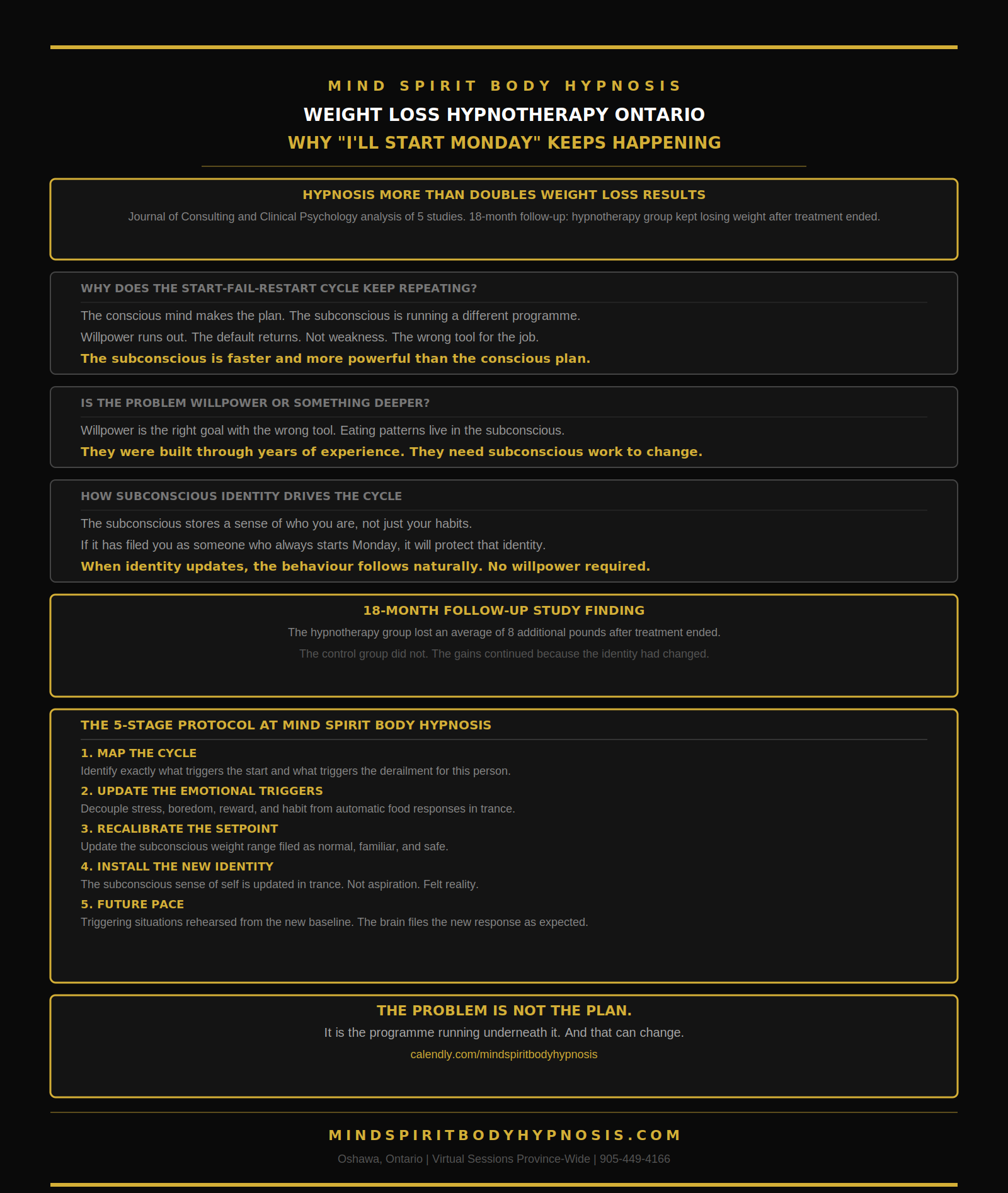
Stage 1: Map the cycle. We identify the specific shape of this person's start-fail-restart pattern. What triggers the start. What triggers the derailment. What the internal narrative sounds like at each stage. What emotional states are most present. This map is precise. The work that follows targets exactly what is driving this particular cycle.
Stage 2: Update the emotional triggers. The emotional states that have been driving off-plan eating are addressed directly in trance. Whether that is stress, boredom, loneliness, reward-seeking, or habit, each trigger is decoupled from the automatic food response and replaced with a more functional automatic response.
Stage 3: Recalibrate the setpoint. The subconscious weight setpoint, the weight range the nervous system treats as normal and familiar, is directly updated. The body is helped to experience a lower weight range as safe rather than unfamiliar or threatening. This is the layer that sustains results over months rather than weeks.
Stage 4: Install the new identity. In trance, the subconscious sense of self is updated. The person experiences what it feels like to genuinely be someone who has a healthy, easy relationship with food and their body. Not as aspiration but as felt reality. This identity installation is the most durable component of the work.
Stage 5: Future pace. Specific situations that have previously triggered the cycle are visited in trance from the new baseline. The Friday night. The stressful week. The social event. The person experiences navigating these from the updated identity. The brain files these rehearsals as expected experience.
The research supports this approach. An analysis of five studies published in the Journal of Consulting and Clinical Psychology found that hypnosis more than doubled the effects of traditional weight loss methods. An 18-month study found the hypnotherapy group continued to lose weight after treatment ended, while the control group did not. The gains kept going because the identity had changed. The plan no longer needed willpower to sustain it.
What Do Sessions Look Like at Mind Spirit Body Hypnosis?
A typical programme for weight loss hypnotherapy in Ontario at Mind Spirit Body Hypnosis:
Session 1: Intake and cycle mapping. A thorough conversation about the specific pattern for this person. No diet advice. No calorie counting. The focus is on the subconscious pattern and what drives it.
Sessions 2 and 3: Emotional trigger work and setpoint update. Direct trance work on the emotional drivers and the subconscious weight setpoint. Many clients notice shifts in their automatic responses to food within these two sessions.
Sessions 4 and 5: Identity installation and future pacing. The new subconscious sense of self is installed. Future triggering situations are visited from the new baseline.
In my practice, weight loss cycle work typically runs between three and five sessions. All sessions are virtual, available to clients aged 10 and older across Ontario. No referral is required. My credentials and approach are detailed on the about page.
For more on how anxiety and stress patterns compound weight loss difficulty, the hypnotherapy for anxiety and stress page covers those connections.
WHAT MY CLIENTS SAY
“I don’t write many reviews, but Fanis truly earned this one. I came in skeptical. What I got was a practitioner who takes the work seriously while being incredibly supportive. He asked the right questions up front, actually listened to the answers, and explained his approach in plain language before starting. No theatrics, no vague promises. The sessions themselves were comfortable and easy to settle into. I felt a shift after the first one and it held. He also gave me practical things to do between sessions, which made the progress stick rather than fade after a few days. He’s honest about what hypnotherapy can and can’t do, which is exactly why I trusted him. If you’re considering it, go see Fanis. Thank you Fanis for helping me and approaching it in the manner you did!” — Faisal H.
Frequently Asked Questions
Why does the "I'll start Monday" cycle keep repeating even when I am motivated? Because the cycle is driven by the subconscious, not the conscious mind. The conscious mind makes the plan. The subconscious, which controls automatic habits and behaviour, is running a different programme. Until the subconscious is updated, willpower runs out and the default returns.
Is my problem willpower? No. Willpower is being applied to the right goal with the wrong tool. The automatic eating patterns, emotional responses to food, and subconscious identity all live below the level where willpower reaches. Addressing them requires direct subconscious work.
What is a subconscious weight setpoint? It is the weight range the nervous system has filed as normal, familiar, and safe. When your weight drops below that range, the subconscious works to restore it through hunger signals, cravings, and emotional pulls toward old patterns. Hypnotherapy updates this setpoint directly.
Does hypnotherapy actually produce lasting weight loss? Research supports it for sustained results. An 18-month follow-up study found the hypnotherapy group continued to lose an average of 8 additional pounds after treatment ended. The control group did not. The lasting effect is explained by the identity update: when the subconscious changes who you believe yourself to be, the behaviour sustains naturally.
Do I need to follow a specific diet during hypnotherapy? No. I do not provide dietary advice. What hypnotherapy does is change your automatic relationship with food so that sensible choices become natural rather than effortful. Most clients find that their food choices shift organically as the sessions progress.
How is hypnotherapy different from a weight loss app or programme? Apps and programmes address the conscious layer: information, tracking, accountability. These are useful tools. They do not address the subconscious identity, emotional triggers, or setpoint that drive the cycle. Hypnotherapy addresses those layers. For most people, the two approaches are complementary.
How many sessions will I need? In my practice, this work typically runs three to five sessions. A specific, honest estimate is always given in the free 30-minute strategy session, with no commitment required.
Can younger people be helped with weight and food relationship patterns? Yes. I work with clients aged 10 and older. These patterns often establish early, and the approach is adapted appropriately.
Can I access sessions from anywhere in Ontario? Yes. All sessions are delivered virtually across Ontario, including Durham Region, Toronto, Canada, and beyond. No referral is required.
Ready to Take the Next Step?
If you have started Monday many times and ended up back in the same place, the problem is not the plan. It is the programme running underneath it.
I offer a free 30-minute virtual strategy session for new clients across Ontario. No pressure. Just an honest conversation about the cycle and whether this approach can help break it.
Book your free session: calendly.com/mindspiritbodyhypnosis
Call or text: 905-449-4166
Email: mindspiritbodyhypnosis@gmail.com
Visit: mindspiritbodyhypnosis.com
RECOMMENDED READING
Serving clients virtually across Ontario, including Durham Region, Toronto, Canada, and beyond.
Disclaimer: This article is for informational purposes only and does not constitute medical or psychological advice. Hypnotherapy, NLP, and EMDR are complementary approaches and are not a substitute for diagnosis or treatment by a qualified healthcare provider. Please consult your doctor before beginning any weight management programme. Results vary by individual.
Written by Fanis Makrigiannis | Certified Hypnotherapist (ABH, NGH) and NLP Master Practitioner (ABNLP) | Mind Spirit Body Hypnosis, Oshawa, Ontario.