Why do I keep sabotaging Myself When things go well?
Hypnotherapy for Self-Sabotage in Ontario: Why You Might Be Afraid of Success
TL;DR: Most people worry about failing. Fewer talk about what happens when success itself becomes the fear. If you have ever pulled back at the last moment, missed a deadline that mattered, or felt strangely uncomfortable when things started going well, you may be experiencing fear of success. It is a subconscious pattern, not a character flaw. Research shows 31% of adults struggle with fear of failure that leads to self-sabotage, and for many, the fear of what comes after success is even more powerful. Fanis Makrigiannis at Mind Spirit Body Hypnosis in Oshawa, Ontario, offers virtual hypnotherapy for self-sabotage Ontario sessions for clients aged 10 and older across the province.
Quick Answer
Hypnotherapy for self-sabotage Ontario is a subconscious approach that identifies and updates the hidden beliefs causing people to undermine their own progress, especially when success is within reach. The subconscious stores beliefs formed early in life that can conflict with conscious goals, and research shows these subconscious scripts drive automatic avoidance, procrastination, and self-defeat without the person being aware of them. Research also confirms that 31% of adults struggle with fear of failure and self-sabotage. Fanis Makrigiannis, a Certified Hypnotherapist (ABH, NGH) and NLP Master Practitioner (ABNLP) at Mind Spirit Body Hypnosis in Oshawa, Ontario, offers virtual sessions for clients aged 10 and older across Ontario. No referral is required.
Questions This Article Answers
What is the fear of success and how is it different from fear of failure?
Why do people self-sabotage when they are close to achieving something important?
What role does the subconscious play in self-sabotage?
What does hypnotherapy specifically do for fear of success and self-sabotage?
How many sessions does it take to notice a real shift?
In this article:
Everyone talks about fear of failure. Not enough people talk about its quieter twin.
The fear of success is the pattern that causes people to stall just before a breakthrough, to miss a deadline that would have changed things, to shrink back when an opportunity appears, or to feel genuinely anxious when life starts going well.
It is sneakier than fear of failure because it is harder to recognize. Failing to reach a goal feels like the problem. But when the problem is getting close to the goal and then doing something to derail it, the pattern is much harder to see clearly.
In my practice in Oshawa, I see this constantly. People who are clearly capable. Close people. And who, for reasons they cannot fully explain, keep finding ways to stay just short of where they want to be.
What Is the Fear of Success?
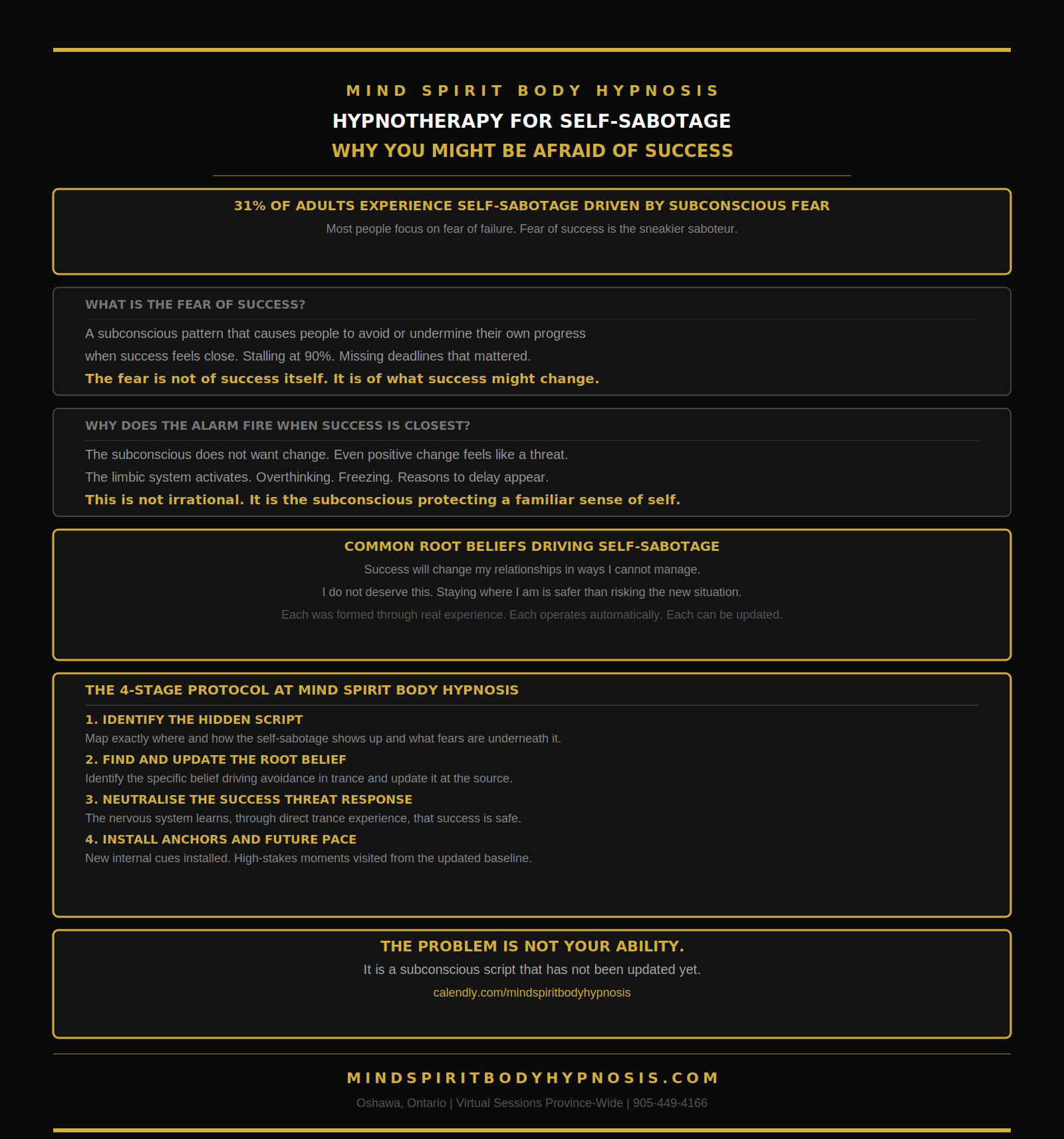
The fear of success is a subconscious pattern that causes people to avoid, delay, or undermine their own progress when success feels close.
It usually shows up in specific, recognizable ways. Setting goals that are slightly too small to be challenging. Finishing 90% of a project and then stalling on the final 10%. Saying yes to an opportunity and then doing nothing with it. Feeling inexplicably flat or anxious when something goes well.
The fear is not of success itself. It is of what success might bring. More responsibility. Higher expectations. More visibility. The possibility of being seen, judged, and found wanting at a higher level. The loss of the familiar, comfortable sense of who you are when you are still working toward something.
Some people also fear what others will think if they succeed. Will relationships change? Will people expect too much? Will they be able to sustain it?
The subconscious cannot distinguish between these feared outcomes and actual threats. So it treats success like danger. And when danger approaches, it creates avoidance.
For more on how self-sabotage patterns show up across different areas of life and how they are addressed at Mind Spirit Body Hypnosis, the confidence and self-sabotage pillar page covers the full range of work.
Why Do People Self-Sabotage at the Last Moment?
Because the subconscious fires an alarm exactly when success is closest.
Here is the mechanism. The subconscious does not want change. Even positive change. Change means moving away from the familiar, and the familiar, however uncomfortable, feels safe. The subconscious has spent years building a settled sense of who this person is, what their life looks like, and what they can expect.
When success threatens to change all of that, the subconscious fires the same alarm system it uses for genuine threats. The limbic system activates. Overthinking begins. The person finds themselves catastrophizing, doubting, freezing, or finding reasons to delay. This is not irrational. It is the subconscious doing exactly what it was designed to do: protect you from change.
The problem is that it cannot tell the difference between a change that would hurt you and a change that would help you. Both feel like the same category of threat: unfamiliar.
Research shows that 31% of adults experience this kind of fear-based self-sabotage. For many, it has been a lifelong pattern that has cost them opportunities, relationships, and the version of themselves they know they are capable of being.
What is self-sabotage?
What Does the Subconscious Have to Do With Self-Sabotage?
Everything. Self-sabotage is not a conscious choice. It is a subconscious programme running without awareness.
The subconscious stores beliefs built from experience. If early life taught you that visibility leads to criticism, the subconscious will avoid it. If you learned that standing out from your family or social group carries costs, the subconscious will quietly work to keep you in line with that group. If a painful consequence followed a past success, the subconscious may have connected the two and decided that success itself is risky.
These beliefs operate automatically. You do not decide to self-sabotage. The subconscious simply steers your behaviour toward the pattern it has stored. A deadline passes. An email goes unsent. A decision gets endlessly deferred. From the outside, it can look like laziness, carelessness, or lack of motivation. From the inside, it often feels like paralysis that makes no sense.
Hypnotherapy for self-sabotage in Ontario works at the level where these beliefs are stored and where they can actually be updated.
What Does Hypnotherapy Specifically Do for Self-Sabotage and Fear of Success?
As a Certified Hypnotherapist with ABH and NGH credentials and NLP training through ABNLP, working with clients across Durham Region and Ontario, I address fear of success and self-sabotage through a structured four-stage approach.
Stage 1: Identify the hidden script. In the first session, we map the specific shape of the self-sabotage for this person. What does it look like in practice? At what point does the pattern activate? What fears are present when the self-defeating behaviour occurs? What would success actually change, and which of those changes feel threatening? This clarity is essential. Generic self-help targets self-sabotage in general. Targeted hypnotherapy works with the specific script driving this person's specific pattern.
Stage 2: Find and update the root belief. In trance, the subconscious belief or beliefs driving the avoidance are identified and directly updated. Common root beliefs include: success will change my relationships, I do not deserve this, if I aim high and fail it will be worse, staying small is safer. Each of these is examined at its origin and updated with adult understanding and a more accurate assessment of the current situation.
Stage 3: Neutralize the success threat response. The alarm that fires when success approaches is directly recalibrated. In trance, the experience of being close to a goal, completing a project, or being recognized for something significant is visited from a position of calm rather than threat. The nervous system learns, through direct experience, that these situations are safe. The alarm does not need to fire.
Stage 4: Install new anchors and future pace. Positive anchors are installed: specific internal cues that trigger a sense of capability, readiness, and safety in the moments when the old pattern would have activated. Future situations are visited in trance from the new baseline. The final 10% of the project, the moment of sending the email, the conversation where you accept the opportunity: all visited and completed from the updated subconscious state.
Most people begin to notice meaningful shifts within two to six sessions, with some experiencing a recognizable change in the very first session.
What Do Sessions Look Like at Mind Spirit Body Hypnosis?
Every hypnotherapy for self-sabotage Ontario session at Mind Spirit Body Hypnosis is virtual, one-to-one, and tailored to the specific pattern for this person.
A typical programme:
Session 1: Mapping the pattern. A thorough conversation about where and how the self-sabotage shows up. No judgement. Just a precise map of the specific pattern and its triggers.
Sessions 2 and 3: Root belief work and success threat recalibration. Direct trance work on the hidden belief driving avoidance and the alarm response that fires when success feels close. New anchors installed.
Sessions 4 and 5: Future pacing and consolidation. Specific high-stakes situations visited in trance from the updated baseline. The new response is filed as expected. The old pattern loses its automatic quality.
In my practice, self-sabotage and fear of success work typically runs between three and five sessions. Many clients notice a meaningful shift within the first two. All sessions are virtual, available to clients aged 10 and older across Ontario. No referral is required. More about my credentials is on the about page.
For more on how the anxiety and nervous system activation that fuels self-sabotage is addressed, the hypnotherapy for anxiety and stress page covers those mechanisms.
Frequently Asked Questions
What is the difference between fear of failure and fear of success? Fear of failure causes people to avoid starting. Fear of success causes people to avoid finishing, or to finish and then find a way to undermine the outcome. Both are subconscious self-protection patterns. Fear of success is often harder to identify because it looks like carelessness, inconsistency, or bad luck rather than fear.
Why do I self-sabotage when I am close to achieving something? Because the subconscious fires an alarm when significant change approaches, even positive change. The familiar, however uncomfortable, feels safer than the unknown. The closer you get to success, the more the subconscious sees the change as threatening, and the more actively it works to prevent it.
Is self-sabotage a conscious choice? No. Self-sabotage is a subconscious automatic programme. The person does not decide to miss the deadline or avoid the opportunity. The subconscious simply steers behaviour in the direction that matches its stored belief, often without any conscious awareness that this is happening.
What kinds of beliefs drive self-sabotage? Common ones include: success will change my relationships in ways I cannot manage; I do not deserve this at this level; if I aim high and fall short, the failure will be worse; staying where I am is safer than risking the new situation. Each of these is formed through specific experience and operates automatically.
Does hypnotherapy actually work for self-sabotage? Yes. Hypnotherapy reaches the subconscious level where the self-defeating beliefs are stored and updates them directly. Most people begin to notice meaningful shifts within two to six sessions. The approach is specific to each person's pattern, not generic, which is why results tend to be more durable than willpower-based attempts.
How is hypnotherapy different from coaching for self-sabotage? Coaching typically works at the conscious level: setting goals, building accountability, and identifying conscious strategies. This is useful but does not reach the subconscious where the avoidance pattern lives. Hypnotherapy works directly at the subconscious level. The two approaches are complementary: many clients find coaching more effective once the subconscious block has been cleared.
How many sessions will I need? In my practice, this work typically runs three to five sessions, with meaningful shifts often noticeable within the first two. A specific honest estimate is always given in the free strategy session.
Can younger people be helped with self-sabotage patterns? Yes. I work with clients aged 10 and older. Self-sabotage patterns often develop early, particularly around academic performance and social situations, and addressing them before they become deeply entrenched tends to produce faster results.
Can I access sessions from anywhere in Ontario? Yes. All sessions are delivered virtually across Ontario, including Durham Region, Toronto, Ottawa, and beyond. No referral is required.
Ready to Take the Next Step?
If you keep getting close and then somehow not quite making it, the problem is not your ability. It is a subconscious script that has not been updated yet.
I offer a free 30-minute virtual strategy session for new clients across Ontario. No pressure. Just an honest conversation about the pattern and whether this approach can help break it.
WHAT MY CLIENTS SAY
“Working with Fanis has been such an incredible and, at times, surreal experience. After hitting what felt like rock bottom and losing myself to chronic pain, stress, and anxiety, I had become so accustomed to certain memories and experiences intruding on my daily life and influencing my emotions. They could creep into my mind unexpectedly and completely change how I felt in the moment, often sending me into a spiral before I even realized what was happening. What has been truly remarkable about working with Fanis is experiencing those same memories becoming completely neutralized. Things that once carried so much emotional weight no longer have the same power over me. I can think about them without being pulled back into the emotions associated with them. It’s difficult to put into words just how surreal it is to realize that something that once affected my day, my thoughts, and my emotions can now simply be a memory. Within just a couple of weeks of working together for one hour a week, I began noticing a profound shift. I felt more grounded, more in control of my emotions, and, most importantly, more like myself again. Fanis has given me an entirely different relationship with my past, and the freedom that has come from that has been incredibly meaningful. I’m genuinely grateful for the work we’ve done together and would wholeheartedly recommend Fanis to anyone who feels overwhelmed by the weight of their past, struggles with memories that continue to affect their everyday life, or simply feels like they’re carrying emotional weight that needs to be lifted.” — Karly B.
Book your free session: calendly.com/mindspiritbodyhypnosis
Call or text: 905-449-4166
Email: mindspiritbodyhypnosis@gmail.com
Visit: mindspiritbodyhypnosis.com
Serving clients virtually across Ontario, including Durham Region, Toronto, Canada, and beyond.
RECOMMENDED READING
Disclaimer: This article is for informational purposes only and does not constitute medical or psychological advice. Hypnotherapy, NLP, and EMDR are complementary approaches and are not a substitute for diagnosis or treatment by a qualified healthcare provider. Results vary by individual.
Written by Fanis Makrigiannis | Certified Hypnotherapist (ABH, NGH) and NLP Master Practitioner (ABNLP) | Mind Spirit Body Hypnosis, Oshawa, Ontario.