Can Hypnosis help stop procrastination?
Hypnotherapy for Procrastination in Ontario: Why You Cannot Just Push Through It
TL;DR: Procrastination is not a time management problem. Research from Carleton University in Canada confirms it is an emotional problem. You avoid the task because it has become linked to fear, shame, or overwhelm in the subconscious. Willpower fights the symptom. Hypnotherapy goes to the source. Chronic procrastination cuts daily productivity by 20 to 25%, and studies show hypnotherapy produces significant improvements in self-regulation and task initiation. Fanis Makrigiannis at Mind Spirit Body Hypnosis in Oshawa offers virtual hypnotherapy for procrastination Ontario sessions for clients aged 10 and older across the province.
Quick Answer
Hypnotherapy for procrastination Ontario is a subconscious approach that targets the emotional root of avoidance behaviour. It works with the fear, perfectionism, and overwhelm keeping you stuck, not the schedule. A 2023 study on hypnotherapy and therapeutic coaching found significant improvements in self-regulation, time management, and task initiation, with sustained results at follow-up. Research by Dr. Timothy Pychyl at Carleton University confirms that procrastination is fundamentally an emotional problem, not a time management one. Fanis Makrigiannis, a Certified Hypnotherapist (ABH, NGH) and NLP Master Practitioner (ABNLP) at Mind Spirit Body Hypnosis in Oshawa, Ontario, offers virtual sessions for clients aged 10 and older across Ontario. No referral is required.
Questions This Article Answers
Why does procrastination keep happening even when you genuinely want to stop?
Is procrastination really about laziness, or is something else going on?
What does the subconscious have to do with avoiding tasks?
What does hypnotherapy specifically do for procrastination?
How many sessions does it take to notice a real difference?
In this article:
Most people who struggle with procrastination have already tried to fix it. They have set timers. They have reorganized their schedule. They have read the productivity books. They have given themselves pep talks. And the next task arrives, and they still avoid it.
The frustration of this is real. You know what needs to be done. You know the cost of not doing it. And you still do not start.
In my practice in Oshawa, I see this pattern constantly. It is not a character flaw. It is a subconscious pattern. And like all subconscious patterns, it needs a different kind of work to change.
Why Pushing Through Procrastination Does Not Work
When you try to force yourself through procrastination, you are fighting a response that is older and faster than your thinking brain.
The task that feels so hard to start has been tagged by the subconscious as threatening. Maybe it is linked to fear of failure. Maybe it is tied to perfectionism. Maybe it is connected to a sense of not being capable enough, or a history of being criticized when things went wrong.
When that tag fires, the nervous system treats the task the same way it would treat a genuine threat. It creates avoidance. The email stays unopened. The project stays untouched. The phone comes out instead.
Willpower is being asked to override a survival response. That is an unequal fight. And it gets harder the longer the day goes on, and the more depleted your self-regulation resources become.
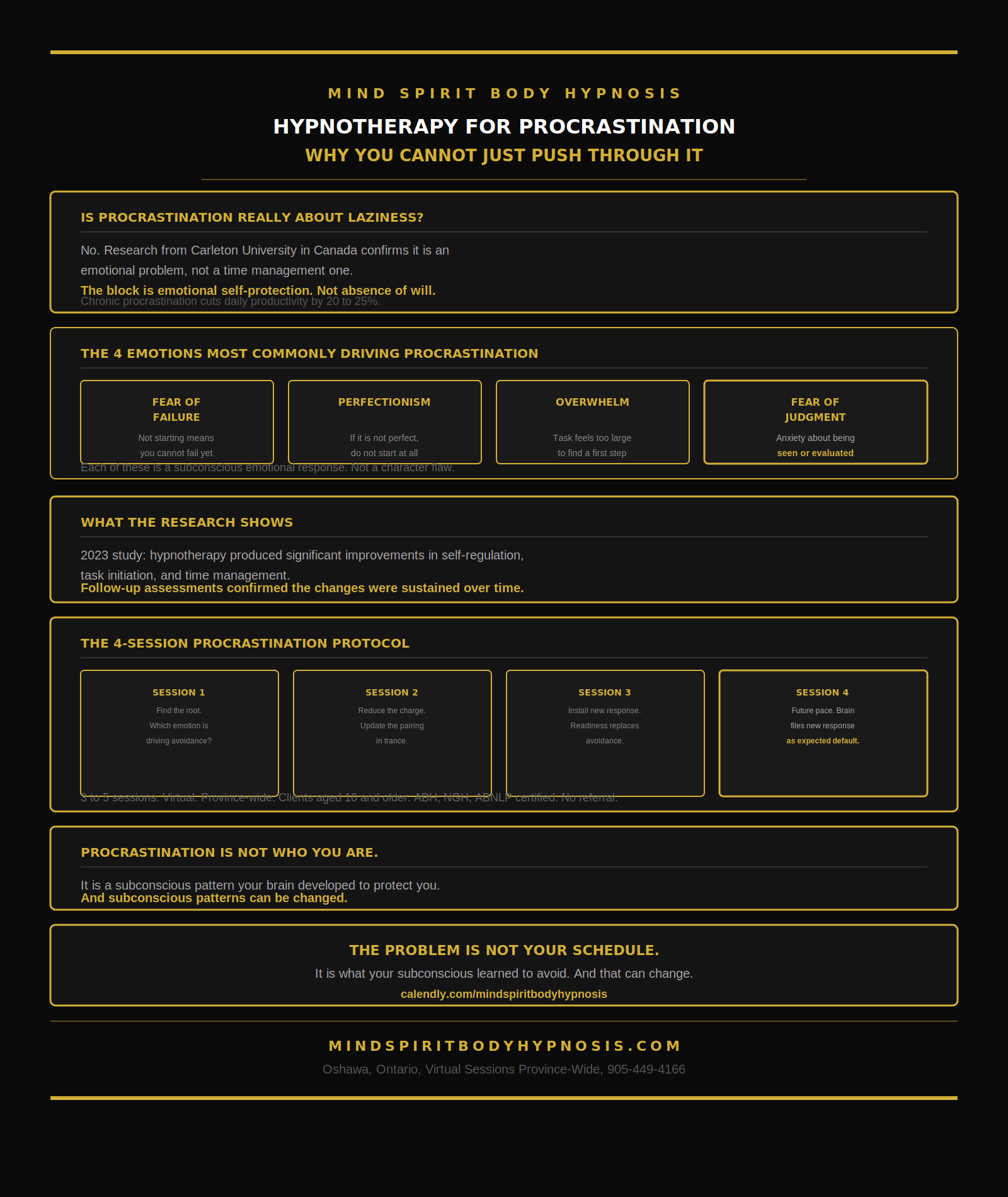
Chronic procrastination cuts daily productivity by 20 to 25%, and research links it to measurable harms across career, academic, and health outcomes. These are not the results of laziness. They are the results of a nervous system doing exactly what it was designed to do: protect you from something it has learned to associate with threat.
For more on how the anxiety and nervous system patterns that fuel procrastination are addressed at Mind Spirit Body Hypnosis, the hypnotherapy for anxiety and stress page explains the underlying mechanics.
Is Procrastination About Laziness?
No. This is one of the most important things to understand.
Research by Dr. Timothy Pychyl at Carleton University in Canada and Professor Fuschia Sirois from Durham University shows that procrastination is fundamentally an emotional problem, not a time management one.
People who procrastinate are not lazy. Most of them are actually quite motivated. They care about doing well. They are often very capable. The problem is that the task has become emotionally loaded. It is attached to a feeling they do not want to experience. So they avoid it, not out of laziness, but out of emotional self-protection.
The emotions most commonly driving procrastination are:
Fear of failure. If I do not start, I cannot fail. The task stays in a state of potential, where it is still possible that it could go well.
Perfectionism. If I cannot do it perfectly, I am better off not starting. Perfectionism is not high standards. It is the fear that anything less than perfect will expose something shameful.
Overwhelm. The task feels so large that starting anywhere feels pointless. The brain cannot find a clear first step, so it does not move.
Fear of judgment. The task involves being seen or evaluated. The anxiety about how it will be received is more uncomfortable than the discomfort of delay.
Each of these is an emotional response, not a time management failure. And emotional responses live in the subconscious.
What Does the Subconscious Have to Do With Procrastination?
Everything. The subconscious is where the avoidance pattern is stored and where it needs to be changed.
Think of the subconscious as the part of your brain that runs your automatic responses. It does not ask you to decide. It just fires. When you were learning to drive, every movement required conscious thought. Now you drive without thinking. That is the subconscious taking over a pattern.
Procrastination works the same way. At some point, a task was paired with an uncomfortable feeling. The subconscious learned: this type of task equals discomfort. Now, whenever that type of task appears, the avoidance response fires automatically. You reach for your phone before you even know you have done it.
Trying to change this with conscious effort is like trying to override muscle memory by deciding to change it. The decision is at the wrong level. The pattern is deeper.
Hypnotherapy reaches the subconscious level directly. In trance, the automatic pairing between the task and the uncomfortable feeling can be updated. The emotional charge is reduced. A new automatic response is installed in its place.
What Does Hypnotherapy Specifically Do for Procrastination?
As a Certified Hypnotherapist with ABH and NGH credentials and NLP training through ABNLP, working with clients across Durham Region and Ontario, I address procrastination through a clear, structured protocol.
Here is what I do, session by session:
Session 1: Find the root. We talk about when procrastination is worst, what tasks it hits hardest, and what the feeling is underneath the avoidance. This tells me exactly where the emotional charge is and what the subconscious has learned to protect you from.
Session 2: Reduce the emotional charge. In trance, the specific feeling linked to the task is directly addressed. The fear of failure, the perfectionism, the overwhelm. The subconscious association between this type of task and this uncomfortable feeling is updated. The task becomes more neutral. Starting it feels less like walking into danger.
Session 3: Install the new response. A new automatic response is put in place. Instead of avoidance, the trigger now fires a sense of readiness, curiosity, or simple willingness to begin. This is not manufactured enthusiasm. It is the removal of the block that was preventing natural engagement.
Session 4: Future pace and consolidate. We rehearse starting specific tasks from the new baseline. The brain files these rehearsals as expected experience. The new response becomes the default.
Studies on hypnotherapy for procrastination found significant improvements in self-regulation, time management, and task initiation, with follow-up assessments confirming the changes were sustained over time.
What Do Sessions Look Like at Mind Spirit Body Hypnosis?
Hypnotherapy for procrastination in Ontario at Mind Spirit Body Hypnosis is straightforward and works at a pace that suits you. Sessions are virtual, 60 to 90 minutes each, and delivered across Ontario via secure video.
You do not need to prepare anything special. You just need a quiet space and a comfortable place to sit. The first session is mostly conversation. I ask questions. You describe what the procrastination looks like in your daily life and what you want to feel different.
The trance work begins in session two. It is not dramatic. You stay aware throughout. You will remember the session. It feels like a very focused, deeply relaxed state of attention.
Most clients notice a shift within the first two or three sessions. Not a complete transformation overnight, but a different quality in how the avoided tasks feel. Less charged. Less threatening. More startable.
In my practice, procrastination work typically runs between three and five sessions. A specific honest estimate is always given in the free strategy session. All sessions are virtual, available to clients aged 10 and older across Ontario. No referral is required. More about my credentials is on the about page.
For more on how self-sabotage patterns like procrastination are addressed alongside confidence and self-worth work, the confidence and self-sabotage pillar page covers the full approach.

WHAT MY CLIENTS SAY
“I had a wonderful experience working with Fanis and his hypnosis program to help me work through anxiety, fears, and past traumas. The results have been incredibly positive. I felt comfortable, supported, and understood throughout the entire process and noticed a meaningful shift in how I feel and respond to things that once caused me anxiety. I am very grateful for the experience and would highly recommend Fanis and his services.” — Tracy D.
Frequently Asked Questions
Why do I keep procrastinating even when I genuinely want to stop? Because procrastination is a subconscious emotional response, not a conscious choice. The task has been paired with an uncomfortable feeling, and the avoidance fires automatically before conscious deliberation can engage. Wanting to stop operates at the conscious level. The pattern operates below it.
Is procrastination a sign of laziness? No. Research from Carleton University in Canada confirms procrastination is an emotional problem, not a motivation or time management one. Most people who procrastinate are highly capable and genuinely motivated. The block is emotional, not volitional.
What emotions most commonly drive procrastination? Fear of failure, perfectionism, overwhelm, and fear of judgment. Each of these is an emotional response stored in the subconscious. Each creates avoidance as a form of self-protection. Identifying which one is most active for you is the first step in the first session.
Does hypnotherapy actually work for procrastination? Yes. Studies show that hypnotherapy produces significant improvements in self-regulation, task initiation, and time management, with results sustained at follow-up assessments. When clients come to me specifically for hypnotherapy for procrastination in Ontario, they consistently describe the shift as different from anything willpower or productivity systems produced. Hypnosis reaches the subconscious level where the avoidance pattern is stored, which is why it can produce change that conscious effort alone does not.
How is hypnotherapy different from time management coaching? Time management coaching works at the level of systems, schedules, and conscious strategies. These are useful tools, but they do not address the emotional root of the avoidance. Hypnotherapy works at the subconscious level, reducing the emotional charge that is making the task feel threatening. Both can be useful. Hypnotherapy addresses the layer underneath.
Will I need to do anything between sessions? Not a lot. I may suggest a brief daily self-hypnosis practice of five to ten minutes. This reinforces the trance work between sessions and keeps the new response active. Most clients find this easy and notice it helps.
How many sessions will I need? In my practice, procrastination work typically runs three to five sessions. We provide a specific, honest estimate in our free 30-minute strategy session, with no commitment required.
Can younger people be helped with procrastination? Yes. I work with clients aged 10 and older. Procrastination patterns often develop early, particularly in academic settings, and addressing them before they become deeply entrenched tends to produce faster results.
Can I access sessions from anywhere in Ontario? Yes. All sessions are delivered virtually across Ontario, including Durham Region, Toronto, Canada, and beyond. No referral is required.
Ready to Take the Next Step?
If procrastination has been costing you more than time, the problem is not your schedule. It is what your subconscious learned to avoid. And that can change.
I offer a free 30-minute virtual strategy session for new clients across Ontario. No pressure. Just an honest conversation about what is keeping you stuck and whether this approach is the right fit.
Book your free session:calendly.com/mindspiritbodyhypnosis
Call or text:905-449-4166
Email:mindspiritbodyhypnosis@gmail.com
Visit:mindspiritbodyhypnosis.com
Serving clients virtually across Ontario, including Durham Region, Toronto, Canada, and beyond.
Disclaimer: This article is for informational purposes only and does not constitute medical or psychological advice. Hypnotherapy, NLP, and EMDR are complementary approaches and are not a substitute for diagnosis or treatment by a qualified healthcare provider. Results vary by individual.
Written by Fanis Makrigiannis | Certified Hypnotherapist (ABH, NGH) and NLP Master Practitioner (ABNLP) | Mind Spirit Body Hypnosis, Oshawa, Ontario.