Can hypnosis make you more confident?
Hypnotherapy for Confidence in Ontario: Why Telling Yourself to Be Confident Does Not Work
TL;DR: Real confidence does not come from positive thinking or willpower. It comes from what your subconscious believes about you. If the belief underneath says you are not good enough, telling yourself otherwise changes nothing. Hypnotherapy reaches the belief directly. A meta-analysis in the American Journal of Clinical Hypnosis found that hypnosis for self-esteem significantly boosts confidence. Fanis Makrigiannis at Mind Spirit Body Hypnosis in Oshawa, Ontario, offers virtual hypnotherapy for confidence Ontario sessions for clients aged 10 and older across the province.
Quick Answer
Hypnotherapy for confidence Ontario is a subconscious approach that replaces the deep beliefs keeping you stuck with something more accurate and more useful. The subconscious controls up to 90% of our beliefs and behaviours. This is why affirmations and pep talks rarely produce lasting change. A meta-analysis in the American Journal of Clinical Hypnosis found that hypnosis for self-esteem significantly boosts confidence, with most people needing three to ten sessions. Fanis Makrigiannis, a Certified Hypnotherapist (ABH, NGH) and NLP Master Practitioner (ABNLP) at Mind Spirit Body Hypnosis in Oshawa, Ontario, offers virtual sessions for clients aged 10 and older across Ontario. No referral is required.
Questions This Article Answers
Why does telling yourself to be more confident not work?
Where does low confidence actually come from?
What does hypnotherapy do that affirmations and willpower cannot?
What does a session look like for confidence work?
How many sessions does it take to notice a real shift?
In this article:
Most people who struggle with confidence have already tried to fix it. They have read the books. They have repeated the affirmations. They have told themselves they are capable, worthy, and enough. And the inner voice that says otherwise is still there.
This is not a failure of effort. It is a mismatch of levels.
You are trying to change something that lives in the subconscious by working on it from the conscious level. These two levels do not communicate the way we expect them to.
In my practice in Oshawa, I see this pattern constantly. Intelligent, capable people who cannot shake the feeling that they are not good enough. People who know, rationally, that the belief is not true. And yet the belief keeps running the show.
What is confidence?
Why Telling Yourself to Be Confident Does Not Work
Your conscious mind and your subconscious mind learn differently.
The conscious mind learns through logic. You hear a new idea. You evaluate it. If it makes sense, you accept it. This is how affirmations are supposed to work. You repeat a positive statement until you believe it.
The problem is that the subconscious does not learn this way. It learns through experience and emotion. It builds its beliefs by living through things, not by hearing things. And it is very resistant to being updated by the conscious mind alone.
Think of it like this. If you are afraid of dogs because you were badly bitten as a child, you know, logically, that not all dogs are dangerous. You can tell yourself this a thousand times. But the fear is still there when a dog runs toward you. The subconscious has not been updated. The knowledge does not reach the belief.
Low confidence works the same way. The belief was formed through experience. It needs a different kind of experience to change it. Not a better argument. A different felt reality.
For more on how the subconscious holds these patterns and how hypnotherapy reaches them, the confidence and self-sabotage pillar page covers the full picture.
Where Does Low Confidence Actually Come From?
Low confidence is not something you were born with. It is something you learned.
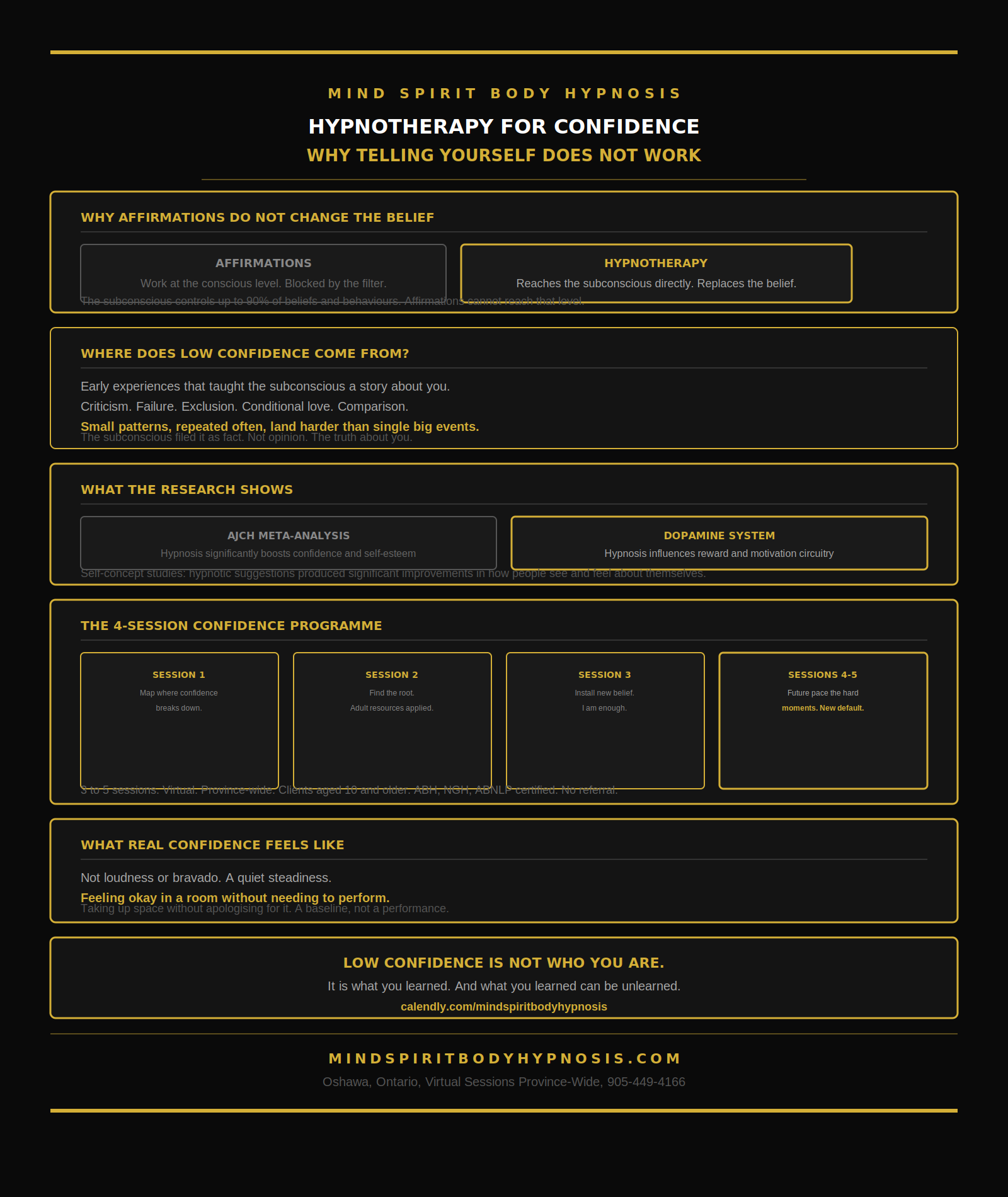
The subconscious built its model of you from your earliest experiences. If those experiences regularly told you that you were not good enough, not smart enough, not likeable enough, or not safe to take up space, the subconscious filed that as fact. Not as an opinion. As the truth about you.
These early lessons can come from many places. A parent who was critical more often than encouraging. A teacher who made you feel stupid in front of the class. Bullying. Being the outsider in a group. An early failure that left a big mark. A home environment where love felt conditional on performance.
None of these needed to be dramatic to leave a real impression. The subconscious is particularly sensitive to patterns. A small criticism, repeated often enough, can land harder than a single big event.
The result is a set of subconscious beliefs. Beliefs like: I am not as capable as other people. I will be found out. I do not deserve this. I am too much or not enough. These beliefs run quietly underneath daily life, shaping every decision, every interaction, and every moment when confidence would have been useful.
The good news is that beliefs formed through experience can be updated through experience. That is exactly what hypnotherapy provides.
What Does Hypnotherapy Do That Affirmations and Willpower Cannot?
In trance, the critical, analytical part of the mind becomes quieter. The subconscious becomes more open.
This matters because the critical part of the mind is what rejects positive change. It is the voice that hears "you are confident and capable" and immediately replies, "no, you are not; remember what happened last time." It acts as a filter. It keeps the old belief in place by blocking anything that contradicts it.
In the hypnotic state, this filter relaxes. The subconscious can receive new information directly. New beliefs can be installed, not just at the level of knowing but at the level of feeling. And when the feeling changes, the behaviour changes with it.
Research supports this clearly. Research cited in Choosing Therapy shows that hypnotherapy for confidence helps people reevaluate old belief systems and replace them with new habits and patterns, resulting in improved self-esteem and self-efficacy.
Research also shows that hypnosis can influence the brain's dopamine system, which is central to motivation and reward. Vividly imagining success during trance actually triggers a dopamine release. The brain starts to associate confident action with a feeling of reward. Over time, this creates a genuine positive feedback loop, not a forced one.
This is the key difference. Affirmations try to override the old belief through repetition. Hypnotherapy replaces the old belief at its root.
For more on how anxiety often travels alongside low confidence and how both are addressed together, the hypnotherapy for anxiety and stress page covers the connection.
What the Research Says
The evidence for hypnotherapy for confidence is strong and growing.
A meta-analysis in the American Journal of Clinical Hypnosis found that hypnosis for self-esteem significantly boosts confidence. Most people need three to ten sessions to experience results.
Studies on hypnotic suggestions for confidence found significant improvements in self-concept, which is how a person sees and feels about themselves. This is not just a temporary mood lift. Self-concept is a deep, stable belief. Changing it changes how a person shows up in every area of their life.
As a Certified Hypnotherapist with ABH and NGH credentials and NLP Master Practitioner training through ABNLP, working with clients across Durham Region and Ontario, I see this in practice. Clients who have struggled with confidence for years often describe a shift that feels different from what they expected. Not a sudden burst of bravado. A quieter, steadier sense of being okay. Of belonging in the room. Of not needing to shrink.
That is what real confidence feels like. And it is exactly what hypnotherapy for confidence Ontario is designed to help build, session by session, at the subconscious level where the belief actually lives.

What Do Sessions Look Like at Mind Spirit Body Hypnosis?
Hypnotherapy for confidence Ontario sessions at Mind Spirit Body Hypnosis follow a clear structure. Each session builds on the last. Nothing is rushed.
Here is what a typical programme looks like:
Session 1: Conversation and mapping. We talk about where the low confidence shows up most. What situations trigger it. What the inner critic says. What you want to feel instead. This shapes everything that follows.
Session 2: Finding the root. In trance, we look for the specific experiences that taught the subconscious its current story about you. We visit these experiences with adult understanding and resources, not as the child who was hurt by them. The meaning of those experiences begins to change.
Session 3: Installing the new belief. We work directly on replacing the old belief with something more accurate. Not "I am perfect" or "I am the best." Just: I am capable. I am allowed to be here. I am enough. These are installed at the felt, subconscious level, not just as ideas.
Sessions 4 and 5: Future pacing and consolidation. We visit the specific situations where confidence has been hardest: the presentation, the conversation, the moment of being seen. You experience them from the new baseline. The brain files these as expected experience. The new response becomes the default.
In my practice, confidence work typically runs between three and five sessions. Some people notice a shift within the first two. Others need more time, particularly if the roots go deep. A specific, honest estimate is always given in the free strategy session.
All sessions are virtual, available across Ontario, and open to clients aged 10 and older. No referral is required. More about my background is on the about page.
WHAT MY CLIENTS SAY
“A family member had worked with Fanis at Mind Spirit Body Hypnosis and told me he was unlike any therapist or coach he had ever worked with. I had been dealing with the aftermath of a difficult childhood: emotional neglect, instability, and the low confidence that comes from growing up feeling like you are never quite enough. I booked a session more out of curiosity than hope, honestly. What happened over the following weeks was something I can only describe as a quiet revolution inside me. Fanis helped me connect the dots between what had happened in my past and the way I had been showing up in my adult life, shrinking in rooms, apologizing constantly, assuming the worst about how others saw me. He worked through it layer by layer, with more patience and skill than I have encountered anywhere else. The confidence I have now is not performed or forced; it feels like it actually belongs to me. He also created a custom recording for me, awesome!” — Oboke A.
Frequently Asked Questions
Why does telling myself to be more confident not work? Because the belief that drives low confidence lives in the subconscious, and the subconscious does not update from conscious instruction alone. It updates from direct experience. Affirmations work at the conscious level. Hypnotherapy works at the subconscious level, where the belief is actually stored.
Where does low confidence come from? It comes from early experiences that taught the subconscious a particular story about you. Criticism, failure, exclusion, conditional love, or comparison. These experiences do not have to be dramatic to leave a lasting mark. The subconscious is especially sensitive to repeated patterns.
What does hypnotherapy do differently? In trance, the critical filter that blocks new positive beliefs relaxes. New beliefs can be installed at the felt, subconscious level rather than just the intellectual level. The brain's dopamine system responds to vivid positive imagery, creating a real neurological feedback loop, not just an idea.
Do I have to talk about painful past experiences? Not in detail. I map the pattern in the intake conversation, but you do not have to relive painful events. The work in trance approaches the root gently and from a position of safety.
Is hypnotherapy for confidence different from therapy for anxiety? They often overlap. Low confidence and anxiety frequently travel together. The confidence work addresses the subconscious belief layer. The anxiety work addresses the threat response. In my practice, both are often addressed in the same programme when they are both present.
What does real confidence feel like? Not loudness or bravado. More like a quiet steadiness. Feeling okay in a room without needing to perform. Being able to disagree without collapsing. Taking up space without apologizing for it. That is what the work builds toward.
How many sessions will I need? Confidence work typically runs three to five sessions in my practice. A specific, honest estimate is always given in the free strategy session, based on your particular situation.
Can younger people be helped with low confidence? Yes. I work with clients aged 10 and older. Confidence patterns often form early and are best addressed before they become deeply entrenched.
Can I access sessions from anywhere in Ontario? Yes. All sessions are delivered virtually across Ontario, including Durham Region, Toronto, Ottawa, and beyond. No referral is required.
Ready to Take the Next Step?
If you have been trying to build confidence from the outside in and it has not stuck, it may be time to work from the inside out.
I offer a free 30-minute virtual strategy session for new clients across Ontario. No pressure. Just an honest conversation about what you are experiencing and whether this approach might help.
Book your free session: calendly.com/mindspiritbodyhypnosis
Call or text: 905-449-4166
Email: mindspiritbodyhypnosis@gmail.com
Visit: mindspiritbodyhypnosis.com
Serving clients virtually across Ontario, including Durham Region, Toronto, Canada, and beyond.
Disclaimer: This article is for informational purposes only and does not constitute medical or psychological advice. Hypnotherapy, NLP, and EMDR are complementary approaches and are not a substitute for diagnosis or treatment by a qualified healthcare provider. Results vary by individual.
Written by Fanis Makrigiannis | Certified Hypnotherapist (ABH, NGH) and NLP Master Practitioner (ABNLP) | Mind Spirit Body Hypnosis, Oshawa, Ontario.