What to expect during a hypnosis session
What to Expect in Your First Hypnotherapy Session in Ontario
TL;DR: Most people arrive at their first hypnotherapy session nervous about things that will not happen. They will not lose control. They will not be made to do anything against their will. They will not get stuck in a trance. What actually happens is much simpler and much more comfortable than most people expect. This article walks through the five most common fears about a first hypnotherapy session in Ontario, and what actually occurs instead.
Quick Answer
A hypnotherapy session in Ontario at Mind Spirit Body Hypnosis has two parts. First, a conversation where I learn about you, what you want to change, and what matters to you. Second, the trance work itself, where I guide you into a deeply relaxed, focused state and we work with the subconscious patterns driving the issue. As Reachlink (2026) explains, most hypnotherapy sessions follow a four-stage structure: induction, deepening, therapeutic suggestion, and emergence. You stay aware and in control throughout. Studies have found that hypnosis is 93% effective within six sessions. Fanis Makrigiannis, a Certified Hypnotherapist (ABH, NGH) and NLP Master Practitioner (ABNLP) at Mind Spirit Body Hypnosis in Oshawa, Ontario, offers virtual sessions for clients aged 10 and older across Ontario. No referral is required.
Questions This Article Answers
Will I lose control or do something embarrassing during hypnosis?
What if I cannot be hypnotized?
Will the hypnotherapist be able to make me reveal secrets?
Will I remember the session afterwards?
What will I actually feel during the trance?
In this article:
The most common thing people say when they arrive for their first session is some version of "I'm not sure I can be hypnotized."
The second most common is "I'm a bit nervous."
Both are completely understandable. Most people's only reference point for hypnosis is what they have seen in movies or on stage. The swinging watch. The person clucking like a chicken. The idea that the hypnotist is somehow in control of your mind.
None of that is what happens in a clinical hypnotherapy session. Not even close.
In my practice in Oshawa, I spend time at the start of every first session addressing exactly what people are worried about. By the time the trance work begins, most people are surprised by how normal and calm the process feels.
Here is what you actually need to know.
The Five Biggest Fears and the Reality
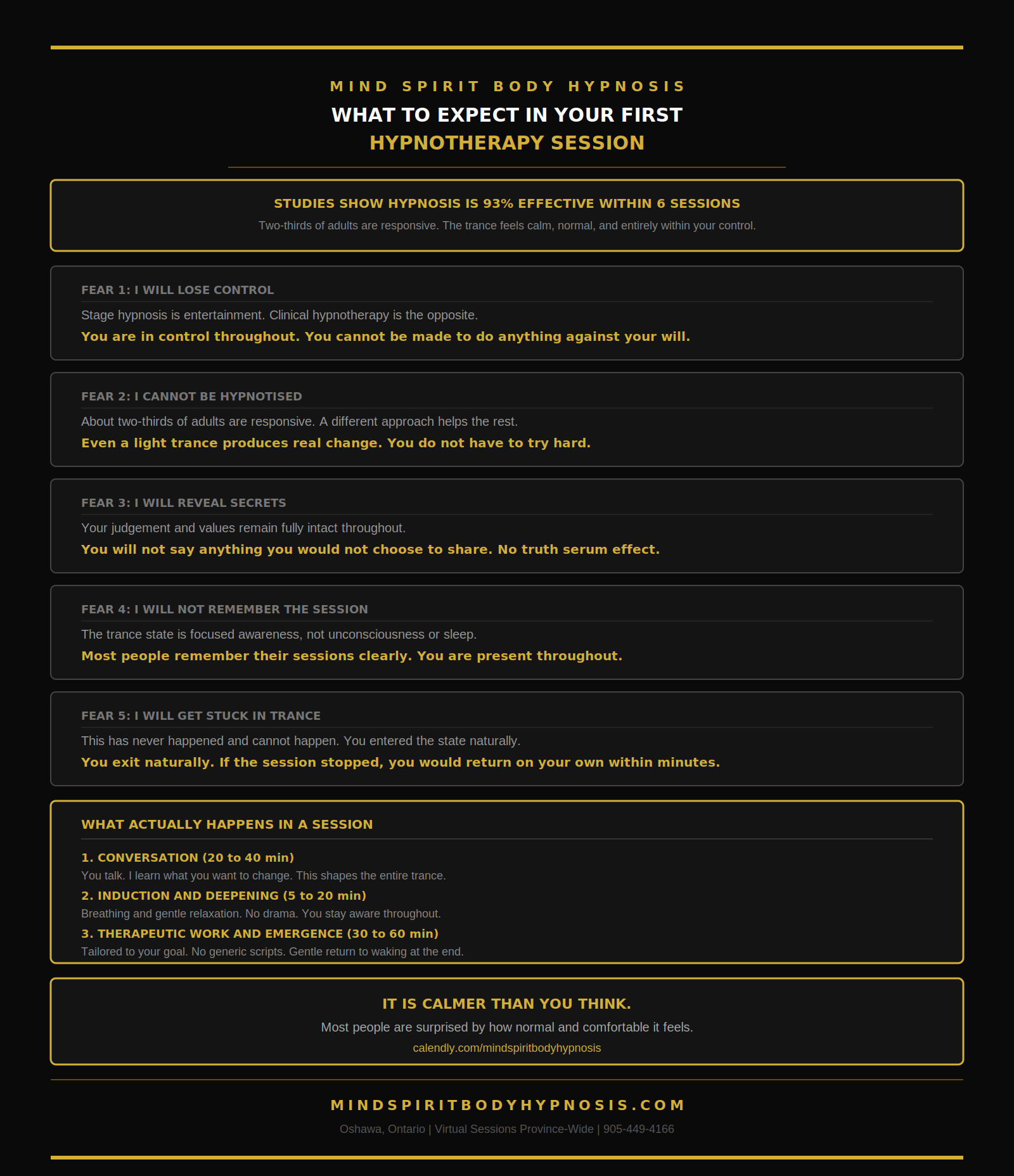
Fear 1: I will lose control and do embarrassing things.
This comes from stage hypnosis, which is entertainment. The people who cluck like chickens on stage have volunteered for a performance and chosen to play along. It has nothing to do with clinical hypnotherapy.
In a clinical session, you are in control the entire time. The trance state is simply a deeply relaxed, focused state of attention. You can speak, move, and open your eyes at any point. You cannot be made to do anything that goes against your values or your wishes. If I suggested something you were uncomfortable with, you would simply not follow it.
Think of it like being absorbed in a really good book. You are deeply focused. The outside world fades a little. But you are still fully yourself. If someone called your name loudly, you would respond immediately.
Fear 2: I cannot be hypnotized.
Research published in Time Magazine (2026) found that about two-thirds of adults are responsive to hypnosis. The remaining third are not unresponsive. They simply need a different induction approach. In my experience, almost everyone can reach a useful trance state if the approach is tailored to them. The people who find it hardest are often those who are trying too hard, which is easily addressed in the first session.
The trance state also does not need to be deep to be effective. Even a light state of focused relaxation produces measurable changes in how the subconscious receives new information.
Fear 3: The hypnotherapist will make me reveal secrets.
This cannot happen. In trance, you are not under anyone's control. Your own judgement and values remain fully intact. You will not say anything you would not choose to say in a normal conversation. There is no truth serum effect. The trance state simply makes the subconscious more receptive to helpful suggestions. It does not bypass your sense of what you want to share.
Fear 4: I will not remember the session.
Most people remember their sessions clearly. The trance state is focused awareness, not unconsciousness or sleep. You are present throughout. You may find that some parts feel more vivid than others, in the same way that some moments of a relaxing holiday stay with you more clearly than others. But amnesia is not a feature of a standard clinical session.
Fear 5: I will get stuck in the trance and not be able to come out.
This has never happened and cannot happen. The trance state is something you enter naturally and exit naturally. If I stopped speaking mid-session, you would simply drift toward normal wakefulness on your own within a few minutes. The emergence at the end of a session is gentle and gradual, but there is no possibility of becoming stuck.
For more on how hypnotherapy compares to other therapeutic approaches, the hypnotherapy for anxiety and stress page explains the mechanisms in plain language.
What is hypnotherapy?
What Actually Happens in a Session, Step by Step
Here is exactly what a first hypnotherapy session in Ontario at Mind Spirit Body Hypnosis looks like.
Part 1: The conversation
We talk. I ask about what has been bringing you to this point, what you have already tried, what the pattern looks like in daily life, and what you want to feel differently. This is not a clinical intake with a clipboard. It is a real conversation, and it shapes everything that follows.
The more specific you can be about what you want to change, the more precisely I can direct the trance work. Vague goals produce vague sessions. Specific goals produce specific change.
Part 2: Induction
I guide you into the trance state using a combination of focused breathing, directed attention, and progressive relaxation suggestions. This is gentler and less dramatic than most people expect. There is no swinging watch. There is no sudden sleep. It feels like settling into a very comfortable chair and allowing the mind to slow down.
Part 3: Deepening
Once you are in a relaxed, focused state, I deepen it slightly. This is where the critical, analytical part of the mind becomes quieter, and the subconscious becomes more open. You remain aware. The experience typically feels like a very peaceful, floaty calm.
Part 4: The therapeutic work
This is the core of the session. Using the map from the conversation, I work directly with the subconscious patterns relevant to your goal. Depending on the issue, this might involve imagery, direct suggestion, gentle exploration of past experiences, or NLP pattern interrupts. It is tailored to you specifically. There are no generic scripts.
Part 5: Emergence
I bring you back to full waking awareness gradually through a simple count-up and closing suggestions. Most people describe feeling calm, clear, and slightly surprised by how pleasant the experience was.
What the Trance State Actually Feels Like
The trance state is not what most people imagine. It is not dramatic. It does not feel like unconsciousness or sleep. It does not feel like being under someone's control.
Most people describe it as feeling like one of these:
The moments just before falling asleep, when the mind is relaxed but still aware
Being so absorbed in a book or film that the room around you fades slightly
A very deep, comfortable meditation where thoughts slow down naturally
A warm, floaty calm with a mild sense of physical heaviness
As MindBody7 (2026) puts it, clinical hypnotherapy is the opposite of stage hypnosis. You remain fully aware and in control throughout the entire experience.
One thing that surprises most people: they expected to feel hypnotized in some obvious way, and they did not. They just felt very calm and focused. That is the trance state. It is not a strange altered reality. It is a naturally occurring human state that most people enter briefly every day, just before sleep and just after waking.
As a Certified Hypnotherapist with ABH and NGH credentials and NLP Master Practitioner training through ABNLP, I tailor the induction approach to each client. Some people respond better to visual imagery. Others respond better to physical sensation focus. Others respond better to narrative. Knowing which approach works for you is part of what the first session establishes.
For more on what my approach looks like and what kinds of issues I work with, the about page has the full picture.
What to Do to Get the Most from Your Session
A good first session does not require much preparation. But a few simple things help.
Come with a specific goal. Not "I want to feel better." Something more like: "I want to be able to go to work on Monday without the anxiety hitting before I leave the house." The more specific the goal, the more precise the work.
Find a quiet, private space. For virtual sessions, this means a room where you will not be interrupted and where you feel comfortable. Headphones help significantly with audio quality and with the sense of the practitioner's voice being close.
Allow some time after the session. Build 15 to 20 minutes of quiet time into your schedule after the session ends. You will not need to rush. Returning to a demanding context immediately after a trance is not harmful, but easing out gradually is more comfortable and allows the work to settle.
Bring curiosity, not pressure. The most effective trance states come when a person approaches the session with relaxed openness rather than effortful trying. You do not have to try to be hypnotized. You just need to be willing to follow the guidance and allow the process to unfold.
What Sessions Look Like at Mind Spirit Body Hypnosis
Every hypnotherapy session in Ontario at Mind Spirit Body Hypnosis is delivered virtually via secure video. All sessions are one-to-one and tailored completely to the individual.
Sessions are available across Ontario for clients aged 10 and older. No referral is required.
Before your first paid session, I offer a free 30-minute virtual strategy session. This is a conversation, not a trance session. We talk about what you are hoping to work on, I explain my approach in detail, and we decide together whether hypnotherapy is the right fit for your specific situation. There is no pressure to book and no obligation.
As noted by Reachlink, the skill of your hypnotherapist matters enormously. Qualified practitioners adapt their techniques to your specific needs and measure progress over time. I hold certifications through the American Board of Hypnotherapy (ABH), the National Guild of Hypnotists (NGH), and the American Board of NLP (ABNLP). These are the three most recognized certification bodies in the field. All credentials are available for verification on request.
For more on how the confidence and self-worth patterns that often co-occur with anxiety and stress are addressed across sessions, the confidence and self-sabotage pillar page covers the full range.

WHAT MY CLIENTS SAY
“Geez, man! How do I possibly thank this guy enough! Fanis is one solid guy, did exactly what he said he would. My life felt like I was spinning, no confidence, no love, nothing! Now I feel amazing, working out, eating healthy and no more vaping! Damn Fanis you're the man!” — J.W.
Frequently Asked Questions
Will I lose control during hypnosis? No. The trance state is a deeply relaxed and focused awareness, not unconsciousness. You remain in control throughout. You cannot be made to do anything against your values or wishes. If a suggestion made you uncomfortable, you would simply not follow it.
What if I cannot be hypnotized? About two-thirds of adults are naturally responsive to hypnotherapy. For those who find it harder, a different induction approach often works well. The trance state does not need to be deep to be effective. Even a light state of focused relaxation produces real changes in how the subconscious receives new information.
Will the hypnotherapist be able to read my thoughts or make me reveal secrets? No. Your judgement and values remain fully intact throughout the session. You will not say anything you would not choose to say in a normal conversation. The trance state makes the subconscious more receptive to helpful suggestions. It does not bypass your own boundaries.
Will I remember the session? Most people remember their sessions clearly. The trance state is focused awareness, not sleep. You may find some parts feel more vivid than others, but amnesia is not a feature of standard clinical sessions.
What does the trance actually feel like? Most people describe it as similar to the moments just before falling asleep, a deep meditation, or being absorbed in a book. It is warm, calm, and gently floaty. Most people are surprised by how normal and pleasant it feels.
Can I get stuck in the trance? No. This has never happened and cannot happen. You entered the state naturally, and you exit it naturally. If the session stopped midway, you would return to normal wakefulness on your own within a few minutes.
How many sessions will I need? It depends on what you are working on. Habit change typically runs two to four sessions. Anxiety and confidence work typically runs three to five sessions. Complex patterns typically run four to six. A specific and honest estimate is always given in the free strategy session.
How do I prepare for my first session? Come with a specific goal. Find a quiet private space. Use headphones if possible. Allow some quiet time afterwards. And bring curiosity rather than pressure. The rest takes care of itself.
Can I access sessions from anywhere in Ontario? Yes. All sessions are delivered virtually across Ontario, including Durham Region, Toronto, Ottawa, and beyond. No referral is required.
Ready to Take the Next Step?
If you have been curious but held back by not knowing what to expect, now you know. It is calmer, more comfortable, and more interesting than most people anticipate.
I offer a free 30-minute virtual strategy session for new clients across Ontario. No trance work in this session. Just a conversation about what you want to work on and whether hypnotherapy is the right fit.
Book your free session: calendly.com/mindspiritbodyhypnosis
Call or text: 905-449-4166
Email: mindspiritbodyhypnosis@gmail.com
Visit: mindspiritbodyhypnosis.com
Serving clients virtually across Ontario, including Durham Region, Toronto, Canada, and beyond.
Disclaimer: This article is for informational purposes only and does not constitute medical or psychological advice. Hypnotherapy, NLP, and EMDR are complementary approaches and are not a substitute for diagnosis or treatment by a qualified healthcare provider. Results vary by individual.
Recommended reading
Written by Fanis Makrigiannis | Certified Hypnotherapist (ABH, NGH) and NLP Master Practitioner (ABNLP) | Mind Spirit Body Hypnosis, Oshawa, Ontario.