Does hypnosis for Anxiety really work? What the science says
Hypnotherapy for Anxiety in Ontario: Why Your Brain Gets Stuck and How to Break the Loop
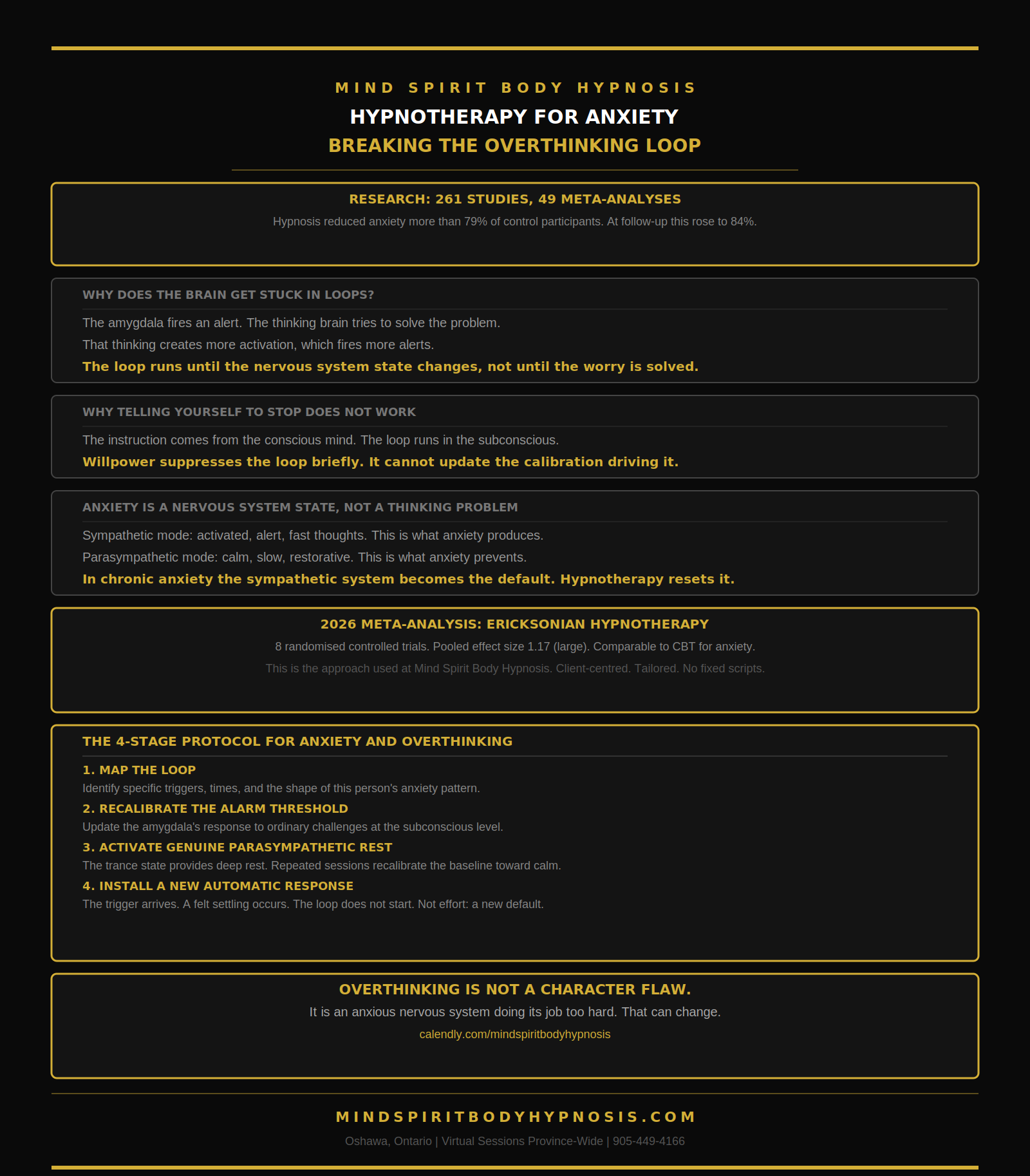
TL;DR: Overthinking is not a thinking problem. It is an anxiety problem. The brain gets stuck in loops not because you are analyzing things too carefully, but because the threat-detection system is running in the background and will not switch off. Hypnotherapy for anxiety in Ontario reaches this system directly. A meta-analysis of 261 studies and 49 reviews found that participants receiving hypnosis reduced their anxiety more than 79% of control participants, with that figure rising to 84% at follow-up. Fanis Makrigiannis at Mind Spirit Body Hypnosis in Oshawa offers virtual sessions for clients aged 10 and older across Ontario.
Quick Answer
Hypnotherapy for anxiety Ontario is a subconscious approach that works directly with the nervous system driving anxious overthinking, not just the thoughts themselves. Research across 261 studies and 49 meta-analyses found that participants receiving hypnosis reduced their anxiety more than 79% of control participants at the end of treatment, rising to 84% at follow-up. A January 2026 systematic review in MDPI Behavioural Sciences found Ericksonian hypnotherapy produced a large pooled effect size of 1.17 across eight randomized controlled trials. Fanis Makrigiannis, a Certified Hypnotherapist (ABH, NGH) and NLP Master Practitioner (ABNLP) at Mind Spirit Body Hypnosis in Oshawa, Ontario, offers virtual sessions for clients aged 10 and older across Ontario. No referral is required.
Questions This Article Answers
Why does the anxious mind get stuck in thought loops?
Why does telling yourself to stop overthinking not work?
What is the connection between anxiety and the nervous system?
What does hypnotherapy specifically do for overthinking and anxiety?
How many sessions does it take to notice a real difference?
In this article:
Most people who overthink are not doing it on purpose. They know they are doing it. They know it is not helping. They have told themselves to stop hundreds of times.
And the loop keeps running anyway.
In my practice in Oshawa, I see this pattern more than almost any other. Intelligent, self-aware people who cannot quiet the mind. People who lie awake at 2 am replaying conversations that happened three days ago. People who know, rationally, that the worry is out of proportion. And feel it anyway.
The problem is not the thinking. The problem is what is driving it.
Why Does the Brain Get Stuck in Overthinking Loops?
The anxious brain is not overthinking because it enjoys suffering. It is overthinking because the threat-detection system is running.
Here is what that means. The brain has a part called the amygdala. Think of it as the body's alarm system. Its job is to scan for danger. When it spots something that might be threatening, it fires an alert. The thinking brain then tries to work out what to do about it.
The problem is that the amygdala does not know the difference between a real physical threat and a worried thought. Both feel like danger to it. So when you start thinking about a difficult conversation, a deadline, or something that could go wrong, the amygdala fires. The thinking brain responds by trying harder to solve the problem. That thinking creates more activation in the amygdala. This fires more alerts. Which produces more thinking.
The loop does not switch off because the system that would switch it off, the parasympathetic nervous system, cannot get a foothold. The anxiety keeps the body just activated enough to prevent genuine rest or resolution.
Telling the loop to stop is like telling a car alarm to be quiet. The alarm is not running because it chose to. It is running because something triggered it. And the trigger has not been addressed.
For more on how the anxiety system works at the nervous system level and how it affects daily life, the hypnotherapy for anxiety and stress pillar page explains the full picture.
Why Does Telling Yourself to Stop Overthinking Not Work?
Because the instruction to stop comes from the conscious mind, and the loop is running in the subconscious.
The conscious mind is good at logic. It can evaluate a situation, identify a solution, and make a plan. But it is not the part of the mind running the anxiety loop. The loop is generated by the amygdala and the subconscious nervous system, which operate faster and more powerfully than conscious deliberation.
When you tell yourself to stop worrying, you are asking the conscious mind to override a subconscious alarm system. It sometimes works briefly. Then something triggers the alarm again and the loop restarts. This is why willpower-based approaches to overthinking produce temporary relief at best.
The same pattern shows up in almost every person I work with for anxiety. They have tried mindfulness, journalling, exercise, and breathing exercises. All of these are useful. All of them reduce the output of the anxiety loop for a while. None of them reach the subconscious level where the loop is generated.
This is the gap that hypnotherapy fills. It reaches the subconscious directly.
What anxiety feels like…
What Is the Connection Between Anxiety and the Nervous System?
Anxiety is not a thinking disorder. It is a nervous system state.
The nervous system has two main modes. The sympathetic system is the activated, alert state. Heart rate goes up. Breathing becomes faster. Muscles tighten. Thoughts speed up. This is the state anxiety produces and the state overthinking feeds.
The parasympathetic system is the rest-and-digest state. Heart rate slows. Breathing deepens. Muscles relax. The mind quiets. This is the state that recovery and genuine calm require.
In a person with chronic anxiety, the sympathetic system has become the default. The nervous system has learned, through repeated experience, that vigilance is required. It has calibrated itself to stay alert. Genuine parasympathetic rest becomes harder to access because the subconscious keeps pulling the system back toward alert.
This is not a character flaw. It is a learned nervous system state. And learned states can be updated.
The research confirms this. A review of 261 studies and 49 meta-analyses found that hypnosis reduced anxiety in more than 79% of control participants at the end of treatment, rising to 84% at follow-up, with effects increasing over time. This is why hypnotherapy for anxiety in Ontario continues to attract people who have tried other approaches and want something that reaches deeper.
What Does Hypnotherapy Specifically Do for Overthinking and Anxiety?
As a Certified Hypnotherapist with ABH and NGH credentials and NLP training through ABNLP, working with clients across Durham Region and Ontario, I address overthinking and anxiety through a structured four-stage approach.
Stage 1: Map the loop. In the first session, I build a precise map of this person's specific anxiety loop. What triggers it. What times of day it is worst. What the inner voice sounds like. What the feared outcome usually is. This map shapes every trance session that follows. Generic anxiety work produces generic results. Specific mapping produces specific change.
Stage 2: Recalibrate the alarm threshold. In trance, the amygdala's threat threshold is addressed directly. The situations and thoughts that are currently triggering a full alarm response are gently worked with at the subconscious level. The calibration is updated. Ordinary challenges stop registering as emergencies. The alarm fires less often and at lower intensity.
Stage 3: Activate genuine parasympathetic rest. The trance state itself is a deep parasympathetic experience. The nervous system accesses a quality of genuine rest that overthinking has been preventing. Repeated across sessions, this recalibrates the baseline. The nervous system learns that it is safe to settle. The default begins to shift from alert to calm.
Stage 4: Install a new automatic response. Instead of thought-loop-firing-more-anxiety, a different automatic response is installed. The trigger arrives. A brief felt sense of settling occurs. The loop does not start. This is not conscious effort. It is a new subconscious default.
A January 2026 meta-analysis of Ericksonian hypnotherapy across eight randomized controlled trials found a large pooled effect size of 1.17, with Ericksonian approaches showing comparable efficacy to CBT for anxiety-related outcomes. Ericksonian hypnotherapy is the approach I use. It is client-centred, indirect, and tailored specifically to each person rather than following a fixed script.
What Do Sessions Look Like at Mind Spirit Body Hypnosis?
Every hypnotherapy for anxiety Ontario session at Mind Spirit Body Hypnosis is virtual, one-to-one, and tailored to you. Here is what a typical programme looks like.
Session 1: Intake and loop mapping. We talk about your specific anxiety pattern. What triggers it, what it feels like in the body, how long it has been present, and what you want to feel differently. No pressure to describe everything at once. We build the map at the pace that feels right.
Sessions 2 and 3: Threshold recalibration and baseline work. Direct trance work on the subconscious alarm threshold and the nervous system baseline. Many clients notice a different quality to their evenings and sleep within these two sessions.
Sessions 4 and 5: New response installation and future pacing. The new automatic response is installed and consolidated. Specific triggering situations are visited in trance from the updated baseline. The brain files the calmer response as expected.
In my practice, anxiety and overthinking work typically runs between three and five sessions. Many clients notice meaningful shifts within the first two. All sessions are virtual, available to clients aged 10 and older across Ontario. No referral is required. More about my credentials and approach is on the about page.
For more on how confidence and self-worth patterns often travel alongside anxiety, the confidence and self-sabotage pillar page covers those dimensions.
Frequently Asked Questions
Why does my brain get stuck in thought loops? Because the anxiety threat-detection system (the amygdala) is running in the background. When a worried thought appears, it triggers the alarm system. The thinking brain tries to solve the problem. That thinking creates more activation. This fires more alerts. The loop runs until the underlying nervous system state changes, not until the problem is solved.
Why does telling myself to stop overthinking not work? Because the instruction to stop comes from the conscious mind, and the loop is running in the subconscious nervous system. Conscious effort can suppress the loop briefly. It cannot update the subconscious calibration driving it. That update requires direct subconscious work.
Is anxiety a thinking problem or a nervous system problem? It is primarily a nervous system problem. Anxiety is a state of sympathetic nervous system activation, not just a pattern of negative thinking. The thoughts are symptoms of the underlying state. Addressing the state directly produces more durable change than addressing the thoughts alone.
Does hypnotherapy actually reduce anxiety? Yes. Research across 261 studies and 49 meta-analyses found that participants receiving hypnosis reduced their anxiety more than 79% of control participants at the end of treatment, rising to 84% at follow-up. A 2026 meta-analysis of Ericksonian hypnotherapy found a large effect size of 1.17 across eight randomized controlled trials.
How is hypnotherapy different from mindfulness for anxiety? Mindfulness trains conscious attention to redirect away from the loop. This is useful and produces real relief. Hypnotherapy reaches the subconscious level where the loop is generated and directly updates the alarm threshold. The two approaches complement each other well. Many clients use both.
Will I need to talk about everything that makes me anxious? No. The first session maps the pattern, but you do not need to detail every worry or experience. The trance work operates at the level of the nervous system state rather than the content of specific thoughts. The less you have to describe, the more comfortable the process tends to be.
How many sessions will I need? In my practice, anxiety and overthinking work typically runs three to five sessions, with meaningful shifts often noticeable within the first two. A specific honest estimate is always given in the free 30-minute strategy session.
Can younger people be helped with anxiety and overthinking? Yes. I work with clients aged 10 and older. Anxiety patterns often establish early, and the approach is adapted appropriately for younger clients.
Can I access sessions from anywhere in Ontario? Yes. All sessions are delivered virtually across Ontario, including Durham Region, Toronto, Canada, and beyond. No referral is required.
Ready to Take the Next Step?
If the loop has been running for long enough, it is time to address what is driving it, not just manage what it produces.
I offer a free 30-minute virtual strategy session for new clients across Ontario. No pressure. Just an honest conversation about what the anxiety has been like and whether this approach is the right fit.
Book your free session:calendly.com/mindspiritbodyhypnosis
Call or text:905-449-4166
Email:mindspiritbodyhypnosis@gmail.com
Visit:mindspiritbodyhypnosis.com
Serving clients virtually across Ontario, including Durham Region, Toronto, Canada, and beyond.
Disclaimer: This article is for informational purposes only and does not constitute medical or psychological advice. Hypnotherapy, NLP, and EMDR are complementary approaches and are not a substitute for diagnosis or treatment by a qualified healthcare provider. Results vary by individual.
RECOMMENDED READING
Written by Fanis Makrigiannis | Certified Hypnotherapist (ABH, NGH) and NLP Master Practitioner (ABNLP) | Mind Spirit Body Hypnosis, Oshawa, Ontario.