Can Hypnosis Help me Stop Avoiding Social Situations?
Social Anxiety Hypnotherapy in Ontario: Why It Is Not Shyness and What Actually Helps
TL;DR: Social anxiety is not shyness. Shy people feel a little awkward in new situations. People with social anxiety experience something much more consuming: a constant internal focus on how they are being perceived, a near-certain expectation of negative judgment, and a body that fires the full stress response before a conversation even begins. Willpower and exposure alone rarely solve this because the subconscious has learned to treat social situations as genuinely dangerous. A 2025 study found hypnotherapy alters the attentional bias toward social threat at the neurological level. Fanis Makrigiannis at Mind Spirit Body Hypnosis in Oshawa offers virtual social anxiety hypnotherapy Ontario sessions for clients aged 10 and older across the province.
Quick Answer
Social anxiety hypnotherapy Ontario is a subconscious approach that addresses the attentional bias, the nervous system threat response, and the core beliefs driving the constant self-monitoring that makes social situations so exhausting. A 2025 event-related potential study published in the World Journal of Psychiatry found that hypnotherapy alters attentional bias toward social threat cues in ways directly relevant to social anxiety disorder. A meta-analysis published in the International Journal of Clinical and Experimental Hypnosis found large effect sizes for anxiety outcomes (Cohen's d > 0.8), with 90% of participants reporting high treatment satisfaction. Fanis Makrigiannis, a Certified Hypnotherapist (ABH, NGH) and NLP Master Practitioner (ABNLP) at Mind Spirit Body Hypnosis in Oshawa, Ontario, offers virtual sessions for clients aged 10 and older across Ontario. No referral is required.
Questions This Article Answers
What is the difference between shyness and social anxiety?
Why does the body react so strongly to ordinary social situations?
Why do people with social anxiety focus so intensely on how they are being perceived?
What does hypnotherapy specifically do for social anxiety?
How many sessions does it take to notice a real difference?
In this article:
Social anxiety is one of the most commonly misunderstood experiences people bring to my practice. It is often dismissed as shyness. Sometimes the person experiencing it dismisses it, telling themselves they just need to push through, force themselves into more social situations, and get over it.
Pushing through helps sometimes. It does not change the underlying pattern. And people with social anxiety often spend years forcing themselves through situations that feel like walking a tightrope, only to find that the anxiety is just as sharp the next time.
In Oshawa and across Ontario, I work with people across a wide range of social anxiety presentations. The pattern they describe is almost always the same. The social situation itself is not the problem. It is the constant monitoring of the self that the social situation triggers.
What Is Social Anxiety and How Is It Different From Shyness?
Shyness is a temperament. It is the tendency to feel a little hesitant or reserved in new or unfamiliar social situations. Shy people may take a moment to warm up. Once they do, they are comfortable. The hesitation fades. They stop thinking about themselves and engage with the situation.
Social anxiety is something different in kind, not just in degree.
A person with social anxiety does not just feel hesitant. They enter a social situation with an activated threat response. The body is already preparing for danger before anything has happened. The heart rate increases. The breathing becomes shallow. The mind narrows onto a specific question: how am I coming across right now?
That question does not stop. It runs as a constant background process throughout the social interaction. Every word is evaluated for how it might have sounded. Every silence is interpreted as evidence of failure. Every facial expression on the other person is scanned for signs of judgment or disapproval.
This is not overthinking in the ordinary sense. It is an automatic, subconscious process running underneath conscious awareness. The person is not choosing to do it. The subconscious threat system is doing it for them.
The cost is enormous. It takes enormous cognitive and emotional energy to be in a social situation while simultaneously monitoring every aspect of your own performance within it. People with social anxiety often find even brief social interactions genuinely exhausting. And over time, the exhaustion leads to avoidance. The situations that trigger the response get smaller and smaller. Life contracts around the anxiety.
For more on how the anxiety and nervous system mechanisms underlying social anxiety are addressed at Mind Spirit Body Hypnosis, the hypnotherapy for anxiety and stress page explains the foundational picture.
What is social anxiety?
Why Does the Body Treat Social Situations Like Genuine Threats?
Because the subconscious has learned, through experience, that social evaluation is dangerous.
The threat response is calibrated in early life. If the experience of being seen, judged, evaluated, or criticized in social situations was repeatedly associated with pain, shame, rejection, or humiliation, the subconscious files social evaluation itself as a threat category. It does not matter that the current situation involves friendly colleagues rather than a childhood classroom. The threat category fires automatically.
This calibration is not a flaw. It was a reasonable adaptation to the environment where it formed. The problem is that it is being applied to situations that do not warrant it. The amygdala scans the room, finds social attention, and fires the alarm. By the time the conscious mind arrives at the situation, the body is already in stress mode.
This is why telling yourself to calm down in a social situation rarely works. The alarm has already fired. The conscious instruction to calm down is working against a physiological state that has already been activated.
What is needed is not better conscious management of the response. It is an update to the subconscious calibration that is generating it.
What Is the Attentional Bias Problem?
Attentional bias is the tendency of the anxious mind to automatically prioritize threat-relevant information over neutral or positive information.
In social anxiety, this means that when scanning a room or a conversation, the anxious subconscious picks out frowns, silences, and signs of disinterest far more readily than smiles, engagement, or warmth. This is not a deliberate choice. It is the subconscious threat system doing its job: scanning for danger. And in social anxiety, other people's reactions are the source of perceived danger.
The result is that people with social anxiety often have an inaccurate read on how they are being received. They notice the one person in the room who looked disinterested. They miss the six who were engaged. Their subsequent belief that the interaction went badly is based on genuinely biased information, not a deliberate distortion.
A 2025 event-related potential study published in the World Journal of Psychiatry found that hypnotherapy measurably alters this attentional bias toward social threat cues. This is significant because it suggests hypnotherapy is not just producing subjective feelings of calm. It is changing the neurological processing of social information at a level below conscious awareness.
This is exactly the level where social anxiety lives. And it is precisely the level that social anxiety hypnotherapy in Ontario reaches.
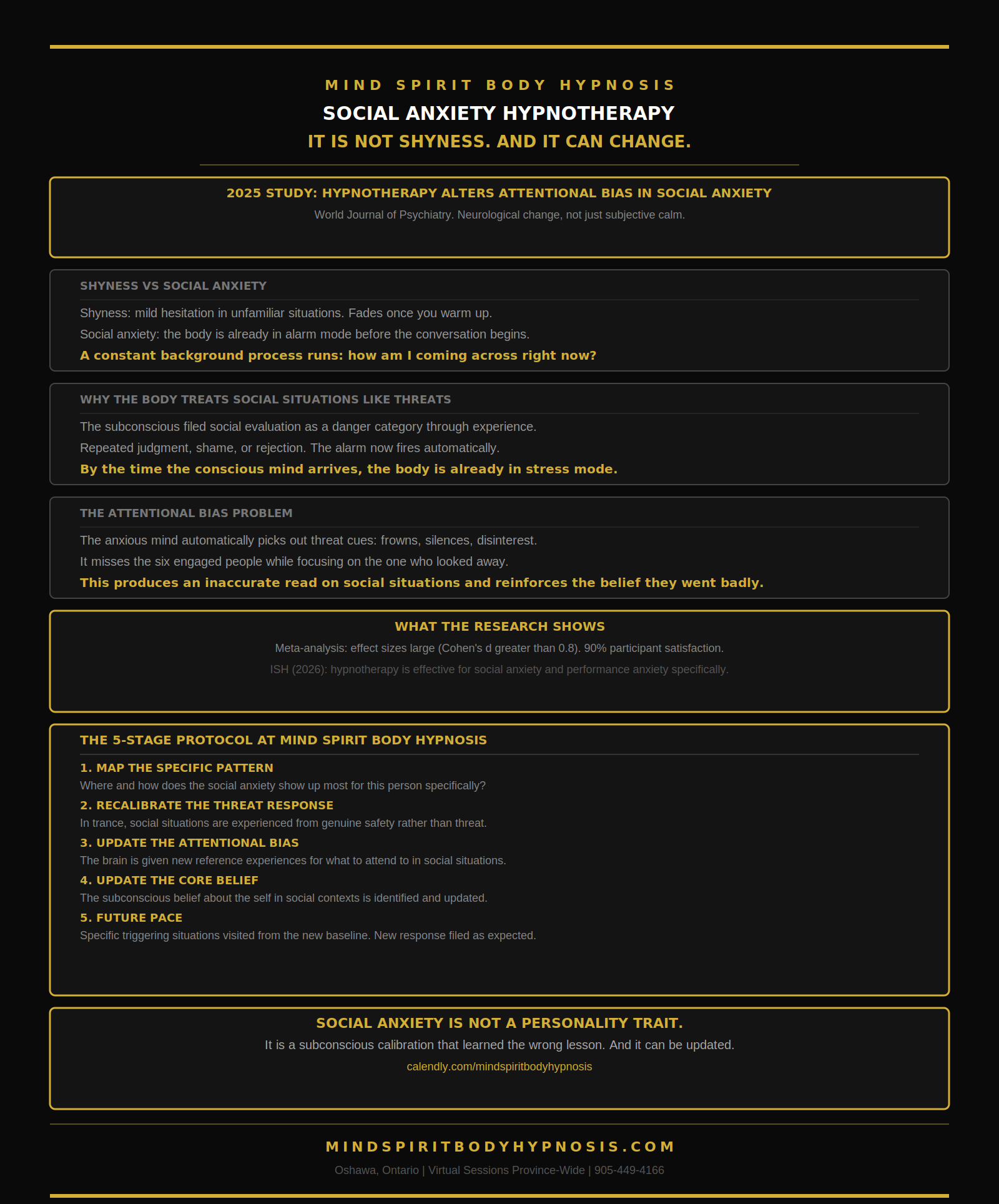
What Does Hypnotherapy Specifically Do for Social Anxiety?
As a Certified Hypnotherapist with ABH and NGH credentials and NLP training through ABNLP, working with clients across Durham Region and Ontario, I address social anxiety through a five-stage approach.
Stage 1: Map the specific pattern. Social anxiety is not the same for everyone. For some people, it is most active in one-to-one conversations. For others, it is group settings, public speaking, or being observed while doing ordinary tasks. In the first session, I build a precise map of where and how the pattern is most active for this person. This shapes everything that follows.
Stage 2: Recalibrate the threat response. In trance, the subconscious calibration that has been treating social evaluation as a threat category is directly updated. The specific situations that currently trigger the alarm are approached at the subconscious level and experienced from a position of genuine safety rather than threat. The body learns, through direct trance experience, that these situations do not require an emergency response.
Stage 3: Update the attentional bias. The subconscious scanning pattern is directly addressed. In trance, social situations are visited with attention guided toward neutral and positive social cues rather than threat cues. The brain is given new reference experiences for how social situations can feel and what information is worth attending to. This is not positive thinking. It is a direct neurological recalibration.
Stage 4: Update the core belief. Social anxiety is almost always underpinned by a core belief about the self in social contexts: I am being judged; I am less than others; my presence is burdensome; I will inevitably say the wrong thing. In trance, these beliefs are identified and updated directly. A more accurate and functional belief is installed at the subconscious level.
Stage 5: Future pace. Specific social situations that have previously triggered the strongest anxiety are visited in trance from the updated baseline. The brain files these rehearsals as expected experience. The new, calmer response is filed as the default rather than the aspirational.
A meta-analysis in the International Journal of Clinical and Experimental Hypnosis found large effect sizes (Cohen's d > 0.8) for hypnotherapy on anxiety outcomes, with 90% of participants reporting high treatment satisfaction. The International Society for Hypnosis (2026) confirms hypnotherapy is effective for social anxiety disorder and performance anxiety specifically.
What Do Sessions Look Like at Mind Spirit Body Hypnosis?
A typical programme for social anxiety hypnotherapy in Ontario at Mind Spirit Body Hypnosis:
Session 1: Mapping. A thorough conversation about the specific shape of the social anxiety for this person. No pressure to perform or explain. Just an honest description of where the anxiety shows up and what it feels like.
Sessions 2 and 3: Threat recalibration and attentional bias work. Direct trance work on the subconscious alarm threshold and the bias toward threat cues in social situations. Many clients notice a different quality in low-stakes social interactions within these two sessions.
Sessions 4 and 5: Core belief update and future pacing. The underlying belief about the self in social contexts is updated. Specific triggering situations are visited from the new baseline and filed as expected experience.
In my practice, social anxiety work typically runs between three and five sessions. All sessions are virtual, available to clients aged 10 and older across Ontario. No referral is required. More about my approach and credentials is on the about page.
For more on how confidence and self-worth patterns that travel alongside social anxiety are addressed, the confidence and self-sabotage pillar page covers those dimensions.
WHAT MY CLIENTS SAY
“Fanis is excellent at what he does. He knows the right words and what you need to heal and move forward freely in life. I initially experienced major ups and downs throughout my journey but Fanis was always just an email away. He is very caring and truly puts so much of his time and effort just to see the best in you. At times I gave up on my journey but Fanis never did. I felt comfortable and open to sharing even my deepest secrets. He makes you feel comfortable enough to completely be yourself without any judgments. I am so grateful for this experience.” — Bella K.
Frequently Asked Questions
What is the difference between shyness and social anxiety? Shyness is a temperament: mild hesitation in unfamiliar situations that fades once the person warms up. Social anxiety is a subconscious threat response: the body activates a stress alarm before social situations begin, and a constant self-monitoring process runs throughout them. It is different in kind, not just in degree.
Why does my body react so strongly to ordinary social situations? Because the subconscious threat system has been calibrated to treat social evaluation as a danger category. This calibration is typically formed through repeated experiences of judgment, shame, rejection, or humiliation. The alarm now fires automatically in any situation that resembles those experiences, regardless of whether the current situation is actually threatening.
What is attentional bias and why does it matter for social anxiety? Attentional bias is the automatic tendency to scan for and prioritize threat-relevant information. In social anxiety, the mind picks out signs of disinterest, disapproval, or judgment more readily than signs of engagement or warmth. This produces an inaccurate read on social situations and reinforces the belief that they went badly. A 2025 study found hypnotherapy measurably alters this bias at the neurological level.
Can hypnotherapy actually help with social anxiety? Yes. A 2025 study found hypnotherapy alters attentional bias toward social threat cues at the neurological level. A meta-analysis found large effect sizes (Cohen's d > 0.8) for hypnotherapy on anxiety outcomes, with 90% of participants reporting high satisfaction. The International Society for Hypnosis (2026) identifies social anxiety disorder as a specific area where hypnotherapy demonstrates effectiveness.
Will I have to talk in detail about embarrassing social situations? No. The intake conversation maps the pattern and its triggers. You do not need to relive specific embarrassing memories in detail. The trance work approaches these experiences gently and from a position of safety, not from inside the activated anxiety response.
How is hypnotherapy different from CBT for social anxiety? CBT works at the conscious level: identifying thoughts, challenging them, and building behavioural strategies. This is useful and produces real results. Hypnotherapy works at the subconscious level, updating the threat calibration, attentional bias, and core beliefs that CBT works alongside but does not directly access. The approaches complement each other well.
How many sessions will I need? In my practice, social anxiety work typically runs three to five sessions, with many clients noticing meaningful shifts in lower-stakes social situations within the first two. A specific honest estimate is always given in the free strategy session.
Can younger people be helped with social anxiety? Yes. I work with clients aged 10 and older. Social anxiety often begins in adolescence, and addressing it early, before avoidance patterns become deeply entrenched, tends to produce faster and more durable results.
Can I access sessions from anywhere in Ontario? Yes. All sessions are delivered virtually across Ontario, including Durham Region, Toronto, Ottawa, and beyond. No referral is required.
Ready to Take the Next Step?
If social situations have been costing you more energy than they should, and you have been pushing through without the underlying pattern changing, it may be time to address what is driving it.
I offer a free 30-minute virtual strategy session for new clients across Ontario. No pressure. Just a conversation about what social anxiety has been like for you and whether this approach is the right fit.
Book your free session: calendly.com/mindspiritbodyhypnosis
Call or text: 905-449-4166
Email: mindspiritbodyhypnosis@gmail.com
Visit: mindspiritbodyhypnosis.com
RECOMMENDED READING
Serving clients virtually across Ontario, including Durham Region, Toronto, Canada, and beyond.
Disclaimer: This article is for informational purposes only and does not constitute medical or psychological advice. Hypnotherapy, NLP, and EMDR are complementary approaches and are not a substitute for diagnosis or treatment by a qualified healthcare provider. Results vary by individual.
Written by Fanis Makrigiannis | Certified Hypnotherapist (ABH, NGH) and NLP Master Practitioner (ABNLP) | Mind Spirit Body Hypnosis, Oshawa, Ontario.