Why can’t I stop buying things online? Understanding the Root cause
Hypnotherapy for Shopping Addiction in Ontario: When Spending Stops Being a Choice
TL;DR: Compulsive shopping is not a money problem. It is an emotional and subconscious habit loop. The purchase gives temporary relief from stress, boredom, or emotional pain. Then comes guilt. Then comes more spending to manage the guilt. Research shows that approximately 5 to 8% of the population experiences compulsive buying disorder, and the rise of one-click purchasing and buy-now-pay-later apps has made the habit easier to spiral and harder to break. Hypnotherapy for shopping addiction in Ontario addresses the emotional root of the pattern at the subconscious level, where willpower and budgeting apps cannot reach. Fanis Makrigiannis at Mind Spirit Body Hypnosis in Oshawa offers virtual sessions for clients aged 10 and older across Ontario.
Quick Answer
Hypnotherapy for shopping addiction Ontario is a subconscious approach that works with the emotional triggers, reward loop, and identity patterns driving compulsive spending behaviour. Research from the University of Iowa found that approximately 5 to 8% of the worldwide population suffers from compulsive buying disorder, with a lifetime prevalence of 5.8% in the US general population. A 2025 study published in Frontiers in Psychiatry confirmed that online shopping exhibits the hallmarks of behavioural addiction, including hedonic reward, loss of control, and continued use despite harm. Fanis Makrigiannis, a Certified Hypnotherapist (ABH, NGH) and NLP Master Practitioner (ABNLP) at Mind Spirit Body Hypnosis in Oshawa, Ontario, offers virtual sessions for clients aged 10 and older across Ontario. No referral is required.
Questions This Article Answers
Is compulsive shopping a real addiction or just a bad habit?
What emotions are actually driving the spending?
Why do budgeting apps and willpower not work for this?
What does hypnotherapy specifically do for compulsive shopping?
How many sessions does it take to notice a shift?
In this article:
Most people who struggle with compulsive spending do not think of themselves as addicts. They think of themselves as someone who needs to do better with money. Someone who needs more discipline. Someone who knows what they are doing and keeps doing it anyway.
That last part is the tell. When you know exactly what is happening, genuinely want it to stop, and cannot make it stop, that is not a discipline problem. That is a subconscious pattern.
In my practice in Oshawa, I see this more often than people would expect. It is one of the habits people feel most ashamed to bring up. They have not told their partner. They have moved packages to avoid questions. They have opened new cards and hidden statements. Not because they are dishonest people. Because the pattern has taken on a life of its own.
The shame is part of what keeps the loop running. And shame responds very well to the right kind of work.
Online shopping addiction explained!
Is Compulsive Shopping Actually an Addiction?
Yes. The research is detailed.
A 2025 study published in Frontiers in Psychiatry found that online shopping now exhibits all the hallmarks of behavioural addiction. Hedonic reward: the dopamine hit of finding something, adding it to the cart, and completing the purchase. Loss of control: spending more than intended, more often than intended, despite genuine attempts to stop. Continued use despite harm: debt, relationship conflict, and persistent guilt that does not prevent the next purchase.
The brain's reward system does not distinguish between a chemical substance and a pleasurable behaviour. Both produce dopamine. Both create tolerance, meaning more is needed over time for the same relief. Both produce withdrawal-like discomfort when the behaviour is stopped. And both respond well to approaches that work directly with the subconscious, where the reward loop is stored.
Research from the University of Iowa found that approximately 5 to 8% of the worldwide population experiences compulsive buying disorder. The rise of one-click purchasing, mobile shopping apps, and buy-now-pay-later services has widened access and shortened the gap between impulse and purchase. A 2026 review found that BNPL services are directly linked with impulse buying and post-purchase regret, particularly among younger adults.
For more on how behavioural addictions are addressed at the subconscious level at Mind Spirit Body Hypnosis, the hypnotherapy for anxiety and stress page covers the nervous system dimension of habit loops. Clients looking specifically for hypnotherapy for shopping addiction Ontario often come to that page first before booking their strategy session.
What Emotions Are Actually Driving the Spending?
The purchase is rarely about the item. It is about the feeling the purchase produces, and the feeling it temporarily relieves.
Compulsive shopping is most commonly driven by one or more of the following emotional states.
Stress and overwhelm. The shopping experience narrows attention, produces a short-term sense of control and reward, and temporarily relieves the weight of whatever is pressing on the person. The relief is real. It just does not last.
Boredom and emptiness. The scroll, the search, the add-to-cart, and the checkout produce stimulation and a sense of forward motion. For people who feel flat, empty, or disconnected, this can be one of the few reliable ways to feel something. The dopamine hit fills a gap that has not been addressed at its source.
Low self-worth. For some people, the purchase is an attempt to feel better about themselves. A new item represents a version of the self they want to inhabit. This is why so many compulsive shoppers report that the relief evaporates the moment the item arrives. The item was never the point. The feeling of being the kind of person who has that item was.
Reward and self-soothing. After a hard day, a difficult week, or an uncomfortable experience, spending can feel like the only available form of self-care. Many people have never developed alternative ways to reward or comfort themselves.
Anxiety and control. For some, the act of acquiring things, of having and holding and owning, provides a temporary sense of security in a life that feels uncertain or out of control.
Each of these is an emotional driver, not a financial one. And emotional drivers are not addressed by tracking spending in an app.
Why Do Willpower and Budgeting Not Work?
Because both operate at the conscious level, and compulsive shopping is a subconscious pattern.
The budgeting app knows what you spent. The conscious mind knows it was too much. And the next time the emotional trigger fires, the subconscious produces the familiar response before deliberate thought can engage. The phone is in the hand, and the checkout is complete before the thinking mind has fully arrived at the situation.
Willpower can interrupt this loop temporarily. But willpower is a finite resource. It depletes with fatigue, stress, emotional difficulty, and anything else competing for cognitive resources. The moment the person is tired, overwhelmed, or emotionally depleted, the willpower that was holding the pattern in check runs out. And the pattern returns.
This is not a character failure. It is the predictable result of trying to manage a subconscious habit using conscious tools.
What is needed is direct work at the level where the habit lives.
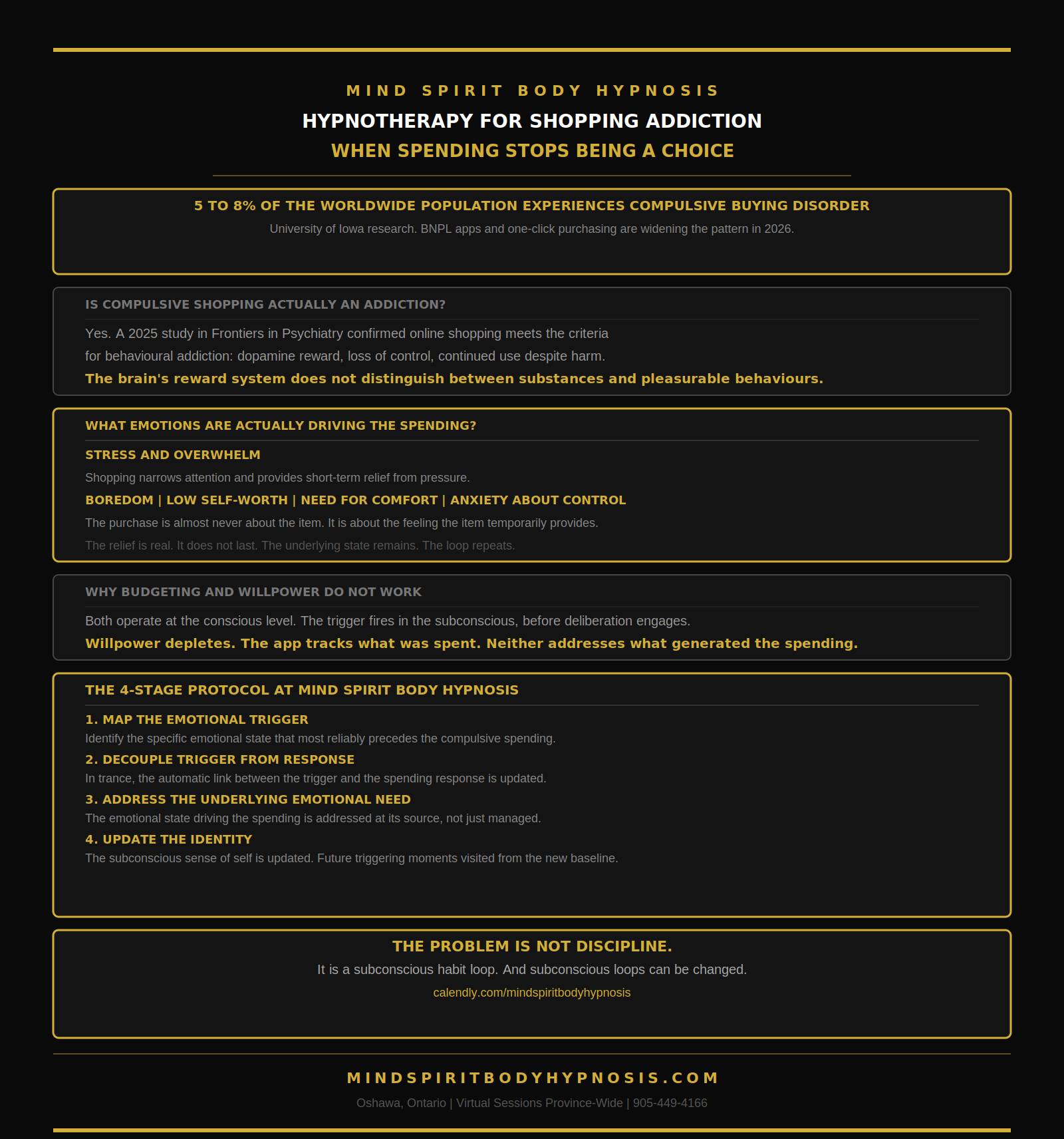
What Does Hypnotherapy Specifically Do for Compulsive Shopping?
As a Certified Hypnotherapist with ABH and NGH credentials and NLP training through ABNLP, working with clients across Durham Region and Ontario, I address compulsive shopping through a structured four-stage approach.
Stage 1: Map the emotional trigger. In the first session, we identify the specific emotional states that most reliably precede compulsive spending for this person. Is it stress? Boredom? A particular time of day? A particular feeling in the body? A specific type of social situation? This map is precise. The trance work that follows is built directly around it.
Stage 2: Decouple the trigger from the response. In trance, the automatic link between the identified emotional state and the shopping response is directly addressed. The subconscious learns to meet the underlying need (relief from stress, stimulation, comfort, self-worth) through a response that does not create debt and shame. The trigger still arrives. The automatic response changes.
Stage 3: Address the underlying emotional need. The emotional state driving the spending is addressed at its source. Stress patterns, low self-worth, boredom tolerance, and the capacity for genuine self-soothing are all worked on directly in trance. The goal is not just to stop the spending. It is to make the spending unnecessary because the underlying need is being met differently.
Stage 4: Update the identity. Many people who compulsively shop have a settled subconscious identity around it. The person who treats themselves. The person who always has something new. The person who rewards hard work this way. In trance, this identity is updated to one that is grounded in genuine self-respect rather than external acquisition. Future situations are visited from the new baseline.
What Do Sessions Look Like at Mind Spirit Body Hypnosis?
Hypnotherapy for shopping addiction Ontario sessions at Mind Spirit Body Hypnosis are private, non-judgmental, and virtual. You do not have to share account balances or describe every purchase. The focus is on the emotional pattern, not the financial ledger.
A typical programme:
Session 1: Mapping. A thorough conversation about the shape of the pattern for you specifically. When it happens, what triggers it, how it feels before and after, and what you want to feel differently.
Sessions 2 and 3: Trigger decoupling and emotional need work. Direct trance work on the emotional states driving the spending and the subconscious link between them and the shopping response.
Sessions 4 and 5: Identity update and future pacing. The new subconscious sense of self is installed. High-risk moments (the stress spike, the boredom, the late-night scroll) are visited from the updated baseline.
In my practice, compulsive shopping work typically runs three to five sessions. All sessions are virtual, available to clients aged 10 and older across Ontario. No referral is required. More about my credentials is on the about page.
For more on how self-worth and identity patterns that often underlie compulsive spending are addressed, the confidence and self-sabotage pillar page covers that dimension directly.
WHAT MY CLIENTS SAY
“Weekly sessions with Fanis helped me uncover the underlying roots of my addictive behaviours — patterns that had been buried deep within my unconscious mind. Through this process, I began to understand that the emotional baggage I had carried throughout childhood, which once served as a protection mechanism, was now, in fact, harming my emotional and physical well-being. Uncovering my true self beyond the invisible boundaries I had created for myself allowed my psyche to begin healing through inner reflection, greater self-awareness, and intentional self-care. Equipped with positive meditation techniques and a deeper awareness of my emotional triggers, I learned to recognize and overcome the emotional pulls that once controlled me. This enabled me to regain control over negative influences and begin deconstructing the outdated and unwanted limiting beliefs that had shaped my thoughts and behaviours. Fanis, while I do miss our weekly interaction, I am ever so grateful for the guidance, patience and understanding to rewire my internal thoughts and belief system. It’s okay to say no thank you and stand firm on your boundaries.” — Tanya Z
Frequently Asked Questions
Is compulsive shopping a real addiction or just a bad habit? It is a recognized behavioural addiction with the same neurological hallmarks as substance addiction: dopamine-driven reward, tolerance, loss of control, and continued use despite harm. A 2025 study in Frontiers in Psychiatry confirmed that online shopping meets the criteria for behavioural addiction. Approximately 5 to 8% of the worldwide population is estimated to experience compulsive buying disorder.
What emotions most commonly drive compulsive spending? Stress, overwhelm, boredom, low self-worth, the need for comfort or reward, and control anxiety. The purchase provides temporary relief from each of these. The relief is real and short-lived. The underlying emotional state remains and drives the next purchase.
Why does budgeting not solve the problem? Because budgeting addresses the financial output, not the emotional input. The trigger is still firing. The subconscious response is still automatic. Tracking what was spent does not update the habit loop generating the spending.
Does hypnotherapy work for shopping addiction? Yes. Hypnotherapy reaches the subconscious level where the habit loop is stored, addresses the emotional states driving the spending, and installs a new automatic response to the triggers that previously led to compulsive purchasing. The approach is the same as for any other behavioural addiction at the subconscious level.
Do I have to disclose how much I have spent? No. Sessions are private and non-judgmental. We work with the emotional pattern, not the financial details. You do not need to share account statements, debt amounts, or specific purchase histories.
How is hypnotherapy different from CBT for shopping addiction? CBT works at the conscious level: identifying thoughts, challenging beliefs, and building behavioural strategies. This is useful and can produce real results. Hypnotherapy works at the subconscious level, reaching the automatic reward loop and the underlying emotional need directly. The two approaches complement each other well.
How many sessions will I need? In my practice, this work typically runs three to five sessions. I always give a specific, honest estimate in the free 30-minute strategy session, with no commitment required.
Can I access sessions from anywhere in Ontario? Yes. All sessions are delivered virtually across Ontario, including Durham Region, Toronto, Canada, and beyond. No referral is required.
Ready to Take the Next Step?
If spending has stopped feeling like a choice, the problem isn't discipline. It is a subconscious pattern that needs the right kind of attention.
I offer a free 30-minute virtual strategy session for new clients across Ontario. No judgment. No financial disclosure. Just a conversation about the pattern and whether this approach can help.
Book your free session: calendly.com/mindspiritbodyhypnosis
Call or text: 905-449-4166
Email: mindspiritbodyhypnosis@gmail.com
Visit: mindspiritbodyhypnosis.com
Serving clients virtually across Ontario, including Durham Region, Toronto, Canada, and beyond.
RECOMMENDED READING
Disclaimer: This article is for informational purposes only and does not constitute medical or psychological advice. Hypnotherapy, NLP, and EMDR are complementary approaches and are not a substitute for diagnosis or treatment by a qualified healthcare provider. If compulsive spending is causing significant financial harm, please also consider speaking with a financial counsellor. Results vary by individual.
Written by Fanis Makrigiannis | Certified Hypnotherapist (ABH, NGH) and NLP Master Practitioner (ABNLP) | Mind Spirit Body Hypnosis, Oshawa, Ontario.