Can Hypnosis Help with Insomnia Permanently?
Hypnotherapy for Insomnia in Ontario: Why You Cannot Switch Your Brain Off at Night
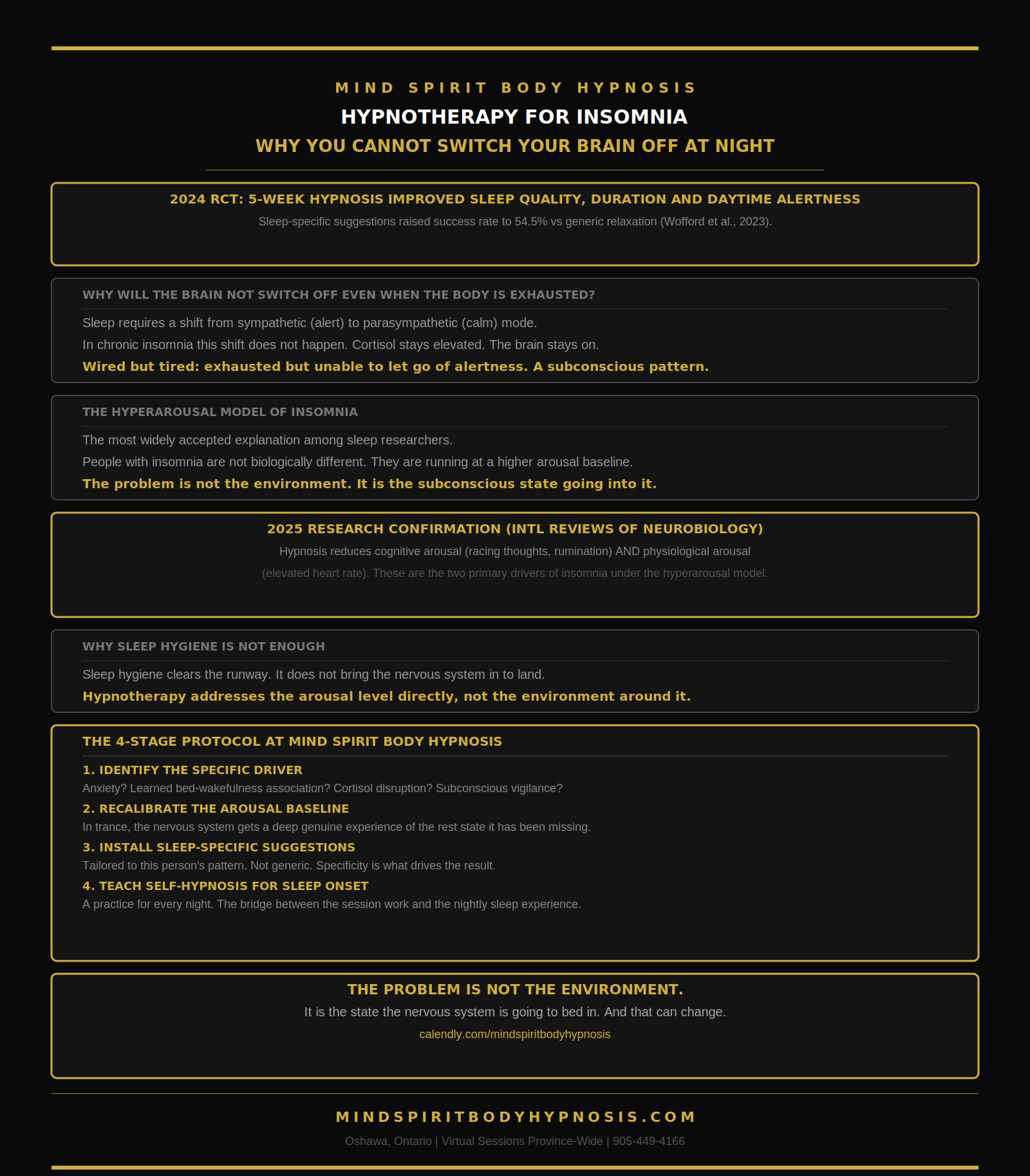
TL;DR: Insomnia is not just about sleep hygiene. For most people who lie awake night after night, the problem is hyperarousal: the brain and nervous system are too activated to allow the shift into sleep, regardless of how tired the body is. Hypnotherapy addresses this directly. A 2024 randomized controlled trial found a five-week hypnosis intervention improved sleep quality, increased sleep duration, and reduced daytime sleepiness. Sleep-specific hypnotic suggestions increased the success rate for sleep improvement to 54.5% compared to generic relaxation approaches. Fanis Makrigiannis at Mind Spirit Body Hypnosis in Oshawa offers virtual hypnotherapy for insomnia Ontario sessions for clients aged 10 and older across the province.
Quick Answer
Hypnotherapy for insomnia Ontario is a subconscious approach that targets the cognitive and physiological hyperarousal driving the inability to fall or stay asleep. A 2024 randomized controlled trial by Elkins and colleagues found that a five-week self-administered hypnosis intervention improved subjective sleep quality, increased sleep duration measured by actigraphy, and reduced daytime sleepiness. Research published in International Reviews of Neurobiology (2025) confirmed that hypnosis reduces both cognitive arousal (worry, rumination) and physiological arousal (elevated heart rate), which are the two primary drivers of insomnia under the hyperarousal model. Fanis Makrigiannis, a Certified Hypnotherapist (ABH, NGH) and NLP Master Practitioner (ABNLP) at Mind Spirit Body Hypnosis in Oshawa, Ontario, offers virtual sessions for clients aged 10 and older across Ontario. No referral is required.
Questions This Article Answers
Why does the brain stay active even when the body is exhausted?
Why does sleep hygiene advice not fix chronic insomnia?
What is the hyperarousal model of insomnia and why does it matter?
What does hypnotherapy specifically do for insomnia?
How many sessions does it take to notice a real difference?
In this article:
There is a particular quality to chronic insomnia that makes it different from just being tired. It is the experience of lying in bed, genuinely exhausted, wanting to sleep, and being completely unable to. The mind starts running. The body keeps registering as awake. The awareness of not sleeping starts to feel like an additional problem on top of the original one.
Most people with chronic insomnia have already tried the standard advice. They have cut the caffeine. They have bought the blackout curtains. They have put the phone away before bed. They have tried the magnesium and the melatonin. And they are still lying there at 2 am watching the minutes change on the clock.
In my practice in Oshawa, I see this pattern regularly. And the reason the standard approaches have not worked is almost always the same: the problem is not the sleep environment. It is the state of the nervous system going into sleep.
Why Will the Brain Not Switch Off at Night?
Because the body's arousal system is still running when the sleep system is trying to start.
Sleep requires a very specific set of physiological conditions. Body temperature needs to drop. Heart rate needs to slow. The stress hormone cortisol needs to be at its daily low. And critically, the nervous system needs to shift from sympathetic mode (alert, activated, ready for action) into parasympathetic mode (calm, recovery, repair).
For many people with insomnia, this shift does not happen fully. The sympathetic nervous system stays partially activated. Cortisol remains slightly elevated. The brain maintains a background hum of alertness that prevents the deep drop into sleep that the body needs.
This happens for several reasons. Ongoing stress or anxiety keeps the nervous system primed. A learned association between the bed and wakefulness, formed through many nights of lying awake in it. Worry about sleep itself, which creates a self-reinforcing loop: the more anxious you are about not sleeping, the more aroused your nervous system becomes, the harder it is to sleep. And sometimes, a subconscious belief that it is not safe to fully let go of awareness and control.
All of these are subconscious patterns. And they all respond to subconscious work.
For more on how the anxiety and nervous system activation that drives insomnia is addressed at Mind Spirit Body Hypnosis, the hypnotherapy for anxiety and stress page explains the foundational mechanisms.
Why Is Sleep Hygiene Not Enough for Chronic Insomnia?
Sleep hygiene creates the right conditions for sleep. It does not change the nervous system state that determines whether the body can use those conditions.
Cutting caffeine removes a stimulant. Darkening the room reduces light-based arousal. Consistent bedtimes support the circadian rhythm. These are all useful adjustments. They remove obstacles to sleep. They do not, however, address the hyperarousal that is preventing sleep in the first place.
Think of it this way. Imagine the bed is a landing strip. Sleep hygiene clears the runway. But if the nervous system is still flying at altitude, a clear runway does not produce landing. The plane needs to descend first.
Hypnotherapy is the descent. It directly addresses the arousal state itself, not the conditions around it.
The evidence supports this distinction. Research published in International Reviews of Neurobiology (2025) confirmed that hypnosis is a valid method for reducing both cognitive arousal (the racing thoughts, worry, and rumination that keep insomniacs awake) and physiological arousal (the elevated heart rate and bodily activation that signals wakefulness). These are the two components of what researchers call the hyperarousal model of insomnia.
For more on the sleep and burnout pillar at Mind Spirit Body Hypnosis and the full range of sleep-related work available, the hypnotherapy for sleep and insomnia page covers the complete approach.
What is insomnia?
What Is the Hyperarousal Model and Why Does It Matter?
The hyperarousal model is the most widely accepted explanation for chronic insomnia among sleep researchers.
It says this: people with chronic insomnia are not biologically different from good sleepers in terms of their capacity for sleep. They are different in terms of their baseline level of arousal. Their nervous systems are running higher. Their minds are more active. And because sleep requires a drop below a certain arousal threshold, the chronically aroused nervous system simply cannot get there.
This model has two important implications.
First, it explains why people with insomnia often do not feel tired during the day in the way you would expect after a bad night. The high arousal state that is preventing sleep is also keeping them alert and activated during the day. The result is what many people describe as wired but tired: exhausted but unable to settle, even when sleep is the only thing they want.
Second, it explains why approaches that try to directly force sleep (such as lying in bed trying harder, or taking sedatives) do not address the underlying problem. Sedatives lower the arousal threshold temporarily. They do not update the subconscious state that is keeping the arousal level elevated in the first place. When the sedative wears off, the arousal returns.
Hypnotherapy works at the subconscious level where the arousal calibration is set. This is why hypnotherapy for insomnia in Ontario continues to attract people who have exhausted every other approach and are ready to address the root rather than the surface.
What Does Hypnotherapy Specifically Do for Insomnia?
As a Certified Hypnotherapist with ABH and NGH credentials and NLP training through ABNLP, working with clients across Durham Region and Ontario, I address insomnia through a four-stage approach.
Stage 1: Identify the specific driver. Insomnia is not one thing. For some people, the primary driver is anxiety and racing thoughts at bedtime. For others, it is a learned association between the bed and wakefulness. For others, it is cortisol disruption from chronic stress, or a subconscious belief that it is not safe to fully let go of awareness. The first session builds a precise map of the specific driver for this person. The trance work that follows targets exactly that driver.
Stage 2: Recalibrate the arousal baseline. In trance, the nervous system is given a genuine and deep experience of the parasympathetic rest state. This is qualitatively different from ordinary relaxation. The trance state produces measurable physiological changes: heart rate slows, breathing deepens, muscle tension releases, and the cortisol curve begins to settle. Repeated across sessions, this recalibrates the subconscious baseline downward. The nervous system learns that it is safe to go below the arousal threshold that has been keeping sleep out of reach.
Stage 3: Install sleep-specific suggestions. Once in trance, direct sleep-specific suggestions are applied. These are not generic relaxation scripts. They are tailored to the specific pattern identified in the intake: suggestions for the body to cool and settle, for the mind to slow and release the need to monitor, for the specific fears or vigilance patterns maintaining the insomnia to be updated. Research found that sleep-specific hypnotic suggestions raised the success rate for sleep improvement to 54.5% compared to generic relaxation approaches. The specificity of the suggestion matters.
Stage 4: Teach self-hypnosis for sleep onset. I teach a brief self-hypnosis practice for use at the point of sleep onset. This gives the client a tool they can use every night, between sessions and beyond. The practice reinforces the trance work and provides a reliable route into the parasympathetic state that sleep requires. A 2024 randomized controlled trial by Elkins and colleagues found that a five-week self-administered hypnosis intervention significantly improved sleep quality, increased sleep duration, and reduced daytime sleepiness. The self-hypnosis practice is the bridge between the session work and the nightly sleep experience.
What Do Sessions Look Like at Mind Spirit Body Hypnosis?
A typical programme for hypnotherapy for insomnia in Ontario at Mind Spirit Body Hypnosis:
Session 1: Intake and sleep pattern mapping. A thorough conversation about the specific shape of the insomnia: how long it has been present, what a typical bad night looks like, what the mind does when the body is trying to sleep, what the daytime effects are, and what has already been tried. No sleep diary required. Just an honest description.
Sessions 2 and 3: Arousal recalibration and suggestion installation. Direct trance work on the nervous system arousal baseline and the specific cognitive and physiological drivers of the insomnia. Sleep-specific suggestions installed. Self-hypnosis practice taught. Many clients notice a shift in sleep quality within these two sessions.
Sessions 4 and 5 (where needed): Consolidation and future pacing. The self-hypnosis practice is deepened. The specific fears, associations, or beliefs maintaining the insomnia are addressed. A future of regular, restorative sleep is rehearsed in trance from the new baseline.
In my practice, insomnia work typically runs between two and four sessions. Some people notice a meaningful shift within the first session. All sessions are virtual, available to clients aged 10 and older across Ontario. No referral is required. More about my credentials and approach is on the about page.
WHAT MY CLIENTS SAY
“Thank you so much Fanis for your enduring commitment to my health and well being. You are truly dedicated to your craft and to your clients. You stuck with me well beyond the initial timeline set for my progress and worked with me during travel cancellations, time changes and even a hurricane! Your belief in me, in yourself and in the process established a steady and stable foundation for my continued growth and recovery. And if I ever need a little support or boost, I trust you will be there if I come knocking. Mahalo nui loa! In gratitude.” — Jill R.
Frequently Asked Questions
Why will my brain not switch off at night even when I am exhausted? Because the body's arousal system is still running. Sleep requires the nervous system to shift from sympathetic (alert, activated) to parasympathetic (calm, recovery). In chronic insomnia, this shift does not happen fully. The sympathetic nervous system stays partially active, cortisol stays slightly elevated, and the arousal threshold that sleep requires is not reached.
Why has sleep hygiene not fixed my insomnia? Sleep hygiene removes obstacles to sleep. It does not change the hyperarousal state preventing sleep. It clears the runway but does not bring the plane down. Hypnotherapy addresses the arousal level directly, not the environment around it.
What is the hyperarousal model of insomnia? The most widely accepted explanation for chronic insomnia among sleep researchers. It states that people with chronic insomnia are not biologically different from good sleepers. They are running at a higher baseline arousal level that prevents the drop into sleep that the body needs. Hypnotherapy works directly at the subconscious level where this baseline is set.
Does hypnotherapy actually improve sleep? Yes. A 2024 randomized controlled trial found a five-week hypnosis intervention improved sleep quality, increased sleep duration measured by actigraphy, and reduced daytime sleepiness. Research in 2025 confirmed hypnosis reduces both cognitive and physiological arousal, the two primary drivers of insomnia. Sleep-specific hypnotic suggestions raised the success rate to 54.5% compared to generic relaxation.
How is this different from taking a sleeping tablet? Sedatives lower the arousal threshold temporarily. They do not update the subconscious calibration, maintaining the elevated arousal. When the sedative wears off, the insomnia pattern returns. Hypnotherapy works at the subconscious level where the calibration is set, producing changes that do not require a pill to be maintained.
Will I learn anything I can use every night? Yes. I teach a self-hypnosis practice for use at sleep onset, typically in session two or three. This is one of the most useful things to take away from the programme. Clients use it every night and report it as the most reliably effective tool they have found for switching off.
How many sessions will I need? In my practice, insomnia work typically runs two to four sessions, with some clients noticing a meaningful shift after the first. I always give a specific, honest estimate during the free 30-minute strategy session.
Can I access sessions from anywhere in Ontario? Yes. All sessions are delivered virtually across Ontario, including Durham Region, Toronto, Ottawa, and beyond. No referral is required.
Ready to Take the Next Step?
If you have been lying awake night after night and nothing has worked, the problem is probably not your sleep environment. It is the state your nervous system is going to bed in.
I offer a free 30-minute virtual strategy session for new clients across Ontario. No pressure. Just an honest conversation about what the insomnia has been like and whether this approach can help.
Book your free session: calendly.com/mindspiritbodyhypnosis
Call or text: 905-449-4166
Email: mindspiritbodyhypnosis@gmail.com
Visit: mindspiritbodyhypnosis.com
RECOMMENDED READING
Serving clients virtually across Ontario, including Durham Region, Toronto, Canada, and beyond.
Disclaimer: This article is for informational purposes only and does not constitute medical or psychological advice. Hypnotherapy, NLP, and EMDR are complementary approaches and are not a substitute for diagnosis or treatment by a qualified healthcare provider. If insomnia is significantly affecting your health, please consult your doctor before starting any complementary programme. Results vary by individual.
Written by Fanis Makrigiannis | Certified Hypnotherapist (ABH, NGH) and NLP Master Practitioner (ABNLP) | Mind Spirit Body Hypnosis, Oshawa, Ontario.